Tag: censorship

Censoring the Metaverse

A post by the Hong Kong independent media outlet Boom News (爆炸頭) commemorating the 14th anniversary this past week of the death of Tiananmen activist Li Wangyang (李旺阳) was removed from social media platforms Facebook and Instagram, both owned by Mark Zuckerberg’s Meta.

The posts commemorated Li, a labor organizer and pioneering advocate for independent trade unionism in China who played a leading role in the 1989 Tiananmen pro-democracy movement. After 22 years in Chinese prisons, Li was released in 2012 in such poor health that he required immediate hospitalization. He was found dead in his hospital room on June 6 of that year. Authorities ruled his death a suicide and cremated his body without his family’s consent.

Meta offered no public explanation for the takedowns and also permanently terminated the outlet’s monetization on both platforms. The removal coincides with growing restrictions on commemorating the 1989 Tiananmen crackdown, not only in China, where any reference to June 4 is prohibited and removed from the internet, but also in Hong Kong, where authorities have arrested people for posting about the anniversary on social media and a once-massive annual candlelight vigil is no longer allowed.

Boom News is a YouTube-based platform focusing on Hong Kong stories, with close to 50,000 subscribers on the platform.

Trapped in China

Fu Cha (富察), editor-in-chief of Taiwanese publishing house Gusa Press (八旗文化), was released from a Shanghai prison in May after serving three years for “inciting national secession,” a charge Chinese authorities use against speech, writing, or advocacy seen to contest China’s territorial claims. Fu remains unable to return to Taiwan, however, according to a June 8 report in the Liberty Times (自由時報), because his February 2025 verdict included a one-year supplementary sentence stripping him of political rights, which begins running only after his prison term ends.

Fu Cha, who holds Taiwanese citizenship and is of Manchu descent, was detained in China in March 2023 after traveling there to cancel his household registration. His detention was connected to his work at Gusa Press, which has long published titles challenging the CCP’s official narratives on Tibet, Xinjiang, and Inner Mongolia. The CCP internally flagged over a hundred of the press’s titles as problematic, but used only five as the basis for sentencing, according to a May 11 analysis by Storm Media (風傳媒). His three-year prison term was calculated from the date of his 2023 detention, not his February 2025 sentencing, which is why he was released as early as May this year.

China’s top judicial authorities publicly named Fu Cha in their March 2026 annual reports as an example of punishment for what they called “stubborn Taiwan independence elements” (嚴懲台獨頑固分子), according to Storm Media — a move the publication describes as a cautionary signal to Taiwan’s publishing industry. Under Chinese law, the supplementary sentence allows security authorities to impose exit bans, mandatory check-ins, and communication restrictions for its duration, meaning Fu Cha cannot leave China until at least May 2027.

Xianzi Silenced, Again

Since she rose to prominence as the face of China’s #MeToo movement in 2018 after publicly accusing a celebrity television anchor of sexual harassment, Xianzi (弦子) has suffered continued victimization by the state and its vast system of information controls for her efforts to speak out. In the latest effort to silence her, the social media platform Weibo banned her account on May 26, citing unspecified violations of its community guidelines, according to Radio Taipei International.

Xianzi, whose full name is Zhou Xiaoxuan (周曉璿), first came to public attention in 2018 when she accused Zhu Jun (朱軍), a well-known host at state-run China Central Television, of groping and forcibly kissing her while she was an intern there in 2014. A court rejected her case in 2022, citing insufficient evidence. The latest ban is not her first. Her account has been silenced multiple times since 2018, including for a full year following the 2021 court ruling that first dismissed her claims.

Among the slogans Xianzi has posted to Weibo, where she will likely re-emerge if the past is anything we can go by: “Stand tall and straight, and you need not be afraid” (堂堂正正,就不要害怕).

X Marks the Spot

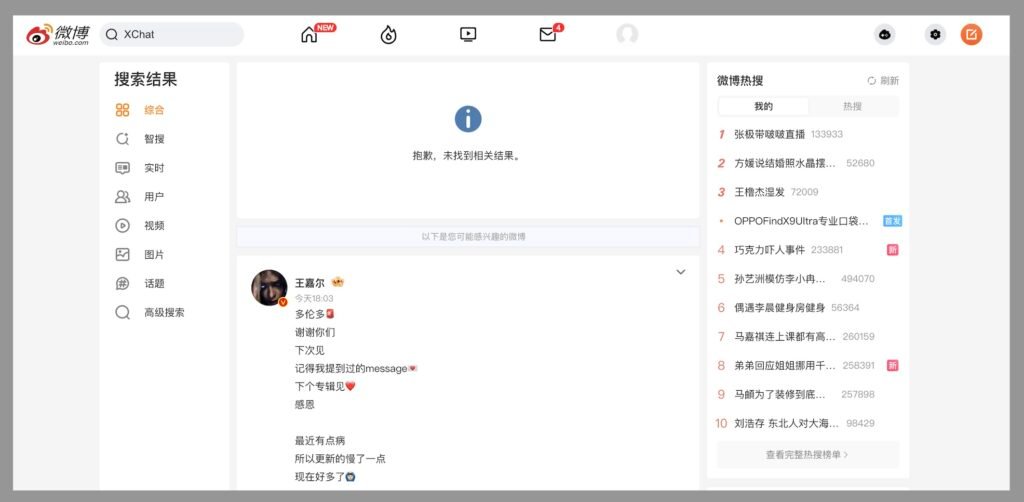
Elon Musk’s social media platform X was making no secret of its ambitions in China. Its new standalone messaging app, XChat, came equipped with Simplified Chinese language support and was listed simultaneously on the China App Store, suggesting X had its sights set on a vast base of Chinese users. But the app was buried in China before it could even get off the ground. X — or more precisely, “404” — marks the spot.

According to a post by the influencer known as Teacher Li Is Not Your Teacher (李老师不是你老师), who goes by @whyyoutouzhele on X, outlets including Xinhua, People’s Daily Online, The Paper, and Jiemian News had each published reports on XChat’s impending launch — only to delete them. Teacher Li’s post drew nearly 970,000 views. Searches for “XChat” on Weibo, WeChat and Douyin returned no results.

A search for “XChat” on Weibo returns a message: “We’re sorry, relevant results cannot be found.”

XChat, an encrypted, ad-free messaging service with no user data tracking, is part of Musk’s broader “everything app” strategy for X and has been compared for this reason to China’s WeChat.

Off the Books

Last week, Malaysia’s Ministry of Home Affairs banned two books documenting the history of the Malayan Communist Party (马来亚共产党), a guerrilla movement that fought first against British colonial rule and then against the post-independence government in a decades-long insurgency that ended only with a peace agreement in 1989. The ministry invoked the Printing Presses and Publications Act of 1984 to prohibit the titles, saying their content poses a threat to public safety and national security.

The two books — a memoir by former guerrilla commander Shamsiah Fakeh (珊西雅法姬) and a study of a communist regiment — had circulated for years before the ban. The memoir, first published in 2004 and distributed by Gerakbudaya (文运书坊), had gone through three reprints. The ministry warned that ideas once confined to limited, closed circles are now being “normalized and beautified,” a trend it said clearly runs counter to national security interests. Gerakbudaya, an independent Kuala Lumpur bookstore that received notice of the ban, has vowed to mount a legal challenge.

PEN Malaysia (多语作家协会), the local chapter of the international writers’ rights group, condemned the move as a severe setback for freedom of thought and democratic dialogue. According to a statement quoted in Malaysiakini, the group said the books were “not weapons, but repositories of research, debate, and critical thinking.” The ministry stressed, according to Kwong Wah, that it would not tolerate any behavior that spreads, promotes, or revives ideologies that violate the law. 

Silencing University Voices

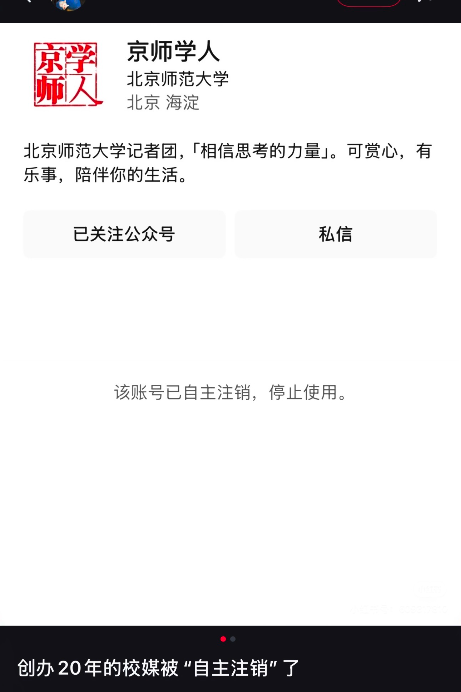
Earlier this month, Beijing Normal University quietly deleted the social media account of Jingshi Scholars (京师学人), a student-run publication that had operated on campus for twenty years. No announcement was made to readers or former members as between 600 and 700 articles disappeared overnight. The account was listed as “voluntarily closed” (自主注销) — a bureaucratic formality that, according to former members, was not what had actually happened.

Student newspapers and other outlets in China have long occupied a rare and contested space. Operating nominally under university party committees (党委), they have sometimes managed, within narrow limits, to report on subjects that official outlets dare not touch. Jingshi Scholars tended to cover such issues as labor rights and the lives of migrant workers in the capital city, topics that can sit uneasily with the Party’s preferred narratives.

The move this month is just the latest in a series of moves against the publication. In November 2017, the editorial team was summoned by university authorities after publishing a sensitive article and forced to hand over editorial authority. The office space used by the publication was reclaimed by the university. The public account stopped updating, until the final deletion this year.

What happened to Jingshi Scholars over nearly a decade was compressed, at other institutions, into weeks. Between November and December 2024, at least 10 universities, including Fudan University (复旦大学), Wuhan University (武汉大学), and the Communication University of China (中国传媒大学), shut down more than a thousand WeChat public accounts (微信公众号) in rapid succession. Wuhan explained the closures as necessary for “improving online public opinion guidance” (提升网络舆论引导质效) — an invocation of the Party’s doctrine that media exist not to report, but to manage what people think.

Reflecting on the shutdown this month, one former member of Jingshi Scholars wrote that “the account can be deleted, but the hotpot smell has seeped into our blood — it won’t wash out.”

Too Pretty for the PLA?

Late last week, in a move that signaled future regulatory trends for the industry, China’s film and television regulator summoned major production companies and streaming platforms — including iQIYI, Mango TV, and Tencent Video — for a symposium on “wholesome aesthetics” in drama production. Though it is unclear whether the two events are connected, the symposium came just six days after sharp official criticism was directed at the hit costume drama Pursuit of Jade (逐玉), primarily from an account affiliated with the People’s Liberation Army (PLA). 

In the April 2 symposium, the National Radio and Television Administration (中國廣播電視總局), or NRTA, criticized what it called “lookism” (顏值至上) — referring to the casting of actors for their looks rather than their talent. It also spoke out against “traffic dependency” (流量依賴), the practice of centering productions on social media celebrities with substantial existing fan bases, which are expected to drive viewership. The readout from the NRTA meeting seems to suggest such an approach was being pursued without care to quality. “What the people demand of television dramas has never been merely that they look good in terms of appearance,” it said, “but that the story holds up to repeated viewing.” 

As the NRTA stated that actors must “look the part” (演什麼要像什麼), it was impossible for media not to relate these latest signals to the controversy recently surrounding Pursuit of Jade in China. While the drama has been a genuine streaming phenomenon in China and across the region, even topping charts in Taiwan, its male lead, Zhang Linghe (張凌赫) — who plays a battlefield general — has prompted amusement with his flawless, K-pop complexion even in the midst of battle. This has earned him the affectionate or mocking online nickname “General Foundation” (粉底液將軍). The portrayal seems to have rankled some in the military, and on March 27, “Junzhengping” (鈞正平), a social media account linked to the PLA, complained that such portrayals undermine “the spirit of masculinity.” 

Revising Hong Kong’s Past

Last week, the Hong Kong Museum of History reopened its flagship permanent exhibit after more than five years of renovation. Do the math. The museum closed its doors just months after Hong Kong’s National Security Law was enacted on June 30, 2020 – and it has been closed ever since. The revamped exhibit, called “The Hong Kong Story“ in a nod to Chinese leader Xi Jinping’s storytelling formula for what the Chinese Communist Party calls “external propaganda,” displays over 2,800 artifacts spanning six millennia. But it’s the re-framing of the narratives threading the artifacts together that it most worth attention — that is, if you are a media outlet with even an iota of critical spirit.

Hong Kong’s Ming Pao newspaper, published by Malaysia’s Media Chinese International, was the only major outlet in Chinese to touch the story as a matter of journalistic truth-seeking. It ran a point-by-point comparison of the exhibit’s previous and new language. Among the changes noted was a complete erasure of references to the Tiananmen Massacre, which was recast as “political turmoil in the late spring and early summer of 1989.” Gone from the exhibit entirely, the Ming Pao reported, is a previous image that showed one million Hong Kongers taking to the streets in 1989 in support of the demonstrators in China.

Also apparent was the effort to recast the British acquisition of Hong Kong, previously described as “cession” (割讓) — language still widely used even in pro-establishment sources — as “forcible occupation” (強佔). Similarly, the 1967 leftist riots, previously referred to in the exhibit as the “1967 riots” (六七暴動), are now characterized as “Anti-British Resistance” (反英抗暴).

Government-aligned media outlets were notably uncritical. The Ta Kung Pao, published by China’s central government, ran a celebratory feature emphasizing how satisfied visitors are with the reopened exhibit. Sing Tao Daily previewed the new exhibit content with no critical evaluation whatsoever. The most brutally direct response came, unsurprisingly, from Hong Kong exile media outlets. UK-based Green Bean, an outlet run by exiled Hong Kong illustrators, posted a cartoon of a figure on a ladder hanging a new sign over the museum entrance that reads: “Falsification” (篡改).

Silence Follows Harassment

Last Friday, InMedia (獨立媒體), one of Hong Kong’s few remaining independent news outlets, published an unusual apology to readers through its newsletter. The outlet said that its normal operations had been disrupted in recent days  by “harassing messages” (滋擾訊息) as it sought to cover hearings looking into the deadly fire at the Wang Fuk Court residential buildings in November last year that killed 168 people. InMedia said in its message that it had filed police reports in two specific cases of harassment by “unidentified persons” (不明人士).  

On Tuesday, online commentator Fung Hei-kin (馮睑乾), a former columnist for Hong Kong’s Apple Daily, noted in a Facebook post that not one mainstream Hong Kong outlet had covered the InMedia story in the four days since the outlet’s disclosure. In fact, the only outlet to cover the news at all, said Fung, had beenEpoch Times, the right-wing American media outlet backed by the Falun Gong religious group — a brief report that added no new information. Fung likened the silence over the InMedia case to that which followed revelations by the independent Hong Kong Journalists Association (HKJA) in September 2024 that reporters from thirteen news organizations had been harassed or threatened in the preceding few months. The chilling effect on the press could clearly be inferred from the silence, said Fung. “The more you think about it,” he wrote, “the more chilling it becomes.”