On March 2, just days before China’s annual parliamentary sessions opened in Beijing, the country’s state-run women’s organization held its annual ceremony to mark International Women’s Day — a holiday recognized by the United Nations in 1977 as a global call for women’s rights and equal participation in public life. But the organization’s vision of the limits of that participation was clear from the start, as its chair, Chen Yiqin (谌贻琴), a senior government official, called on women to follow the party, contribute to China’s next five-year development plan, and promote family civilization to “consolidate the family foundation for Chinese-style modernization.”
It was the beginning of a barrage of official messaging in which women were not subjects but instruments of state policy. China Women’s News (中国妇女报), the organization’s official newspaper, ran its usual coverage. Model workers were honored, and speeches made about the “wisdom and strength” of women in the service of national rejuvenation. On March 8, International Women’s Day itself, the paper ran a full-page spread titled “THIS Is Our Women’s Day!”
The question of who exactly was subject to that “our” had in fact been settled three days earlier by China’s premier, Li Qiang (李强), as he delivered his annual policy address to the country’s National People’s Congress. He pledged to build a “fertility-friendly society” (生育友好型社会), offer housing support for first-time married couples, extend parental leave, and expand childcare subsidies, which he said had already reached more than 30 million infants. With births plunging to a record low of 7.92 million in 2025, the premier’s message was clear: women have a primary role in resolving China’s demographic emergency — and the state will pay for their cooperation in these goals.
The price of that bargain, so familiar to women around the world, is silence and marginalization. And just as the state prepared its empty message of female empowerment, this was enforced with precision. In the days leading up to International Women’s Day, authorities shut down at least 10 WeChat public accounts that had built communities around the real concerns of women. Taken together, those accounts offered a different vision of participation — one the party-state was not prepared to tolerate.
These were not fringe voices. For years, Chinese women have been telling a different story — on WeChat, on Weibo, on Xiaohongshu — about why they do not want to marry, do not want children, or simply do not see motherhood as the defining purpose of their lives. But for a state bent on managing demographic trends, these voices are regarded as a form of contamination.
Weeks ahead of International Women’s Day, as the Cyberspace Administration of China (CAC) launched its latest periodic “Clear and Bright” (清朗) campaign, social media platforms were ordered to purge not just the usual content deemed harmful to the state but also speech that “promotes not marrying and not having children” (鼓吹不婚不育) or that “provokes gender antagonism” (挑动性别对立) — language that has tended in recent years to radicalize feminism in all of its forms.
Platforms were ordered to set up dedicated task forces and proactively purge content from front pages, trending lists, and comment sections. Then, on the evening of March 6, as the Women’s Federation held a reception celebrating International Women’s Day with foreign dignitaries, the purge directly impacted feminist and sexual minority communities online.
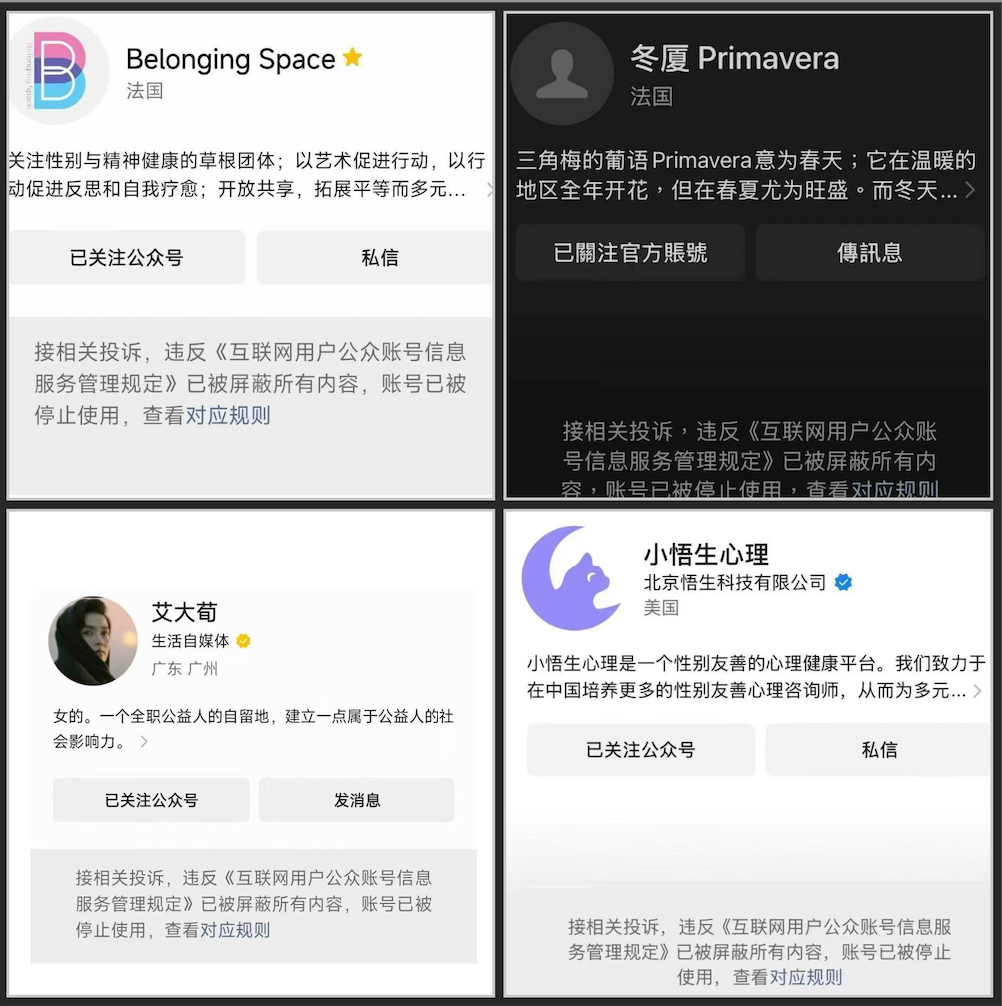
From the evening of March 6 into the early hours of March 7, at least ten WeChat public accounts focused on gender rights vanished one after another. Among them were “Xiaowusheng Psychology” (小悟生心理), which writes about the mental health of marginalized communities; “Dongxia Primavera” (冬廈Primavera), a platform discussing feminism and left-wing youth issues; the Gen Z feminist account “Letters from Two Stranger Girls” (两个陌生女生的来信); “HerStoryNow,” a grassroots feminist community space; “Free NORA” (自由娜拉NORA), which advocates for victims of human trafficking and people with mental disabilities; “Belonging Space,” a counseling and community platform; “Ai Dasun”(艾大荀) which focuses on public welfare, science popularization, and related social issues; “Pride Voice” (骄傲声浪), renamed from the once prominent LGBTQ Weibo account “Voice of Comrades” (同志之声); and “Exile LandAi Dasun” (流放地), which publishes essays, fiction, and personal narratives by sexual minorities.
Screenshots of four WeChat accounts banned around International Women’s Day, March 2026: “Free NORA” (自由娜拉); “Dongxia Primavera” (冬厦); “Belonging Space”; and “Ai Daxun” (艾大荀).
For those who follow China’s online feminist communities, this playbook from the authorities is all too familiar. Nearly 10 years ago, on March 6, 2018, “Feminist Voices” (女权之声), the country’s most influential feminist account with a following of at least 180,000 on Weibo and 70,000 on WeChat, published an article titled “The Ultimate Women’s Day Celebration Guide” (最强妇女节过节指南) — which called on women to mark the holiday not with shopping discounts or the flattery of being called a “goddess,” but by joining a campus anti-sexual harassment campaign that had grown out of China’s nascent #MeToo movement.
Two days later, on March 8, as official outlets like China Women’s News ran their usual tributes to International Women’s Day that put the achievements of the Party first, “Feminist Voices” was permanently banned. Similar waves of enforcement against accounts devoted to women have followed nearly every year since. In an article this year called “Multiple Gender Equality Accounts ‘Arranged’ Ahead of International Women’s Day,” writer and independent commentator Li Yuchen (李宇琛) observed that the early-March crackdown has become almost a form of ritual. “This operation has already formed a stable, institutionalized rhythm,” he wrote.
The action this year has not been limited to public accounts. Individual voices on social media have also been targeted. In February, Xinjiang stand-up comedian Xiao Pa (小帕) became another casualty. On February 5, she posted on Weibo: “I’ve been lying at home with a fever for two days. I was thinking that if I had a husband and children, I’d probably have to force myself up against the wall right now to cook for them.” Her account was quickly muted and remains restricted.
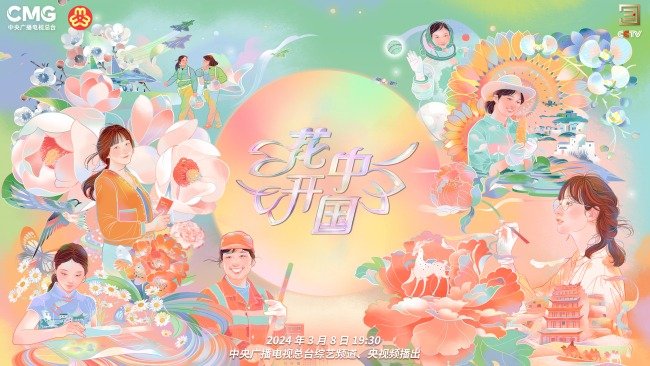
China Media Group poster for “Flowers Blooming for the Nation” (花中开国 ), a Women’s Day special programme airing on March 8, 2024, on CCTV’s General Arts Channel and the CMG Video platform.
Three weeks later, the platform’s official moderator account “Weiboxia” (围脖侠) explained the reasons behind the closure. Xiao Pa, it said, had violated requirements of the CAC’s “Clear and Bright” campaign against content that “incites gender antagonism” and stokes “marriage fear” and “fertility anxiety.” Posts expressing support for the comedian were also quietly scrubbed from the platform.
Even caution has offered little protection. On March 7, author “Ai Daxun” (艾大荀), a public-welfare worker who writes about social work, women’s rights, and civil society, published a farewell essay after her WeChat account was pulled down. Called “Written at the Moment My Public Account Was Banned,” the post described the constant paranoia that prevails when one writes under tightening restrictions.
In 2025, “Ai Daxun” had tried to organize an offline book club in Guangdong ahead of International Women’s Day, only to have it canceled two nights before the event. She never attempted such an event again, and said she had grown accustomed on a fundamental level to the atmosphere of self-censorship. She was someone who knew every sensitive keyword and every shifting red line on Chinese cyberspace. “I might even be the mildest among the accounts you follow that still track social issues,” she wrote. “But even so, my account was banned. I kept retreating and treading carefully, yet as the red lines kept tightening, there was still no way around them.”
Each year around March 8, the cycle repeats. Accounts disappear, keywords are scrubbed, and communities scatter and regroup elsewhere. For those trying to speak about gender, feminism, or women’s rights in China’s digital public sphere, the space left to speak grows smaller still.
On March 24, Hong Kong’s National Security Department, established in July 2020 under a national security law China imposed on Hong Kong, arrested four people connected to Book Punch (一拳書館), an independent bookshop in the Sham Shui Po district, on suspicion of “knowingly selling publications with seditious intent” under Article 24 of the Safeguarding National Security Ordinance. Among those detained were the shop’s founder, Pong Yat-ming (龐一鳴), and three female staff members.
Pong, currently standing trial on charges of running an “unregistered school” — for hosting Spanish classes at the bookshop — has already faced legal pressure. A verdict on that case is due on April 10. He was also charged separately with holding a stand-up comedy graduation show without a public entertainment license. Wen Wei Po (文匯報), which has in recent years been used as a tool to attack press and publishing figures that displease the government, had previously accused Book Punch of engaging in “soft resistance” (軟對抗), a term increasingly used by Chinese and Hong Kong officials to describe perceived threats to national security.
The seized materials included a biography of Apple Daily founder Jimmy Lai, who in February received a 20-year sentence for “colluding with foreign forces.” The biography, TheTroublemaker, is written by Mark Clifford, a former director of Lai’s Next Digital and editor of the South China Morning Post. Authorities said the book “whitewashed” Lai’s national security convictions and “smeared” Hong Kong’s judiciary and government.
Reporters visiting the shop on Tuesday this week found it shuttered with a handwritten notice reading: “Emergency situation, closed for the day, apologies for the inconvenience,” Points Media (棱角媒體) reported. Clifford, also chairman of the Committee for Freedom in Hong Kong Foundation, called the sedition charge “ironic,” telling Points that freedom of expression “is in the DNA of Hong Kong people.”
This Book Punch raid is the latest in a string of actions targeting Hong Kong’s shrinking independent publishing and bookselling community, a trend that has accelerated since the national security law was imposed in 2020. The arrests follow years of official harassment of Book Punch, including raids and regulatory inspections by six government agencies. Pong and his staff face up to seven years in prison if convicted.
Sometimes “streamlining” is just another name for deep and painful attrition. Over the past two years, this and other euphemisms — like “optimization” and “transformation” — have swept like a wildfire across China’s local broadcast sector. Taken together, they tell a simple story about the rapid contraction of local television and radio under a barrage of cost-cutting directives from the central government. The goal is two-fold: cutting costs, and shifting resources toward newer forms of digital production — part of a broader rebuilding of China’s media infrastructure that the China Media Project has called “Centralization+.”
Announcing the closure of two of its local channels this month, the top state-run broadcasting group in the municipality of Chongqing spoke of “optimizing and integrating media resources” and “adapting to new trends in media convergence.” In practice, this meant shutting down channels the government considers redundant and shifting resources — money, staff, and content — away from traditional broadcast and onto the internet and digital products. The announcement, released by China’s main broadcasting authority, SARFT, makes clear that Chongqing is following directives from the government and national work conferences. This isn’t a local editorial choice but a centrally directed plan.
Chongqing is not an isolated case. It is part of a nationwide wave of broadcast closures that has been accelerating since 2023, when SARFT launched its campaign to “streamline and specialize” China’s radio and television landscape. According to the Chinese industry tracker website Shexiangren Wang (摄像人网), at least 51 TV channels were shut down across China in 2024, and in 2025 that number jumped to at least 75, hitting provincial-level broadcasters in Shanghai, Gansu, Shaanxi, Jiangxi, Xinjiang, and Hunan, among others. Guiyang, the capital of Guizhou province, became the first provincial capital in the country to be reduced to a single television channel in 2025. A separate report from SARFT’s research center confirmed that 79 channels and frequencies were formally eliminated in 2024.
Part of the story is how uncompetitive local channels have become, owing both to technological change and to institutional inertia: CCP-run media tend to be inflexible and formulaic, shaped by the bureaucratic structures that govern them. Shexiangren Wang notes that education channels offered little beyond policy meetings. TV shopping, with its long-duration pitches and infrequent purchases, could not match the speed and scale of e-commerce — what Shexiangren Wang called the “short, fast, and flat” model of online retail. Movie and drama channels, meanwhile, were stuck with aging content and shrinking advertising revenue. The closures have targeted public channels, education channels, shopping channels, and movie and drama channels — categories the government considers redundant or uncompetitive with internet platforms, all outpaced by digital offerings delivering the same content faster and on demand.
The campaign of attrition at local broadcasters does not seem to be slowing down. The Shexiangren Wang report indicates that Guangdong, Sichuan, and Shenzhen are all expected to close or merge additional channels in 2026. The broader pattern is clear: the government is shrinking traditional broadcast — meaning fewer channels and fewer editorial voices — while redirecting money, talent, and content toward digital offerings.
Local Television Channel Closures in 2025
Over the past year, at least 75 channels shut down across 57 cities, as Beijing pushes to consolidate the country’s sprawling state media system and cut costs at the local level.
Rather than a simple retreat from broadcast, the closures reflect a deliberate reorientation. The Chongqing announcement calls on the group to “fortify the main position of internet communication” (筑牢互联网传播主阵地) — language drawn from a broader Party framework that treats media platforms as ideological territory to be held and defended. It also calls for “systematically transforming mainstream media” (推进主流媒体系统性变革) — a phrase that carries specific weight in the Chinese context, where “mainstream media” refers to Party-run outlets tasked with setting the public agenda and shaping opinion.
The imperative is to remake those outlets into something citizens will actually use. That is a hard sell in a media landscape dominated by platforms like Bilibili, a video site built on user-generated entertainment, and Xiaohongshu, known outside China as RedNote, a lifestyle and social commerce platform where hundreds of millions of users go for content that is personal, playful, and not entirely oriented around the ideological goals of the party-state. A 2025 People’s Daily article used the same language to describe Party media’s role as the frontline of ideological control, calling on state outlets to “advance onto the internet main battlefield” (挺进互联网主战场) as a “main force” (主力军).
Rather than a simple retreat from broadcast, the closures reflect a deliberate reorientation.
While real success in the media market will likely remain a challenge, the authorities seem encouraged by the numbers for new state-led digital offerings. Provincial state media app downloads grew by an average of nearly 35 percent in 2024 — 34.9 percent in downloads and 45.2 percent in registered users — according to SARFT’s research center’s annual report. Platforms like Mango TV (芒果TV), a video streaming platform under the state-run Hunan Broadcasting System; Elephant News (大象新闻), an app-based news product from Henan’s provincial broadcaster; and Touch News (触电新闻), the digital product from Guangdong’s provincial broadcaster, each crossed 100 million downloads, with 28 provincial apps surpassing 10 million.
The closures and the digital push are, in the end, two sides of the same coin: a leaner broadcast sector that costs less to maintain, and a rebuilt online presence the Party hopes will keep it not just relevant, but dominant, where the public’s attention has shifted.
One issue conspicuously absent from the official framing of these closures is what happens to the people who worked there. The announcements speak of “optimizing resources,” but say nothing about how employees at Chongqing Economic Radio or the Fashion Shopping Channel — the outlets impacted by the most recent restructuring in Chongqing — might have been affected. Precise figures on job losses across the sector are difficult to come by. Official announcements are silent on the question, and broadcasters do not typically publish staff counts. The data that does exist points in one direction. Beijing’s broadcast sector alone shed more than 2,600 jobs in 2024, according to an annual statistical report from its city-level broadcast authority. The nationwide toll, across more than 125 channels closed in 2024 and 2025, is almost certainly substantial.
_________________________
To learn more about the trend of local “media convergence” in China and the remaking of the infrastructure of “international communication” (国际传播), or “external propaganda” (外宣), download our CENTRALIZATION+ paper below, produced with funding from the Swedish Psychological Defense Agency (MPF).
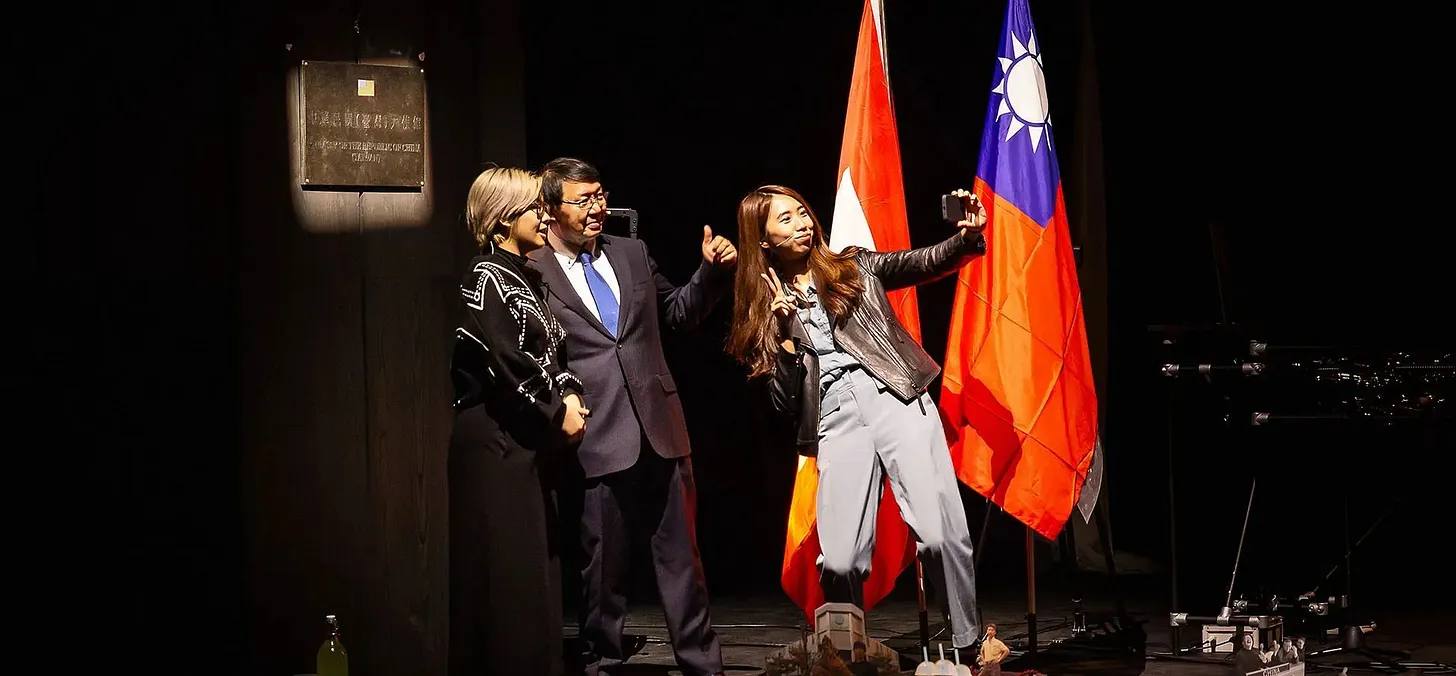
In a case that again exposed China’s use of political pressure abroad to silence voices it views as threats to its state narrative, the Chinese consulate in Strasbourg has pressured a local theater and city officials to cancel a planned stage production with Taiwan’s National Theater and Concert Hall.
According to French media, the Chinese consulate in Strasbourg called the theater in early February to register its displeasure about the play, which was scheduled to run from March 5 to 22.
When theater director Barbara Engelhardt did not respond, the deputy consul general wrote directly to the City of Strasbourg, the theater’s principal funder, demanding the show be cancelled on the grounds that it would harm Sino-French diplomatic relations.
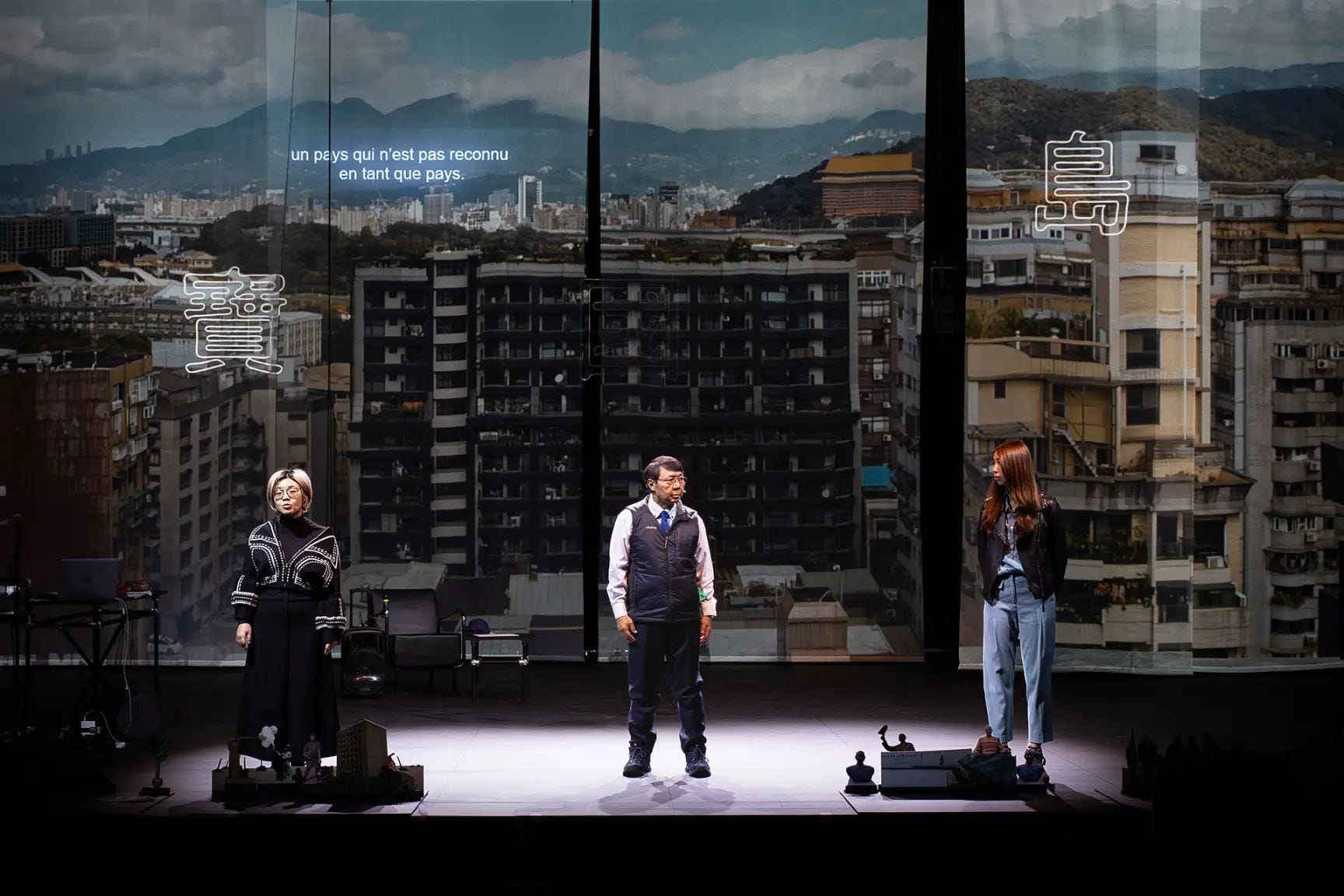
The play — Ceci n’est pas une ambassade, or This Is Not an Embassy — is co-produced by German theater group Rimini Protokoll and Taiwan’s National Theater and Concert Hall, and directed by Stefan Kaegi. It employs documentary theater to simulate the opening of a Taiwanese embassy — describing Taiwan as a country whose international recognition is inversely proportional to its economic importance. The production premiered in Berlin in 2024 and has since toured widely across Europe. It was programmed as the opening event of Le Maillon’s Démocraties en jeu (Democracies at Stake) Festival, a series of performances and discussions exploring threats to democratic governance, running from March 5 to 22.
The Strasbourg performances touch a raw diplomatic nerve with Beijing. China claims Taiwan as its own territory and routinely pressures governments, institutions, and cultural organizations worldwide to avoid any portrayal of Taiwan as a sovereign state.
Mayor Jeanne Barseghian said she responded by reaffirming France’s protections for artistic freedom and reported the incident to the Regional Directorate of Cultural Affairs. France’s AFP newswire reported last week that the Chinese consulate had not responded to a request for comment.
Neither the Chinese Embassy in Paris nor China’s Ministry of Foreign Affairs has publicly commented on the incident. No mention of it has appeared in Chinese state media.
The reports prompted swift coverage in Taiwan. The story was picked up by at least two Taiwanese outlets on March 4. The Liberty Times (自由時報) newspaper, an outlet generally regarded as partial to the ruling Democratic Progressive Party (DPP), ran the story in its arts section, framing the play as the first international theater work to directly address Taiwan’s national status and diplomatic situation.
The Liberty Times article featured the full three-part statement from the Taipei Representative Office in France — the country’s de facto embassy in Paris — which praised Strasbourg’s mayor and French cultural authorities for not bending to China’s demands. The office said that Taiwan’s voice must not be silenced, and called on audiences to attend as an act of solidarity. “Any form of censorship and suppression,” it read, “will only draw greater international attention to Taiwan’s resilience.”
SET News (三立新聞), the news division of Taiwan’s major private broadcaster Sanlih E-Television (三立電視), covered the story in its politics section, leading with the pressure from China’s consulate in Strasbourg. Citing the Liberty Times report, the outlet added that the Taiwan Cultural Center in Paris had confirmed that the shows had not been cancelled, and that local support for the project remained strong.
“The fact that the Chinese government chose this moment to do this only makes it clearer who the anti-democratic side is.”
The news hit Taiwanese media just as China was marking the opening of its annual “two sessions” — the National People’s Congress and Chinese People’s Political Consultative Conference — with state media pushing the familiar message that China’s political system, entirely monopolized by the Chinese Communist Party, is democratic and consultative. Premier Li Qiang’s government work report to the NPC called on officials to “accept democratic supervision” from the CPPCC — a body whose members are appointed, not elected.
On March 5 — the opening day of the NPC — cast member Chiayo Kuo (郭家佑) took to social media to address the situation in France. “We’re here for a festival about democracy,” she wrote. “The fact that the Chinese government chose this moment to do this only makes it clearer who the anti-democratic side is.”
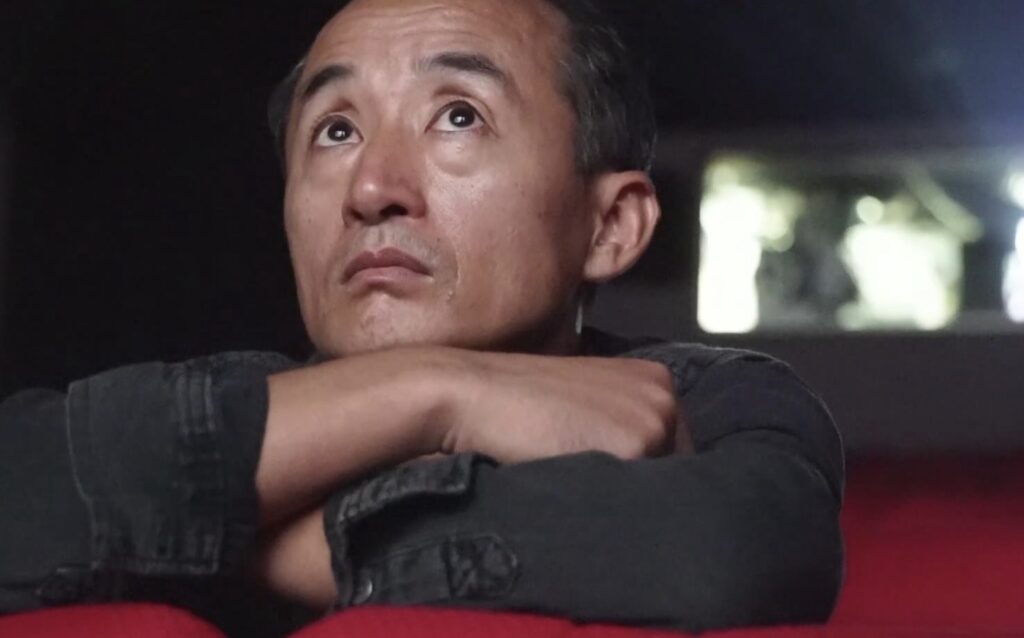
In November 6, 2025, just four days before the official opening of the IndieChina Film Festival in New York, the event’s director, Zhu Rikun (朱日坤), announced that it had been cancelled. In his statement, he said that if he did not halt the festival, given “the situation currently unfolding, anyone involved with the event — directors, forum participants, peripheral figures, volunteers, even audience members — could face threats or harassment.” He had made the “extraordinarily painful decision,” he said, not out of “fear or capitulation,” but out of consideration for the safety of all participants and audience members connected to the festival.
Before relocating to the United States, Zhu Rikun was for decades deeply involved in China’s independent film exhibition and production scene. He helped to organize the inaugural “China Documentary Exchange Week” (中国纪录片交流周) in 2003, and co-founded an independent film forum called, “The Human Way, the Cinematic Way” (人之道, 影之道), the forerunner of what would later become the Beijing Independent Film Festival (北京独立影像展).
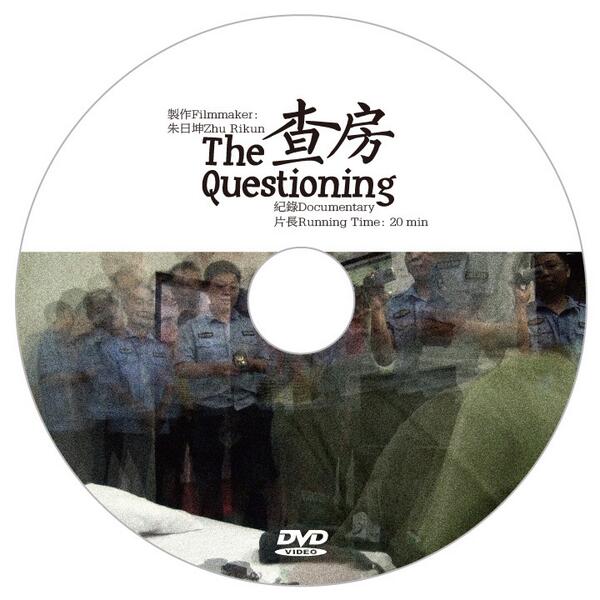
Zhu’s own independent documentary, The Questioning (查房), captures the moment police interrogated him in a hotel room. And this work also helps to explain why the inaugural IndieChina festival he founded in New York became a target of transnational suppression by Chinese authorities.
The DVD cover of Zhu Rikun’s The Questioning. SOURCE: Zhu Rikun on X.
In reporting on the recent fate of IndieChina, media outlets have uniformly used the term “independent film festival” to describe this and other organized film screenings that have faced similar situations. When we look more closely at the various groups now trying to organize Chinese-language film screenings abroad, however, it becomes clear that the ecosystem of the “independent Chinese-language film screening” is much broader — and that the category itself is being pulled in different directions by the very different realities facing each event and the groups involved.
Through interviews with multiple independent Chinese-language screening groups in Europe, this reporter attempts to give readers a day-to-day sense of the circumstances facing acts of independent screening (独立放映).
Part One: Before the Screening
The independent Chinese-language screening groups currently active in Europe have emerged largely within the past five years. This is because a large number of Chinese people with an interest in film — and some with prior screening experience — emigrated to Europe during this period, making these groups a byproduct of the latest wave of emigration. Films, like the people who love them, literally ran (润) to Europe. Intertwined with the Covid-19 pandemic, China’s “dynamic zero-Covid” policy and the aftershocks of the anti-lockdown protests rippled out to Europe, and the stimulation of those external events prompted many of these new arrivals to start thinking about doing something here.
i
Runology
润学
▼
CMP Dictionary · May 18, 2022 · David Bandurski
An online neologism popular from April 2022, “Runology” (润学) derives from the English verb “run,” matching the pinyin of the Chinese character 润. It refers to the study of how to emigrate overseas — a response to worsening economic conditions and shrinking freedoms in China, particularly for young people.
The term surged during the Shanghai lockdown in spring 2022. It is often framed as one of three paths available to Chinese youth: grinding through “involution” (内卷) in a hyper-competitive job market with little reward; “lying flat” (躺平) by rejecting ambition altogether; or practicing Runology — and leaving.
See alsoInvolution (内卷)Lying flat (躺平)
Tang Mingxuan (唐明轩) had accumulated rich experience in independent film screening back in China, co-founding a film collective focused on sexuality and gender, and his professional background was also in film. When he arrived in Europe, he brought with him the operating model and programming approach of that earlier collective, and on this foundation built a new screening group in his adopted city.
Many people share a background similar to that of Tang Mingxuan, though Jiang Bu (蒋不) is perhaps a more typical example. Jiang was active in Chinese civil society even before he entered university, and he later studied at the Beijing Film Academy. Shaped partly by his experience in grassroots organizing and partly by his dissatisfaction with the atmosphere on campus, he always gravitated toward the kind of independent documentaries made by figures like Ai Weiwei (艾未未), Hu Jie (胡杰), and Ai Xiaoming (艾晓明). “For me around 2011, I genuinely believed that you could use this kind of work, making independent documentaries, to have an impact on Chinese society, what people called ‘the surrounding gaze transforming China.’ I thought it was a path for public intellectuals and artists to engage with reality and take part in public action.”
There are also many people who came to Europe with little or no screening experience, and essentially had to learn from scratch how to host a film screening. Chen Zhe (陈哲), one of the founders of “Xinfeng” (信风), had only the vaguest sense of what “independent screening” meant before trying to organize screenings locally, and had never attended a screening event before leaving China. Wei Wenxi (韦文熙) and Lin Aili (林艾历) had each been involved to varying degrees in screening activities before moving abroad, but both only encountered the finer details of organizing screenings after arriving in Europe.
i
The Surrounding Gaze
围观
▼
CMP Dictionary · January 4, 2011 · David Bandurski
Rooted in Lu Xun’s concept of kanke wenhua (看客文化) — the cold indifference of crowds watching their fellows dragged off to execution — the “surrounding gaze” (围观) has taken on new meaning in the Internet age. Rather than passive spectatorship, it now describes the potential of networked publics to concentrate opinion around issues and events, nudging change through accumulated micro-participation.
The term is often associated with the slogan “the surrounding gaze changes China” (围观改变中国). Peking University professor Hu Yong has called it a “bottom-line” form of public participation: modest on its own, but capable of bridging the historic fracture between activist minorities and an indifferent majority — with micro-forces (微动力) doing the work that organized movements never could.
See alsoCulture of the gaze (看客文化)Micro-forces (微动力)
Despite his lack of experience, Chen Zhe still took that first step into organizing film screenings. As he describes his thinking at the time: “This is something that someone should be doing — and since it seems like no one is doing it, we might as well do it ourselves.” There were then a few Chinese-language works that he felt were really decent and were being screened and attracting some attention across Europe. He felt that naturally these films could be screened privately in homes or living rooms — but they also deserved to be seen in cinemas, where people could sit down together and even discuss them.
As Chen Zhe found that some European cities had cinematic screenings and his city did not, he felt that making it happen was his “inescapable responsibility” (责无旁贷). Seizing that opportunity, he and the other founders organized several screenings, which served as the seed from which “Xinfeng” later developed.
Lin Aili’s motivation for founding “79 Square Meters” (79平米) was similar to Chen Zhe’s. In Northern Europe, where Lin now lives, the cultural environment is relatively homogeneous, and opportunities to see Chinese-language films are rare. As contentious issues such as China’s “zero-Covid” policy sparked considerable discussion within the local Chinese community, she hoped to use Chinese-language films to bring people together for conversation — and so “79 Square Meters” held its first screening.
The motivations of these various “screeners” (放映员) may differ, but all have faced a common dilemma: Is film screening an end in itself, or a means to other goals? For Jiang Bu and his group, on-the-ground activism in Paris had gradually ebbed after China’s lockdown policies ended, and they wanted to create a space that was less overtly activist in orientation — one that could reach a broader audience and then engage like-minded people for possible future action. “No Change of Term” (不换届) was their attempt to integrate activism with everyday routines.
Shen Jingping (沈静平) prefers to position their group as a “cultural salon” focused primarily on queer and feminist issues within Chinese-speaking communities, treating film screening as one among many possible activities. Shen might organize events around specific holidays or commemorations — for example, if there is a suitable film around Transgender Day of Remembrance on November 20, they might screen the film. They also direct more resources toward independent filmmakers, reserving their limited screening opportunities for works that rarely get to meet audiences directly.
Among those interviewed for this article, Wei Wenxi is the one most inclined to see film screening as an end in itself. As a film lover, he felt keenly after arrival in Europe that Chinese-language films — and particularly independent films — were too seldom screened. So he joined multiple film screening groups in the hope of somehow making a contribution. He also found the process of curating screenings genuinely interesting. The groups he has been involved with range from those with an issue-oriented or activist focus, like those described above, to ones that are more commercially oriented and already better integrated with the film industry.
Part Two: The Screening Takes Shape
Each of these groups has forged its own distinctive form of “independent screening,” shaped by differing motivations, experience levels, missions, curatorial tastes, and strategies — and each has left its distinctive trace both on and off screen.
The screening groups run by Shen Jingping and Tang Mingxuan are both based in Western Europe, where Chinese communities are larger and local residents speak more complex languages and dialects. Given this relatively diverse and fluid audience composition, Shen and Tang must carefully anticipate on-site conditions, especially when making decisions about subtitling. “79 Square Meters,” located in Northern Europe, has a more fixed audience, and attendance at each screening is more predictable. The relationship between the group and its audience is often closer than in other independent screening contexts.
As Chen Zhe found that some European cities had cinematic screenings and his city did not, he felt that making it happen was his “inescapable responsibility.”
Compared to other groups, “No Change of Term” has a clearer activist character, and so leans toward screening independent documentaries on topics such as Uyghurs, Tibetans, and broader Chinese human rights issues. But because it also wants to lower the threshold for audience comprehension and engagement with discussion, it will sometimes choose works that are more art-oriented, even if the public or political dimension of these works is less explicit.
Choices about screening venues more directly reflect the realities — sometimes actively chosen, sometimes passively determined — that distinguish one independent screening operation from another. Screenings can take place in cinemas or in various kinds of cultural spaces. The cost of a venue, the group’s budget, the terms of cooperation with the venue, the kinds of interaction the space allows — all of these factors can be either constraints or motivations shaping a group’s choices.
By disposition and background, Jiang Bu is drawn to a more “guerrilla” (游击式) mode of screening. “If the content of a film suits that kind of format, we could grab twenty iPads and watch the whole thing in a subway car,” he says. But he also acknowledges that other members of “No Change of Term” had persuaded him on the reasons why screenings in proper cinemas still matter: “The reason we show these films is precisely because they never had a chance to be formally screened in China. We want people to sit down together and enjoy them fully.”
“79 Square Meters” has a strong preference for independent cultural spaces. In Lin Aili’s view, their group is more grassroots, and the potential audience in their city is not large enough to sustain the costs of cinema screenings. “I know that in Berlin or Paris, they screen Asian films in cinemas quite often. But we don’t really like that kind of formal setting. We want a place where people can have a drink and chat and get to know each other. I prefer a more intimate, community-oriented screening model.” “Xinfeng” also gravitates toward such spaces, though it does not rule out cinema screenings. As relative newcomers on the screening scene, however, they want to develop a better understanding of the diverse venues available locally, and so they are ready to seek out more possibilities as they arise.
Chinese indie filmmaker Huang Wenhai (黄文海), author of The Exile Gaze (放逐的凝视), a history of independent film since the 1990s, supported by the China Media Project.
Despite the variety of films screened, the diversity of audiences, and the range of venues, nearly all of these independent screening groups place a premium on the post-screening discussion. Jiang Bu goes so far as to say that for “No Change of Term,” the post-screening discussion is the real point. In many cases, it matters less which film they screen. Even when they use a cinema that charges by the hour, and the relative cost is high, their post-screening discussions can run for an hour or even 90 minutes. And precisely because the content of those discussions tends to be more sensitive, they almost never announce their post-screening guests in advance, nor do they publish summaries of the discussions.
The post-screening discussions hosted by other groups typically last somewhere from 30 minutes to an hour. When inviting particular guests to speak, “Xinfeng takes concrete measures to verify the reliability of their experiences and what they plan to share in advance, providing audiences with a foundation of mutual trust when more sensitive topics are to be discussed.
Part Three: Beyond the Screening
Independent screening groups also face pervasive challenges. For these mostly volunteer-run operations, the relatively heavy demands on funding and members’ time are a significant burden. In response, some groups have tried to broaden their range of activities. Over the past five years, many independent screening groups have emerged across Europe, but a considerable number have also gone quiet or ceased to be active. Their rise and fall is inseparable from these constraints.
For Jiang Bu, with his extensive experience in organizing, it is a constant challenge, amid these various constraints, deciding how to allocate work among members and coordinate progress. Most of the core members of “No Change of Term” live in Paris and have no immediate plans to leave, so the team is relatively stable and built on a foundation of mutual trust. Even so, it can be a challenge to align the varying areas of interest among members. “Personally, I’d like more different voices to be part of film selection decisions,” says Jiang. “But some members aren’t necessarily engaged at the selection stage — and sometimes even after a film has been circulated, only a handful of people will have watched it.” Still, he says, almost everyone shows up for every event, and are actively involved in the on-site work like ticketing and hosting. “I don’t see this as a problem or a failure of duty, but it’s true that different people have different understandings of their role,” Jiang says. “Some tend to see themselves as volunteers or on-site crew.”
Wei Wenxi has witnessed firsthand what Jiang Bu describes, but from a different vantage point. Based on his observations, some groups have a relatively clear leadership and management structure, with core members who hold more authority and decision-making power. When a screening plan prompts audience complaints on social media, some core members may respond hastily without internal consultation, creating unnecessary pressure that then spills over to ordinary members. Given this kind of hierarchical organizational structure, larger conflicts can erupt. Some volunteers have even publicly posted criticisms after leaving a screening group. Different positions within the hierarchy may determine why members interpret the same situation so disparately.
Funding is the lifeblood that sustains any screening organization. Venues can be costly, and screening in a cinema raises costs dramatically. Most films also require a one-time licensing fee for each screening from agents and distributors, even if a “friendly rate” discount is sometimes available in consideration of a group’s independent status. And this is before factoring in the cost of subtitle production, poster design, miscellaneous expenses, and of course the production of DCPs — or digital cinema packages, the standard format used worldwide for digital cinema projection. Although these groups largely depend on the spare time available to members, all of the groups interviewed for this article said they try, within their means, to provide some form of compensation to members and volunteers who contribute their time and labor.
The most direct way to break even is to charge audiences a registration fee. But if ticket prices are set too high and attendance is poor, not only does the organization absorb significant losses, but the event fails also to achieve the very purpose that motivated the screening in the first place — getting people to sit down together, watch a film, discuss it, and connect.
External grants are a realistic and viable option, but funding typically comes with conditions attached. “No Change of Term” is among the more actively grant-seeking organizations interviewed, but Jiang Bu acknowledges that funding can sometimes become a constraint. “We mainly apply for grants in the human rights field, and funders have corresponding expectations for projects,” he says. “For example, [they demand] that the films screened directly address Chinese human rights issues. That practical constraint has also shaped our current curatorial preferences.”
Chen Zhe’s attitude is thoroughly pragmatic — “cook according to the rice you have,” as he puts it. Unable to price tickets on par with mainstream cinemas, his group has tried to explore more flexible licensing arrangements, such as sharing revenue with rights holders based on actual ticket sales, rather than paying a flat licensing fee upfront. But Chen also stresses that lack of spare time among core members is the greater constraint on “Xinfeng,” more crucial than financial shortfalls. Planning and executing a screening requires a burst of effort over a short period, and he and the other core members all have their own primary jobs. With no new members currently joining, they cannot maintain year-round programming and can only hold events during seasons when members are relatively free.
Tang Mingxuan’s group has built a strong relationship of mutual trust with its venue, and so can use the space for free. The rights holders they have worked with do not always proactively charge licensing fees either, which means they can offer free admission to audiences. They have also tried collaborating with queer and feminist groups, selling self-made merchandise at screenings in hopes of covering other expenses.
Planning and executing a screening requires a burst of effort over a short period.
One distinctive feature of independent film screening, compared to other forms of activism, is that the entire screening network is tightly interconnected. To know what films are available to screen and how to reach rights holders, these organizations are pushed to build connections within the field and share information. Networks extend not only within Europe but also across Eurasia and across the Atlantic.
Jiang Bu, as someone who was active in China’s independent film community, carries with him a web of personal relationships that plays a vital role in “No Change of Term’s” day-to-day operations — allowing the group to reach out to a large number of filmmakers and secure screening opportunities. Once one screening organization successfully navigates all the steps to bring a film to the screen, that success story spreads rapidly through the network to other organizations and groups, ultimately allowing more audiences in Europe to see the film.
Among the longer-term plans at “No Change of Term” is to provide more material support for these informal connections. They are working to build an archive cataloguing the Chinese-language independent films available for screening, with an entry and description for each film as well as information on how to contact rights holders. Drawing on this archive, any independent screening organization or group could quickly find out what is available to screen and how to obtain a license. And their ambitions go further still. They hope to provide new screening groups with technical assistance and some financial support, enabling those groups to carry out low-cost screenings adapted to local conditions. This might ultimately achieve a vibrant Chinese-language independent screening network globally.
This vision at “No Change of Term” is one that Chen Zhe arrived at independently. For Chen, his original motivation for doing screenings was simply that no one was showing “the films I wanted to see.” Starting from this simple fact, he has a straightforward view of who should be screening films. Anyone can do it, he says, and everyone should be doing it together. “There are a lot of local community groups now, and I hope more of them, not necessarily independent screening groups per se, will start showing films so that we can all share the risk.” A dispersed, decentralized screening network is more in keeping with his tastes.
Coda: The Aftershocks of IndieChina
Precisely because of the tightly networked, cross-regional nature of independent screening, some of the people interviewed had been watching as Zhu Rikun, now outside of China, built IndieChina from the ground up — and had witnessed the festival’s eventual collapse. Jiang Bu, Chen Zhe, and Lin Aili all experienced this process firsthand; Jiang Bu in particular has had more personal contact with Zhu Rikun. After Zhu Rikun announced the cancellation of IndieChina, Jiang Bu offered him direct assistance, including helping him reach out to the media for coverage.
Each person’s circumstances and past experiences also shape how they interpret what happened to IndieChina. When Lin Aili first heard the news, she was very surprised. The entire IndieChina project had seemed so substantial, with such a long preparation period. If the Chinese authorities had truly wanted to interfere, she felt they could have done so much earlier, not just days before the festival was about to open. Jiang Bu, who has more understanding of the details with IndieChina, found the whole affair even more bewildering. “There have been all kinds of Chinese-language independent film festivals in New York before, and none of them have faced suppression this serious,” he says. “Many of the directors and staff members who were harassed in China are spread across multiple provinces, which means this was a coordinated cross-provincial operation.”
“They’ve really treated this thing as if it were some kind of existential threat,” he says of the Chinese authorities.
The “aftershocks” of the incident have gradually spread to screening organizations on the European side of the Atlantic. “Xinfeng” had at one point considered screening some of the films selected for IndieChina, and had planned to reach out to Zhu Rikun after the festival concluded. That possibility is now out of reach. Some independent filmmakers have also declined screening invitations from “No Change of Term,” citing the risk of spillover from the New York incident.
For Lin Aili and Shen Jingping, however, the incident has only strengthened their determination to screen more films. Lin Aili notes that “79 Square Meters” is focused primarily on women’s and queer issues. While there is some tension with state controls, it is not necessarily highly sensitive, and she believes that as long as they manage risk carefully and keep a low profile, they will not face similar suppression. For her, what happened to IndieChina is actually more of an inspiration to keep going.
Amid the daily grind and the occasional shock of extremes like IndieChina, there is the lingering knowledge that each time the screen lights up could be the last. Though each group faces its own challenges, all remain hopeful about the future. They navigate the murky terrain of everyday operations in search of more sustainable models, hoping to continue bringing Chinese-language films to local audiences. Their hopeful call, never stated outright but conveyed in unison through their actions, is simple: may we all meet again before the opening credits roll.
Note: The organization names “79 Square Meters” (79平米) and “Xinfeng” (信风), and the personal names Lin Aili (林艾历), Wei Wenxi (韦文熙), Tang Mingxuan (唐明轩), Shen Jingping (沈静平), and Chen Zhe (陈哲) are all pseudonyms. To protect the safety and privacy of those interviewed, some details — including times, locations, and personal backgrounds — have been lightly obscured where this does not affect factual accuracy.
China’s state-backed film The Battle of Penghu (澎湖海戰), set for 2026 release, depicts the Qing dynasty’s 1683 defeat of Ming loyalists in Taiwan under the slogan “Unifying Taiwan is unstoppable.” But the reception of the promotional trailer, released on October 25, reminded authorities that history is never so simple. Some Chinese online criticized the film for celebrating the Qing’s conquest while sympathizing with Ming loyalists, according to Taiwan’s Central News Agency. One commenter sarcastically suggested Beijing might also make a film about Wu Sangui (吳三桂), the Ming general who infamously opened the gates for Qing forces. Authorities have since blocked negative comments on social media.
In many countries, training the next generation of journalists means fostering the skills needed to go after the story and report in the public interest — serving the needs of the audience. In China, where media work is defined by the ruling Communist Party as essential to maintaining regime stability, journalism education takes a fundamentally different path. The profession exists not to hold power accountable, but to serve what Xi Jinping calls “the Party’s news and public opinion work” (党的新闻舆论工作).
That reality was on full display on October 11, 2025, when journalists, university representatives, and officials from the Chinese Communist Party’s Central Propaganda Department, the Ministry of Education, and the All-China Journalists Association (ACJA) convened in Beijing for the 2025 edition of the “China Journalism and Communication Forum” (中国新闻传播大讲堂). The ACJA, though ostensibly a “non-governmental organization,” in fact serves as an important layer of media control, regularly taking charge of training and licensing journalists to ensure compliance with the Party’s objectives.
Held every year running since 2020 — even through the years of Covid-19 lockdown, a sign of its critical nature — the journalism and communication forum serves as a key mechanism for synchronizing state media practices with academic training, ensuring that Party control over journalism flows seamlessly from classroom to newsroom. It functions as an annual training exercise, reinforcing the reporting frameworks that journalists and educators must follow to serve Party objectives. While the mandate to serve the Party has always been at the heart of media under the CCP, Xi Jinping has strongly reiterated the principle, telling media in February 2016 that they must be “surnamed Party” (必须姓党).
Marxist View of Journalism Definition
i
Marxist View of Journalism
马克思主义新闻观
▼
The “Marxist View of Journalism” is a shifting set of ideas that prescribe and justify the Chinese Communist Party’s dominance of the news media and application of controls on information. The concept defines journalism in China as fundamentally distinct from Western journalism, particularly rejecting the notion of the press as a fourth estate. At its core, it means that the CCP must and will control the media profession in order to maintain control over public opinion and maintain its hold on power. The concept is central to the training and licensing of journalists in China.
Since launching in 2020, the forum’s themes have consistently focused on news gathering standards and international communication — a crucial topic as China seeks to enhance its global media influence — and, since last year, the integration of artificial intelligence into journalism practice. Over the past six years, the forum has invited 199 news workers to deliver lectures, according to a read-out this week from the National Press and Publication Administration (NPPA), the official government press and publication regulator that is in fact the same body as the Party’s Propaganda Department. Successive forums have produced 192 long-form video courses and 500 short video courses that have, according to the NPPA, reached more than 200,000 journalism students and faculty at over 700 universities nationwide.
Held over the weekend at the Communication University of China (CUC), this year’s forum brought together 32 lead instructors from 22 news organizations, and was attended by representatives from 11 universities. But beyond skills-based capacity building, the focus is on fostering what the leadership calls the “Marxist View of Journalism” (马克思主义新闻观), which justifies CCP control of media to maintain social and political stability.
The theme of this year’s forum was not truth-telling, or how media can remain sustainable amid competition from digital platforms and social media, or any of the topics generally found at journalism-related events worldwide. It was “New Thought Leads the New Journey: Journalists’ Adherence to Principle and Innovation” (新思想引领新征程:记者的守正与创新). “Thought” in this context was a reference to “Xi Jinping Thought,” the ruling ideology of the country’s top leader. “Adherence to principle,” meanwhile, was about remaining true to Party orthodoxy. And “innovation”? This was simply the idea that media must adapt their methods and their models — even as they are, as ever, ideologically tethered to the Party.
The United Nations released a video last week called “The Meaning of Democracy” (民主的意義) on YouTube and on Chinese platforms Bilibili and Weibo that described democracy as the “fairest, most inclusive and most adaptive form of governance.” The video prompted lively chatter on Bilibili, also known as “Bzhan,” with one user wryly remarking that “the meaning of democracy is that you can express different opinions about this video without it being deleted.” The comment quickly vanished from the platform’s comment section — the disappearance itself documented and shared.
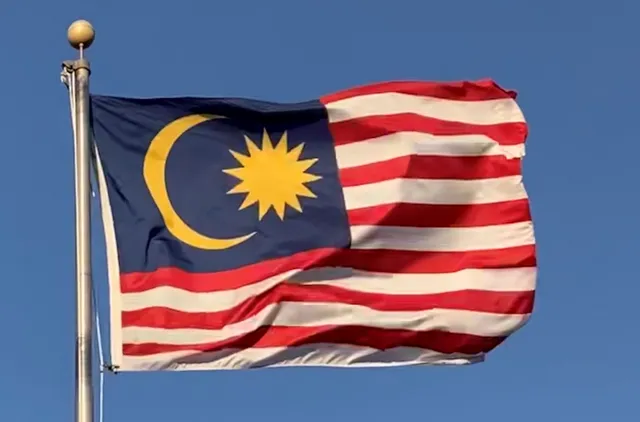
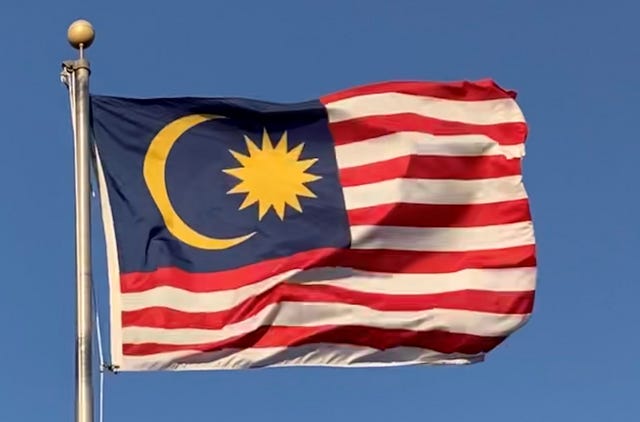
Malaysia’s communications regulator fined two major media outlets RM100,000 (USD 23,800) each last week for content violations. The Malaysian Communications and Multimedia Commission (MCMC) penalized Sin Chew Daily (星洲日报) for publishing an incomplete Malaysian flag image missing the crescent symbol, and Sinar Harian (阳光日报) for falsely identifying the police chief as a political party member on Instagram. Sin Chew Daily announced it would appeal the decision. The Malaysian Media Council, an independent self-regulatory body, criticized the fines as damaging press freedom, while the Malaysia Chinese Media Editors Association (马来西亚华文媒体编辑人协会) said the penalties would hinder media development. MCMC emphasized that the national flag “Jalur Gemilang” must always be displayed accurately as a symbol of sovereignty and unity, warning that false information can undermine public trust and order.
Editors beware. This is how the Malaysian flag should appear. SOURCE: Wikimedia Commons.