SET News (三立新聞), a Taiwanese news outlet, has launched a multimedia series examining the Chinese Communist Party’s tactics for cross-border repression. The project features interviews with individuals from the United States, China and Hong Kong, including Mark Clifford (祈福德), a former executive at Next Digital, and Ka-Man Lau (劉珈汶), a Hong Kong activist now based in the United Kingdom. Other participants include Shirley Leung (梁嘉麗) and Ka-Chung Li (李家聰), who co-founded the Taiwan-based news outlet PulseHK (追光者), as well as various Chinese sources who remain anonymous to avoid repercussions.
The reporting explores what interviewees describe as “bloodless torture” methods used against political prisoners in China, as well as intimidation tactics targeting overseas Chinese communities. The series provides direct testimonials from individuals who have either faced or witnessed Beijing’s pressure tactics across multiple regions.
Discussing their motivations for speaking out, one anonymous Chinese individual told SET News, “I feel a responsibility to raise my voice for those in China who do not have a voice.”
Hong Kong authorities banned the Taiwanese mobile game “Reversed Front: Bonfire” (逆統戰:烽火) on June 10, marking the first time the city has publicly condemned a gaming application under national security laws. The National Security Department warned residents against downloading, sharing, or financially supporting the game, claiming it promoted Hong Kong and Taiwan independence while encouraging armed revolution against China’s government. Hong Kong security chief Chris Tang (鄧炳強) described the game, according to Taiwan’s Central News Agency (CNA), as “quietly poisoning young minds” (悄然荼毒年輕人思想) with “extremely malicious” tactics.
Created by the Taiwan-based development team ESC (台灣境外戰略溝通工作小組), a civilian volunteer group, the strategy game allows players to control various factions, including those representing Taiwan, Hong Kong, and other regions in scenarios involving the overthrow of communist rule. An ESC spokesperson previously told BBC Chinese the group’s main work is to “contact overseas anti-communist organizations, and assist overseas allies in promoting propaganda and organizational work.” Following news of the ban, online searches for the game surged dramatically, according to Taiwan’s Up Media (上報). The app has been removed from local download platforms in Hong Kong.
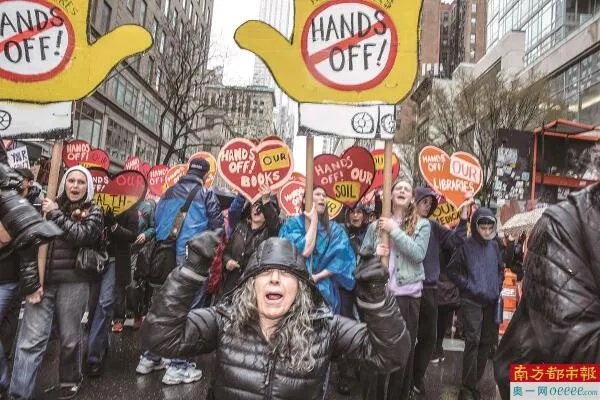
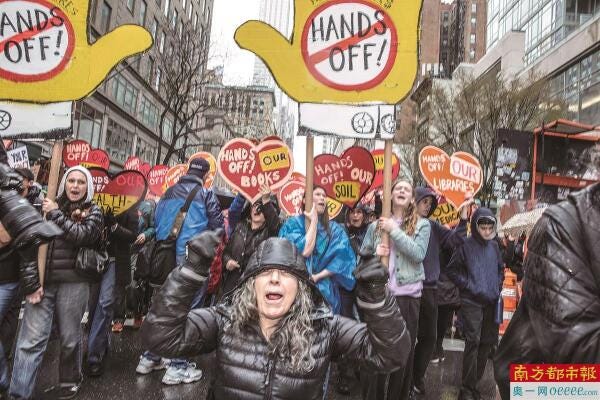
Talk about selective reporting. While protest activity in China remains largely invisible in domestic media, American demonstrations receive front-page treatment. This narrative, emphasizing the apparent disorder of democratic and populist politics in America, is the message that media consumers across China are presumably meant to take away from the wave of protests happening in cities across the country last week.
Chinese coverage of American demonstrations was extensive in its reach, though the official Xinhua News Agency and China Central Television served as the sole sources for most reports, with nearly identical phrasing across outlets. Guangzhou’s Southern Metropolis Daily (南方都市報) reported on April 7 that “more than 500,000 people participated in 1,300 protest events across America” against the Trump administration. The article noted that “even ‘red counties’” — those generally supportive of Republican Party candidates and policies — had seen sizable protest crowds waving banners with messages like “King of Corruption” and “Make Lying Wrong Again.” The Paper (澎湃), a Shanghai-based online outlet, published an extensive gallery of photos showing demonstrations across major US cities on April 5, describing the events as “the largest collective protest since Trump took office.”
While providing comprehensive coverage of American unrest, Chinese media outlets remain silent on domestic protests — even in the once relatively free environment of Hong Kong. The city’s police commissioner, Chow Yat-ming (周一鳴) stressed earlier this month when discussing national security that citizens should consider it their “personal duty” to report violations. The contrast could hardly be clearer. American protests merit detailed coverage, while Chinese ones warrant police scrutiny. If only the Trump administration hadn’t frozen funding for one of the only projects actually monitoring dissent in China.
Initium Media (端傳媒) published an extraordinary inside look earlier this month at the deep challenges facing official Party-run media in China, particularly television networks caught between political control and financial viability — with television audiences left out of the equation. The deeply reported piece reveals how corruption has become normalized as a survival mechanism. China’s nearly 2,500 television stations face deep financial pressures, with insiders describing them as “living like beggars” (大家都是过着要饭的日子). At China Central Television (CCTV), reporters’ salaries have plummeted while top executives often offer public relations services on the side, and news anchors hawk products via livestreams. Local station reporters earn as little as 800 yuan (110 dollars) monthly, which must be supplemented by commissions from commercial activity.
An ad from the China Media Group (CMG), the conglomerate directly under the CCP’s Central Propaganda Department, for a shopping show launched on January 1.
The core problem is political: increasingly stringent content restrictions have made meaningful programming impossible. As one CCTV producer candidly admitted, everyone knows the solution — allow creative freedom and programs that respond to people’s concerns — “but none of these things are possible.” The inevitable result, according to a propaganda official, is that “television will gradually die out.”
CMP’s Dalia Parete reached out to freelance journalist Will Yang (楊智強), the founder of the independent outlet Border Eyes (邊境之眼), which focuses on Myanmar and Southeast Asia, to discuss the near-impossible challenge facing the press as they try to cover Myanmar’s devastating 7.7-magnitude earthquake under military junta restrictions. Yang recently wrote a piece on this issue for Taiwan’s United Daily News (UDN).
Border Eyes (邊境之眼) founder Will Yang.
Lingua Sinica: Is it possible for foreign journalists to enter Myanmar right now to cover the earthquake? What are the challenges and potential ways to get in?
William Yang: The military spokesperson announced that they don’t accept foreign media. Major media from the West, Taiwan, Japan, and Korea probably cannot enter. But NHK and AFP still have some personnel inside Myanmar who can assist. The obstacle is that you’d need to sneak in without a press visa. They won’t issue press visas, so maybe you get in on a tourist visa, which for them is illegal. This is already dangerous for you.
If you’re a TV reporter with big equipment or a microphone, it’s almost impossible. You could do it with a small gear or a cell phone, but it’s very dangerous. People will fear being interviewed because they know it’s unsafe, especially if they’re illegally doing news activity.
Lingua Sinica: How has the military government’s approach to press freedom since the 2021 coup created a particularly challenging environment for disaster coverage?
William Yang: The damage is too devastating. The government doesn’t have enough manpower, equipment, or resources to help its people. They don’t want the press reporting on these shortcomings. It’s all about the government fearing bad press that would expose their lack of infrastructure to respond effectively. Even in Sagaing City, I heard 80 percent of buildings are damaged—the disaster is simply too massive. They probably don’t want international society to know they’re incapable of handling this. They seem to care more about their image than their people. After the past four years, this is sadly credible.
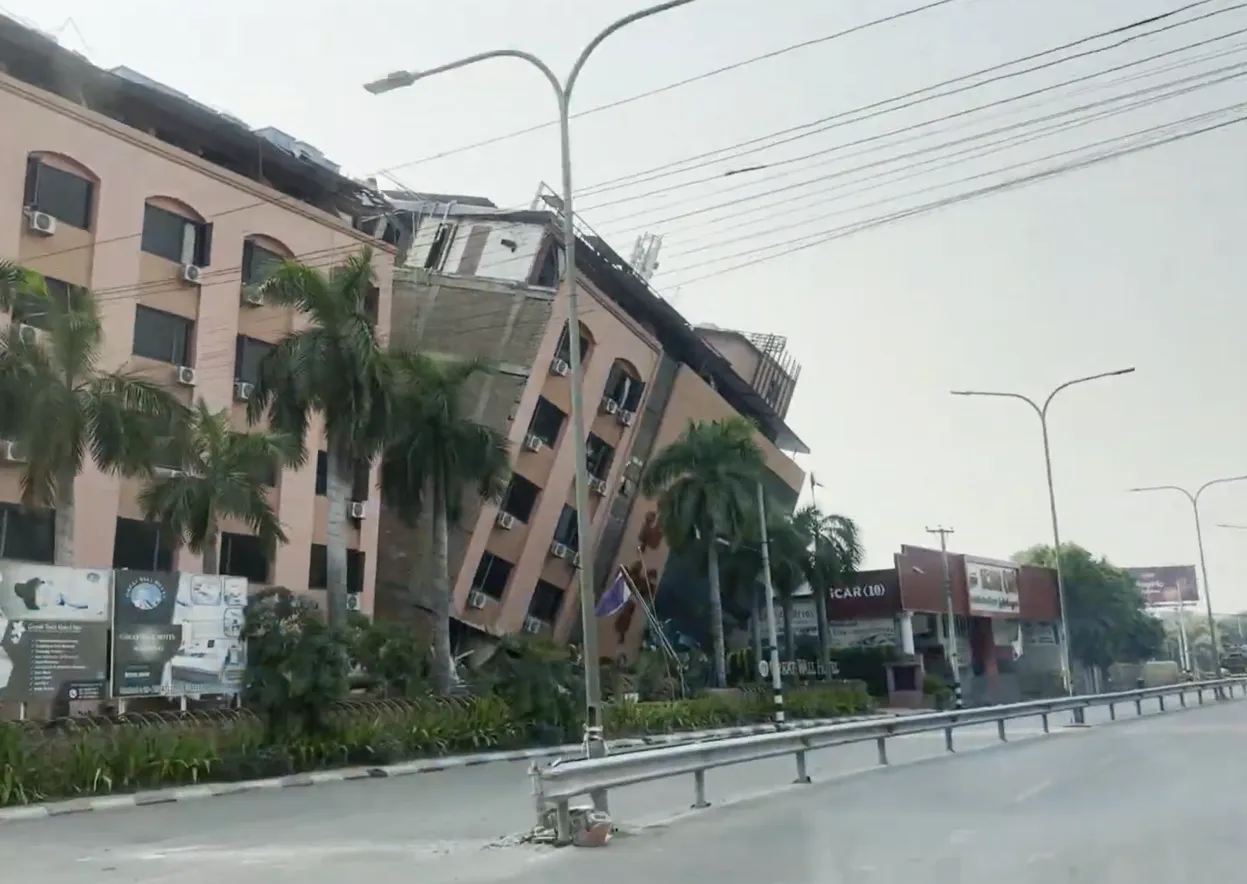
Screenshot of a video from China News Service that shows the aftermath of the Myanmar earthquake. SOURCE: Wikimedia Commons.
By blocking press access, they’re deliberately controlling information. Additionally, the civil war has worsened the disaster response, as ordinary people now view anyone in military uniform as an enemy or threat. The government has lost public trust. Even if officials genuinely try to help now, citizens remain skeptical, creating a significant obstacle to effective disaster relief.
Lingua Sinica: Reporters from what countries can enter Myanmar?
William Yang: Russian, Belarusian, and Chinese reporters are there because they’re allied with the junta. They trust each other and won’t allow the situation to spiral out of their control. Their primary goal is to protect their interests with all parties involved. The junta trusts Chinese state journalists, who can enter to report on what their rescue teams are accomplishing, creating a mutually beneficial arrangement.
Lingua Sinica: Are you seeing any strategies that local or international journalists are developing to continue reporting on this crisis despite the restrictions?
William Yang: Even today, I’m trying to connect with people inside Mandalay. There are independent journalists who had contacts in the city before the earthquake. I asked them to film hospitals and the airport, which has shut down, to understand why. They’ve captured footage but can’t transmit it.
The internet connection is too poor. We can communicate by text, but sending large video files has been impossible all day. Everyone is trying. Everyone wants news from inside Myanmar. However, broken internet remains a major obstacle to getting information out, and VPNs don’t help with speed issues.