China has long sought to control what its citizens see online, restricting access to foreign platforms and content that might challenge the dominant framing, or “public opinion guidance” (輿論導向), of the Chinese Communist Party. Actions taken earlier this month by police in Hubei could be a sign that authorities are moving more concertedly against individuals using VPNs to bypass internet controls, a process referred to as “scaling the wall” (翻牆). On March 11, police in two Hubei cities published administrative penalty notices against individual citizens for doing exactly that.
On March 8 in the river city of Ezhou, a man was fined 200 yuan (about 27 USD) after authorities discovered he had used a proxy tool to access TikTok and X. In the nearby city of Xiaogan, ten police officers had raided a man’s home months prior for similar activity, resulting in a 500 yuan (69 USD) fine. In both cases, the men were issued formal administrative warnings (警告) and ordered to cease unauthorized international networking (責令停止聯網). Previously, law enforcement focused on developers and commercial operators of circumvention tools. Individual VPN use, while technically against the rules, was largely tolerated under a tacit understanding that citizens could bypass the firewall for personal purposes — accessing social media or foreign news — as long as they did not challenge the state. By some estimates, China has as many as 90 million VPN users.
Last year, an apparent drop in the frequency of appearances by President Xi Jinping in the state media — alongside cancelled participation in international gatherings such as the BRICS summit — invited speculation that China’s strongman was losing his grip on power. Closely observing the Chinese Communist Party’s flagship People’s Daily newspaper, we argued last July that these shifts were overstated. It was just too early to tell.
The headline results for 2025 are now in. So what observations can we now make about the standing of China’s top leader?
Before we jump into the analysis, it’s important to note again for those less familiar with CCP-run media that the People’s Daily is a constrained and consensus-based Party flagship paper with a high level of consistency in terms of pages and text density over its history — with highly formalized and repetitive language (more on that below). This is a key reason why the paper, a political signalling platform rather than a space for news or discussion, lends itself to frequency analysis.
The Center Holds
First off, we saw no change in the decisiveness of Xi-centric discourse, nor did we see any rising challenges from other members of the Politburo Standing Committee (PSC) — an important indicator of shifts at the top. In the full year 2025, Xi Jinping appeared in close to 600 headlines in the People’s Daily, more than three times the number of headlines logged by China’s premier, Li Qiang (李强), the country’s second ranking party official.
At no point during the past year did this performance gap narrow in the flagship paper. Xi’s lead remained commanding, as it has done throughout his tenure. As readers can see from the graph below, the performance of all PSC members remained steady in 2025, with moderate declines for both Li Qiang and Zhao Leji (as well as Li Xi) against 2024 levels.
You may notice that above we referred to Xi-centric discourse rather than Xi-centric “coverage.” This is an important distinction, and critical to understanding how CCP media operate within China’s political and media systems. The articles in the People’s Daily do not just “cover” events on the political calendar in the same way that media elsewhere in the world do.
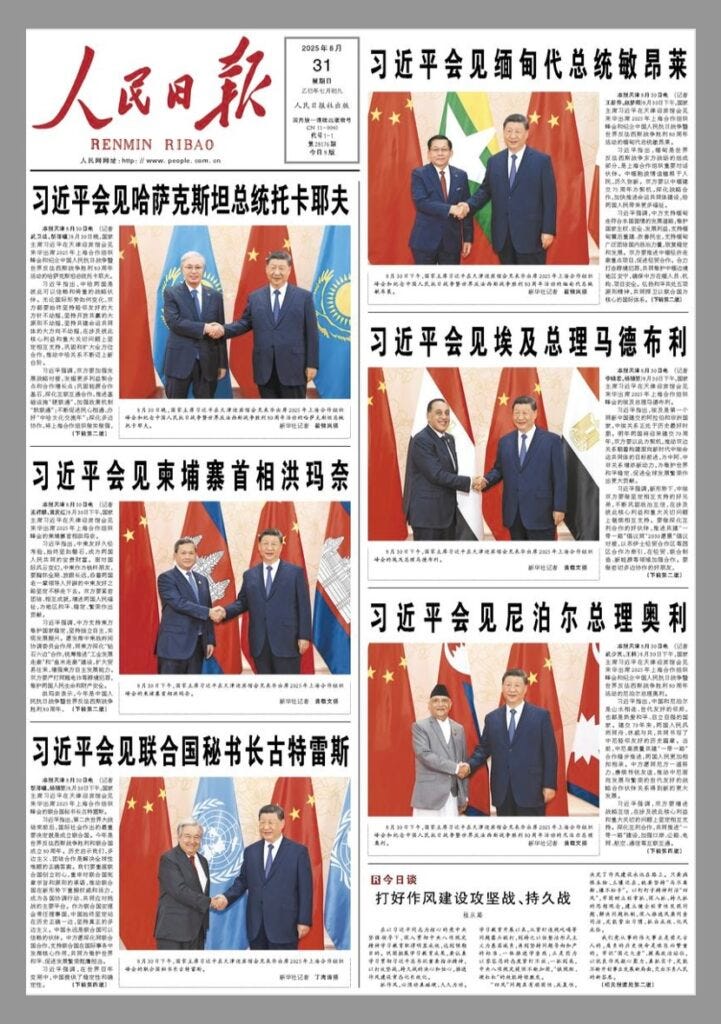
While coverage in a Western newspaper of a political leader’s attendance of a major diplomatic summit would warrant perhaps one report around key issues and points of relevance — with perhaps separate op-eds that reflect independent viewpoints — in China’s system of power signalling it results in a separate article for each diplomatic exchange that resulted. Consequently, a front page during a busy period for Chinese diplomacy can sometimes feel like a Xi Jinping identity parade.
During a summit of the Shanghai Cooperation Organization in August last year, the People’s Daily ran a front-page article for each head of state with whom Xi met.
Why is this ridiculousness necessary?
The Politics of Repetition
In the political system operated by the CCP, repetition is a crucial form of signaling and demonstrating power. This is an absolutely essential part of the People’s Daily’s role. Repetition is a basic way to instill the “main line” (主线) and ensure that the CCP media, as “mouthpieces” (喉舌) of the Party, are the “weathervanes” (风向标) pointing the political direction. This is why six handshakes at a single diplomatic summit become six distinct reports on the paper’s front page.
Understanding the political role of repetition also helps us contextualize another important observation from our 2025 numbers — the fact that headline mentions of Xi Jinping, while decisively in the lead, are also notably down.
When we look at headline appearances for members of the PSC (above), as well as front-page image counts (below), we can see that Xi had seen a notable decrease in appearances on both counts.
What does this mean?
In our analysis back in July last year, we noted that headline counts and images closely follow calendar events, and that over time the total counts can balance out. In other words, Xi’s counts may seem down in July, but then surge in August or October with a busy calendar or a concerted campaign of messaging around events such as Party plenums. Now, with all the data for 2025 accounted for, we can see that this downward trend was no error.
Headline mentions of Xi Jinping, while decisively in the lead, are also notably down.
It is true that Xi made fewer headline appearances this past year in the People’s Daily than in the two years previous. How dramatic was the shift? Xi’s appearances saw an overall drop of 21 percent in 2025. It was a similar story in image counts, where there was a 19 percent drop from the preceding two years. That is not negligible. And yet, as we said at the outset, name checks in front-page headlines for other PSC members remained uniform across all of these years — and far below the soaring heights enjoyed by Xi.
Does this quantitative drop signal a power drain?
While there is always room for error in the perilous business of CCP gazing, the broader context of People’s Daily signaling cautions against over-interpreting this decrease in frequency. First of all, we see continued wall-to-wall “coverage” — again, this is repetition and signalling — of Xi in People’s Daily, combined with a lack of any real challenger. This indicates that he is decisively in control of the narrative, and certainly that he remains the “core” (核心).
Secondly, there are other ways, beyond imperiled leadership, to understand these numbers. One possibility is a general drop in the number of global trips Xi made in 2025. As reporters and analysts have noted, Xi has delegated appearances at major international summits to his premier, Li Qiang. Skipping some of these summits naturally lessened Xi’s 2025 tally — which is to say that it lessened instances not just of “coverage,” but of repetition.
For those tempted to read too much into those absences, it’s important to note that Li’s attendance of these summits in particular did not drive a corresponding increase in article and image numbers for the premier. This is not because those events were not covered, but because they were not repeated like incessant drum beats to promote the leadership core.
The repetition that to most of us appears senseless, and even ridiculous, is a privilege enjoyed only by the man at the apex.
As we enter 2026 and Xi Jinping edges another year closer to the next Party Congress (2027), China’s repetition complex is something to carefully observe. Will the downward trend in his numbers continue? Only time will tell if there is real strength in Xi’s numbers.
“Basketball is a bridge that connects us.” That was the headline of a commentary published in the Chinese Communist Party’s People’s Daily newspaper earlier this month, with a soaring byline from none other than LeBron James, the LA Lakers star who is the NBA’s all-time leading scorer. “I’ve been deeply moved by the enthusiasm and friendliness of my Chinese friends,” the commentary began, with a typical CCP frame of people-to-people friendship. “What I can do in return is give my all in every game as a way to show my gratitude to everyone.” For a generally insipid Party-run mouthpiece, such a celebrity endorsement was too good to be true — and of course it was. Representatives for LeBron James quickly disavowed the story. The star, they said, had only ever conducted interviews with Chinese media.
What does this tell us? The flagship newspaper of the CCP feels it is perfectly acceptable to fake a commentary by one of the world’s most recognizable public figures if it suits the agenda, in this case talking up “friendship” and people-to-people exchange.
It should not surprise readers that this is not an isolated case. In 2016, after a commentary with a byline from a journalism professor in the New York state university system appeared in the paper decrying the falsehood of Western freedom of speech, CMP reached out to the professor in question. In an e-mail exchange, the shocked professor said she had only spoken on the phone with a People’s Daily reporter and raised issues of journalism ethics more generally. Sound familiar?
At the People’s Daily, politics always trump professionalism. In order to have his official press card re-issued back in January, the staff member behind the LeBron James commentary, sports reporter Wang Liang (王亮) would almost certainly have taken refresher courses on the Marxist View of Journalism and fealty to the Party. The most basic ethics and good practice? Not so important. The People’s Daily has issued no public correction on the LeBron James commentary. Don’t bother waiting for the buzzer.
SET News (三立新聞), a Taiwanese news outlet, has launched a multimedia series examining the Chinese Communist Party’s tactics for cross-border repression. The project features interviews with individuals from the United States, China and Hong Kong, including Mark Clifford (祈福德), a former executive at Next Digital, and Ka-Man Lau (劉珈汶), a Hong Kong activist now based in the United Kingdom. Other participants include Shirley Leung (梁嘉麗) and Ka-Chung Li (李家聰), who co-founded the Taiwan-based news outlet PulseHK (追光者), as well as various Chinese sources who remain anonymous to avoid repercussions.
The reporting explores what interviewees describe as “bloodless torture” methods used against political prisoners in China, as well as intimidation tactics targeting overseas Chinese communities. The series provides direct testimonials from individuals who have either faced or witnessed Beijing’s pressure tactics across multiple regions.
Discussing their motivations for speaking out, one anonymous Chinese individual told SET News, “I feel a responsibility to raise my voice for those in China who do not have a voice.”
hink “state media” in China and you’re likely to conjure an image of the People’s Daily (人民日报). The daily newspaper, directly run by the Chinese Communist Party’s (CCP) Central Committee since 1948, prides itself on being the “mouthpiece” (喉舌) of the Party leadership. And a role this important demands regimentation and structure: a staid face to communicate the thoughts of the CCP core.
But while it is the most representative of the Party leadership, the People’s Daily newspaper, first launched in 1946, is not the only face of this Party-run media group. The paper’s parent organization, the People’s Daily Press (人民日报社), is in fact a sprawling media empire. The group oversees a portfolio of 34 periodicals as well as a wide array of newer digital products. It runs a health magazine, a history journal, a newspaper for gearheads, and even the RV Times (房车时代), a periodical for recreational vehicle enthusiasts.
The story of the group’s growth over the years is the story of the PRC media space as a whole, where commercialization and partial privatization were actively encouraged in the reform era, and where more recent developments have made it clear once again that the Party maintains ultimate control.
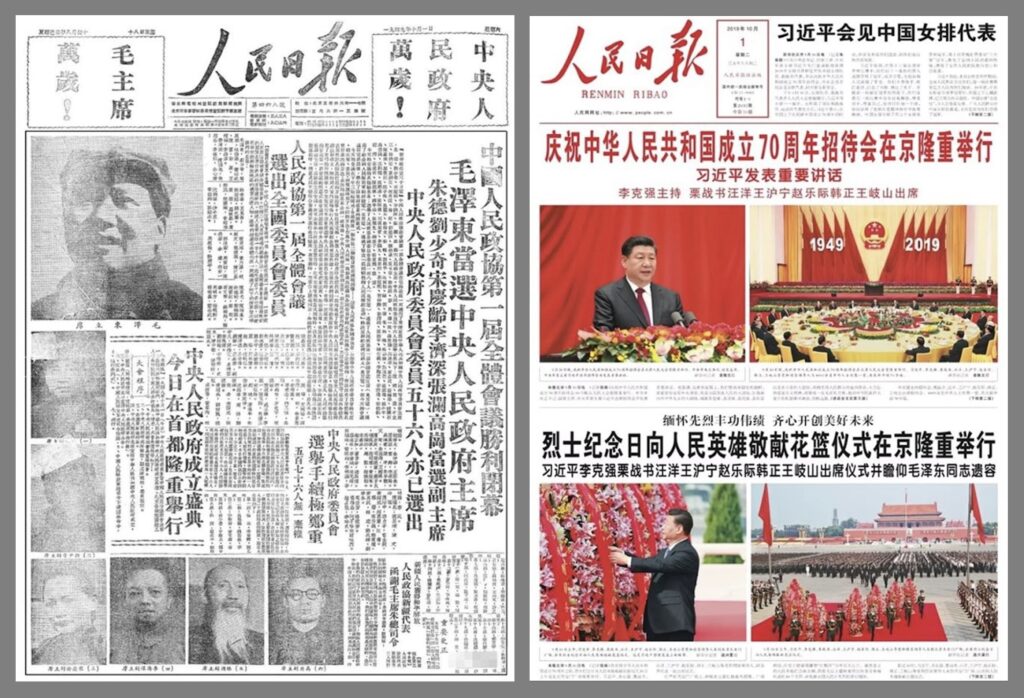
The People’s Daily on the day the People’s Republic of China was founded on October 1, 1949, and the PRC’s 70th anniversary in 2019.
A Fresh Wind Through Chinese Media
In the China of Chairman Mao Zedong, the People’s Daily was one of only a handful of officially sanctioned newspapers run by the CCP — known, fittingly, as “Party-papers” (党报) — to cover the entirety of the newly founded People’s Republic of China. It adhered strictly to Mao’s notion of “politicians running the newspapers” (政治家办报), according to which any printed articles, particularly lead editorials (社论), had to be aligned with the interests of the Party. During the Great Proletarian Cultural Revolution (文化大革命) of 1966-1976, those interests were Mao’s personal political interests, and the chairman’s writings dominated the “two newspapers and one journal” (两报一刊) system, in which the three most influential PRC publications, including the People’s Daily, the People’s Liberation Army Daily and Red Flag journal, reigned supreme.
In the early years of China’s reform and opening up under Deng Xiaoping (邓小平), the number of nationwide publications in China remained small for a country of its size. In 1979 there were just 69 “Party-papers” in print. This contrasts sharply with the latest figures from the National Press and Publication Administration (国家新闻出版署), or NPPA, an agency under the Party’s Central Propaganda Department that supervises print publications in China. The NPPA recorded 2,405 newspapers published in the country in 2023.
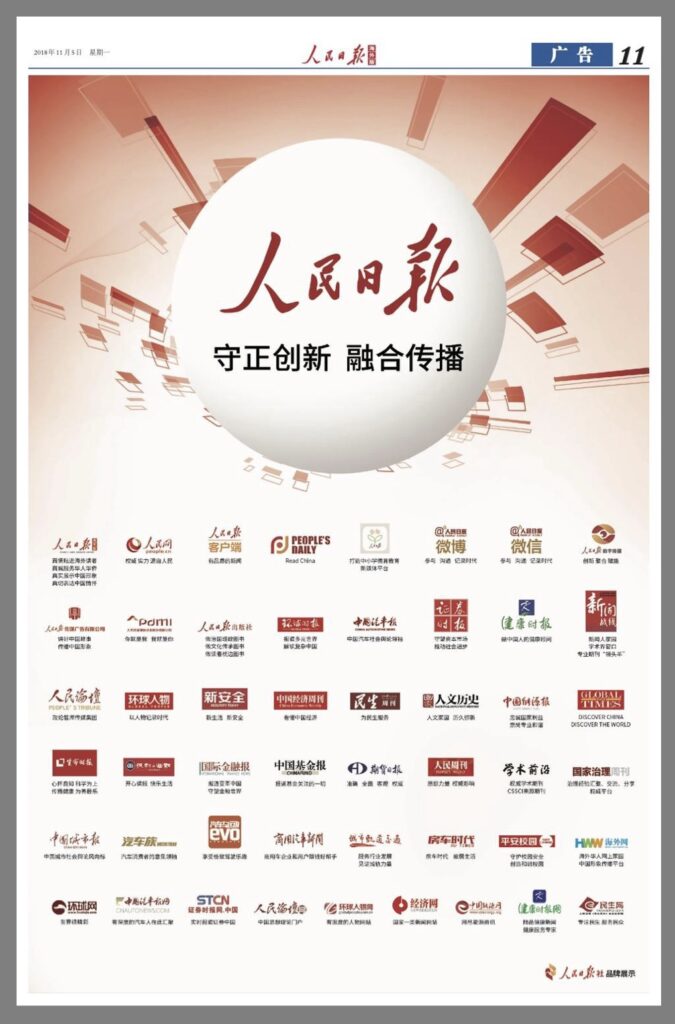
An advertisement is the People’s Daily showcasing the many brands under the People’s Daily umbrella.
This number began its climb from two to four digits in the 1980s, as economic reforms brought a rethink of the role in the media. The term “news reform” (新闻改革) signaled a new openness, including an assessment from the leadership under Deng Xiaoping that the “falsehood, bluster and emptiness” (假大空) of the media from the 1950s onward had to a large extent contributed to the chaos of the period, from the Great Famine through the Cultural Revolution.
Tragically, the push toward greater freedom of speech in the 1980s, seen in the launch of more reform-oriented newspapers like Shanghai’s World Economic Herald (世界经济导报), was brought to a brutal end by the Tiananmen Massacre of June 4, 1989.
But by the mid-1990s, as economic reforms were reinvigorated and accelerated, the spirit of change again swept over the media in China. This era also saw significant liberalization in the industry, with the number of periodicals rising rapidly as a result. Publishing was never a free marketplace of ideas — government licenses remained necessary for any operation — but new voices did begin to emerge. More market-oriented “metro papers” (都市类报纸) served China’s rapidly urbanizing population, oriented around the consumer — of goods and information. The equation meant more readers, more sales, and more ad revenue, a new way for outlets to exist independent of state financial support, even as political ties to the system remained paramount. From time to time, these papers challenged the authorities by reporting more openly on corruption and other political and social issues.
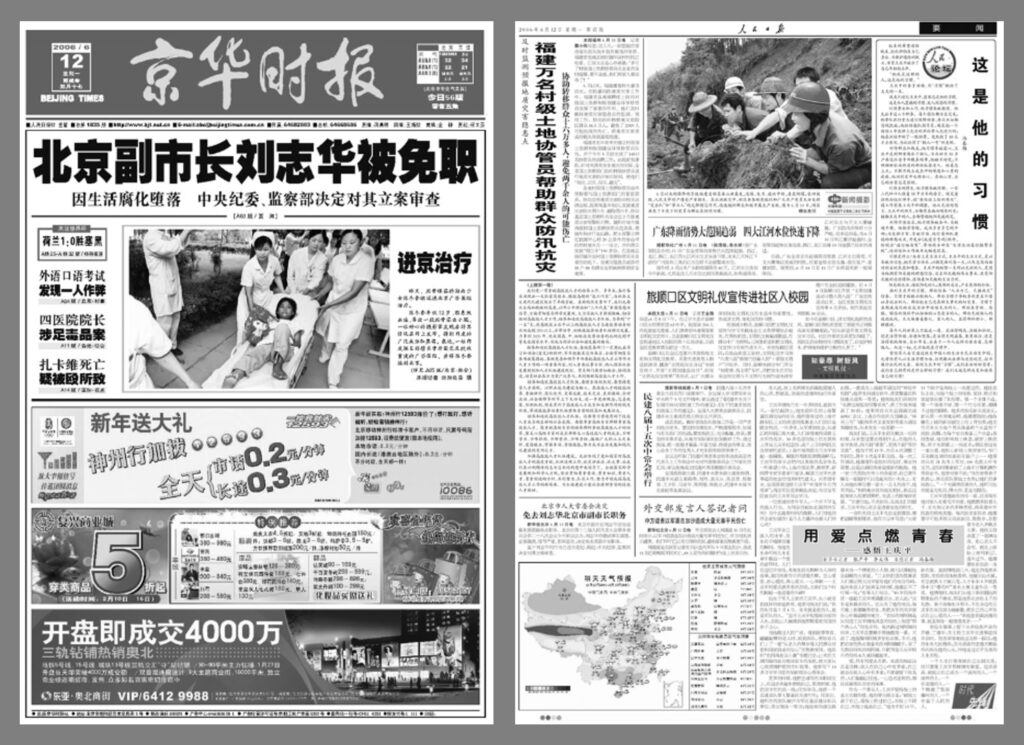
Even the People’s Daily joined the trend, launching its own metro newspaper, the Beijing Times (京华时报), in May 2001. In what has been called the “golden age for metro newspapers,”higher salaries and more comfortable working conditions made the Beijing Times and other commercial competitors attractive to a new generation of young journalists. According to a 2017 account, the “direct approach” and “sharp commentary” found at the Beijing Times in the 2000s made it “like a fresh wind sweeping through Beijing’s then-dull media market.”
Going Public with the People’s Internet
The rise of the internet in China after 1994 was another jolt for the media industry, even though it was heavily regulated from the start to ensure that news gathering remained in the hands of the Party. Inside China, Chinese-language internet portal sites like Sohu.com, launched in 1996, and Sina.com, launched in 1998, could serve as content aggregators — reposting content from Party media and registered commercial spin-offs — but could not themselves maintain teams of journalists. But they revolutionized the consumption of information, even inviting discussion in the comment (跟帖) section underneath news articles.
Contrasting reports from 2006 on corruption charges against the vice-mayor of Beijing illustrate the differences between Party papers and their commercial spin-offs. At left, the Beijing Times places the corruption story prominently on the front page. At right, the People’s Daily includes only a small note on page 4.
The People’s Daily was quick to follow suit, entering this space on January 1, 1997, with the launch of its online portal, People’s Daily Online, or renminwang (人民网). As the group’s “About Us” page explains, the emerging online space offered “unique advantages” including “communication value” (i.e., more interactivity) and “technological value.” Today, the official portal site continues to publish a digitized and downloadable version of the People’s Daily print edition, runs the Chinese Communist Party News Network (中国共产党新闻网), and moderates a “leader’s message board” (领导留言板). This last feature, which China’s government has cited as an example of democratic governance, claims to allow citizens to directly pose questions to officials or express their views, but in fact is little more than an officially curated comment service — serving to promote the idea of Party responsiveness rather than enable real accountability.
People’s Daily Onlineis structured more like a conventional company. Listed on the Shanghai Stock Exchange as People.cn Company Limited (人民网股份有限公司) since April 2012, it has its own investor relations page and publishes its annual returns, the latest of which boasts revenues of 2.1 billion RMB (290 million dollars). Like any other company’s annual reports, People.cn’s are replete with references to the firm’s profits. But unlike those of most publicly listed companies, their reports blend profit talk with performative loyalty to the Chinese Communist Party. Investors are reminded, in the management analysis section, that the company strictly adheres to “Xi Jinping Thought on Socialism with Chinese Characteristics for the New Era.” Career openings at the company also list “loving the Party” and having “strong political integrity” as job requirements.
Building an Empire
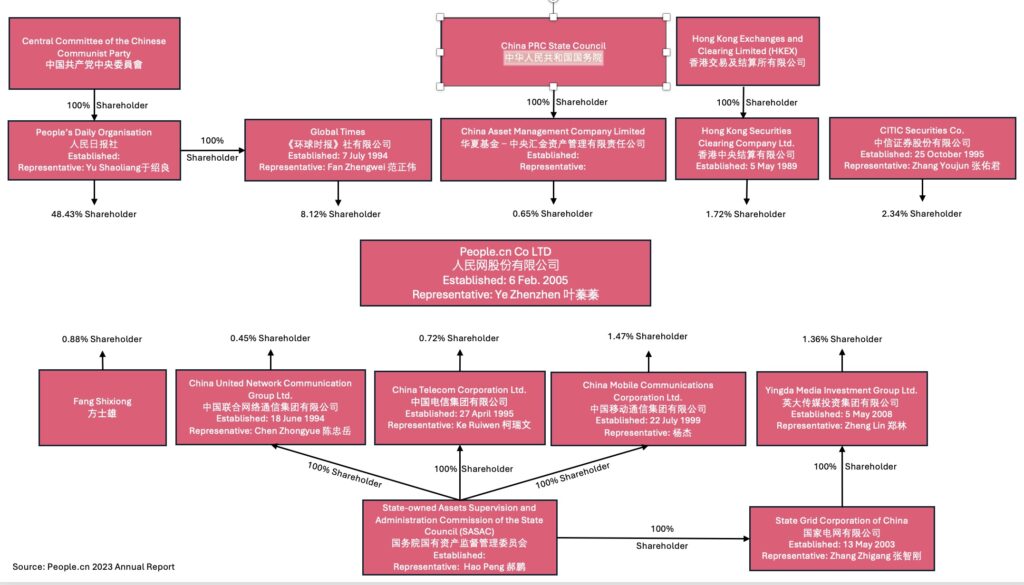
But while the print edition of the People’s Daily falls directly under the CCP’s Central Committee, People’s Daily Online has a series of private buy-ins from investors that complicate its identity. The group’s annual reports reveal their top ten shareholders, compiled into the diagram below. Amongst others, the company’s biggest investors include state-owned investment bank CITIC Securities (中心证券), state-owned telecommunications giant China Mobile (中国移动通信), and the Hong Kong Securities Company (香港中央结算), wholly owned by the Hong Kong Exchange and Clearing Limited (HKEX) that runs the territory’s stock exchange. While the print edition is run unambiguously as part of the Party-state, its online counterpart retains some reform-era features of a legitimate digital news company — although just a little digging reveals that the Party-state is still firmly in control.
Screenshot
Combined with the shares held by the Global Times — a nationalistic tabloid wholly owned by the People’s Daily — the People’s Daily Press has a controlling 56.55 percent stake in People.cn. Even the apparently private minority buy-ins, however, are in fact different arms of the Party-state itself. Take, for example, China Asset Management (华夏基金), which holds 0.65 percent of People’s Daily Online shares and is registered under the State Council. Other investors like China United Network Communications Group (中国联合网络通信), or “China Unicom,” China Telecom (中国电信), and China Mobile Communications are all state-owned enterprises (SOEs) overseen by the State-owned Assets Supervision and Administration Commission of the State Council, which is directly under the management of China’s central government.
So how profitable is the People’s Daily Online? A 2019 article in the industry publication China Newspaper Industry (中国报业) summed up media developments over the previous year in China with a series of bearish keywords. The top three: “decline” (下滑), “loss” (流失), and “avalanche” (雪崩).
While the print edition of the People’s Daily falls directly under the CCP’s Central Committee, People’s Daily Online has a series of private buy-ins from investors that complicate its identity.
But People’s Daily Online doesn’t seem to be faring so poorly.Their 2019 Annual Report logged a 40 percent profit increase from the year before, and they kept growing the next year. Despite a pandemic slump, their profits are on the rise again.
How the outlet manages to be so profitable, however, is not necessarily down to just newsstand sales, subscriptions, or advertising revenue. In the United Kingdom, the People’s Daily Online’s London bureau (People’s Daily Online UK Limited) is based near Hyde Park’s famous Speakers’ Corner, a historic site for free speech and public debate — and famous, too, for having some of the most expensive real estate in the country. The latest financial statement for the UK bureau shows a loss of 2.8 million US dollars, offset only by the 3 million US dollars provided by its head office in Beijing. We have also documented this phenomenon at China Daily USA, where the stateside operations of the state-run newspaper are run at a considerable loss thanks to millions in direct funding from China Daily HQ.
The People’s Daily Online also runs Global Times Online (环球网), the digital edition of the nationalistic tabloid Global Times (环球时报). Ownership of the newspaper is split 60-40, respectively, between the People’s Daily Online and the Global Times Press (环球时报社) — the latter of which also sits directly under the CCP Central Committee. Haiwainet (海外网), the website of the overseas edition of the People’s Daily, is split along the same lines by the People’s Daily Online and the People’s Daily Press.
China Energy and Automobile Communication Group (中国能源汽车传播集团有限公司) is responsible for the People’s Daily’s stable of specialized trade publications (专业行业报). The Group is wholly owned by the People’s Daily Press — again, directly under the Central Committee. Its properties include China City News (中国城市报), a weekly bulletin aimed at “party and government leaders” involved in “urban planning, construction, and management,” as well as China Automotive News (中国汽车报), a print weekly and digital news outlet for fans of cars and engineering.
One Voice, Many Channels
For most companies around the world, corporate social responsibility reports are used to demonstrate how the business has had a positive impact on society and the environments in which it operates. It is underpinned by the idea that for-profit institutions still have a responsibility to the broader community. The People’s Daily Press files its own “social responsibility reports” (社会责任报告), but theirs have a distinctive twist: instead of demonstrating their philanthropic deeds, they are used to demonstrate their unwavering loyalty to the Communist Party.
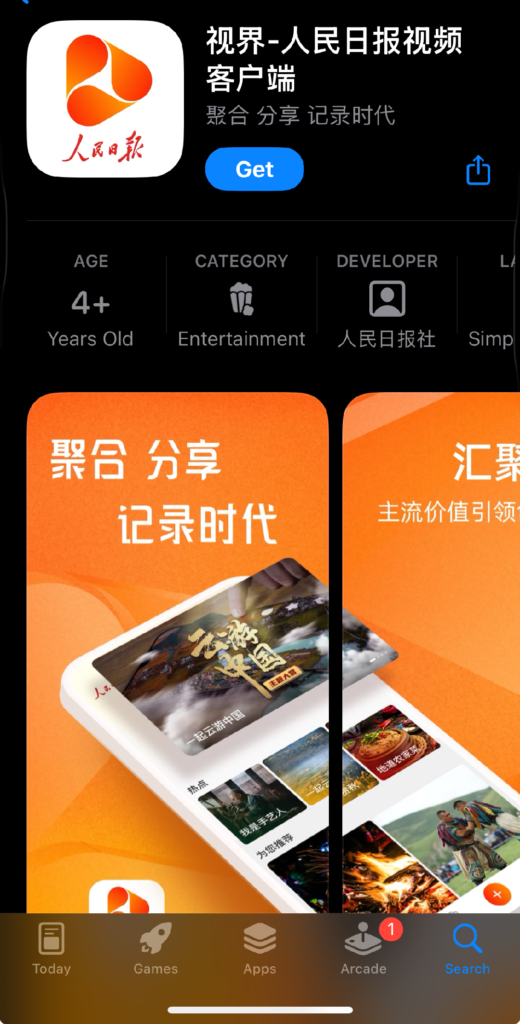
In their latest report, they remind readers that the outlet “strictly adheres to the principle of politicians running the newspapers” — the phrase that was first raised by Mao in the 1950s as he asserted his dominance over the media as a means of consolidating political power, and has since come back in vogue as Xi Jinping has similarly tightened controls on the media. This means that all of the group’s ventures are bound ultimately to the same basic principle: Party first, profit second. This is true whether they are app-based new media outlets like Visual World (视界), at right, sending state-produced video material straight to your mobile, AI text generation tools like “Easy Write” (写易), or just the dry, Xi-filled pages of the flagship People’s Daily newspaper.
Mao’s old phrase, applied in state media today to stake the CCP’s claim over emerging digital media, encompasses the enduring truth behind the many faces of the People’s Daily empire. While this media giant continues to transform through the process of Party-led commercialization that began in the reform era — seen in its diverse inventory of media properties — its core remains unchanged. It is still, in its own words, “the throat and tongue and eyes and ears of the CCP Central Committee.” The principle holds true whether it is reporting on the latest Party plenum or the latest make of luxury camper.
In a dry publicity stunt meant to affirm the leadership’s staunch backing of arts and culture, China’s official People’s Daily published a letter on the front page earlier this month reportedly sent by Xi Jinping to eight “film artists” (电影艺术家). According to the paper, the artists had previously written to the leader to reflect on their decades in the field, and to pledge to help build China into a “cultural power” (文化强国). In his response, Xi lauded the filmmakers for their “love for the Party and people” (对党和人民的热爱). He urged them to continue serving as role models embodying “cultural confidence,” or wenhua zixin (文化自信).
But when it came to cultural currency there was just one problem. All of these “film artists” were veteran actors from the revolutionary cinema era of the 1950s to 1970s, far predating reforms. Chief among these old guard stars was Tian Hua (田华), the actress born almost a century ago who starred in the 1950 propaganda classic The White-haired Girl (白毛女).
In more news related to “cultural power” this week, state media report that China’s updated figure of 1.12 billion internet users, reached during the first half of this year, means it has “prowess in culture.”
Responding to a push from the central leadership to supercharge international communication at the local level, China’s southern Guangdong province launched four new digital platforms this month. Going live on July 2 alongside the release of a glossy propaganda film called “Go Guangdong” (够广东), the platforms include IP Guangdong, INFO Guangdong, LIVE Guangdong, and GO Guangdong.
Provincial propaganda officials have lauded the online portals as new forms of “citizen-based external propaganda” (人人外宣), and state media have suggested they mark an innovative departure from previous top-down approaches to global communication. But the sites, and the plans announced alongside them, have the same underlying flaw as all external media communication conceived by China’s leadership in the name of “enhancing cultural soft power.” The point is power first, never culture. As for “soft,” these initiatives involve aspects of outright deceit that clearly mark them as classic iterations of sharp power.
Backyard Story Furnaces
In their basic concept, Guangdong’s new platforms are echoes of Xi Jinping’s top-down reconfiguration of external propaganda since around 2018, a process accelerating from 2021 onward. That reconfiguration enlists provinces, cities and even counties across the country in a more localized mobilization of messaging — including through a rapidly growing number of “international communication centers” (ICCs). The Chinese Communist Party’s objective is to augment past forms of large-scale and top-down global broadcasting — think CGTN and China Daily — with local voices and narratives.
As the new portals were brought online, propaganda officials in Guangdong hyped what they called an international communication ecosystem in which “everyone can participate and everyone can communicate” (人人可参与、人人能传播). Initially, that might sound like a loosening of state control over international communication, or even an empowerment of grassroots voices. It is not. In fact, it is something starkly familiar — the mobilization by central authorities of local energies, expanding outward and downward by fiat. It is, if you will, the backyard furnace (土法炼钢) approach to external propaganda in the 21st century.
This provincial initiative in Guangdong is premised on a two-fold strategy. First, it aims to make active storytellers of passive audiences, meaning that ordinary Chinese and international creators (such as artists and influencers) can become global communicators by using a built-for-purpose content portal. Second, services for foreign nationals in the province, such as planned cultural exchanges, are to be utilized as communication assets (“服务力”转化为“传播力”) — meaning that the provincial propaganda office has an active plan to exploit foreigners as propaganda resources in the name of service provision.
How exactly will this work?
IP Guangdong is the primary portal for the first of these two approaches. The bilingual creative platform actively solicits submissions from international content creators worldwide. The system aggregates visual materials including photographs, videos, and design elements around eight themes showcasing Guangdong’s economic vitality and cultural achievements. The platform has opened registration, submission, and collaboration functions to global creators, it says, seeking to activate and use creative forces internationally.
Like all four of these new platforms, IP Guangdong is under the direct control of Guangdong’s propaganda office and is operated through its existing state-run media structure. An ICP search for IP Guangdong shows that it is run by Today (Guangdong) International Communication Co., Ltd., a subsidiary of the Nanfang Media Group, the conglomerate under the provincial CCP committee that publishes the official Nanfang Daily newspaper.
A report from the official People’s Daily newspaper claimed earlier this month that IP Guangdong already hosts 712 individual creators and 76 institutional participants. The platform, which enables global registration — and says it offers opportunities for overseas distribution, copyright trading, and exhibition — clearly hopes to become something of an international gathering point for Guangdong-focused content creation. On its Facebook account earlier this month, The South, a rebranding of the former Guangdong Today website, urged its followers to “co-create the world’s next favorite Guangdong story.”
While the platform clearly wishes for international participation, the current contributor breakdown between domestic and foreign participants is not specified, and the draw for international content creators is difficult to imagine. What interest, short of direct payment from the Guangdong government, could content creators possibly have in using this portal over channels like Instagram or TikTok where a truly international reach is possible?
It only makes sense that propaganda authorities in Guangdong have not thought such questions through. Just as local officials in the 1950s fired up their backyard furnaces to please zealous central planners, they have responded not to the needs of audiences and content creators, but to the urgency of political will at the top. It is a recipe for inferior steel, but the slogans of course remain hopeful. “Your video clip is a montage of Guangdong,” read one for IP Guangdong this month. “Your creativity is the new power of Guangdong!” said another, unknowingly fixing the root of the contradiction.
As welcome as the recognition might be in propaganda-think since around 2021 that top-down state propaganda is not paying real dividends among global audiences, the push to mobilize individual voices from the bottom up to serve the larger narrative goals of the state is hardly cute and lovable. It fails, miserably, to understand the root forces that drive individual creativity.
Not to be deterred by a lack of understanding of both creators and audiences, IP Guangdong claims that its initial roster of Chinese contributors includes sculptor Xu Hongfei (许鸿飞), cartoonist Lin Dihuan (林帝浣), and photography association leaders from Guangdong, Hong Kong, and Macau, who have been appointed as “special creators” (特约创作者).
Global Ambassadors
While the first aspect of the Guangdong strategy shows a woeful lack of sensitivity toward creative acts and audiences, the second is outright deceptive.
Another of the new portals, INFO Guangdong, is meant to serve as a “service platform” (服务平台) for foreign nationals living in Guangdong. State media claim that the portal will offer multilingual support across government services, legal assistance, investment guidance, and advice on tourism, education, and healthcare. But another aspect of the INFO Guangdong plan is to establish “Foreign Clubs” (外国人俱乐部) within international communities that can be used to organize cultural exchange activities and attract foreign nationals for the purposes of promoting Guangdong and China.
In discussing these plans, the People’s Daily is shamelessly explicit, making clear that the platforms will “use events like ‘Foreigners Telling Stories’ to transform service recipients into communication partners” (将服务对象转化为传播伙伴). This will likely take shape much as media campaigns currently do, with unwitting foreign students or expats participating in events or junkets that allow state media to project chosen narratives with foreign faces onstage and on-screen.
In fact, according to state media coverage of the plans, five “international community service points” (国际社区信息服务点) have already been designated under INFO Guangdong, with foreign business leaders appointed as “Global Ambassadors” (全球推介官) to facilitate integration (融入) so that “all can tell the Guangdong story” (共同讲述广东故事).
This is not — it should go without saying — a role that foreign business leaders should be asked to play as they do business anywhere in China. Nor should city or provincial governments view their provision of basic information services to expatriates, tourists or other visitors as something transactional, to be cashed in for the broader narrative goals of the Party-state.
Ultimately, Guangdong’s latest approach to external propaganda, heeding Xi Jinping’s call to remake China’s global communication, reveals the same fundamental contradiction that has plagued Beijing’s pursuit of “discourse power” for years. Even as China’s leaders recognize the failure of top-down messaging and scramble to harness individual voices, they cannot find the soft spot in soft power because they refuse to loosen their stranglehold on expression itself.
The logic is circular and self-defeating: creativity must serve the leadership, and precisely because it must, it will not. Until China’s leaders can allow genuine individual expression to flourish without political instrumentalization, their myriad localized efforts at external communication will yield nothing more than inferior steel.
DeepSeek’s R1 AI model, released in February, has been rapidly adopted by governments and companies worldwide, including India’s government and American tech multinational Nvidia. Meanwhile, China’s government has promoted the model as democratizing AI access. “DeepSeek has accelerated the democratization of the latest AI advancements,” China’s embassy in Australia declared back in March this year.
DeepSeek, a global whale in Chinese AI. Image: ChatGPT by CMP.
Much of the hype around DeepSeek is premised on the idea that the model can be “de-censored” — training out of its embedded PRC biases. But our research at the China Media Project questions this premise, suggesting the model risks becoming a vehicle for the global spread of Chinese Communist Party narratives and authoritarian influence rather than genuine democratization of information. Our work suggests the model’s biases run deeper than simple censorship, and that even “uncensored” versions continue spreading CCP disinformation — for example claiming Taiwan has been “part of China since ancient times.”
CMP researcher Alex Colville writes: “Open-source can mean, broadly speaking, greater democratic decision of the benefits of AI. But if crucial aspects of the open-source AI shared across the world perpetuate the values of a closed society with narrow political agendas — what might that mean?”
On March 4 this year, just as China’s annual legislative meetings were set to open, the government surprised journalists with the decision to scrap the annual news conference with the premier, ending a practice in place for three decades. For most, this change was yet another sign of China’s inward turn.
A press conference with the foreign minister three days later finally gave the international press an opportunity for a face-to-face, and Wang Yi (王毅) seemed eager to appear open and off-the-cuff. As the spotlight fell on Ameen Muneer Mohammed Al-Obaidi, a reporter with the Dubai-based China-Arab TV, the foreign minister became jocular: “Are you the young man who performed the kemusan dance [online]?” he beamed, referencing a freestyle street dance that had gone viral on China’s internet the previous year. Al-Obaidi, who is Iraqi, then lobbed a softball question that referenced China’s external propaganda policies. “What role can foreign reporters play in telling China’s story well?” he asked in faultless Chinese.
This exchange, no doubt intended to appear unscripted, highlights how fundamentally China has shifted the game in recent years to advance its state narrative. For starters, it has expelled experienced foreign correspondents and made visa approvals difficult; it has stacked the deck at government events with compliant guest reporters on government-run journalism exchanges. The Al-Obaidi case is likely something different altogether — the creation of a completely cloaked regional media group abroad that can further China’s state propaganda goals, no questions asked.
For several days after Wang Yi’s smiling exchange at the National People’s Congress (NPC) with Al-Obaidi, who is also known as Fang Haoming (方浩明), state media continued to relish the moment. They remarked the level of interest “foreign journalist Fang Haoming” had shown in “telling China’s story,” a phrase now synonymous with the soft power goals of the Chinese Communist Party.
For our team at the China Media Project, the affectionate exchange between Wang and Al-Obaidi prompted a simple question: Who is China-Arab TV? Over several weeks, that question took us through a labyrinth of companies and personalities. We found compelling evidence to suggest that this friendly voice in the Middle East, a long time in the making, has more than a cordial relationship with the Chinese party-state and its foreign affairs ministry.
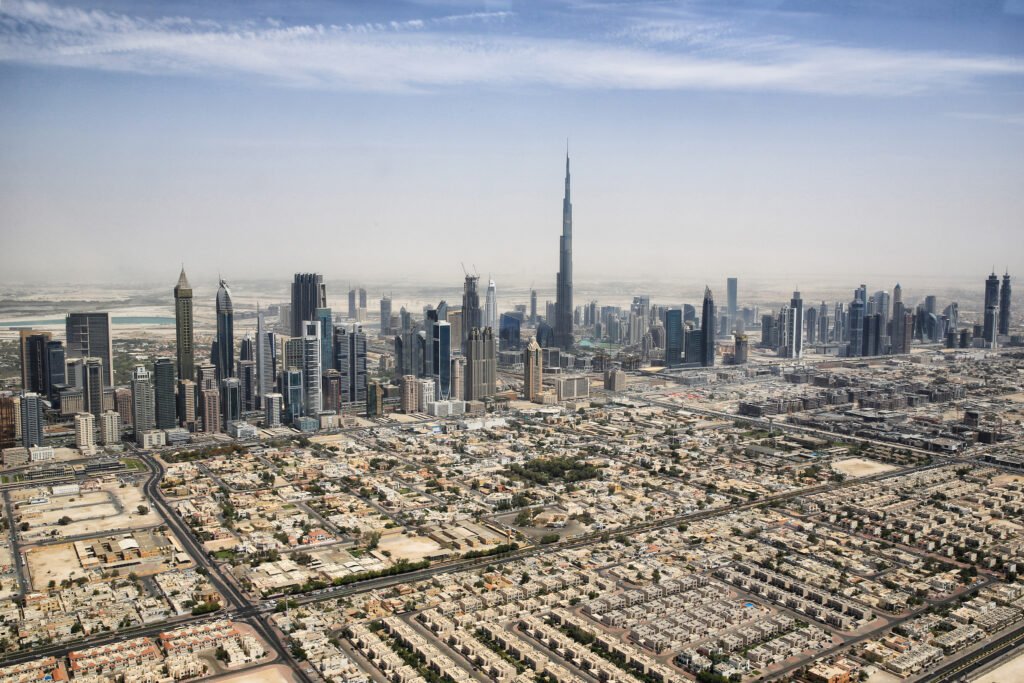
he Dubai skyline. Image by Tim Reckmann, available at Wikimedia Commons under CC license.
The Brothers Liu
China-Arab TV (中阿卫视), or CATV for short, which on its Facebook page calls itself “the first and only Sino-Arabic satellite television channel in the Middle East,” was the brain-child of two brothers. The elder, Liu Haitao (刘海涛), arrived in Dubai in 1993 to explore new business opportunities. For a time his focus was on Chinese restaurants in the city, but before long he had connected with a “shrewd” and like-minded businessman Wang Weisheng (王伟胜), whose interests ranged from real estate to footwear and bedding. On the board of a local Chinese business association, Wang was at the center of a growing Chinese expatriate community in Dubai. In 1999, the year after his arrival, he and Liu Haitao set up “Dubai Chinese Info Online” (迪拜华人信息网), a free listings website to connect Chinese and Arab businesses, which made them “celebrities” in the Dubai Chinese community, according to a later profile.
In 2006, the two men established Alibaba Business TV (阿里巴巴商务卫视), which focused on product sales across the Middle East. The investment made sense given the growing trade relationship between China and the region, even though the two had, by their own admission, a “limited understanding” of the media industry beyond their online listings venture. The company had no relationship with China’s Alibaba Group. By this time also, Liu Haitao’s younger brother, Liu Haijiang (刘海江), had followed him to Dubai.
At this early stage, Chinese state media showed an interest in Liu and Wang’s network only insofar as it could showcase China’s growing economic ties with the UAE. But that changed in 2013, as Xi Jinping outlined in August that year a bold new vision for foreign propaganda work that would urge Chinese media and official entities across the country to join in “telling China’s story well” on the global stage. This was followed closely by the launch of Xi’s massive signature infrastructure development project, the Belt and Road Initiative (BRI).
Both initiatives sharpened China’s focus on partnerships in the Global South, including the Middle East. For Liu Haitao, who now had seven years’ experience operating a TV station in Dubai, this must have seemed a moment of near-perfect alignment between his business interests and China’s international goals.
Right Place, Right Time
On July 20, 2014, less than a month after Xi Jinping’s announcement that China would deepen cooperation with Arab states in oil and gas, infrastructure, trade and investment, and other areas under BRI, the Liu brothers enlisted Sheik Majid, an Emirati royal, to found China-Arab TV. The network was registered under the economic license of Arab Business TV FZ-LLC.
From the outset, they described their network as positioned at the intersection of state and commercial interests. In an interview with Home Voice (鄉音), a Chinese diaspora outlet based in New Zealand, Liu Haijiang stressed that overseas Chinese media like CATV must seek business success by serving the BRI and following Beijing’s latest directives. “The development of overseas Chinese media,” said Liu, “is inseparable from China itself.”
Was there more direct involvement at this early stage from the Chinese government? This is unclear. But a terse post in Chinese to CATV’s website, dated to late 2014 and preserved in online archives, offers a tantalizing clue. According to the post, the network was registered in Dubai “under the support of the Chinese and UAE governments.”
Was there more direct involvement at this early stage from the Chinese government? This is unclear.
Like the Liu brother’s old Alibaba channel, CATV continued to promote products for Chinese enterprises in the Middle East. But by this time it was also clear that the Chinese leadership’s interest in exploring new forms of international communication was offering the network new opportunities.
Within six months of its founding, CATV had signed a strategic partnership agreement with the China International Communication Center (五洲传播中心), or CICC, an organization directly under the Information Office of the State Council, which handles the government’s external communication strategy and overlaps with the Party’s Central Propaganda Department. According to the partnership, the two sides would strengthen cooperation in film and TV production in order to “transmit China’s voice” and “promote China’s image among Arab countries.” This would also mean, according to state media coverage of the deal, advocating for Xi Jinping’s signature Belt and Road Initiative.
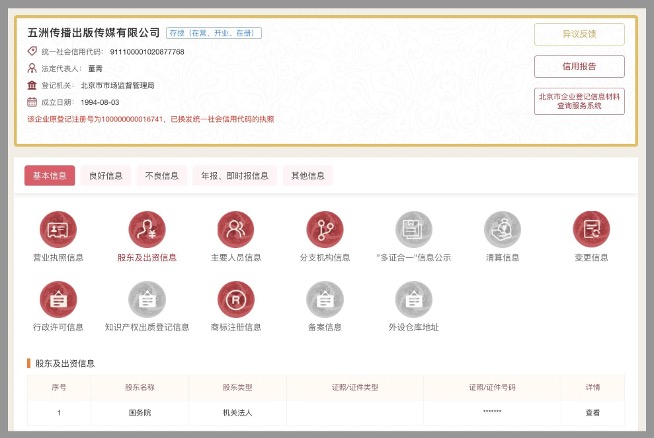
The company listing for CICC (五洲传播出版传媒有限公司) shows that it is fully held by China’s State Council.
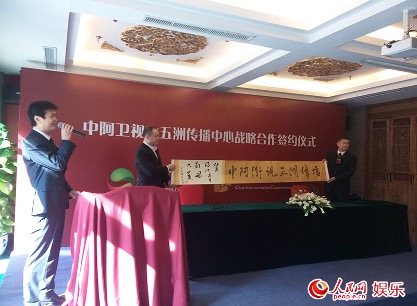
In a report on the deal in the entertainment section of People’s Daily Online, business and patriotic duty seemed to swirl together as company executives offered their felicitations. Jing Shuiqing (井水清), CICC’s vice-president, stressed the diplomatic advantages for the Chinese state — how the deal would work for the “foreign transmission of Chinese culture” and “telling China’s story.” Liu Haitao emphasized the huge trade opportunities opening up between China and Arab countries.
Liu Haitao (right) and Jing Shuiqing (middle) hold up a calligraphy scroll during a ceremony to celebrate a deal between CICC and CATV. Liu Haijiang (left) holds the microphone. SOURCE: People’s Daily Online.
How lucrative was this deal for China-Arab TV? No related information is publicly available. But CICC is one of China’s most globally active official media organizations, with massive state resources at its disposal. Among its longstanding partners is the Discovery Channel, which has globally distributed CICC-backed programming that clearly tows the official line of China’s government on issues like Xinjiang, and has recently drawn scrutiny from members of the US Congress.
Whatever the arrangement, this was just the beginning of CATV’s dealings with powerful CCP-linked media groups that were now under a strong mandate to venture forth and find new ways to reach foreign audiences.
Future collaborations, however, would be spearheaded by new corporate leadership.
Enter Zhang Lijun
In August 2016, Hong Kong’s publicly listed V1 Group — which trades today as Crazy Sports (0082 HK) — made a strategic investment in the Arab television network launched almost exactly two years earlier by the Liu brothers, purchasing more than three-quarters of the company’s shares.
V1, which was named in financial media at the time as a “Beijing-based Internet video producer and mobile-phone lottery company,” sought a partnership, according to a company press release, that would help it pursue a media convergence strategy called “Internet Plus TV,” a name that referenced the “Internet Plus” strategy unveiled the previous year in the government work report from Premier Li Keqiang. Prior to its majority purchase of CATV, the V1 group had placed the State Council’s guiding opinion on “Internet Plus” at the core of its strategic planning, making it “a key business of the Group.” Together, V1 and CATV would advance these goals and create a media platform to “accelerate cultural exchanges and economic and trade cooperation between China and Arab countries,” said the release.
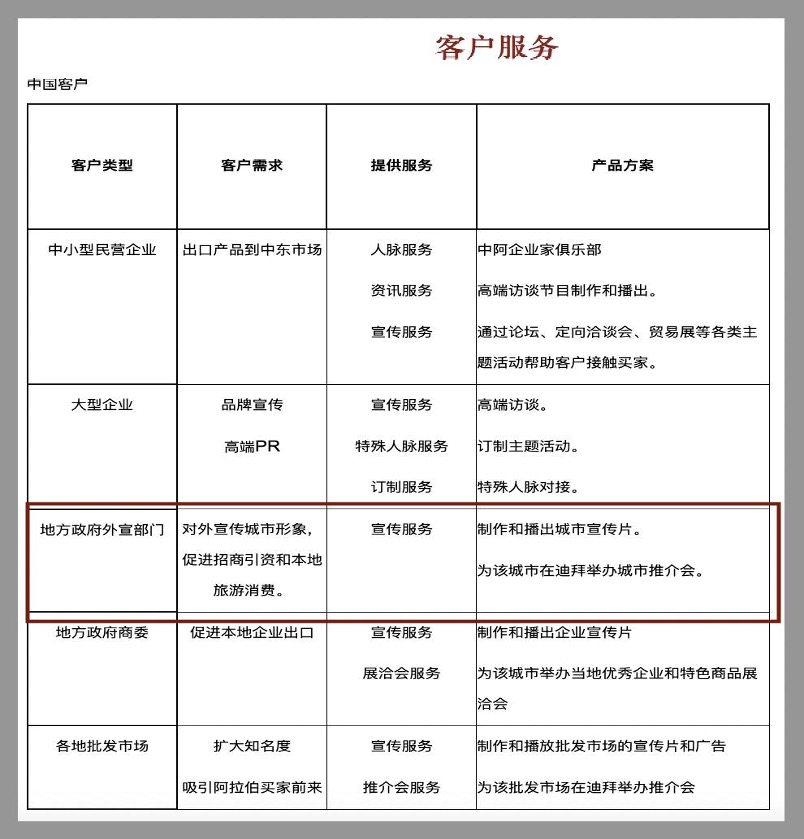
An archived page on the China-Arab TV website listing out client services, including (highlighted) “external propaganda image” services for local government propaganda departments in China.
Within a year of the V1 share purchase, the network was also offering a range of client services to Chinese companies and local governments capitalizing on its position as a media player in the Middle East. For local government propaganda offices in China, for example, its services included “external image publicity,” which involved the production and broadcast of promotional films for cities.
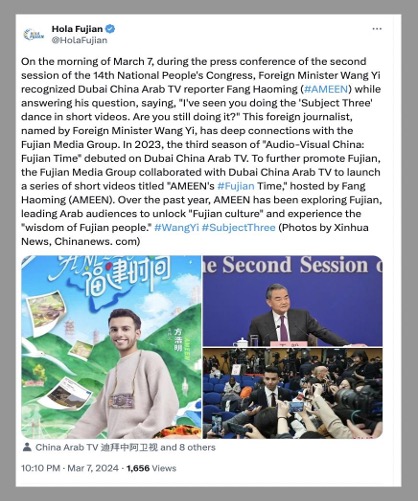
We need not imagine such services in practice. As Al-Obaidi rode the wave of official news coverage after the NPC press conference with Wang Yi in March, “Hola Fujian,” a foreign communication platform operated by the CCP leadership in the province, wrote on its X account that the Arab journalist had “deep connections with the Fujian Media Group,” which had collaborated with China-Arab TV on a series of promotional short videos called “Ameen’s Fujian Time.” Directed at Arab audiences, the series aired in late March on China-Arab TV and was shared across its accounts on Facebook, YouTube and TikTok.
The ambitions of executives at V1 at the time of the purchase in 2016 went beyond such government-backed promotional schemes — and those ambitions were embodied in the person of V1 CEO Zhang Lijun (张力军).
In comparison to the relatively low-profile Liu brothers, Zhang Lijun, who became the new boss at China-Arab TV, was a mover and shaker. He positioned himself as an innovator and business ambassador, a champion of “disruptive innovation.” Among the many hats he wore, Zhang was an honorary chairman of the Bank of Asia (亚洲银行), a cross-border financial services provider based in the British Virgin Islands that serves “high net worth China-based and other Asia-based customers,” and in which V1 Group was an early investor. Another co-founder of the Bank of Asia — which, to be more frank, helps Chinese businesses register in offshore jurisdictions — is Carson Wen (溫嘉旋), a prominent member of Hong Kong’s leading pro-Beijing political party, the Democratic Alliance for the Betterment and Progress of Hong Kong (DAB), and a three-time deputy representative for the city to China’s National People’s Congress.
Public coverage of Zhang Lijun suggests a savvy networker in diplomatic circles as much as business ones. In 2002, he became chairman of the China APEC Development Council (中国APEC发展理事会), an organization ”guided” by the Ministry of Foreign Affairs (MFA) and designated by the ministry in 2004 as “a working organization to promote China’s participation in the APEC development process through a mechanism of combining government, industry and academia.” APEC, or Asia-Pacific Economic Cooperation, is an intergovernmental forum promoting free trade among 21 member economies in the Asia-Pacific.
Within a year of the V1 share purchase, the network was also offering a range of client services to Chinese companies and local governments.
This close MFA connection with the China APEC Development Council is worth bearing in mind given the exchange between Foreign Minister Wang Yi and Ameen Al-Obaidi that began this story. A curious fact of unknown significance is that the APEC Development website directs queries to an address at V1 Group.
Whatever the relationship, Zhang’s APEC title put him right at the center of trade and diplomacy. And this was by no means his only appellation. The V1 CEO was also an advisor to the Overseas Chinese Affairs Office (国务院侨务办公室) of the State Council, the external moniker used by the CCP’s United Front Work Department (UFWD) — which coordinates many of China’s influence operations globally, including within diaspora communities. He was a governing member of the Association for Relations Across the Taiwan Straits (海峡两岸关系协会), or ARATS, an organization directly under the Taiwan Affairs Office of China’s State Council.
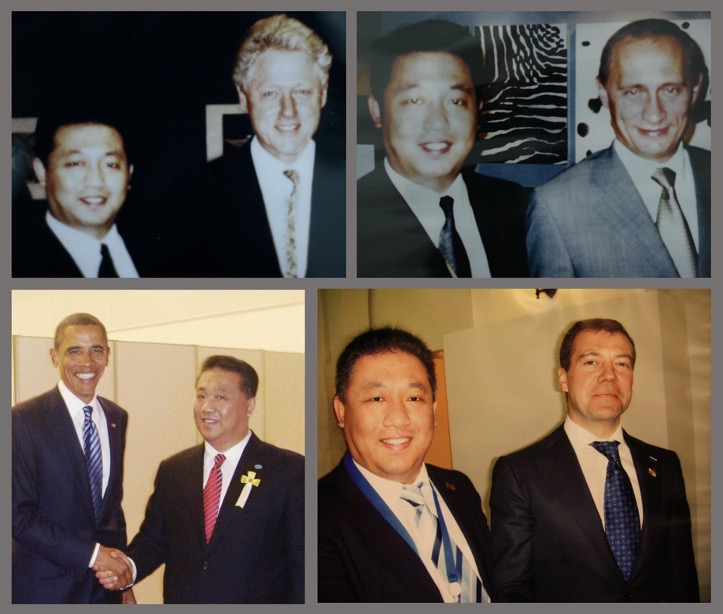
Zhang’s APEC role also placed him in close proximity with global leaders. Over the years, he managed to collect photos of himself with a parade of presidents and premiers, including Russian President Vladimir Putin, and US presidents Bill Clinton and Barack Obama.
V1 CEO and APEC Development Council chairman Zhang Lijun appears with (clockwise from top left) Bill Clinton, Vladimir Putin, Dmitry Medvedev, and Barack Obama.
Like many PRC business executives, Zhang was also adept, when necessary, at code-switching from business talk to the specialized jargon of China’s party-state. At times, the V1 CEO sounded the part of the Party politician.
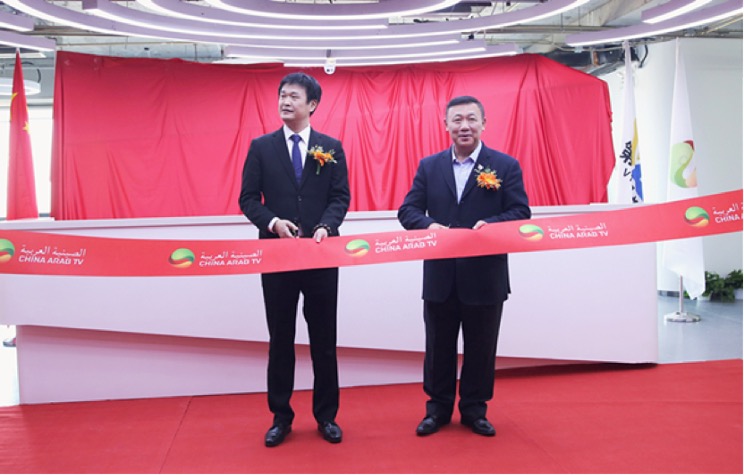
In 2018, for example, two years after the purchase, Zhang laid emphasis not on business or even media as CATV opened a news center in the Chinese capital. The CATV center, he said, was helping China realize its Second Centennial Goal, referring to the building of a “modernized and powerful” country by 2021 — one hundred years, that is, since the founding of the Chinese Communist Party.
Liu Haijiang (left) and Zhang Lijun (right) prepare to cut the ribbon for CATV’s Beijing news center in 2018.
Such mixing of priorities was evident even at the time of the V1 takeover, in ways that might have perplexed investors in the Hong Kong-listed entity.
At the press briefing announcing the acquisition, Zhang said CATV dovetailed with V1’s aspirations to serve as “an important foreign propaganda platform for China.” He painted in the broad strokes of state media and trade policy — with phrases about “implementing [the] media integration strategy” (媒体融合战略), “changing lanes to overtake” competitor nations (换道超车), and, of course, promoting the BRI. Shortly after, echoing Xi Jinping, he said that the main responsibility of media outlets was to “tell China’s story well.”
In China, it is not unusual for politics to go hand-in-hand with profit making. But another knock-on effect of the sale of China-Arab TV to a Hong Kong listed company was that the finances of the network became public. They raise further questions about the motivations behind the purchase.
As the V1 Group took over CATV, the network was already in financial straits, according to early filings under V1. Losses deepened after the takeover, increasing threefold between 2016 and 2017. In August 2016, V1 signed a “service agreement” with one of the brothers, Liu Haijiang, to stay on as director of CATV and deliver a profit by the end of 2018 — or else forfeit his shares. Perhaps the task was too much for Liu, or perhaps the spell of “love at first sight” he reportedly experienced with Zhang had begun to wear off. Whatever the facts behind the scenes, the CATV founder had formally resigned as a CATV director by the end of 2017, with no profit in sight. From that point on, Liu’s role in the network is unclear. He reemerged briefly to attend the opening of CATV’s Beijing news center on January 31, 2018, an occasion curiously anticipated by the setup in Hong Kong of a lone entity called Dubai China Arab TV (迪拜中阿衛視), of which Liu was the only listed director and shareholder through to its folding five years later.
So far as can be ascertained through publicly available documents, CATV remained a consistent loss maker for the V1 Group.
Cozy Connections
Even as the commercial prospects of V1’s China-Arab TV dimmed in public disclosures, its political horizons brightened. In 2018, just two years after the takeover, the network struck an agreement with the recently-formed CCP mega-conglomerate China Media Group (CMG). According to the agreement, CATV would dub and broadcast Chinese television programming in the Middle East.
The China Media Group deal, unveiled in Dubai, was a major diplomatic affair for China and the UAE. The marquis event was attended by Wang Xiaohui (王晓晖), the executive deputy head of the CCP’s Central Propaganda Department as well as senior Chinese diplomats. The official host was the Information Office of the State Council, once again driving home the opaque distinction between the CCP’s powerful media control body and the government office responsible for China’s international communications.
After two years with Zhang Lijun at the helm, CATV remained unprofitable, according to V1 filings. But the network was swimming with the biggest fish in China’s state-controlled media pond. Its partners, according to filings with the Hong Kong Stock Exchange, included the aforementioned CICC; the state-run broadcaster and CMG subsidiary China Central Television (CCTV); the official newswire Xinhua News Agency; the country’s number-two newswire, China News Service, led by the CCP’s United Front Work Department; and local government-run networks like Ningxia TV.
After two years with Zhang Lijun at the helm, CATV remained unprofitable.
CATV was now actively pursuing, as Zhang had explained early on in his involvement, “intensive cooperation with Chinese mainstream media” — this being a buzzword in the Chinese context for CCP-run media meant to lead the public agenda.
Given this positioning of China-Arab TV’s interests, it was simply a matter of business that the network’s agenda should match that of China’s leadership. According to V1’s 2016 Annual Report, one of CATV’s arrangements under its deal with the propaganda department-linked CICC was for production of a documentary supporting China’s claims to contested areas of the South China Sea.
This production work was timely. On July 12, 2016, an arbitral tribunal under the United Nations Convention on the Law of the Sea adjudicated a case brought by the Philippines against China in the South China Sea, and ruled overwhelmingly in favor of the Philippines. The tribunal deemed that key elements of China’s territorial claims in the highly-contested region were illegal, including its land reclamation efforts. China’s Ministry of Foreign Affairs fumed. Within weeks, China-Arab TV, newly in the hands of V1, was working with the CICC to produce a state-backed documentary mirroring China’s foreign policy to its audience in the Middle East.
At this point in the story, China’s strategic interest in the UAE-based broadcaster — evidenced in the line-up of state media partners — should be apparent. Positioned in the Middle East, China-Arab TV could reach audiences in the region at a time when the CCP leadership was doubling down on its efforts to strengthen China’s presence in foreign public opinion. And in fact, this pivot was one of Zhang Lijun’s first orders of business as CATV chairman following the V1 buyout.
According to the V1 Group’s 2018 annual report, Zhang led the strategic decision to focus CATV on Arabic audiences in the Middle East. This was a departure from the channel’s target audience under the Liu brothers, who had prioritized overseas Chinese — particularly those engaged in trade in the region. After 2018, CATV’s languages were Chinese and Arabic, and English was dropped.
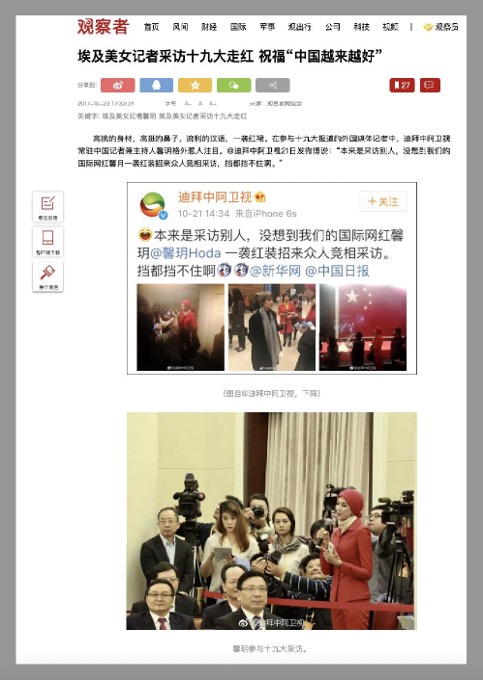
CATV Anchor Hada Alaa is a focus in state media coverage during the 19th CCP Congress in 2017.
Soon, passengers shuttling between China and the Middle East on the national flagship carrier Air China could watch CATV programs, including state-funded content from CICC and the China Media Group, in either Chinese or Arabic. That programming included news dispatches from Ameen Al-Obaidi’s predecessor as celebrity reporter at CATV, the Egyptian anchor Hoda Alaa (馨玥) — referred to with seasonal sexism in China’s state media as the “beautiful Arab female journalist,” and “the spice girl” for her dashing red outfits.
Like Al-Obaidi, Alaa rode waves of publicity in Chinese state media around major political events — including the CCP’s 19th National Congress in 2017, where she too was handed a rare opportunity for a question at the official press conference. Alaa’s presence at this and other events, such as Beijing’s Conference on Dialogue of Asian Civilizations in 2019, was an opportunity for outlets like the government’s own China Daily to demonstrate the friendly and non-confrontational posture expected of journalists for foreign media.
By March of last year, when newly-minted CATV correspondent Al-Obaidi had his first opportunity to question a senior Chinese official — the soon-to-vanish Foreign Minister Qin Gang (秦刚) — the UAE-based network had settled into a rhythm as a friendly foreign outlet with privileged access. For state media, Al-Obaidi was the quintessential “foreign media representative,” stressing in conspicuous CCP jargon the need for international journalists to report “a more multifaceted China.” But more than this, he epitomized the “lovable” (可爱) presentation of China to the world that Xi Jinping had strategically outlined for foreign propaganda during a related session of the CCP’s Politburo in May 2021. What could be cuter than the country’s foreign minister and a foreign reporter sharing a moment about a viral dance routine?
The network’s close collaboration with central state media and provincial government propaganda departments notwithstanding, China-Arab TV’s real connections to China have remained opaque. To what extent was the intimacy between Al-Obaidi and Foreign Minister Wang Yi friendly and sympathetic, and to what extent might it be familial? How, in other words, does this Dubai-based media outlet connect?
The Journey East
The UAE’s discernibly China-friendly China-Arab TV remains in the hands of Zhang Lijun today. But closer scrutiny of the network’s corporate structure is a mystifying journey across geographies. The path zigzags from Dubai to the British Virgin Islands, to Hong Kong — and on to Beijing.
The clearest views of the landscape of China-Arab TV can be found in corporate registration records in Hong Kong, the home of the V1 Group (now Crazy Sports) — and across the border in China.
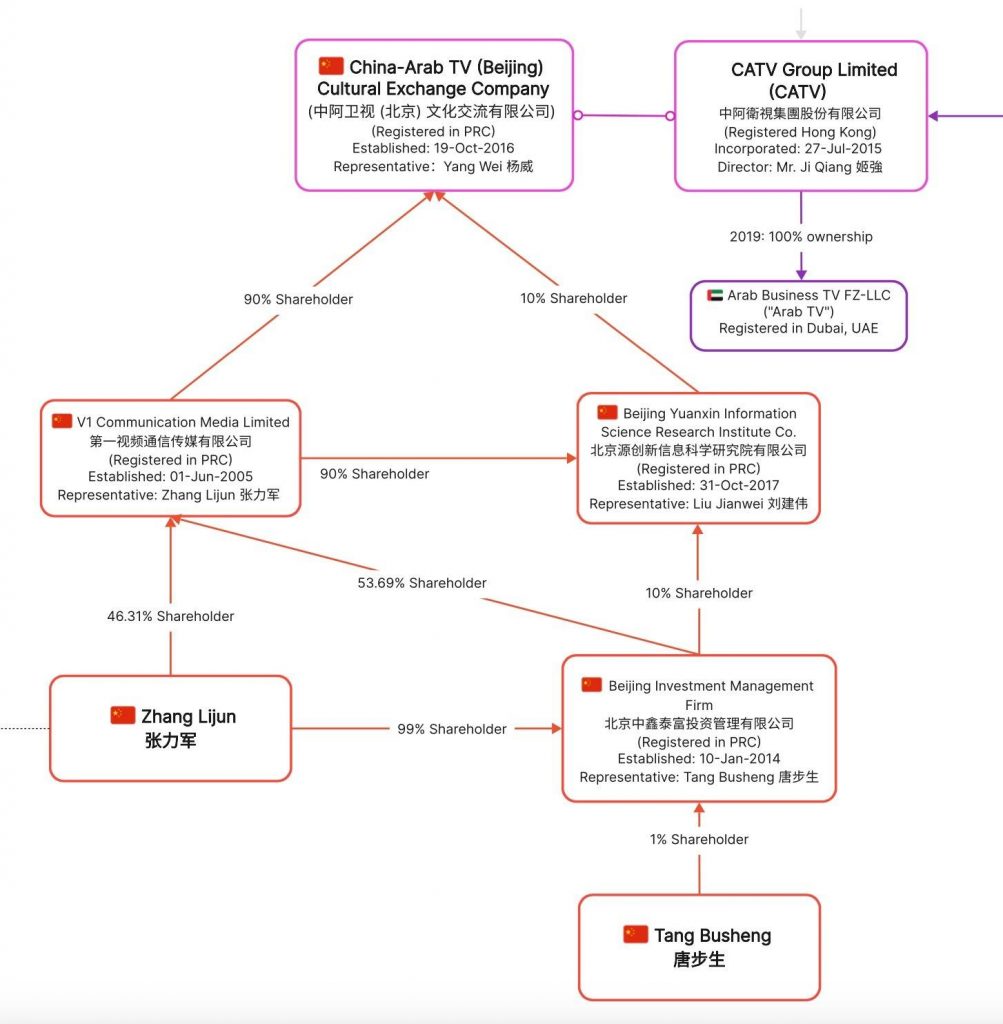
The top left-hand side of our sprawling map of CATV, the two entities at the top (in pink) show CATV registered in two locations, Beijing (China-Arab TV (Beijing) Cultural Exchange Company) and Hong Kong (CATV Group Limited (CATV)). Follow the entities down (in pink) for PRC associated links.
On the Hong Kong side, CATV is registered as CATV Group Limited, a company incorporated in July 2015, one year before the announcement of the V1 takeover. Between 2016 and 2019, the Hong Kong company’s stake in Arab Business TV FZ-LLC, the Dubai-based license holder, ballooned to 100 percent.
Where does the road to China lead?
The first stop on the China side is China-Arab TV (Beijing) Cultural Exchange Company, which is 90 percent held by Beijing-based V1 Communication Media Limited — its representative being the familiar Zhang Lijun. Zhang directly holds just over 46 percent of V1 Communication Media. All other shares are held by a separate company, Beijing Investment Management Limited, in which Zhang Lijun owns 99 percent. Holding the final one percent, giving him a sliver of China-Arab TV (Beijing), is Tang Busheng (唐步生), whose story is at least as colorful as that of his business partner.
The path zigzags from Dubai to the British Virgin Islands, to Hong Kong — and on to Beijing.
Like Zhang Lijun, Tang Busheng is a key figure in the China APEC Development Council, the APEC engagement mechanism “guided” by China’s Ministry of Foreign Affairs (MFA). Zhang is chairman and Tang secretary-general of the group. Also linked to the group — and not at all incidentally — is Yang Wei (杨威), the registered representative of China-Arab TV (Beijing) Cultural Exchange, the first company in the China-side chain. Yang has served as deputy secretary-general of the APEC Development Council, and according to his LinkedIn profile, has been CATV station chief since the departure in 2018 of network co-founder Liu Haijiang. Before that, however, Yang was Section Chief Yang, working as a mid-level official within the CCP’s Central Propaganda Department. Immediately prior to that on his resume is a five-year stint at the State Council Information Office, which, as Chinese foreign policy expert Anne-Marie Brady writes, “oversees the country’s external propaganda, guiding the foreign-propaganda activities of the multiple government offices whose portfolios touch on foreign matters.”
Given the association of all core China-side partners in China-Arab TV with the APEC Development Council, it seems probable the organization plays a crucial intermediary role for its “guiding” institution, the Ministry of Foreign Affairs. That probability increases exponentially when one considers that China-Arab TV’s current station chief formerly worked at the heart of the party-state’s external propaganda apparatus. Remember: the CCP’s Central Propaganda Department and the State Council Information Office, where Yang Wei spent a combined 18 years, are in fact a single office dealing with foreign propaganda, and working, just as Brady has indicated, in close concert with China’s MFA.
But the connections do not stop here.
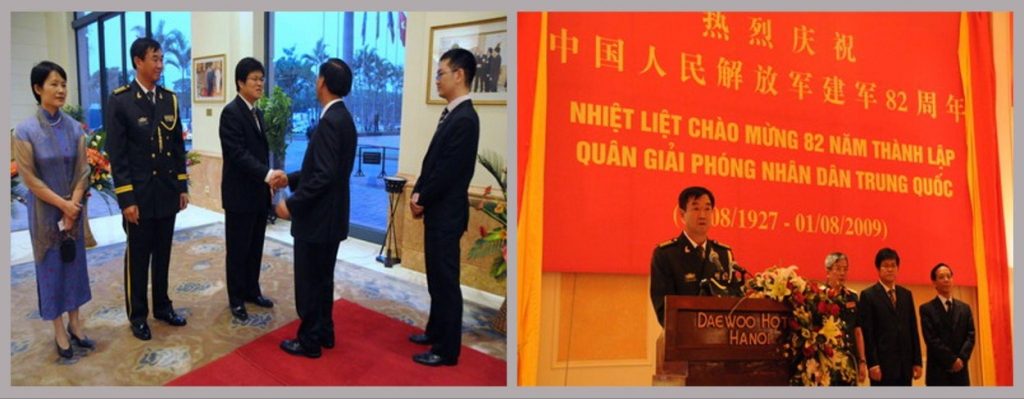
Returning to Tang Busheng — the holder of that sliver of China-Arab TV (Beijing) Cultural Exchange — there are fewer and less frequent details available than for his conspicuous counterpart, Zhang Lijun. Digging deep into online archives, however, it is clear that before he took his more recent soft turn into the world of broadcast media, Tang was involved on the security side of China’s foreign diplomacy. With the rank of major in the People’s Liberation Army (PLA), Tang served more than a decade ago as China’s military attaché for land, air and sea forces at the Chinese Embassy in Vietnam. He is pictured meeting with senior Vietnamese officials in Hanoi in July 2009, and in 2010 played host in Saigon to one of China’s most senior generals, Ma Xiaotian (马晓天), then commander of the PLA Air Force — who famously sparred at the Shangri-La Dialogue that year with US Defense Secretary Robert Gates.
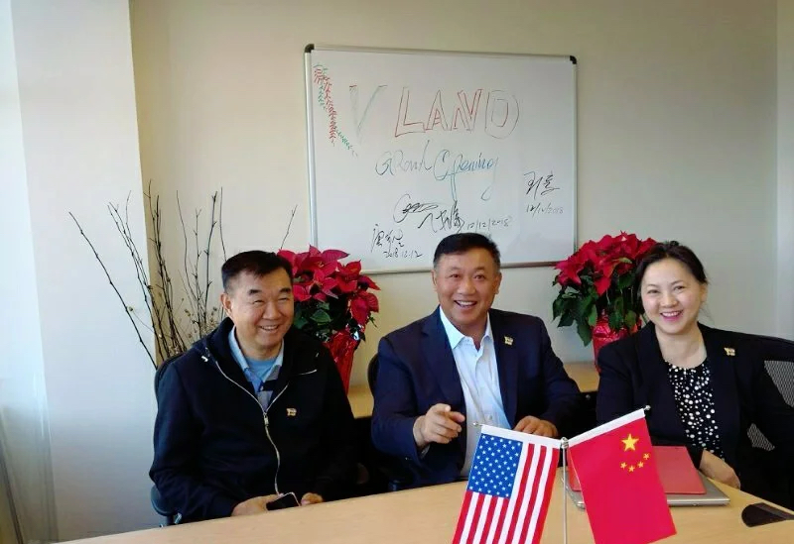
Tang Busheng worked previously in Chinese embassies in the United States, Denmark and the United Kingdom. He was also, according to his China APEC Development Council profile, a United Nations military observer for China to Iraq and Kuwait. More recently, in December 2018, Tang was pictured in his capacity as secretary-general of the China APEC Development Council alongside V1 Group Chairman Zhang Lijun in Silicon Valley, where he attended the formal launch of a V1 branch in the United States called Vland Inc.
Beyond the connections outlined above, both of these men have leaned more than casually into their political allegiance to China’s ruling Party and its propaganda objectives. Just two weeks before their Silicon Valley trip, the two men were together in Beijing for a V1 Group meeting, where Zhang Lijun was introduced as the group’s “Secretary of the CCP Committee.” In his address to the gathering, Zhang stressed the need to study and submit to the media control policies of the CCP leadership, including enforcement of strict “public opinion guidance.” Party-run media, said Zhang, must maintain “a high level of unity with the Party, and only then can [China] respond to international competition and challenges.” Tang Busheng, identified in the report as V1’s “external liaison director,” another title with oddly political cadences for a listed company, echoed these cautions. “It is important that as media we are responsible, adhering to correct public opinion guidance and continuing to transmit positive energy,” he said, “even as we ensure readability, interest and originality.”
Tang Busheng with Zhang Lijun and his wife, and V1’s former-COO, Wang Chun (王淳), as they lay out their plans for expansion into Silicon Valley.
It is not unusual for private company executives operating in the sensitive sector of the media in China to pay lip service to the control priorities of the party-state — and even at times to grovel to signal compliance. However, it is exceptionally odd for the executive of a Hong Kong-listed company with media interests grounded in foreign markets to suggest that his outlets are “Party-run media” (党办媒体), a phrase referring specifically to media directly under the thumb of the party-state.
The link between the V1 Group and the APEC Development Council, with its clear yet inconclusive dotted line to China’s MFA, offers a tantalizing clue to how China-Arab TV might connect. But for all the transparency required of a publicly listed company, the V1 Group is its own enigma, and the financial attractiveness of the group’s investment in the loss-making CATV is difficult to fathom.
The Crazy Sport of CATV Finances
First launched in 1991 as Yanion International Holdings, the V1 Group underwent a series of name changes over two decades before landing on today’s Hong Kong-listed Crazy Sports Group Limited (0082 HK), which identifies itself as “a leading digital sports entertainment community operator and internet sports industry leader in China.” The name “Crazy Sports,” used after 2021, reflected the V1 Group’s pivot toward what Zhang Lijun called at the time “China’s trillion-yuan sports industry.”
Understanding the link today between Crazy Sports and the China-Arab TV that had its lovable exchange with China’s foreign minister back in March takes us to the offshore side of our sprawling map of CATV.
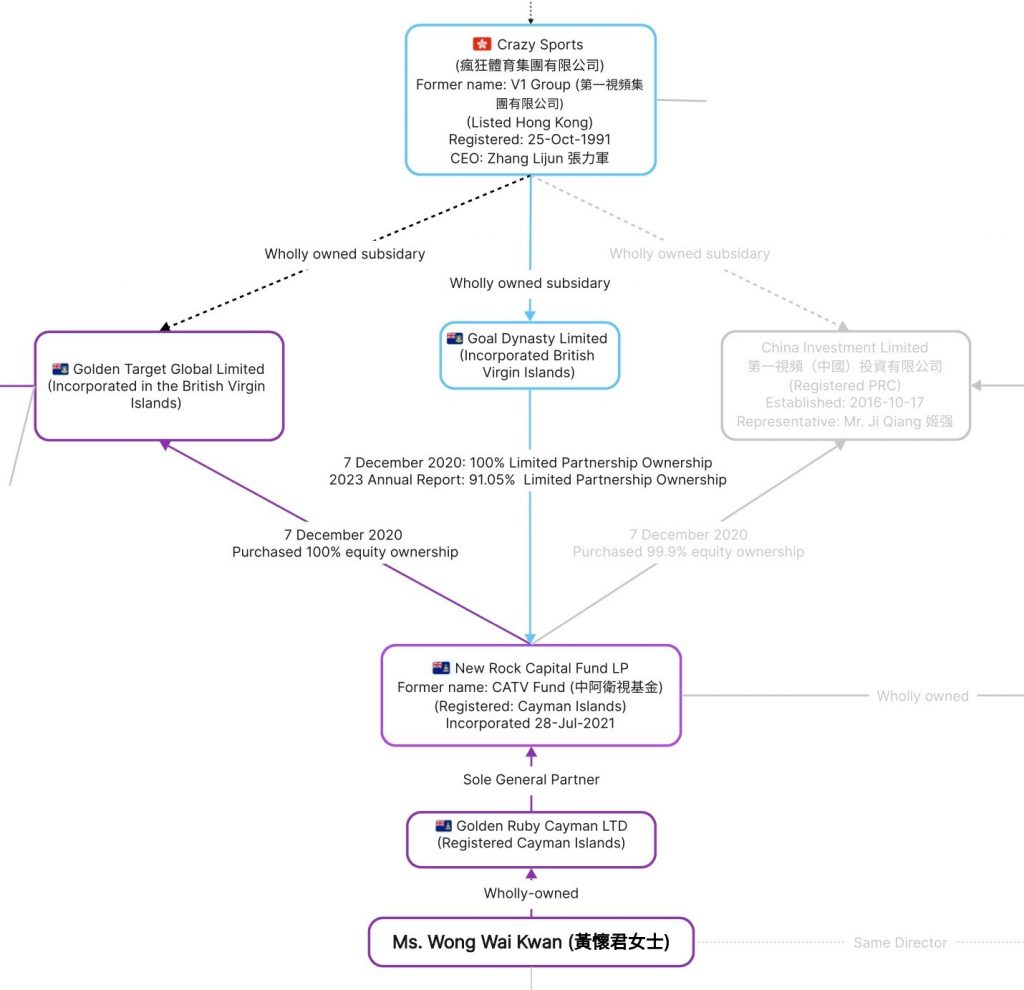
Until the end of 2020, the network’s holding company in Hong Kong, CATV Group Limited, was held by the V1 Group through an investment vehicle in the British Virgin Islands called Golden Target Global Limited, a wholly-owned subsidiary of the V1 Group, according to a Hong Kong filing. In the midst of a restructuring on December 7, 2020, the shares held by Golden Target Global, were sold off to an entity in the Cayman Islands called the CATV Fund (now known as New Rock Capital) for 11.08 million US dollars. In Hong Kong filings, V1 later explained that holding on to CATV had become too “capital intensive.”
And yet, the same day, in a hand-switch move that effectively put CATV finances held by the V1 Group beyond the reach of Hong Kong disclosure requirements, the V1 Group subscribed to the CATV Fund (New Rock Capital) for an identical investment of 11.08 million through Goal Dynasty Limited, another wholly-owned subsidiary in the British Virgin Islands. Despite the language about the “capital intensive” nature of V1 Group’s holdings in China-Arab TV, in other words, the group turned right around and provided a seed investment in the network’s new offshore owner in an amount equivalent to its divestment.
The top right-hand side of our sprawling map of CATV, showing Golden Ruby Cayman, the “general partner” with Crazy Sports operating CATV.
Recent filings by Crazy Sports in Hong Kong are clear about its continued interest and involvement in China-Arab TV, which it holds through a 91.05 percent equity investment in BVI’s Goal Dynasty Limited, making it the majority shareholder in the limited partnership arranged through the December 2020 restructuring. Records released last year lay out Crazy Sports’ continued multi-million dollar investments in the CATV Fund (New Rock Capital), including more than 16 million US dollars in 2022.
The 2020 restructuring did nothing to change Zhang Lijun’s status as the most visible executive at China-Arab TV, and the businessman continues to identify himself as the “Chairman of Dubai’s CATV.” But it did cast a new layer of obscurity over the question of who is behind China’s voice in the Middle East. The entity operating China-Arab TV today, the Cayman-based New Rock Capital (CATV Fund), is a limited partnership, which means that operations — including those of China-Arab TV — are managed by the general partner in return for a management fee and a share in any profit. As public filings make clear, the CATV Fund (New Rock Capital) was created in the restructuring to “achieve long-term capital appreciation” by leveraging the “external network” and “expertise” of the general partner.
So the all-important question: who is the general partner?
CLICK HERE for the full corporate structure of China-Arab TV.
The trail from the CATV Fund (New Rock Capital) leads on through another Cayman-registered entity tantalizingly called Golden Ruby, and thence on to a single name: Ms. Wong Wai Kwan (黃懷君). Public filings by the V1 Group in 2020 claim that Ms. Wong is an expert in running telecommunication and media businesses, which might reassure shareholders in the listed company that their investments are in good hands. Despite Ms. Wong’s vaunted expertise and apparent importance to the ongoing CATV venture, however, she is a complete mystery. She has left no digital footprint, a feat nearly inconceivable for a woman who, according to V1 filings, controls a company that “invested approximately US$200 million in a PRC mobile games company and made a remarkable return on the investment.”
In the end, the trail that began with a television studio in Dubai ends with an unknown quantity. Who is Wong Wai Kwan? And why is this question so important?
To answer this, we must return to the scene of this year’s National People’s Congress and the good-humored exchange between Chinese Foreign Minister Wang Yi and China-Arab TV reporter Ameen Al-Obaidi, which epitomizes China’s politics of media distraction. A moment that should have been an opportunity for serious questions directed to the foreign minister of the world’s second-largest economy, a hugely consequential player on the global stage, became instead a comic setup that spiraled into a state media love fest about Al-Obaidi and the kemusan dance.
At a time when citizens globally need integrity and truth from journalists and media, China’s leadership is not just becoming less open — but is working determinedly behind the scenes to obscure, soften and make “lovable” the entire question of its role in the world. In the case of China-Arab TV, the fact that our determined pursuit of transparency ends only with the baffling Ms. Wong and her Golden Ruby, glistening in the offshore murk, tells us that when it comes to China we might have a much more serious problem than not getting the answers — we may not even know who is asking the questions.










.jpg)