Fu Cha (富察), editor-in-chief of Taiwanese publishing house Gusa Press (八旗文化), was released from a Shanghai prison in May after serving three years for “inciting national secession,” a charge Chinese authorities use against speech, writing, or advocacy seen to contest China’s territorial claims. Fu remains unable to return to Taiwan, however, according to a June 8 report in the Liberty Times (自由時報), because his February 2025 verdict included a one-year supplementary sentence stripping him of political rights, which begins running only after his prison term ends.
Fu Cha, who holds Taiwanese citizenship and is of Manchu descent, was detained in China in March 2023 after traveling there to cancel his household registration. His detention was connected to his work at Gusa Press, which has long published titles challenging the CCP’s official narratives on Tibet, Xinjiang, and Inner Mongolia. The CCP internally flagged over a hundred of the press’s titles as problematic, but used only five as the basis for sentencing, according to a May 11 analysis by Storm Media (風傳媒). His three-year prison term was calculated from the date of his 2023 detention, not his February 2025 sentencing, which is why he was released as early as May this year.
China’s top judicial authorities publicly named Fu Cha in their March 2026 annual reports as an example of punishment for what they called “stubborn Taiwan independence elements” (嚴懲台獨頑固分子), according to Storm Media — a move the publication describes as a cautionary signal to Taiwan’s publishing industry. Under Chinese law, the supplementary sentence allows security authorities to impose exit bans, mandatory check-ins, and communication restrictions for its duration, meaning Fu Cha cannot leave China until at least May 2027.
Since she rose to prominence as the face of China’s #MeToo movement in 2018 after publicly accusing a celebrity television anchor of sexual harassment, Xianzi (弦子) has suffered continued victimization by the state and its vast system of information controls for her efforts to speak out. In the latest effort to silence her, the social media platform Weibo banned her account on May 26, citing unspecified violations of its community guidelines, according to Radio Taipei International.
Xianzi, whose full name is Zhou Xiaoxuan (周曉璿), first came to public attention in 2018 when she accused Zhu Jun (朱軍), a well-known host at state-run China Central Television, of groping and forcibly kissing her while she was an intern there in 2014. A court rejected her case in 2022, citing insufficient evidence. The latest ban is not her first. Her account has been silenced multiple times since 2018, including for a full year following the 2021 court ruling that first dismissed her claims.
Among the slogans Xianzi has posted to Weibo, where she will likely re-emerge if the past is anything we can go by: “Stand tall and straight, and you need not be afraid” (堂堂正正,就不要害怕).
The two books — a memoir by former guerrilla commander Shamsiah Fakeh (珊西雅法姬) and a study of a communist regiment — had circulated for years before the ban. The memoir, first published in 2004 and distributed by Gerakbudaya (文运书坊), had gone through three reprints. The ministry warned that ideas once confined to limited, closed circles are now being “normalized and beautified,” a trend it said clearly runs counter to national security interests. Gerakbudaya, an independent Kuala Lumpur bookstore that received notice of the ban, has vowed to mount a legal challenge.
PEN Malaysia (多语作家协会), the local chapter of the international writers’ rights group, condemned the move as a severe setback for freedom of thought and democratic dialogue. According to a statement quoted inMalaysiakini, the group said the books were “not weapons, but repositories of research, debate, and critical thinking.” The ministry stressed, according toKwong Wah, that it would not tolerate any behavior that spreads, promotes, or revives ideologies that violate the law.
Last Friday, InMedia (獨立媒體), one of Hong Kong’s few remaining independent news outlets, published an unusual apology to readers through its newsletter. The outlet said that its normal operations had been disrupted in recent days by “harassing messages” (滋擾訊息) as it sought to cover hearings looking into the deadly fire at the Wang Fuk Court residential buildings in November last year that killed 168 people. InMedia said in its message that it had filed police reports in two specific cases of harassment by “unidentified persons” (不明人士).
On Tuesday, online commentator Fung Hei-kin (馮睑乾), a former columnist for Hong Kong’s Apple Daily, noted in a Facebook post that not one mainstream Hong Kong outlet had covered the InMedia story in the four days since the outlet’s disclosure. In fact, the only outlet to cover the news at all, said Fung, had beenEpoch Times, the right-wing American media outlet backed by the Falun Gong religious group — a brief report that added no new information. Fung likened the silence over the InMedia case to that which followed revelations by the independent Hong Kong Journalists Association (HKJA) in September 2024 that reporters from thirteen news organizations had been harassed or threatened in the preceding few months. The chilling effect on the press could clearly be inferred from the silence, said Fung. “The more you think about it,” he wrote, “the more chilling it becomes.”
Sometimes “streamlining” is just another name for deep and painful attrition. Over the past two years, this and other euphemisms — like “optimization” and “transformation” — have swept like a wildfire across China’s local broadcast sector. Taken together, they tell a simple story about the rapid contraction of local television and radio under a barrage of cost-cutting directives from the central government. The goal is two-fold: cutting costs, and shifting resources toward newer forms of digital production — part of a broader rebuilding of China’s media infrastructure that the China Media Project has called “Centralization+.”
Announcing the closure of two of its local channels this month, the top state-run broadcasting group in the municipality of Chongqing spoke of “optimizing and integrating media resources” and “adapting to new trends in media convergence.” In practice, this meant shutting down channels the government considers redundant and shifting resources — money, staff, and content — away from traditional broadcast and onto the internet and digital products. The announcement, released by China’s main broadcasting authority, SARFT, makes clear that Chongqing is following directives from the government and national work conferences. This isn’t a local editorial choice but a centrally directed plan.
Chongqing is not an isolated case. It is part of a nationwide wave of broadcast closures that has been accelerating since 2023, when SARFT launched its campaign to “streamline and specialize” China’s radio and television landscape. According to the Chinese industry tracker website Shexiangren Wang (摄像人网), at least 51 TV channels were shut down across China in 2024, and in 2025 that number jumped to at least 75, hitting provincial-level broadcasters in Shanghai, Gansu, Shaanxi, Jiangxi, Xinjiang, and Hunan, among others. Guiyang, the capital of Guizhou province, became the first provincial capital in the country to be reduced to a single television channel in 2025. A separate report from SARFT’s research center confirmed that 79 channels and frequencies were formally eliminated in 2024.
Part of the story is how uncompetitive local channels have become, owing both to technological change and to institutional inertia: CCP-run media tend to be inflexible and formulaic, shaped by the bureaucratic structures that govern them. Shexiangren Wang notes that education channels offered little beyond policy meetings. TV shopping, with its long-duration pitches and infrequent purchases, could not match the speed and scale of e-commerce — what Shexiangren Wang called the “short, fast, and flat” model of online retail. Movie and drama channels, meanwhile, were stuck with aging content and shrinking advertising revenue. The closures have targeted public channels, education channels, shopping channels, and movie and drama channels — categories the government considers redundant or uncompetitive with internet platforms, all outpaced by digital offerings delivering the same content faster and on demand.
The campaign of attrition at local broadcasters does not seem to be slowing down. The Shexiangren Wang report indicates that Guangdong, Sichuan, and Shenzhen are all expected to close or merge additional channels in 2026. The broader pattern is clear: the government is shrinking traditional broadcast — meaning fewer channels and fewer editorial voices — while redirecting money, talent, and content toward digital offerings.
Local Television Channel Closures in 2025
Over the past year, at least 75 channels shut down across 57 cities, as Beijing pushes to consolidate the country’s sprawling state media system and cut costs at the local level.
Rather than a simple retreat from broadcast, the closures reflect a deliberate reorientation. The Chongqing announcement calls on the group to “fortify the main position of internet communication” (筑牢互联网传播主阵地) — language drawn from a broader Party framework that treats media platforms as ideological territory to be held and defended. It also calls for “systematically transforming mainstream media” (推进主流媒体系统性变革) — a phrase that carries specific weight in the Chinese context, where “mainstream media” refers to Party-run outlets tasked with setting the public agenda and shaping opinion.
The imperative is to remake those outlets into something citizens will actually use. That is a hard sell in a media landscape dominated by platforms like Bilibili, a video site built on user-generated entertainment, and Xiaohongshu, known outside China as RedNote, a lifestyle and social commerce platform where hundreds of millions of users go for content that is personal, playful, and not entirely oriented around the ideological goals of the party-state. A 2025 People’s Daily article used the same language to describe Party media’s role as the frontline of ideological control, calling on state outlets to “advance onto the internet main battlefield” (挺进互联网主战场) as a “main force” (主力军).
Rather than a simple retreat from broadcast, the closures reflect a deliberate reorientation.
While real success in the media market will likely remain a challenge, the authorities seem encouraged by the numbers for new state-led digital offerings. Provincial state media app downloads grew by an average of nearly 35 percent in 2024 — 34.9 percent in downloads and 45.2 percent in registered users — according to SARFT’s research center’s annual report. Platforms like Mango TV (芒果TV), a video streaming platform under the state-run Hunan Broadcasting System; Elephant News (大象新闻), an app-based news product from Henan’s provincial broadcaster; and Touch News (触电新闻), the digital product from Guangdong’s provincial broadcaster, each crossed 100 million downloads, with 28 provincial apps surpassing 10 million.
The closures and the digital push are, in the end, two sides of the same coin: a leaner broadcast sector that costs less to maintain, and a rebuilt online presence the Party hopes will keep it not just relevant, but dominant, where the public’s attention has shifted.
One issue conspicuously absent from the official framing of these closures is what happens to the people who worked there. The announcements speak of “optimizing resources,” but say nothing about how employees at Chongqing Economic Radio or the Fashion Shopping Channel — the outlets impacted by the most recent restructuring in Chongqing — might have been affected. Precise figures on job losses across the sector are difficult to come by. Official announcements are silent on the question, and broadcasters do not typically publish staff counts. The data that does exist points in one direction. Beijing’s broadcast sector alone shed more than 2,600 jobs in 2024, according to an annual statistical report from its city-level broadcast authority. The nationwide toll, across more than 125 channels closed in 2024 and 2025, is almost certainly substantial.
_________________________
To learn more about the trend of local “media convergence” in China and the remaking of the infrastructure of “international communication” (国际传播), or “external propaganda” (外宣), download our CENTRALIZATION+ paper below, produced with funding from the Swedish Psychological Defense Agency (MPF).
On November 7, 2025, Chinese-language media in Malaysia reported that radio station CITY+ will likely cease broadcasting by the end of this month, after eight years on the air. Difficulties for the station come amid a shrinking market for Chinese-language radio in the country.
Launched by Malay media veterans Rita Sim, Rose Ismail, and Fui K Soong, the station officially launched in May 2017, under the tagline “Connecting You To The World,” providing entrepreneurial insights, market analysis, and cultural content designed for the Chinese-speaking community in Malaysia.
Several flagship programs have already aired their final episodes. “Hearing Jazz” (听爵享受) concluded on October 31, while “Editor’s Take on News” (主编点新闻) host Lum Chih Feng (蓝志锋) aired his last episode on November 7, 2025. In a lengthy Facebook farewell message, Lum attributed the closure to market forces rather than political pressure. “This is a business decision,” he said. “The brutal market supply and demand dynamics have determined the direction of programming. It has nothing to do with politics.”
Lum noted that traditional Chinese-language radio is facing declining listenership as audiences shift to digital platforms and seek more diverse content. Over the past eight years, his program covered two general elections, five prime ministers, and significant political scandals, including the 1MDB corruption case.
The station’s parent company, Ooga X Sdn Bhd, has yet to officially confirm the closure or announce restructuring plans.
“Basketball is a bridge that connects us.” That was the headline of a commentary published in the Chinese Communist Party’s People’s Daily newspaper earlier this month, with a soaring byline from none other than LeBron James, the LA Lakers star who is the NBA’s all-time leading scorer. “I’ve been deeply moved by the enthusiasm and friendliness of my Chinese friends,” the commentary began, with a typical CCP frame of people-to-people friendship. “What I can do in return is give my all in every game as a way to show my gratitude to everyone.” For a generally insipid Party-run mouthpiece, such a celebrity endorsement was too good to be true — and of course it was. Representatives for LeBron James quickly disavowed the story. The star, they said, had only ever conducted interviews with Chinese media.
What does this tell us? The flagship newspaper of the CCP feels it is perfectly acceptable to fake a commentary by one of the world’s most recognizable public figures if it suits the agenda, in this case talking up “friendship” and people-to-people exchange.
It should not surprise readers that this is not an isolated case. In 2016, after a commentary with a byline from a journalism professor in the New York state university system appeared in the paper decrying the falsehood of Western freedom of speech, CMP reached out to the professor in question. In an e-mail exchange, the shocked professor said she had only spoken on the phone with a People’s Daily reporter and raised issues of journalism ethics more generally. Sound familiar?
At the People’s Daily, politics always trump professionalism. In order to have his official press card re-issued back in January, the staff member behind the LeBron James commentary, sports reporter Wang Liang (王亮) would almost certainly have taken refresher courses on the Marxist View of Journalism and fealty to the Party. The most basic ethics and good practice? Not so important. The People’s Daily has issued no public correction on the LeBron James commentary. Don’t bother waiting for the buzzer.
Hong Kong’s highest court has rejected a final appeal by the city’s communications regulator, ending a five-year legal battle over a satirical television program that mocked police during the coronavirus pandemic — just months before the national security law was enacted in the Special Administrative Region.
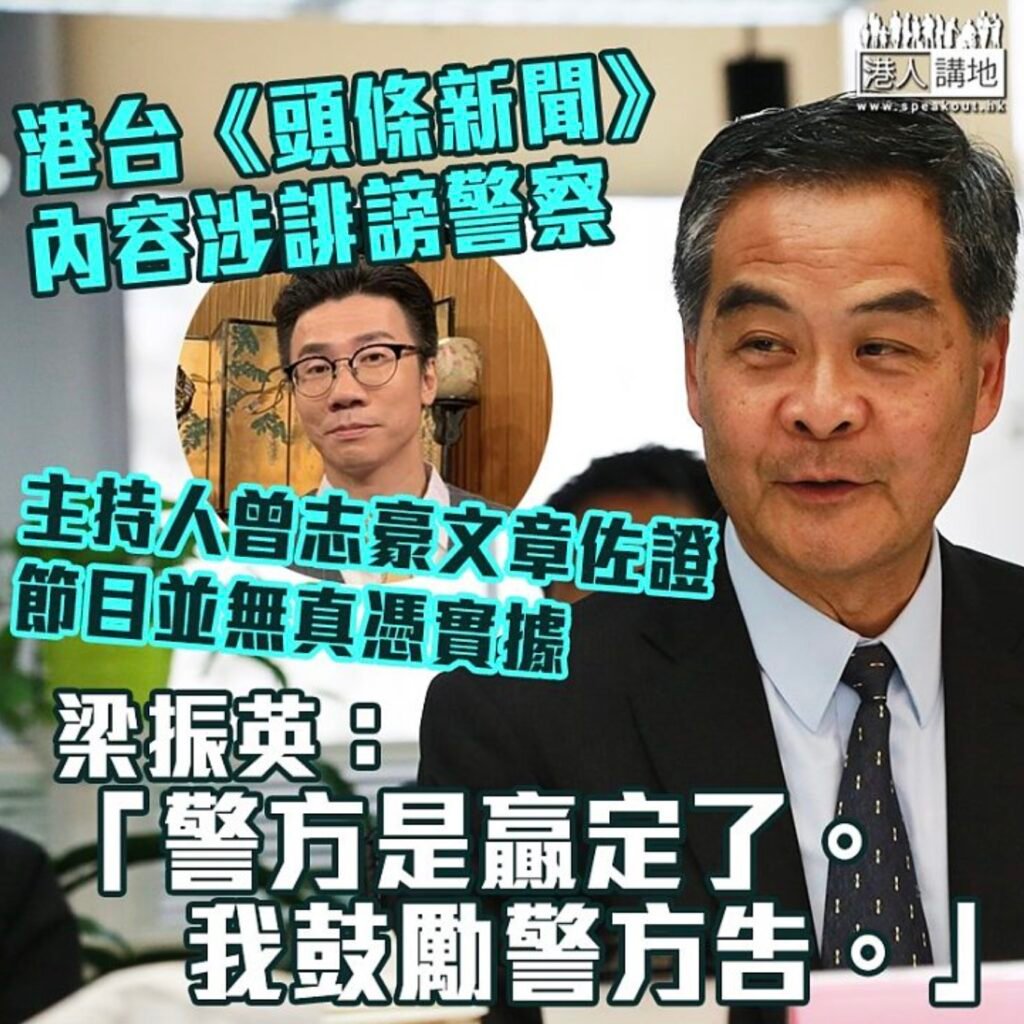
The Communications Authority had issued warnings to the public broadcaster Radio Television Hong Kong in February 2020 over an episode of the program “Headliner” (頭條新聞), which it claimed had derided the Hong Kong police force. Segments of the program made jokes about police officers hoarding masks, and in another skit an actor played a police officer emerging from a garbage bin.
Some critics at the time, including former Hong Kong Chief Executive Leung Chun-ying (梁振英), claimed that the program had libeled the department, and called on police to sue the network.
Shortly after the warning came from the Communications Authority, the staff union at RTHK joined hands with the independent Hong Kong Journalists Association (HKJA) to challenge the decision through judicial review — a process by which the High Court’s Court of First Instance reviews actions taken by administrative bodies to ensure they act within the bounds of the law.
The Court of First Instance initially ruled in 2021 that some complaints were valid while others were not, prompting both sides to appeal. The Court of Appeal later sided with the journalists’ union and association, ordering all warnings to be rescinded.
The Court of Final Appeal’s Appeals Committee ruled on August 7 that the authority had shown no reasonable grounds for appeal, upholding lower court decisions that overturned the warnings. According to a report from InMedia, the court emphasized that regulators must distinguish between content targeting individuals’ or groups’ “status” versus their “behavior,” with the satirical program found to be criticizing police conduct rather than their professional standing. HKJA has called on the Communications Authority to publicly rescind its original ruling and acknowledge publicly that it was wrong.
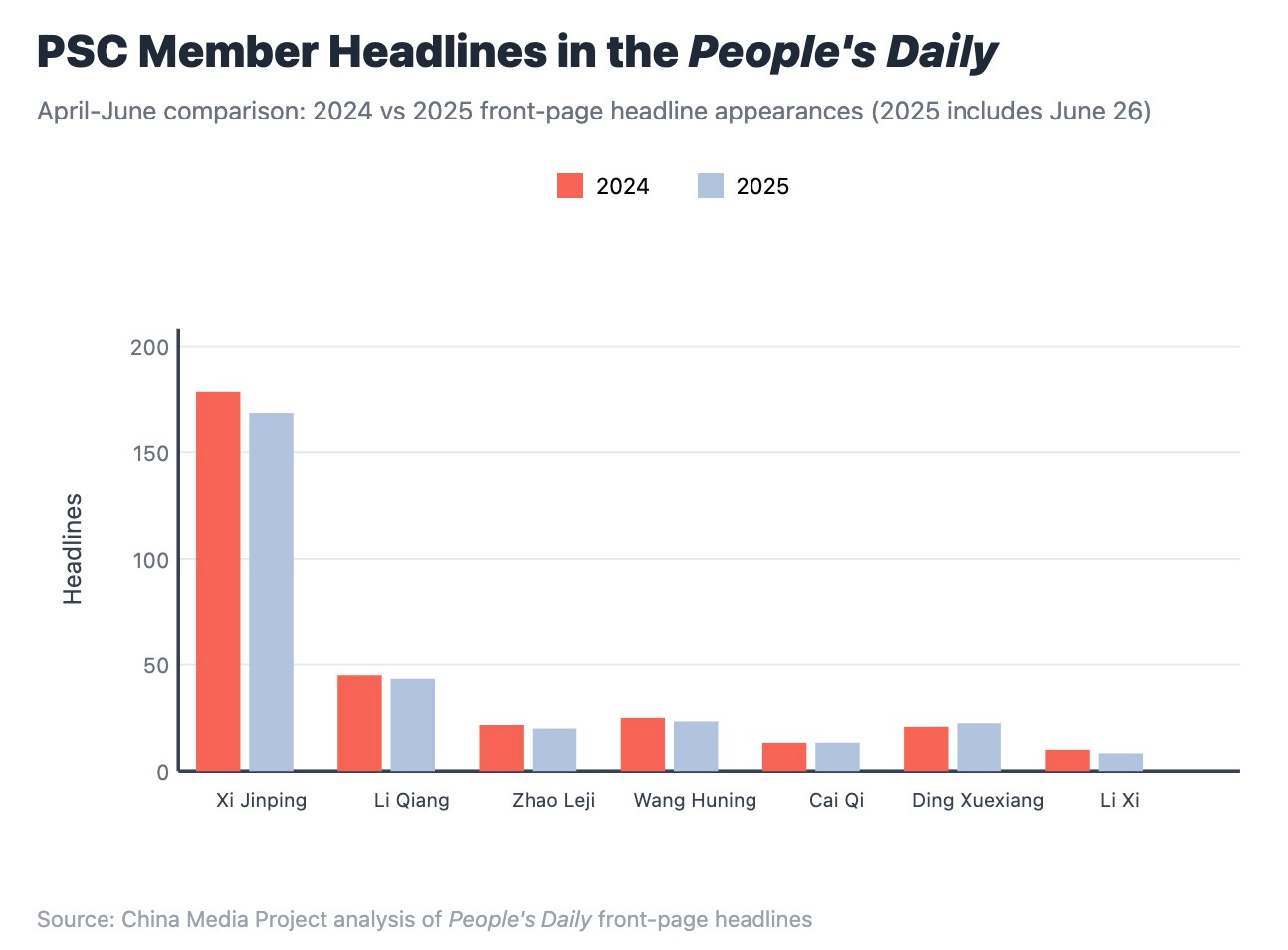
Speculation about Xi Jinping’s waning influence intensified late last month following news of his planned absence from this week’s BRICS summit in Rio, on top of reports suggesting his presence in China’s state-run media has declined. Willy Wo-Lap Lam at the Jamestown Foundation’s China Brief noted that “citations of Xi’s name have become thinner and thinner in authoritative official media,” raising questions about potential leadership changes as China approaches its next Party congress.
However, our analysis of front-page headlines in the Party’s official People’s Daily challenges this narrative. Comparing the second quarters of 2024 and 2025, we found that Xi appeared in headlines 177 times versus 157 times respectively — a modest decline likely explained by incomplete June 2025 data. More significantly, Premier Li Qiang, Xi’s closest competitor, showed virtually no change with 45 appearances in 2024 and 43 in 2025.
While these headline counts cannot capture insider dynamics or leadership effectiveness, they hardly suggest a power shift in the Party’s most important publication. Xi’s dominance in China’s authoritative media remains intact — contradicting speculation about his declining grip on power. The data suggests China’s most powerful leader in generations continues to command overwhelming media attention. Read more on this at the China Media Project website.