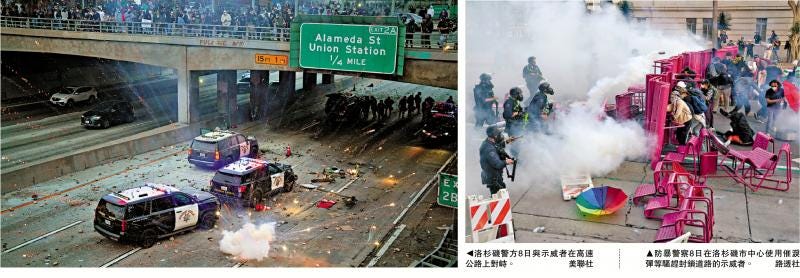
Donald Trump’s use of the National Guard and US Marines to quell protests in Los Angeles against his immigration policies became a major story across Chinese media last week. Op-eds filled with images of turbulence interpreted the news as pointing toward imminent “civil war,” words used in several reports. Pursuing their long-term goal of discrediting the US political system, Chinese state media are now pushing at a door the Trump administration has opened wide.
Scenes of aggressive police action in LA are reported by Hong Kong’s government-run Ta Kung Pao.
China’s state-run Xinhua News Agency reported that its journalists had been injured while covering the protests. The article purported to deliver the will of the protesters, quoting them as saying they were “hard-working local community residents who wanted to express their opinions peacefully.” The report reached second-place on the Baidu search engine’s list of hottest news topics on June 9. The same day, another trending post from a prominent self-media account predicted that the events in California were a “prelude” to deeper conflict. “America’s ‘civil war’ has begun” (美国”内战”开始了), the author declared, calling the unrest “the first large-scale street conflict of the Trump 2.0 era” and comparing downtown Los Angeles to “a Middle Eastern war zone.” The post received close to 1.6 million reads.
In Hong Kong, media similarly mirrored these narratives of American decline. The online news outlet HK01 and state-backed newspaper Ta Kung Pao (大公报) both framed the conflict as a consequence of long-term social divides within the US, with HK01 warning that without resolution, America would “eventually fall into the abyss.”
For more on Chinese media portrayals of protests in the United States, and our perspective at CMP on how Trump administration actions have been a huge assist for China’s external propaganda efforts, read “A Trump Card for China’s Media.”
Elephant News (大象新聞), a platform operated by Henan Broadcasting System, has collaborated with anti-human trafficking activist Shangguan Zhengyi (上官正義) to expose an illegal surrogacy lab in Changsha, Hunan province.
Their undercover investigation revealed a makeshift facility equipped with wards, operating theaters and a laboratory. Among the nine women found at the site was a 41-year-old deaf-mute woman from Shanxi province who communicated via sign language that she had received 280,000 yuan ($38,600) for serving as a surrogate mother. The circumstances suggest possible coercion, as she indicated being brought to the facility by “outside people” (外面的人) and seemed uncertain how long she had been there. Reporters documented vehicles delivering more than 17 women to the facility over two days.
Elephant News has reported the case to authorities, and related hashtags including “Underground surrogacy handlers show strong counter-surveillance awareness,” have trended on Weibo.
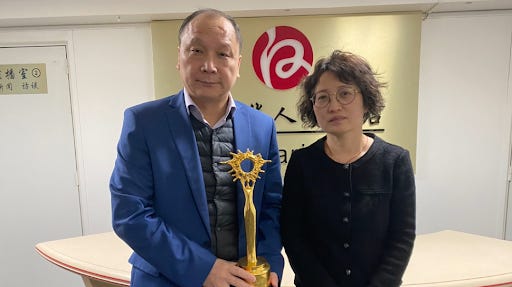
Founded in 2015 by Chen Shiming (陳世明), a restaurant owner turned media entrepreneur, France-based Mandarin TV (歐視TV) — rebranded in 2021 from “French Chinese TV” (法國華人衛視) — makes little effort to disguise its ambition to serve the agenda of the Chinese state. The outlet describes its mission as “spreading China’s voice, telling China’s story well” (傳播中國聲音,講好中國故事) — language that mirrors the goal for external propaganda set out by Xi Jinping in August 2013, less than two years before Chen’s media outfit set up shop in Paris’s 8th Arrondissement.
In interviews with Chinese media, Chen has said he hopes his station can counteract what he says are deeply biased views toward China in France, his home for the past four decades. “I want to show the real China to the French,” he told the Yueqing Daily (樂清日報), a county-level CCP-run newspaper in coastal Zhejiang province. The real China for Chen is apparently reflected by the country’s strictly controlled state-run media. As Chen himself acknowledged in a 2021 interview, the channel openly collaborates with central CCP media like China Central Television (中央電視臺) and China Radio International (中國國際廣播電臺), both under the China Media Group conglomerate directed by the CCP’s Central Propaganda Department. The channel has also cooperated with regional state broadcasters like Wenzhou TV (溫州電視臺).
Founded by through Chen’s C-MEDIA Group (歐洲中誼文化傳媒集團), and claiming to be the only Chinese-language television station authorized by France’s media regulator Arcom, the station broadcasts 24-hour content, almost entirely from its Chinese state partners. The same state content, including from CCTV and Xinhua News Agency, fills its YouTube channel.
Mandarin TV founder Chen Shiming (left). SOURCE: Mandarin TV.
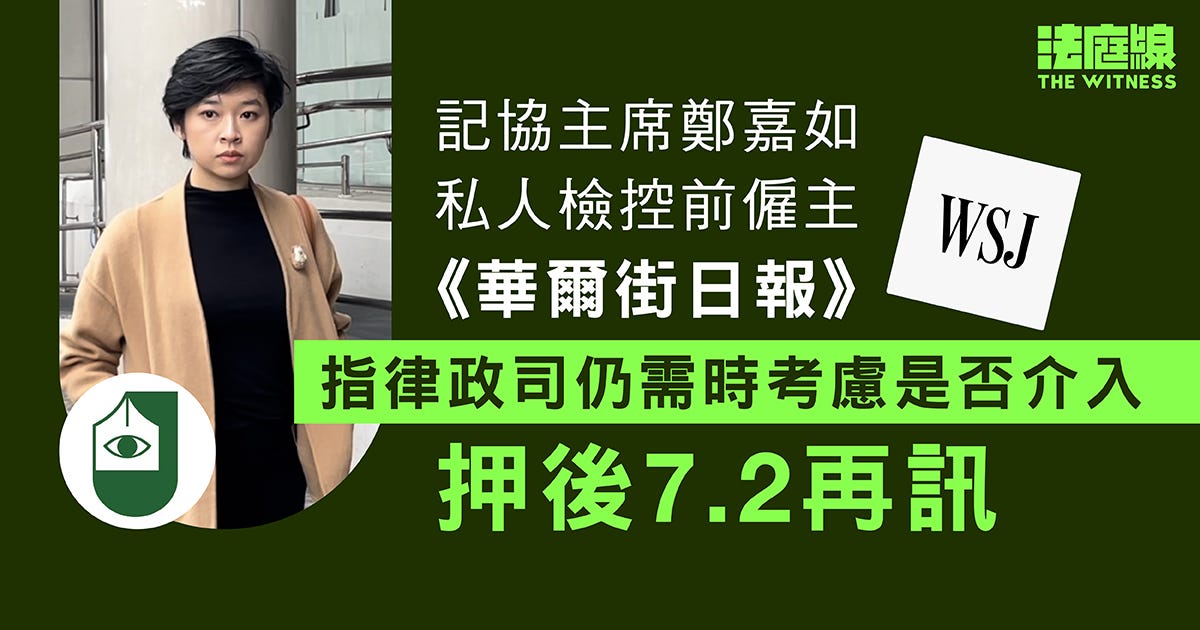
Hong Kong journalist Selina Cheng (鄭嘉如), the chairperson of the Hong Kong Journalists Association (HKJA) who contends that she was illegally dismissed in July last year by the Wall Street Journal after her election to her HKJA position, appeared in Eastern Magistrates’ Court Tuesday through legal representatives in her private prosecution against her former employer. According to the court reporting outletThe Witness (法庭線), Cheng’s case involves two charges claiming her employer demanded she withdraw from the HKJA election and later terminated her employment for holding the position. Barrister Ma Ah-shan (馬亞山) represented Cheng in the proceedings, which were adjourned until July 2 by Principal Magistrate So Man-lung (蘇文隆). Hong Kong’s Department of Justice reportedly has requested additional time to consider intervention in the case — possibly considering its unwanted visibility on the question of deteriorating press freedoms in Hong Kong.
Report on the Selina Cheng case. SOURCE: The Witness.
Foreigners aren’t the only ones in Xi’s China who are at risk of spying accusations. At the annual shareholders meeting of Gree Electric Appliances Ltd, an electronics conglomerate based in Guangdong, CEO Dong Mingzhu (董明珠) said the company “absolutely does not use overseas returning students” (海归派) because of the risk some have been turned into spies. “I have to choose conservatively,” said Dong.
The CEO is known for stirring up controversy, and this time was no exception. Her words racked up hundreds of millions of views on Chinese social media, with some netizens praising Dong and others mocking her, wondering what spies would find among the company’s stock of air conditioners.
Youth unemployment is a frustrating topic in Chinese society, with many young people investing a great deal of personal wealth studying abroad in the hope this will improve their chances on the job ladder. Major central state news outlets like Xinhua and CCTV have not run the story. Indeed, in the past the latter celebrated Dong’s reputation for controversy as an asset. But the story has appeared in newspapers under the state-owned Shanghai United Media Group, including The Paper and the Xinmin Evening News. The latter called Dong’s remarks “absurd” and potentially damaging to the prospects of returning students.
On social media, the prominent Weibo user “Liu Ji Shou” (留几手) declared, “In light of Ms. Dong Mingzhu’s public discrimination against overseas returnees seeking employment, I announce that until Ms. Dong publicly apologizes and retracts her statement, my family will refuse to purchase any Gree products. We mean what we say!”
Taiwan’s extensive network of 13,000 convenience stores has emerged as a surprising element in the country’s emergency planning against Chinese aggression, following reporting in The Guardian that revealed plans from a cabinet-level committee to transform these ubiquitous retail outlets into wartime community hubs. “We must prepare for the worst scenario,” one defense official told the British newspaper. Block Tempo (動區動趨), an online blockchain-based outlet, details how these ubiquitous retailers could distribute emergency rations and medical supplies, and provide Wi-Fi hotspots during a conflict. The pro-China leaning China Times (中國時報) reports that the stores would serve as community support centers where citizens could receive rationed supplies when transportation systems are compromised through the retailers’ own logistics networks. Taiwan’s Central News Agency (中央通訊社) notes that this idea is among numerous scenarios being considered by President Lai Ching-te’s 27-member team, which comprises senior cabinet members, national security ministers, NGO representatives, and figures from the business and religious communities.
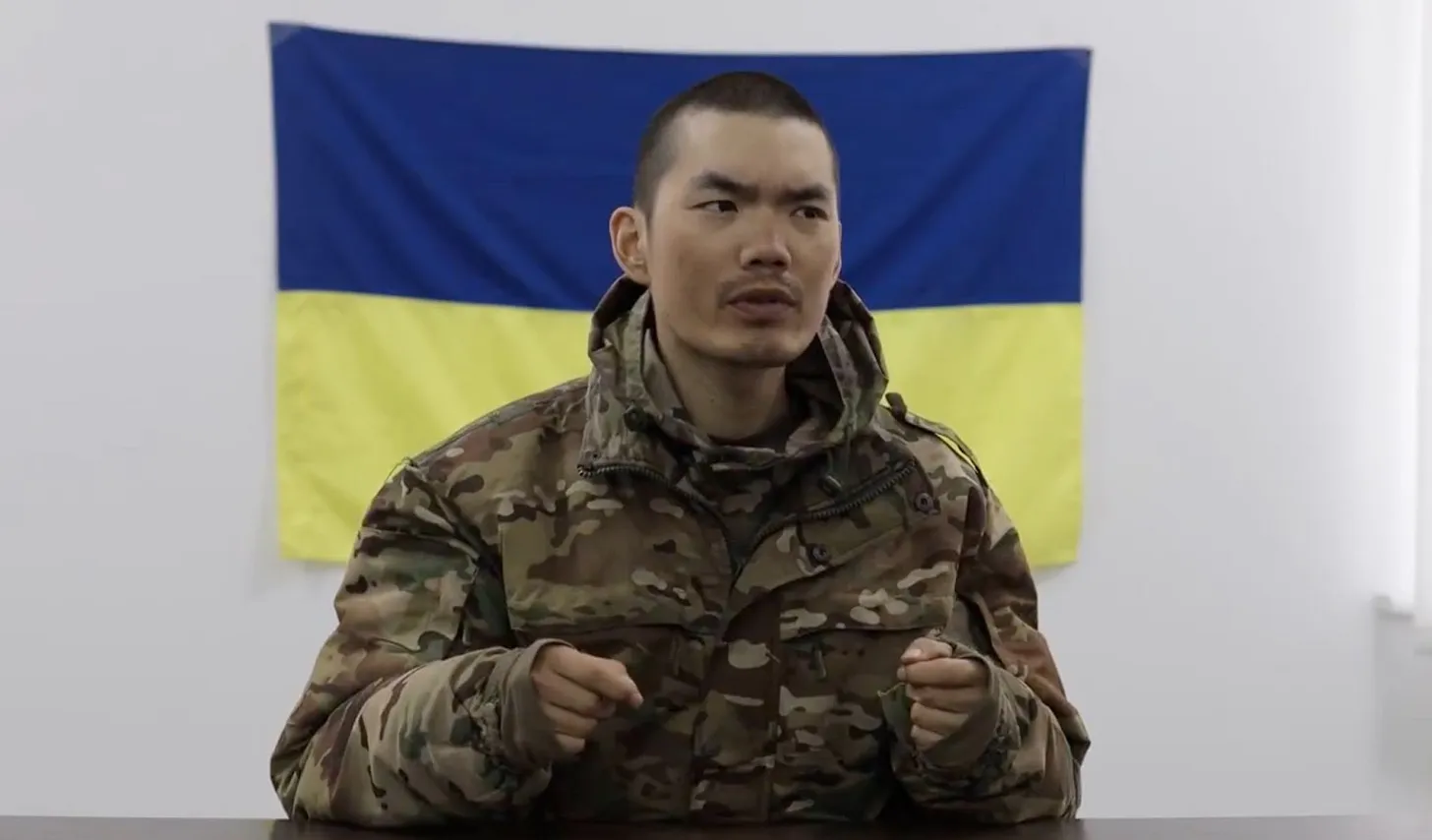
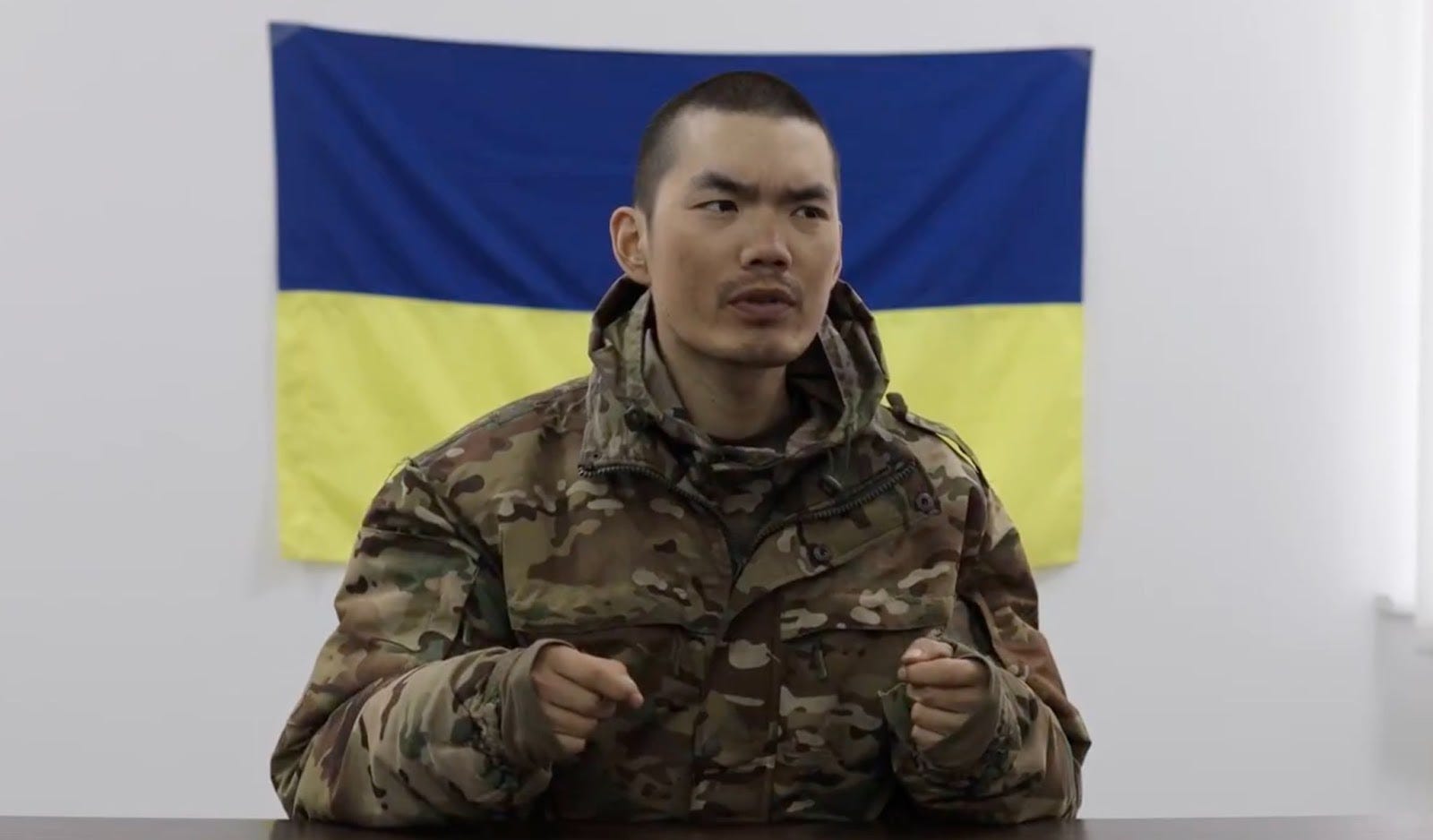
One week ago, Ukrainian President Volodymyr Zelensky announced that his intelligence services had identified at least 155 Chinese citizens fighting for Russia in Ukraine. “We are collecting information and we believe there are more, many more,” he said, adding that the Chinese government appeared to be “turning a blind eye” to recruitment efforts on Chinese social networks. China’s Foreign Ministry quickly called Zelensky’s claims “groundless,” but even this official response was non-existent in media coverage inside China. Meanwhile, the story received strong Chinese-language coverage in overseas outlets including Deutsche Welle, Radio France Internationale, Radio Free Asia and Singapore’s Lianhe Zaobao (聯合早報).
But some of the most illuminating coverage had already emerged more than a week earlier — even before Zelensky’s public remarks. On March 30, former CCTV celebrity anchor Chai Jing (柴静) released an hour-long video special to her YouTube channel for which she interviewed Chinese fighters on both sides of the conflict. She spoke with “Ma Kalong” (马卡龙), a Russian-allied Chinese soldier, as well as several volunteer combatants fighting for Ukraine, such as Gao Shan (高山) and Peng Chenliang (彭陈亮), who was killed in action.
Chai suggests in her investigation that these fighters are not officially sent by China. However, the video released by Ukraine last week alludes tantalizingly to intermediaries, which points to networks in China that are likely recruiting fighters — a highly sensitive story one Chinese media insider tells us is just waiting to unfold.
According to Chai’s interviews, Russian-allied recruits are primarily motivated by financial incentives, while Ukraine’s Chinese volunteers cite ideological commitments to democracy and freedom. This contrast in motivation matches the stark difference in their treatment. While Russian-allied fighters describe poor equipment and conditions, Ukraine’s Chinese volunteers (though facing high casualty rates) express a sense of purpose in their choice. Chai Jing’s YouTube channel is chock full of excellent interviews, a welcome comeback from the former state journalist who once roused ordinary Chinese to share images of wasteful government buildings in China by saying: “You are a citizen, and you are a journalist.”
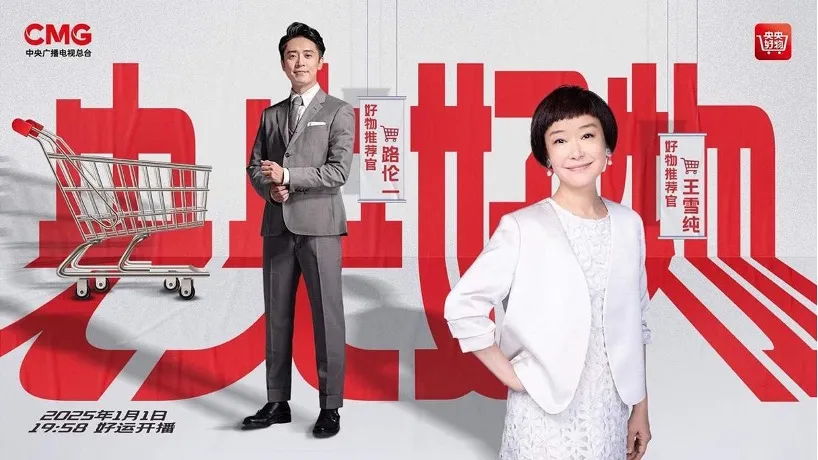
Initium Media (端傳媒) published an extraordinary inside look earlier this month at the deep challenges facing official Party-run media in China, particularly television networks caught between political control and financial viability — with television audiences left out of the equation. The deeply reported piece reveals how corruption has become normalized as a survival mechanism. China’s nearly 2,500 television stations face deep financial pressures, with insiders describing them as “living like beggars” (大家都是过着要饭的日子). At China Central Television (CCTV), reporters’ salaries have plummeted while top executives often offer public relations services on the side, and news anchors hawk products via livestreams. Local station reporters earn as little as 800 yuan (110 dollars) monthly, which must be supplemented by commissions from commercial activity.
An ad from the China Media Group (CMG), the conglomerate directly under the CCP’s Central Propaganda Department, for a shopping show launched on January 1.
The core problem is political: increasingly stringent content restrictions have made meaningful programming impossible. As one CCTV producer candidly admitted, everyone knows the solution — allow creative freedom and programs that respond to people’s concerns — “but none of these things are possible.” The inevitable result, according to a propaganda official, is that “television will gradually die out.”
Once known for quality print journalism, Italy’s media industry has suffered several financial strain in recent decades that has in many ways weakened professional values. Traditional reporting has increasingly given way to “infotainment” — a trend pioneered since the 1990s by former prime minister Silvio Berlusconi’s Mediaset empire, the country’s largest broadcaster, which prioritizes entertainment over substantive news. Cash-strapped outlets struggle to maintain journalistic standards, resulting in declining salaries for reporters and cautious approaches to digital innovation and AI integration. Against this backdrop of economic vulnerability, China has been strategically expanding its influence throughout Italy’s weakened media landscape.
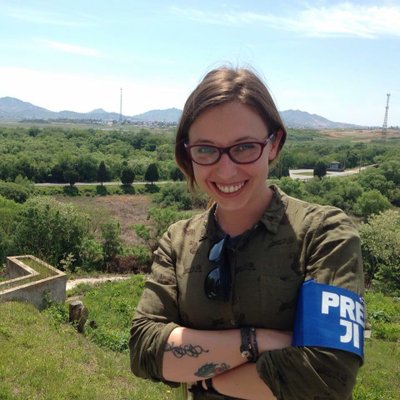
Despite having nearly 285,000 Chinese residents, Italy has few Chinese-language media outlets. Meanwhile, collaborations between Chinese state media and Italian news agencies have facilitated the spread of Beijing’s narratives into mainstream discourse. To better understand the complex interplay between Italian media and Chinese state narratives and media engagement, we spoke to Italian journalist Giulia Pompili. As one of the few journalists who has critically covered the on-and-off saga of Italy’s involvement in Xi Jinping’s signature Belt and Road Initiative, Pompili offers a unique perspective on Beijing’s information strategy and its ongoing impact on the Italian media landscape.
Dalia Parete: When we look at media landscapes globally, each country has its unique characteristics and challenges. What are the most important things to understand about how media works in Italy today?
Giulia Pompili: The main challenge for Italian media is financial. Print media do not have the income or budgets they once had when they had large paid-for circulations. Television is still a strong presence in the media landscape. But over the past 40 years, it has increasingly shifted toward “infotainment” — a blend of information and entertainment. This means fewer programs are focused on delivering substantive information, and more segments are designed primarily to entertain viewers rather than inform them.
Regarding the “infotainment” trend in Italian media, [former Prime Minister] Berlusconi pioneered this transformation. He fundamentally changed how Italians consumed information with his three television channels under Mediaset Italia S.P.A. He was also the first in Italy to envision using media manipulation to cultivate public support.
After Berlusconi, all Italian channels, including the national public broadcasting company Rai, considered the “Italian BBC,” transformed the way they presented information to follow the Mediaset path. So, there is now more “infotainment” and less information across the board.
A young Silvio Berlusconi at the Mediaset headquarters. SOURCE: RAI.
Newspapers lost many readers in the early 2000s, and printed information experienced a major crisis at that time. In the past decade, Italy has attempted to expand into digital media through websites and social media. But it has lagged behind countries like the United States. We’ve also seen the rise of influencers and information websites that often translate foreign articles. More recently, informational podcasts have gained some traction, but the business model remains unclear. No one has figured out how to monetize these platforms effectively. Nevertheless, this shift has once again changed the media landscape.
DP: What significant challenges and transformations do you see on the horizon for Italian media? For instance, how are developments like AI or changing consumption patterns affecting the industry?
GP: One of the biggest challenges is declining compensation for journalists. For example, if you are a freelancer, you cannot afford to pay rent for an apartment. And if you are a staff writer or a TV producer, you likely have a very low monthly income.
Italy remains quite conservative in the media sector. AI hasn’t been widely implemented in newsrooms, and significant fear surrounds it. Whenever I discuss this with colleagues, especially those from older generations, they express the concern that AI will take their jobs.
From the consumption side, Italy has a significant information literacy gap because there is no education on media literacy. Most of the population is illiterate when it comes to media. They struggle to distinguish between information from influencers, reporters, staff writers, investigative journalists, and activists. This is especially problematic among younger generations, who often can’t differentiate between a TikTok influencer discussing Uyghurs in China’s Xinjiang region, for example, and a professional journalist who has thoroughly investigated the topic. Ideological perspectives create substantial barriers between activists, influencers, and traditional journalists — representing one of our biggest challenges.
Younger generations often can’t differentiate between a TikTok influencer discussing Uyghurs in China’s Xinjiang region and a professional journalist who has thoroughly investigated the topic.
DP: Despite Italy hosting nearly 285,000 Chinese nationals, few Chinese-language media outlets exist. What factors, in your view, have contributed to this limited media presence, and how does this affect information flow within the Chinese community?
GP: In Italy, it often seems that the large Chinese diaspora is already closely aligned with the Chinese Communist Party — though there is no specific research or data about this. They may not demand dedicatedmediabecause the Party already maintains a strong influence over diaspora groups, and pro-China content is known to dominate the media that are present. The main Chinese-language radio station, China FM Italia focuses primarily on entertainment rather than news. Another outlet, Cina in Italia (世界中国) began as a book publisher. They tried to publish educational books in Italian and Chinese. It was originally a cultural company, but it has now changed its business model, working directly with the official China News Service [under the United Front Work Department of the CCP].
Another unique character of the Chinese community in Italy is that you rarely hear any form of dissenting opinion. As the white-paper protests that began in Shanghai spread internationally in late 2022, there were attempts to organize demonstrations in major squares in Bologna and Rome — but these barely made an impact. Compared to similar protests in Germany, France, and the UK, which were much larger and more visible, the level of dissent in Italy was negligible. In Italy, such activities are notably absent.
DP: So, how would you characterize China’s approach to media or media engagement in Italy?
GP: The media engagement approach has been simple. Embassy personnel have built relationships with Italian editors, editors-in-chief, press agencies, and individual journalists.
Before 2019, Chinese media had numerous bilateral contracts and cooperation programs between Chinese and Italian media. We engaged significantly with the official China Media Group [under the CCP’s Central Propaganda Department], which maintains the most prominent presence everywhere. In reality, they were paying for advertising in Italian newspapers. They would pitch original Chinese-language articles translated into Italian. Like everywhere in Europe, they tried to coordinate with Italian media outlets to publish Chinese dossiers written by the embassy or agencies working with the embassy. Generally, they attempted to use Italian media as a powerful tool to share their narratives.
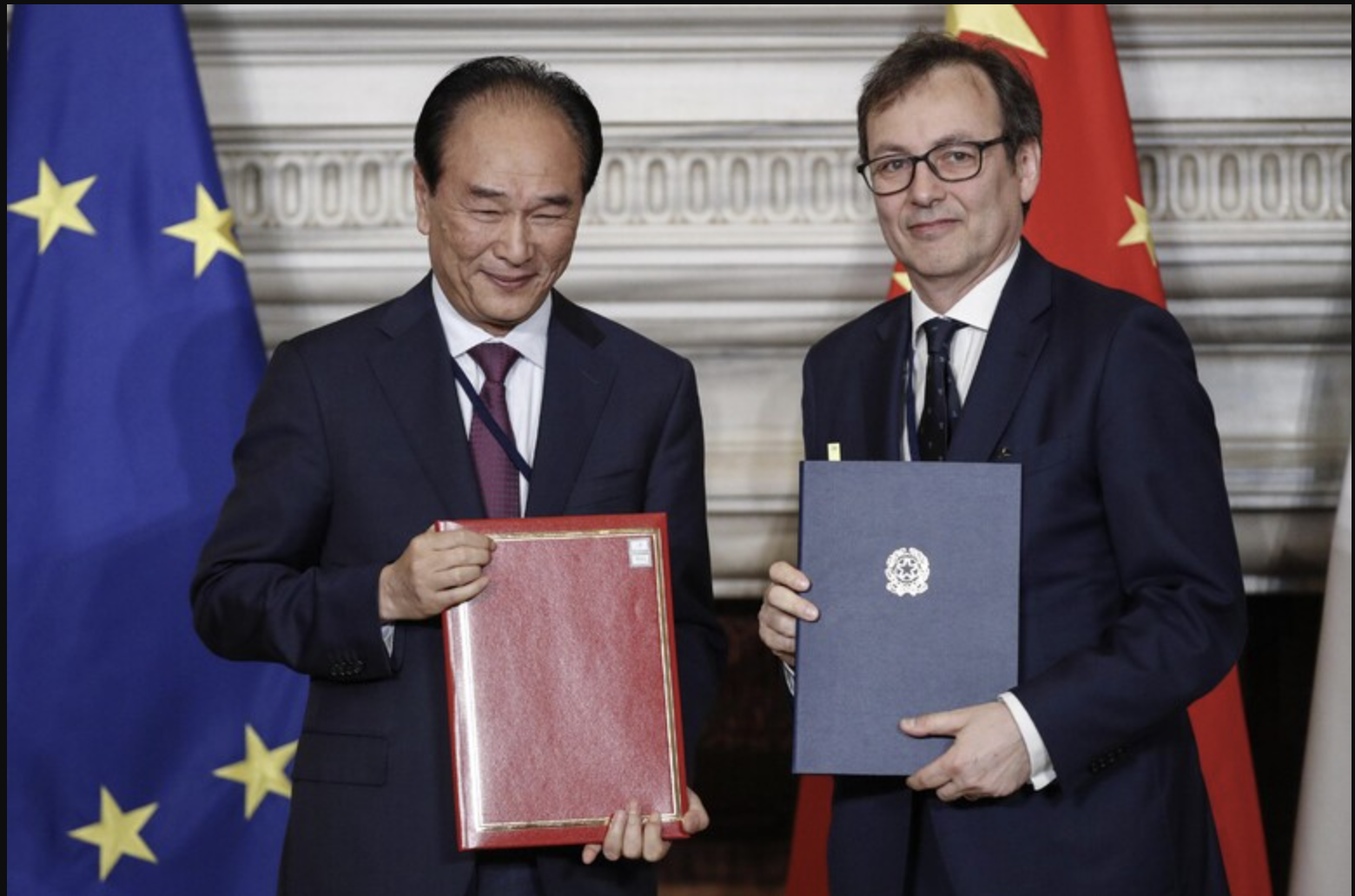
In 2019, something changed. Xi Jinping came to Italy for an official state visit. During that visit, Italy officially joined the Belt and Road Initiative, establishing numerous institutional cooperation agreements. One of the most notorious agreements for the media was between Agenzia Nazionale Stampa Associata (ANSA), our country’s leading news agency, and the Chinese government’s Xinhua News Agency. ANSA is a primary news source for Italian journalists, so this partnership allowed Chinese state narratives to directly enter Italy’s mainstream news ecosystem.
ANSA’s CEO, Stefano De Alessandri, and former Xinhua’s President, Cai Ming Zhao (蔡名照), signing a cooperation agreement between the two agencies. SOURCE: ANSA.
DP: How did the COVID-19 pandemic affect China’s information strategy in Italy?
GP The COVID-19 pandemic was a turning point for Italy, revealing China’s information manipulation tactics more sharply. A key example was when the Chinese Red Cross sent masks to Italy. Our former Foreign Affairs Minister Luigi Di Maio, who had signed the Belt and Road MOU the previous year, was entirely absorbed by Chinese propaganda and disinformation to rehabilitate China’s image as the country where the virus originated.
We engaged significantly with the official China Media Group, which maintains the most significant presence everywhere.
By late March 2020, China was building its image as Europe’s savior. This tactic worked quite well in Italy. They manipulated the situation by sending masks and supplies to the Italian Red Cross, creating a major political event. However, these weren’t donations but rather purchases made by Italy. We still have numerous legal proceedings regarding emergency funds spent on Chinese supplies. The critical point is that during this emergency, China used Italy as an experiment to see how effectively they could manipulate information to craft their image as a savior amid the pandemic.
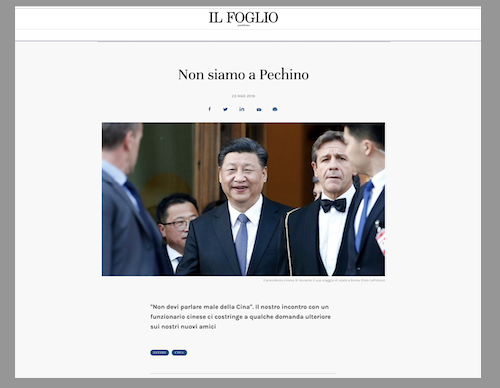
An article in Italy’s Il Foglio, published during a visit to the country by Xi Jinping, bears the headline: “We are not in Beijing,” after Chinese diplomats demanded positive coverage.
DP:How did Chinese officials typically engage with foreign journalists, like yourself, who were critical of their policies?
GP: At the time, I was one of the journalists who extensively covered Chinese-Italian bilateral relations. I was also among the few who criticized Italy’s joining the Belt and Road Initiative. At the time, the appointed spokesperson of the Chinese embassy confronted me at the Quirinale Palace during Xi’s visit. He aggressively told me, “You must stop saying bad things about China.” The next day, we published the news headline, “We are not in Beijing.” In the article that chronicled this confrontation, we included the spokesperson’s full name, which made him very angry.
This incident also marked the first time that the Italian political establishment realized that the silencing of journalists was something that could not go unanswered.
He aggressively told me, “You must stop saying bad things about China.”
DP: Despite claims of a tougher stance toward China since Italy’s exit from the Belt and Road Initiative, how would you assess the reality of Italian-Chinese relations, notably regarding media partnerships and Meloni’s broader political agenda?
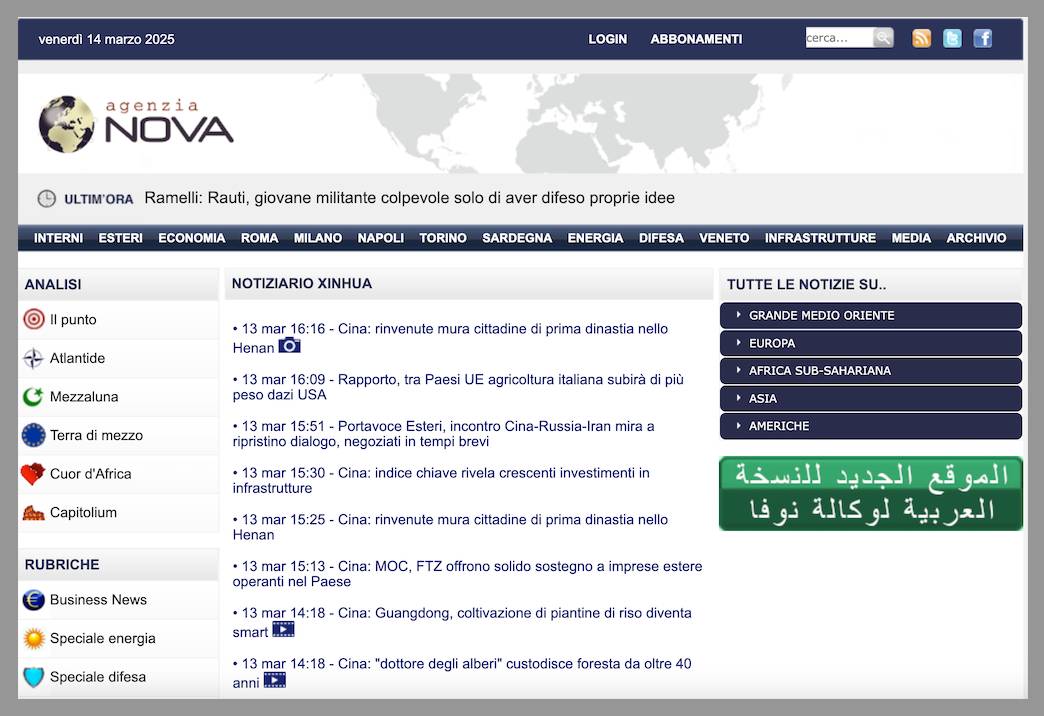
A page at Italy’s Agenzia Nova dedicated to coverage by China’s official Xinhua News Agency.
GP: We are saying that we are restricting Chinese influence, right? Italian printed media generally reduced Chinese content partnerships, but some outlets still publish Chinese state-sponsored content for financial compensation. While the “Chinese dossiers” appear less frequently, Italy remains an outlier in Europe by continuing to monetize the publication of Chinese government messaging in its media landscape.
The Chinese government’s official Xinhua News Agency changed cooperation partners from ANSA to Agenzia Nova, a popular online news source. So, it is still doing what it was doing with new partners.
From a political perspective, Meloni’s core focus as Italian president is immigration — she doesn’t think about much of anything else. She knows that China is the only country that can help her in Africa because China currently has the most significant political influence there.
She understands that she cannot effectively deal with Libya, Algeria, or Egypt without support from Chinese officials and institutions. For Meloni, the only priority is this very concrete issue, and she is ready to do whatever it takes to achieve her singular foreign policy goal: managing immigration. She knows that she needs China to stabilize the relationship with Africa.