As supporters of the Taiwan People’s Party staged a march last Sunday outside the headquarters of the country’s Democratic Progressive Party (DPP) to protest election recalls scheduled for July 26, they resorted to a stunt many Taiwanese would find too perplexing to understand as a provocation. Dear NANA, an influencer aligned with the Taiwan People’s Party (TPP), staged an event called “Cleansing the Sins of Democracy” (民主罪人洗門風), during which participants wore Cultural Revolution-style tall hats and placards around their necks while apologizing to passersby for voting in the past for the DPP. Several attendees, including the TPP’s secretary-general, had “shame” written on their foreheads — a reference to the humiliation to which many were subjected under Mao Zedong’s Cultural Revolution (1966-1976). The spectacle sparked an online backlash but received minimal mainstream media coverage. These are historical references few Taiwanese would understand.
May 1 is a red-letter day for the Chinese Communist Party, which continues to see worker’s rights as at the heart of its identity and legitimacy — even, or especially, in a period when well-paying jobs are in short supply and workers are over-qualified. International Labor Day this year also marks the 100th anniversary of the founding of the All-China Federation of Trade Unions (中华全国总工会), a vehicle for strengthening proletarian unity and a CCP power base in the Party’s early days. The anniversary celebrations on April 28 made the front page of the People’s Daily, with Xi Jinping making a speech about how the federation had been able to “unite and mobilize the working class to follow in the Party’s steps.”
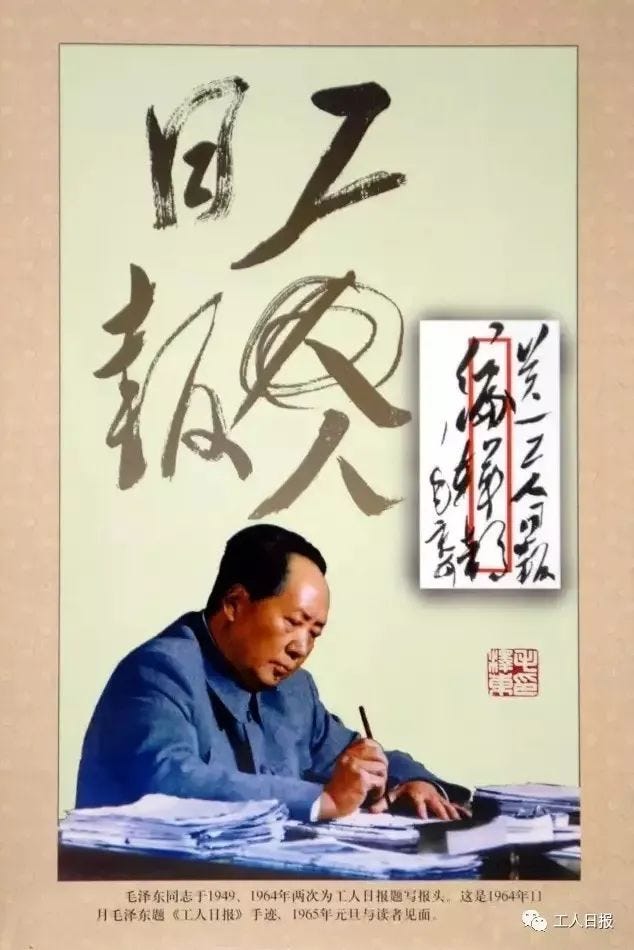
A portrait of Chairman Mao Zedong working at his desk in 1964, with calligraphy showing “工人日報” (Worker’s Daily) displayed prominently above. This image was originally photographed in 1964 and later published in the newspaper in 1965. SOURCE: All-China Journalist’s Association.
One way they have tried to do so is through their newspaper, the Worker’s Daily (工人日报). From the first days after its launch in July 1949, the outlet aimed to serve an audience of blue-collar laborers not used to the heavy ideological prose of the People’s Daily. Then-head of the Federation, Li Lisan (李立三) — who had spent his early days as a labor organizer in China’s coal mines — imagined a newspaper that could better guide workers on Party thinking by being relatable. Xinhua bulletins, for example, were re-written for the paper in simpler Chinese, with authors selected from among workers across the country.
Relatable propaganda is an idea Xi Jinping has tried to resurrect from the earliest days of his presidency. “Wherever readers are, wherever viewers are, that is where propaganda reports must extend their tentacles,” he told an audience at the PLA Daily in 2015. Like the rest of state media, Worker’s Daily has rolled out a news app and accounts on everyday Chinese apps like Douyin, posting videos of heart-warming stories about the toils of modern blue-collar workers across the country.
Macau is intensifying patriotic education efforts targeting young people through “different levels and aspects,” according to a report on March 26, 2025, by All About Macau (論盡) — an independent news outlet launched in May 2013 that focuses on in-depth reporting on social issues in Macau. At a closed-door Youth Council meeting held on March 25, Social and Cultural Affairs Secretary O Lam (柯嵐) emphasized that “President Xi Jinping is very concerned about the development of Macau’s youth.” She outlined such initiatives as “red root-seeking journeys” (紅色尋根之旅) — essentially, junkets for youth from Macau that involve trips to “red tourism” sites like the birthplace of Mao Zedong.
According to All About Macau, the territory’s Education and Youth Development Bureau said it would promote patriotism through methods “appealing to young students,” cultivating the core social value of “loving the country and loving Macau.” This case exemplifies the ongoing efforts in both Hong Kong and Macau to systematically integrate mainland Chinese patriotic education — equating love of country with unconditional support for the CCP regime.