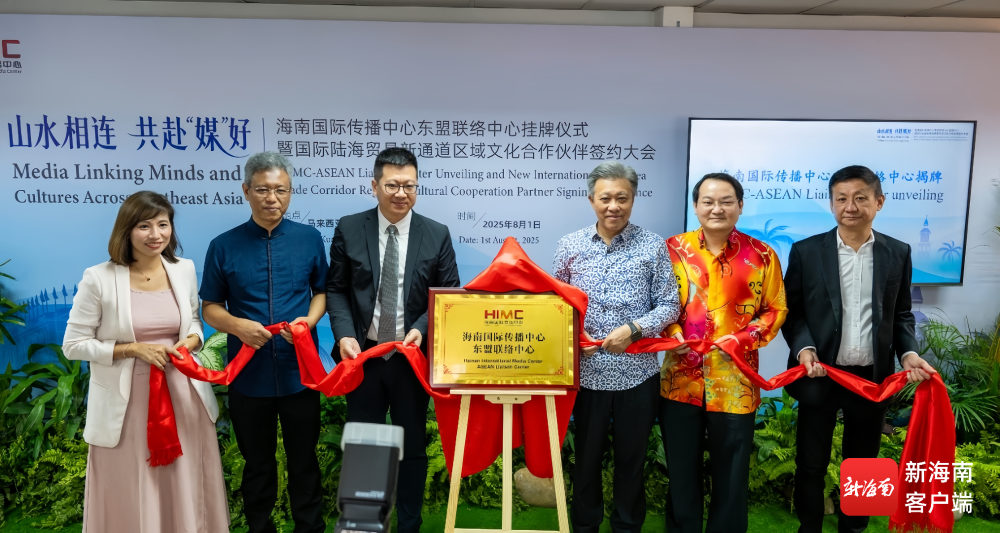
Hainan province, long China’s testing ground for economic and policy innovation, has emerged as a key experimental front in Beijing’s latest campaign — leveraging local and regional media to boost the country’s global “discourse power.” Earlier this summer, the Hainan International Media Center (HIMC), an office directly under the province’s propaganda office, unveiled a liaison center in Dubai, planting its flag in the Middle East. In Kuala Lumpur on Friday, it opened a new ASEAN Liaison Center (東盟聯絡中心), staking out Southeast Asia as a priority region for outreach.
Established in 2019, the HIMC was among China’s earliest provincial-level international communication centers (ICCs), following on the heels of the municipality of Chongqing, which launched its ICC in June 2018. The province’s unique position as a trade port experiment along what the CCP leadership has in recent years dubbed the “Maritime Silk Road” makes it a natural laboratory for President Xi Jinping’s “centralization+” approach to international messaging. It is also a key military region in the South China Sea from which China presses its territorial claims, a constant agitation for many ASEAN member states.
The launch ceremony for the HIMC liaison hub was attended by more than 60 guests under the theme “Media Linking Minds and Cultures Across Southeast Asia,” including Datuk Seri Wong Chun Wai (拿督斯里黃振威), chairman of the Malaysian National News Agency, Teh Hao Ran (鄭豪然), executive editor of Kwong Wah Yit Poh (光華日報), and Niu Xiaomin (牛曉民), deputy editor-in-chief of Hainan Daily Media Group (海南日報報業集團). The formation comes as Hainan prepares for the December 18 start of its free trade port’s closed-loop operation (封關運作), a development that officials say will dramatically increase connections with ASEAN countries. ASEAN has been Hainan’s largest trading partner since 2021.
The center, guided by Hainan’s provincial propaganda department and led by Hainan Daily Media Group, aims to serve as what officials described as a “comprehensive cooperation bridge” linking Hainan with ASEAN countries through international communication, economic cooperation, cultural exchange, and think tank collaboration.
The overseas expansion reflects Xi’s 2021 directive to “tell China’s story well” (講好中國故事) — terminology that has been core to the party’s international communication objectives since August 2013 — and make China “credible, lovable and respected” (可信、可愛、可敬), as Xi urged in a May 2021 speech to a collective study session of the CCP Politburo on “external propaganda” (外宣). Officials at the Kuala Lumpur ceremony invoked the same language, emphasizing the center’s mission to “tell good stories of China and Hainan” (講好中國故事、海南故事) to ASEAN audiences.
Once known for quality print journalism, Italy’s media industry has suffered several financial strain in recent decades that has in many ways weakened professional values. Traditional reporting has increasingly given way to “infotainment” — a trend pioneered since the 1990s by former prime minister Silvio Berlusconi’s Mediaset empire, the country’s largest broadcaster, which prioritizes entertainment over substantive news. Cash-strapped outlets struggle to maintain journalistic standards, resulting in declining salaries for reporters and cautious approaches to digital innovation and AI integration. Against this backdrop of economic vulnerability, China has been strategically expanding its influence throughout Italy’s weakened media landscape.
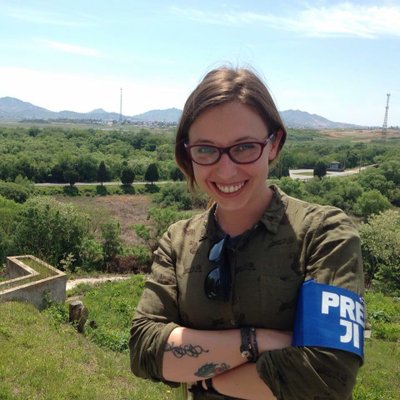
Despite having nearly 285,000 Chinese residents, Italy has few Chinese-language media outlets. Meanwhile, collaborations between Chinese state media and Italian news agencies have facilitated the spread of Beijing’s narratives into mainstream discourse. To better understand the complex interplay between Italian media and Chinese state narratives and media engagement, we spoke to Italian journalist Giulia Pompili. As one of the few journalists who has critically covered the on-and-off saga of Italy’s involvement in Xi Jinping’s signature Belt and Road Initiative, Pompili offers a unique perspective on Beijing’s information strategy and its ongoing impact on the Italian media landscape.
Dalia Parete: When we look at media landscapes globally, each country has its unique characteristics and challenges. What are the most important things to understand about how media works in Italy today?
Giulia Pompili: The main challenge for Italian media is financial. Print media do not have the income or budgets they once had when they had large paid-for circulations. Television is still a strong presence in the media landscape. But over the past 40 years, it has increasingly shifted toward “infotainment” — a blend of information and entertainment. This means fewer programs are focused on delivering substantive information, and more segments are designed primarily to entertain viewers rather than inform them.
Regarding the “infotainment” trend in Italian media, [former Prime Minister] Berlusconi pioneered this transformation. He fundamentally changed how Italians consumed information with his three television channels under Mediaset Italia S.P.A. He was also the first in Italy to envision using media manipulation to cultivate public support.
After Berlusconi, all Italian channels, including the national public broadcasting company Rai, considered the “Italian BBC,” transformed the way they presented information to follow the Mediaset path. So, there is now more “infotainment” and less information across the board.
A young Silvio Berlusconi at the Mediaset headquarters. SOURCE: RAI.
Newspapers lost many readers in the early 2000s, and printed information experienced a major crisis at that time. In the past decade, Italy has attempted to expand into digital media through websites and social media. But it has lagged behind countries like the United States. We’ve also seen the rise of influencers and information websites that often translate foreign articles. More recently, informational podcasts have gained some traction, but the business model remains unclear. No one has figured out how to monetize these platforms effectively. Nevertheless, this shift has once again changed the media landscape.
DP: What significant challenges and transformations do you see on the horizon for Italian media? For instance, how are developments like AI or changing consumption patterns affecting the industry?
GP: One of the biggest challenges is declining compensation for journalists. For example, if you are a freelancer, you cannot afford to pay rent for an apartment. And if you are a staff writer or a TV producer, you likely have a very low monthly income.
Italy remains quite conservative in the media sector. AI hasn’t been widely implemented in newsrooms, and significant fear surrounds it. Whenever I discuss this with colleagues, especially those from older generations, they express the concern that AI will take their jobs.
From the consumption side, Italy has a significant information literacy gap because there is no education on media literacy. Most of the population is illiterate when it comes to media. They struggle to distinguish between information from influencers, reporters, staff writers, investigative journalists, and activists. This is especially problematic among younger generations, who often can’t differentiate between a TikTok influencer discussing Uyghurs in China’s Xinjiang region, for example, and a professional journalist who has thoroughly investigated the topic. Ideological perspectives create substantial barriers between activists, influencers, and traditional journalists — representing one of our biggest challenges.
Younger generations often can’t differentiate between a TikTok influencer discussing Uyghurs in China’s Xinjiang region and a professional journalist who has thoroughly investigated the topic.
DP: Despite Italy hosting nearly 285,000 Chinese nationals, few Chinese-language media outlets exist. What factors, in your view, have contributed to this limited media presence, and how does this affect information flow within the Chinese community?
GP: In Italy, it often seems that the large Chinese diaspora is already closely aligned with the Chinese Communist Party — though there is no specific research or data about this. They may not demand dedicatedmediabecause the Party already maintains a strong influence over diaspora groups, and pro-China content is known to dominate the media that are present. The main Chinese-language radio station, China FM Italia focuses primarily on entertainment rather than news. Another outlet, Cina in Italia (世界中国) began as a book publisher. They tried to publish educational books in Italian and Chinese. It was originally a cultural company, but it has now changed its business model, working directly with the official China News Service [under the United Front Work Department of the CCP].
Another unique character of the Chinese community in Italy is that you rarely hear any form of dissenting opinion. As the white-paper protests that began in Shanghai spread internationally in late 2022, there were attempts to organize demonstrations in major squares in Bologna and Rome — but these barely made an impact. Compared to similar protests in Germany, France, and the UK, which were much larger and more visible, the level of dissent in Italy was negligible. In Italy, such activities are notably absent.
DP: So, how would you characterize China’s approach to media or media engagement in Italy?
GP: The media engagement approach has been simple. Embassy personnel have built relationships with Italian editors, editors-in-chief, press agencies, and individual journalists.
Before 2019, Chinese media had numerous bilateral contracts and cooperation programs between Chinese and Italian media. We engaged significantly with the official China Media Group [under the CCP’s Central Propaganda Department], which maintains the most prominent presence everywhere. In reality, they were paying for advertising in Italian newspapers. They would pitch original Chinese-language articles translated into Italian. Like everywhere in Europe, they tried to coordinate with Italian media outlets to publish Chinese dossiers written by the embassy or agencies working with the embassy. Generally, they attempted to use Italian media as a powerful tool to share their narratives.
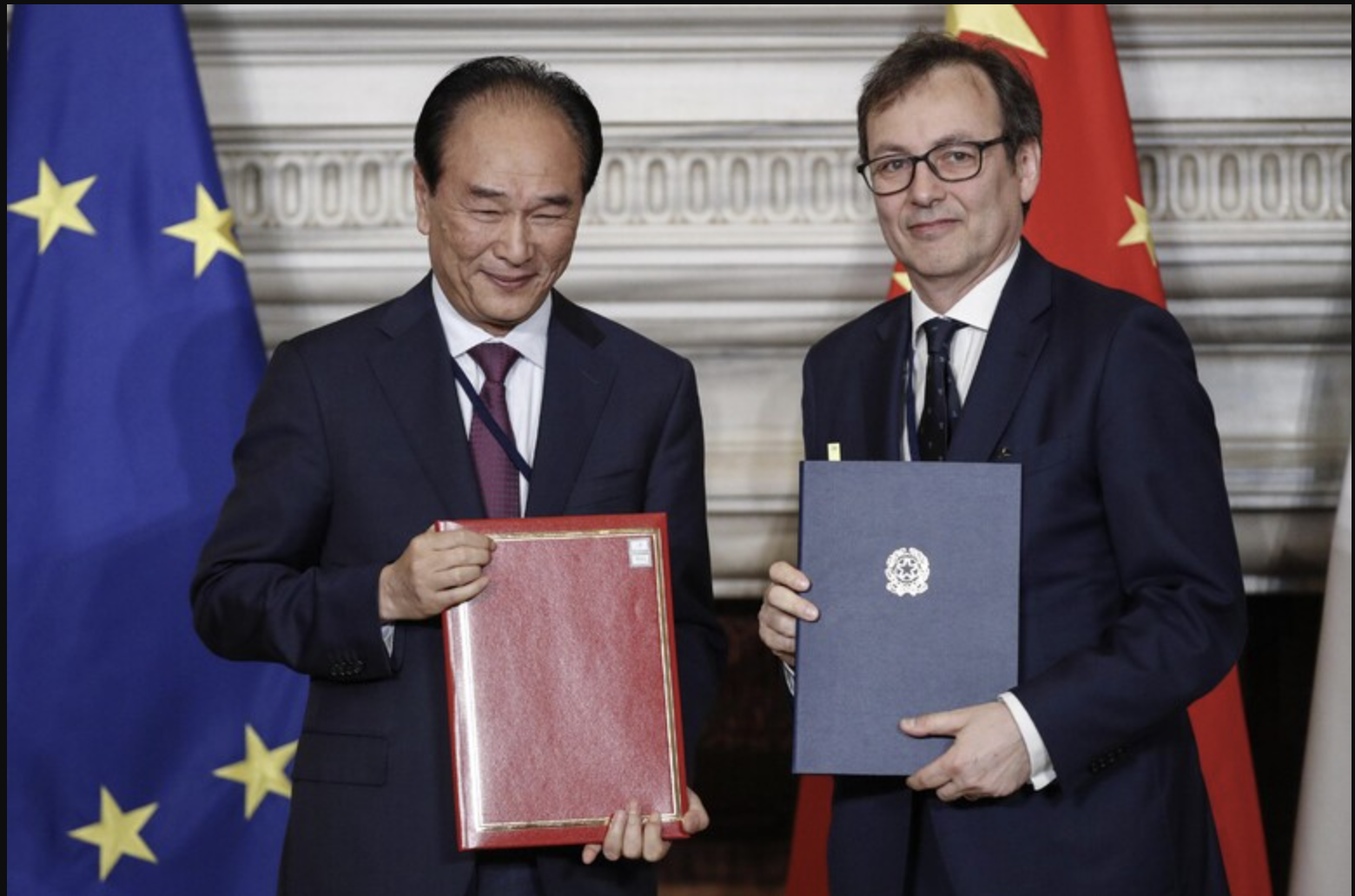
In 2019, something changed. Xi Jinping came to Italy for an official state visit. During that visit, Italy officially joined the Belt and Road Initiative, establishing numerous institutional cooperation agreements. One of the most notorious agreements for the media was between Agenzia Nazionale Stampa Associata (ANSA), our country’s leading news agency, and the Chinese government’s Xinhua News Agency. ANSA is a primary news source for Italian journalists, so this partnership allowed Chinese state narratives to directly enter Italy’s mainstream news ecosystem.
ANSA’s CEO, Stefano De Alessandri, and former Xinhua’s President, Cai Ming Zhao (蔡名照), signing a cooperation agreement between the two agencies. SOURCE: ANSA.
DP: How did the COVID-19 pandemic affect China’s information strategy in Italy?
GP The COVID-19 pandemic was a turning point for Italy, revealing China’s information manipulation tactics more sharply. A key example was when the Chinese Red Cross sent masks to Italy. Our former Foreign Affairs Minister Luigi Di Maio, who had signed the Belt and Road MOU the previous year, was entirely absorbed by Chinese propaganda and disinformation to rehabilitate China’s image as the country where the virus originated.
We engaged significantly with the official China Media Group, which maintains the most significant presence everywhere.
By late March 2020, China was building its image as Europe’s savior. This tactic worked quite well in Italy. They manipulated the situation by sending masks and supplies to the Italian Red Cross, creating a major political event. However, these weren’t donations but rather purchases made by Italy. We still have numerous legal proceedings regarding emergency funds spent on Chinese supplies. The critical point is that during this emergency, China used Italy as an experiment to see how effectively they could manipulate information to craft their image as a savior amid the pandemic.
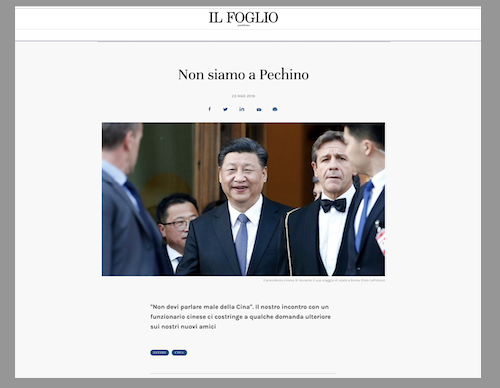
An article in Italy’s Il Foglio, published during a visit to the country by Xi Jinping, bears the headline: “We are not in Beijing,” after Chinese diplomats demanded positive coverage.
DP:How did Chinese officials typically engage with foreign journalists, like yourself, who were critical of their policies?
GP: At the time, I was one of the journalists who extensively covered Chinese-Italian bilateral relations. I was also among the few who criticized Italy’s joining the Belt and Road Initiative. At the time, the appointed spokesperson of the Chinese embassy confronted me at the Quirinale Palace during Xi’s visit. He aggressively told me, “You must stop saying bad things about China.” The next day, we published the news headline, “We are not in Beijing.” In the article that chronicled this confrontation, we included the spokesperson’s full name, which made him very angry.
This incident also marked the first time that the Italian political establishment realized that the silencing of journalists was something that could not go unanswered.
He aggressively told me, “You must stop saying bad things about China.”
DP: Despite claims of a tougher stance toward China since Italy’s exit from the Belt and Road Initiative, how would you assess the reality of Italian-Chinese relations, notably regarding media partnerships and Meloni’s broader political agenda?
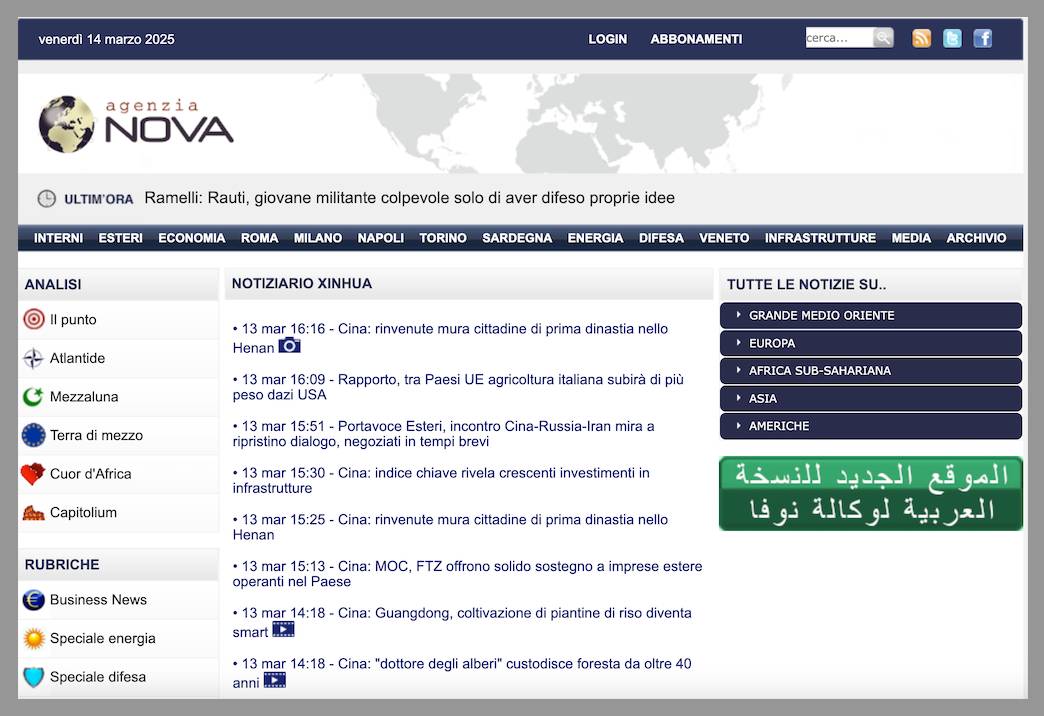
A page at Italy’s Agenzia Nova dedicated to coverage by China’s official Xinhua News Agency.
GP: We are saying that we are restricting Chinese influence, right? Italian printed media generally reduced Chinese content partnerships, but some outlets still publish Chinese state-sponsored content for financial compensation. While the “Chinese dossiers” appear less frequently, Italy remains an outlier in Europe by continuing to monetize the publication of Chinese government messaging in its media landscape.
The Chinese government’s official Xinhua News Agency changed cooperation partners from ANSA to Agenzia Nova, a popular online news source. So, it is still doing what it was doing with new partners.
From a political perspective, Meloni’s core focus as Italian president is immigration — she doesn’t think about much of anything else. She knows that China is the only country that can help her in Africa because China currently has the most significant political influence there.
She understands that she cannot effectively deal with Libya, Algeria, or Egypt without support from Chinese officials and institutions. For Meloni, the only priority is this very concrete issue, and she is ready to do whatever it takes to achieve her singular foreign policy goal: managing immigration. She knows that she needs China to stabilize the relationship with Africa.
The African media landscape has become a contested space where global powers vie for influence and narrative control. While Western media have historically dominated, Chinese and Russian outlets are gaining ground, using their own distinct approaches to shape public opinion. Amid this competition, local media and audiences are also asserting their agency, pursuing their personal interests and presenting worldviews that have been uniquely shaped by the region’s past.
We spoke with Dani Madrid Morales, a media scholar at the University of Sheffield, about how China and Russia have been navigating the African media landscape — where their approaches converge, and where they sharply diverge. Our conversation covered how historical anti-colonial sentiments continue to shape the reception of foreign media, and how African journalists and audiences engage with these competing global narratives.
Dalia Parete: How do China and Russia make use of anti-colonial and anti-imperialist sentiments in Africa to push their narratives?
Dani Madrid Morales: We were interested in how people talk about Chinese and Russian disinformation in Africa and how much focus there is on whether their stories are spreading and how effective they are. Everyone talks a lot about how compelling their narratives are — like blaming NATO for the war in Ukraine and saying it’s not Russia’s fault — but we wanted to dig into why some African countries don’t buy into that. The key thing we found is the prevalence of anti-US sentiment, which has deep roots in the Soviet Union and China pushing anti-colonial ideas in the 60s and 70s.
Back then, China was seen as a victim of colonialism, so that message resonated. Now, China is sometimes accused of being the colonizer itself in Africa, but the reality is a lot of African countries still feel exploited by the West. China and Russia know how to use that. Like when George Floyd was killed, and all the racial tension kicked off in the US, China jumped on that, using it to describe America as a racist country. And while it’s not all false, it has some truth. So, the thing is, China’s not doing straight-up disinformation in Africa — they just pick and choose facts and frame them in ways that connect with people’s lived experiences, which makes it hard just to call it all lies.
China’s not doing straight-up disinformation in Africa — they just pick and choose facts and frame them in ways that connect with people’s lived experiences.
DP: How else do China and Russia’s approaches differ in Africa?
DMM: China and Russia use very different methods in Africa. Russia tends to use more aggressive, hostile tactics, like fabricating attacks or spreading false accusations, especially in places like the Sahel region covering Mali, Niger, and Burkina Faso. They treat information like a weapon in a war, similar to how the US or France have used these tools in the region.
China doesn’t typically go that route. It has a softer approach. While it does spread misinformation on issues like Hong Kong, Taiwan, and Xinjiang, it is more about protecting its interests and image globally, not specifically in Africa. China does not only directly accuse the West of wrongdoing but also highlights the differences between itself and Western countries — for example, how China isn’t a colonial power. It frames things like low-interest loans and medical aid as positive. Still, it often hides the negative side, like how Chinese companies exploit Africa’s mining sector with poor conditions for workers.
While Russia is more about information warfare, China is about shaping its image through PR. Both countries use these tactics based on their different goals. China’s approach shifts if it feels threatened, like during the COVID pandemic, when it adopted more aggressive tactics to defend its image.
DP:What have African residents themselves been doing to counter these efforts?
DMM: Some people in Africa, like journalists or influencers, get exposed to China and end up repeating China’s narratives. For example, a journalist from Ghana might go to China, spend some time there, and then return to Ghana, appearing on Chinese media like CGTN or Xinhua, repeating what China wants them to say. Some genuinely believe in China’s progress, such as the claim that China has lifted 100 million people out of poverty.
However, the average African person might not care much about Xinjiang or Tibet. What they do care more about is anything that paints the West negatively, which is a strong sentiment across the continent. So, they’re more likely to engage when they hear Chinese or Russian narratives criticizing the West.
DP: Based on your findings, to what extent do citizens actively engage with or resist these narratives, and what factors influence their responses?
DMM: There are people like the Swiss-Cameroonian Nathalie Yamb who spread Russian narratives, but not many influencers push Chinese narratives. However, some political groups in Africa, especially those on the extreme left, are using these anti-US and anti-colonial ideas alongside Chinese and Russian examples.
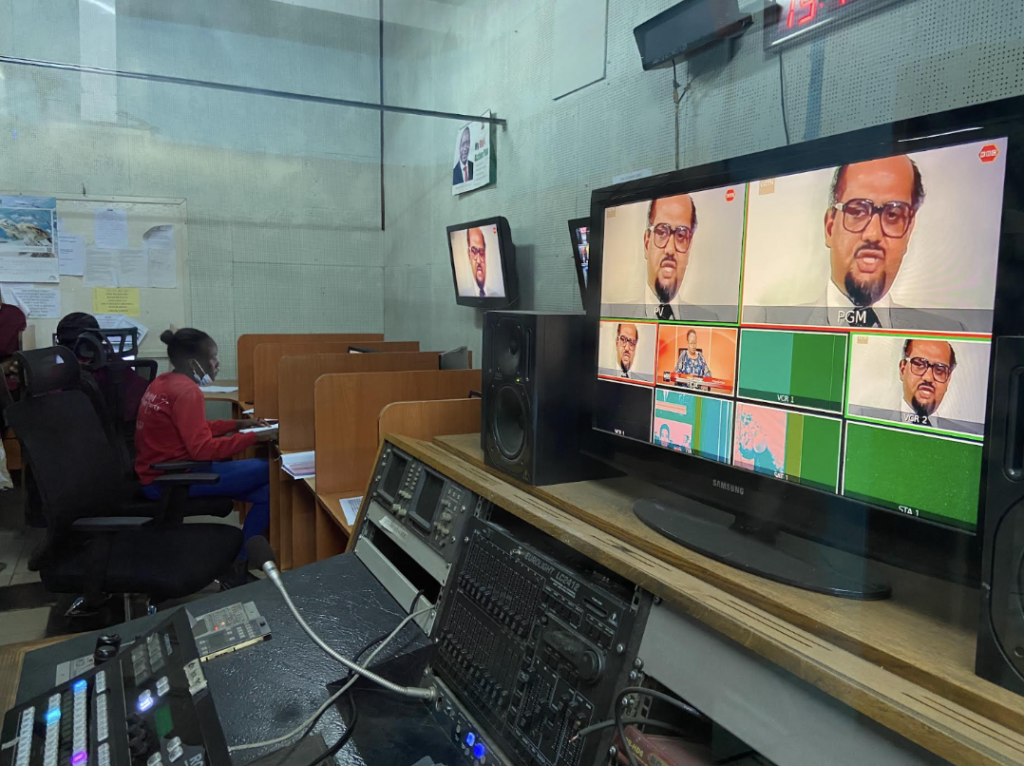
CGTN plays at a Kenya Broadcasting Corporation control room in Nairobi. Photo: Dani Madrid Morales.
Most Africans aren’t concerned with issues like Xinjiang but care about the more significant global power struggle. They might have sided with the US in the past, but now they’re more ambivalent.That’s where China has succeeded — it’s created space for people to feel neutral or even lean toward China rather than the West. It’s not that they’re super pro-China but they’re not anti-China either.
That’s where China has succeeded — it’s created space for people to feel neutral.
DP: How do local media outlets fit into this strategy?
DMM: Some African media outlets help spread messages from China in various ways. One significant method is through Chinese diplomats publishing opinion pieces in local media. These pieces are often presented as equally valid as other voices, giving them a platform to influence public opinion. For example, after an editor in Burundi visited China, his newspaper became almost entirely pro-China. When the Chinese foreign minister visited, the paper ran several editorials praising China. The content in these pieces often blurs the line between fact and propaganda—it’s more opinion than hard news. China is very strategic about this and even tracks how successful these efforts are, measuring how many opinion pieces written by ambassadors are published in foreign media.
DP: How do China and Russia distribute their content through African media, and why do local outlets participate in these arrangements?
DMM: Another method is content-sharing agreements, where China and Russia provide media outlets with free content. Chinese news agency Xinhua and Russian outlets like Ruptly supply articles and video content, which local media may republish. Often, the source isn’t disclosed, making the content appear as though the local outlet created it. This practice is referred to as “information laundering.” For example, in South Africa, the African News Agency (ANA), which has close ties with China, often distributes Xinhua’s content as if it were its own.
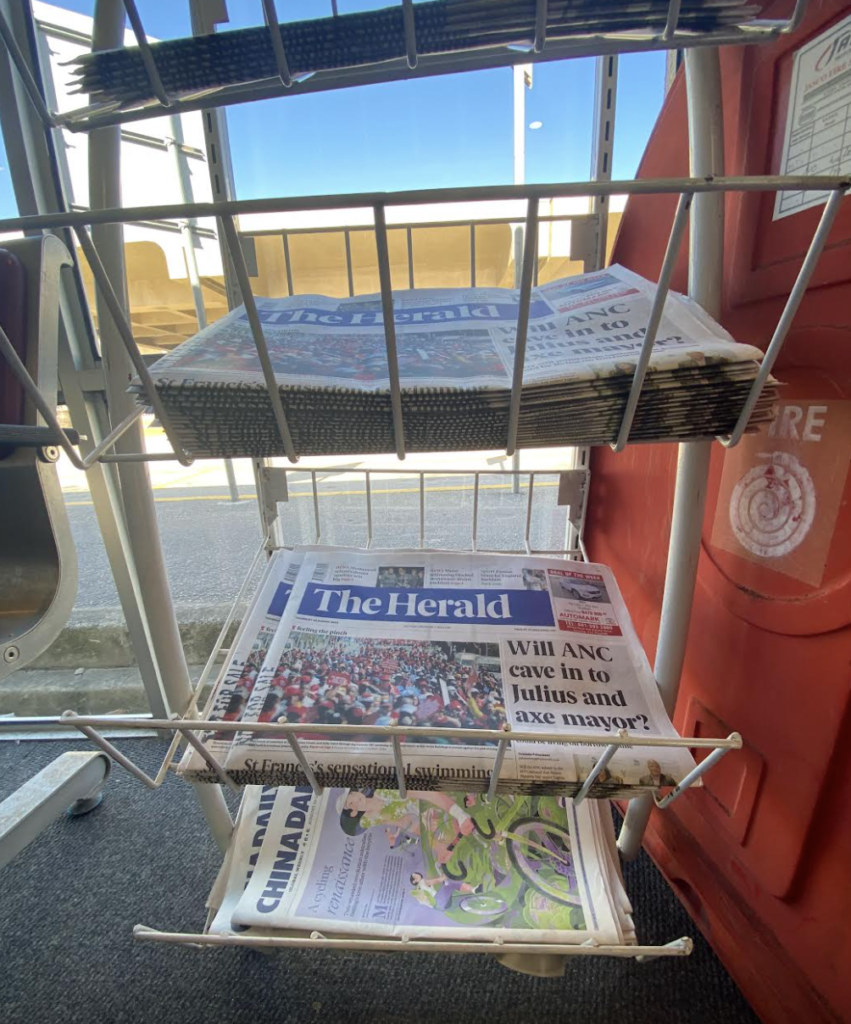
The China Daily offered for free at an airport in South Africa. Photo: Dani Madrid Morales.
As for why local media outlets do this, the motivation isn’t always clear-cut. Many editors don’t have a specific agenda and simply publish content as part of their regular duties, treating foreign content, whether from Xinhua or Agence France Presse, like any other. In some cases, though, like with Independent Media in South Africa, there is a clear financial or political interest in promoting China’s viewpoint. The owner of that media group has close connections with China’s Communist Party and supports China’s global initiatives. Generally, while European people might be more skeptical of content from outlets like Xinhua, many people in other parts of the world don’t see it that way. To them, content from Xinhua is just another news source, just as trustworthy as anything from outlets like the BBC.
To them, content from Xinhua is just another news source, just as trustworthy as anything from outlets like the BBC.
DP: What informs African journalists’ views on foreign media and foreign influence?
DMM: How journalists in Africa view media from different countries, especially China, Russia, and the West, differs significantly from the mindset many of us might have in places like Europe or the U.S.
For example, when I worked at Spain’s national broadcaster covering international news, my colleagues and I would always see the BBC’s reports as trustworthy — though we’d still stay skeptical, like any other journalists — and see Russia’s or China’s CGTN’s news through a very suspicious lens. We were trained to believe that the BBC was pretty independent, while anything from authoritarian regimes like Russia or China was viewed with serious doubt. But when I’ve been in African newsrooms, I’ve noticed that many journalists don’t share that same mindset. To some, the BBC also has an agenda, and they don’t automatically trust it just because it’s from the West. The BBC might align with some of their values, but they’re not blindly following it like we might.
I remember interviewing journalists in Lesotho, a small country in Southern Africa, and I asked them about these concerns with Chinese media. One journalist stopped me mid-interview and asked, “Why are you questioning me about China and not CNN or BBC? Why do you assume that Chinese media is bad?” That threw me off because, from my perspective as someone who cares deeply about media freedom, I could never see China as a good partner for journalists. But to him, it wasn’t about that — his issue was that I was treating China differently from Western media outlets. I think this comes back to a deeper historical context of anti-colonial feelings.
“Why are you questioning me about China and not CNN or BBC? Why do you assume that Chinese media is bad?”Question from a journalist in Lesotho
DP: Do they see Western media organizations like the BBC as more or less reliable than Chinese or Russian state media?
DMM: The BBC has a different legacy for older African journalists — especially those who lived through colonial rule. They remember it as a tool of British colonialism, even though the UK and its foreign policy have changed. In their view, whether it’s China, Russia, or the UK, all these foreign powers come into their countries with their interests. And none of them are genuinely looking out for the local people. So, for many African journalists, it’s not about trusting or distrusting one foreign power more than the other. They tend to be equally cautious of all foreign media, viewing them through a lens shaped by their history with colonialism.
While journalists who studied in the West might still give more respect to French or British media, that’s not the case across the continent. The general sentiment is much more skeptical of foreign press, even if they treat Western media like the BBC differently from Chinese or Russian outlets. And that’s where the real difference lies. Western journalists might see China or Russia as dictatorships that control information, which requires caution when handling their news. However, for many African journalists, that same level of skepticism should also be applied to French or British outlets, given that they, too, have agendas.
DP: How has China become involved in Africa’s media landscape?
DMM: China has been in Africa’s media game since the late 1950s when Radio Peking [now China Radio International] began broadcasts in Arabic for North African countries and Xinhua set up a bureau in Cairo. Despite going through tough times like the Cultural Revolution in the 70s and 80s, China never left the African media space. In the late 90s and early 2000s, China began a push to change how it was seen globally. They used Africa as a testing ground, and by 2004 China had opened a local radio station in Nairobi — the first time they broadcasted locally via FM radio instead of long-wave.
DP: How has their presence changed since then?
DM: The digital era brought a complete transformation in China’s strategy. They established CGTN’s office in Nairobi, produced documentaries showcasing China’s positive impact on Africa, and highlighted significant projects like the Tanzania-Zambia Railway. They were smart about hiring local journalists and investing substantial resources to strengthen their digital presence.
By the 2010s, China shifted its approach. This led to more strategic moves: embedding content in local African media, forming partnerships with media outlets, and having Chinese diplomats take a more active role in public discourse. The real turning point was 2018-19 when their approach became more assertive. Instead of promoting China’s achievements, they actively challenged Western narratives, especially around issues like Hong Kong, Xinjiang, and Covid-19.
DP: What are some trends in China’s messaging that you’re now noticing?
DMM: In recent years, CGTN Africa has focused heavily on Africa, producing two hours of news daily. But there’s been a noticeable shift. While CGTN used to be somewhat more neutral and pragmatic in the early days, there’s now much more ideological content, especially around Xi Jinping and China’s global influence. They cover the US much more, but it’s usually pretty negative — highlighting flaws in American democracy and social issues. It’s not all global politics, though — CGTN Africa mostly sticks to regional matters, like the Sahel region or events in places like Niger and Mali.
China takes a unique approach to covering Africa: it almost always sides with the ruling party.
However, China takes a unique approach to covering Africa: it almost always sides with the ruling party. For example, when elections took place in Mozambique, China’s media congratulated the incumbent before the results were announced. There’s relatively little focus on opposition parties. And just like with other Chinese media, if the government wants a specific topic covered, it will push it.
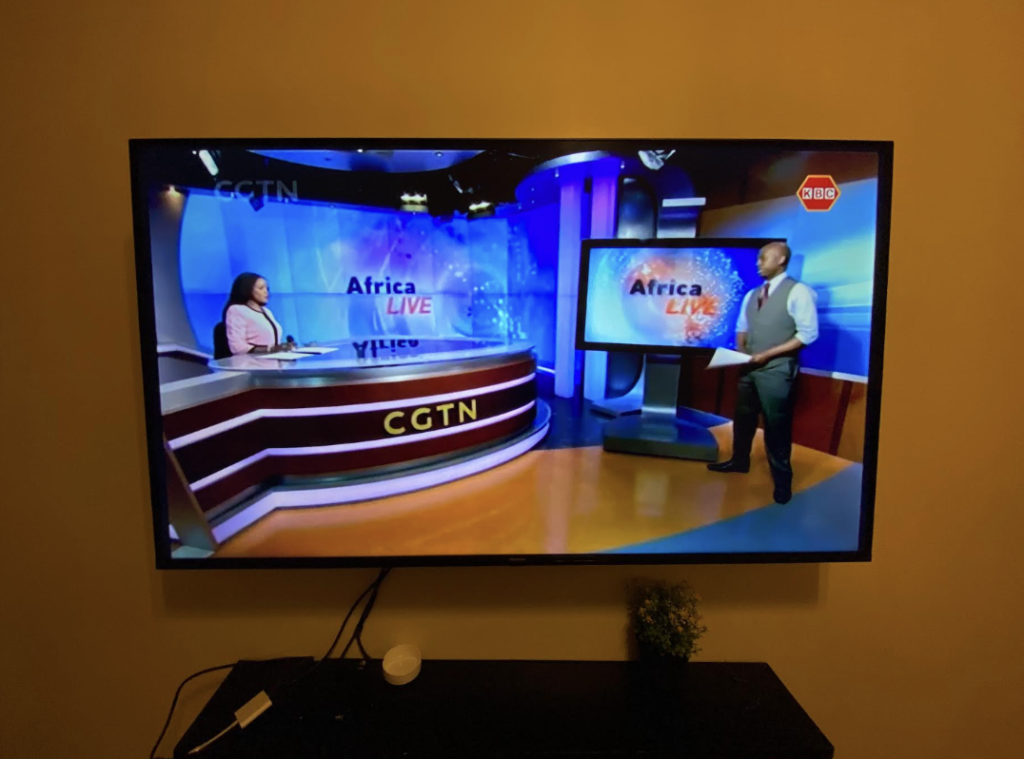
KBC rebroadcasts CGTN’s Africa Live news bulletin. Photo: Dani Madrid Morales.
DP: Can you assess the impact of Chinese media in Africa?
DMM: The impact of China’s media on Africa is complicated. In most African countries, China isn’t a topic in the daily press. It only becomes a focus when a significant event, like a controversy or a state visit. Before Covid-19, Chinese media barely had any presence in local news. After the pandemic hit, coverage exploded, but China’s day-to-day media impact is still minimal. People’s opinions on China tend to come from their personal interactions with Chinese workers or products — not from the media.
For example, during a trip to Kenya, I visited rural areas and asked locals about their views on China. The people had positive views, but it wasn’t because they were watching CGTN or Chinese films but primarily because of their experiences with Chinese workers building infrastructure or running small businesses. It’s the same with Chinese products — people recognize they are often low quality, influencing their opinion of China.
Also, the media landscape makes a difference. There are no permanent African correspondents in China. So, most news comes from agencies like Xinhua or Reuters, not local reporters. This lack of local coverage means China isn’t a daily topic in the news. You might hear about the US or Europe, but China rarely makes the front page unless there’s something big going on.
DP: What about the impact of social media?
DMM: Social media does have an impact, but it’s mostly just for a small group of people — like young, urban folks who are somewhat educated. In places like South Sudan, only 10 percent of the population is online, so social media isn’t significant for most people. But it’s a different story in countries like Ghana or Kenya, where more people have smartphones. Social media, especially TikTok and YouTube, is more important for the younger crowd.
It’s hard to say how much social media directly changes people’s opinions. The big difference is that online spaces have more room for debate and controversy than traditional media, which tends to be controlled by those in power. Like, remember when Chinese businesspeople were accused of mistreating Zimbabweans? That went viral on social media, which wouldn’t have made the news otherwise. China’s getting better at handling these situations, though.
But, honestly, there’s not a massive wave of anti-China sentiment in Africa. Sure, there are small pockets, but it’s pretty marginal. People aren’t talking about China in politics or elections. It just doesn’t come up much. Even if there’s some criticism online, it’s not a big deal. Most of the time, China’s pretty popular.
China is also good at subtly influencing things. CGTN, for example, will back up the government more than the opposition, but it’s not like they’re openly pressuring the media to shut down critical stories. It’s not like in Europe, where Chinese diplomats will put pressure on journalists to kill damaging stories. China’s influence in Africa is much more low-key, and public opinion stays positive.