Tag: Political polarization

Distorted Headlines

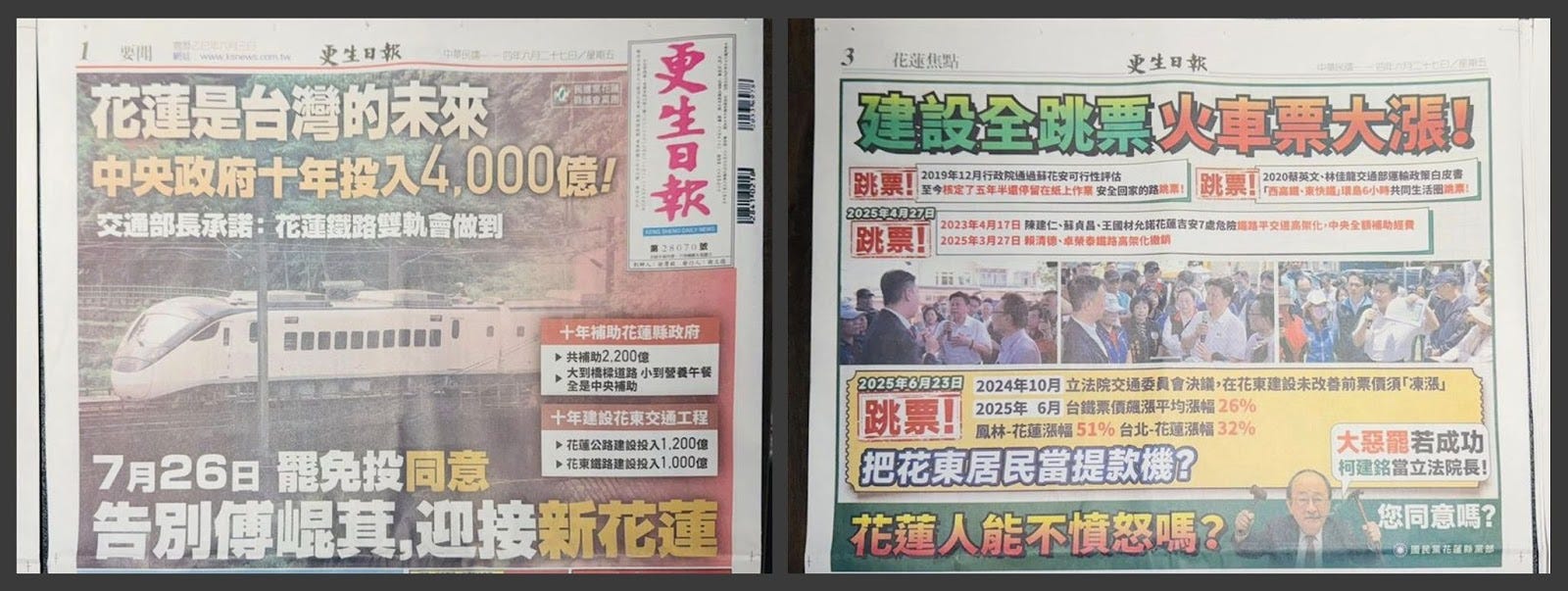
Taiwan’s China Times (中國時報) sparked controversy last month by mistranslating a Reuters report about parliamentary recalls. The paper’s headline claimed “Reuters: Mass Recalls Stoke Social Fear” (路透:大罷免鼓動社會恐懼感). In fact, the quoted assessment came not from Reuters but from National Chengchi University professor Huang Kuei-po (黃奎博).

Reuters reporter Lee Yimou (李憶慕) quickly corrected the misrepresentation on social media, sharing the accurate translation and encouraging readers to practice “media literacy” (媒體識讀). The incident highlights broader concerns about editorial standards and information accuracy amid Taiwan’s contentious recall campaigns, where media outlets across the political spectrum face accusations of bias in their coverage of cross-strait politics.
Dueling Ads

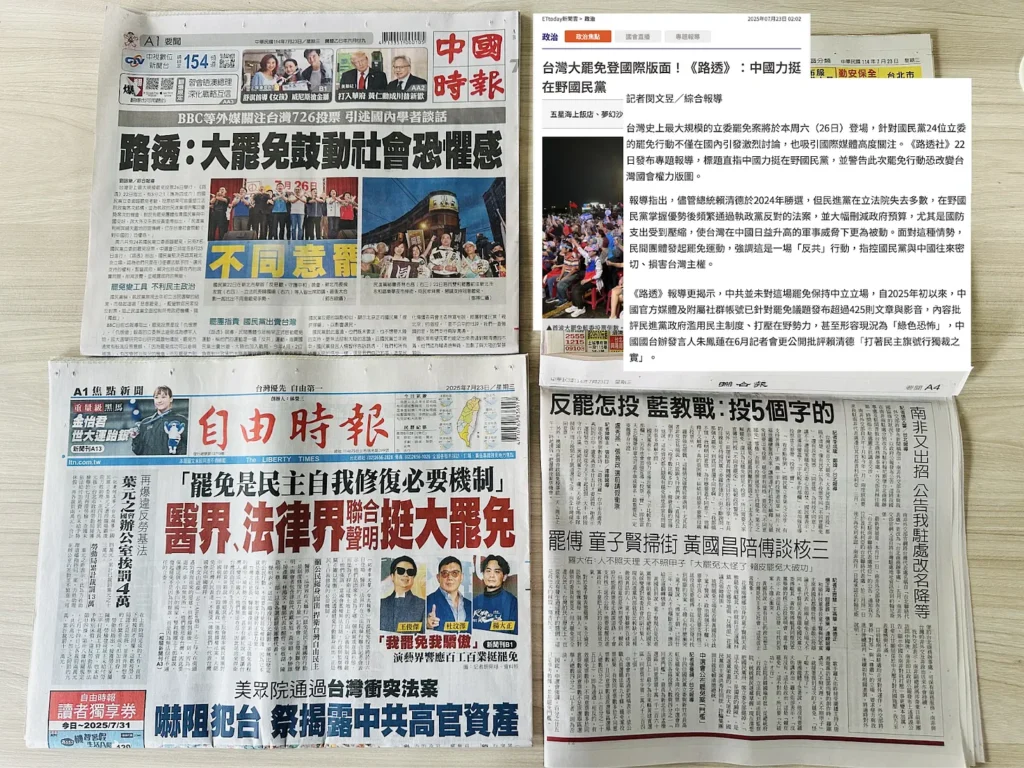
Keng Sheng Daily News (更生日報), the largest newspaper in the eastern coastal Taiwanese city of Hualien, found itself at the center of political theater late last week when it published advertisements from both sides of an upcoming recall election in the same daily edition. Taiwan is presently in the midst of an intensifying recall campaign that could mean early ejection from office for 24 directly elected lawmakers from the opposition Kuomintang (KMT) party. The recall votes are scheduled for July 26. (Read this English explainer from Taiwan’s Commonwealth magazine.)

The Keng Sheng Daily News front page featured a Democratic Progressive Party (DPP) ad targeting a local KMT legislator and urging voters to “Say goodbye to Fu Kun-chi, [and to] welcome a new Hualien.” Inside pages carried a starkly different message from the KMT county office, criticizing the DPP with headlines like, “Construction promises broken, train fares soaring.” Radio and TV host Lin Yu-hui (林育卉), who shared photos of the newspaper on social media, declared: “Hualien’s Keng Sheng battle officially begins” (花蓮更生大戰正式開打). The unusual juxtaposition drew widespread online commentary, with readers calling it “spectacular” and “worth collecting”.

Historically aligned with the opposition KMT, the newspaper appears to be taking paid advertisements from both parties as Taiwan prepares for multiple recall elections. Inter-party politics can be bitter — but so is the battle for media survival.