Tag: Taiwan People’s Party

Political Pulparrazzi

Late last month, Taiwan’s Mirror Daily (鏡報) revealed that Huang Kuo-chang (黃國昌), the chairman of the Taiwan People’s Party (TPP) — the country’s third-largest party in the Legislative Yuan — had since 2021 organized a paparazzi network to follow political figures, including ruling-party politicians, in search of dirt. At the center of the scandal was journalist Hsieh Hsing-en (謝幸恩), who allegedly served as a ghostwriter and paparazzi recruiter for Huang — first while holding a business card from the online outlet RWnews (菱傳媒), and later while employed full-time by the state-run CNA (中央社). Hsieh published stories favorable to Huang on the financial news site Taiwan People News (民報) under the pen name Hsiao Yiyi (蕭依依).

Following the revelations, and before CNA’s internal investigation had concluded, Hsieh announced her resignation in a letter whose expressed Fourth Estate ideals starkly contrasted with the conduct described in news reports. “I deeply believe that the media’s pen should be fearless of power and unafraid of storms, serving as an important force in democratic society to supervise authority,” Hsieh wrote.

CNA’s president responded to the scandal by saying the agency had received complaints two years earlier but lacked sufficient evidence to act. The agency has filed breach of trust charges against Hsieh, stating that her actions have “seriously damaged” its reputation. RWnews, which had provided Hsieh with business cards — something often necessary to access reporting events in Taiwan — announced its shutdown immediately after its president admitted collaborating with Huang. This was apparently a decision by Taiwan Steel Group, which purchased the outlet two years ago.

Image of Hsieh Hsing-en from her Facebook page.

Shame Theater

As supporters of the Taiwan People’s Party staged a march last Sunday outside the headquarters of the country’s Democratic Progressive Party (DPP) to protest election recalls scheduled for July 26, they resorted to a stunt many Taiwanese would find too perplexing to understand as a provocation. Dear NANA, an influencer aligned with the Taiwan People’s Party (TPP), staged an event called “Cleansing the Sins of Democracy” (民主罪人洗門風), during which participants wore Cultural Revolution-style tall hats and placards around their necks while apologizing to passersby for voting in the past for the DPP. Several attendees, including the TPP’s secretary-general, had “shame” written on their foreheads — a reference to the humiliation to which many were subjected under Mao Zedong’s Cultural Revolution (1966-1976). The spectacle sparked an online backlash but received minimal mainstream media coverage. These are historical references few Taiwanese would understand.

Demonstration Deception

Huang Kuo-chang (黃國昌), the chairman of the Taiwan People’s Party (TPP), the center-left political party formed in 2019 by now-jailed former Taipei mayor Ko Wen-je (柯文哲) and in coalition with the KMT, faces criminal investigation after playing what he called a “demonstration tape” (示範帶) during legislative questioning of Justice Minister Cheng Ming-chien (鄭銘謙) on June 16 about alleged misconduct by prosecutors under the current government.

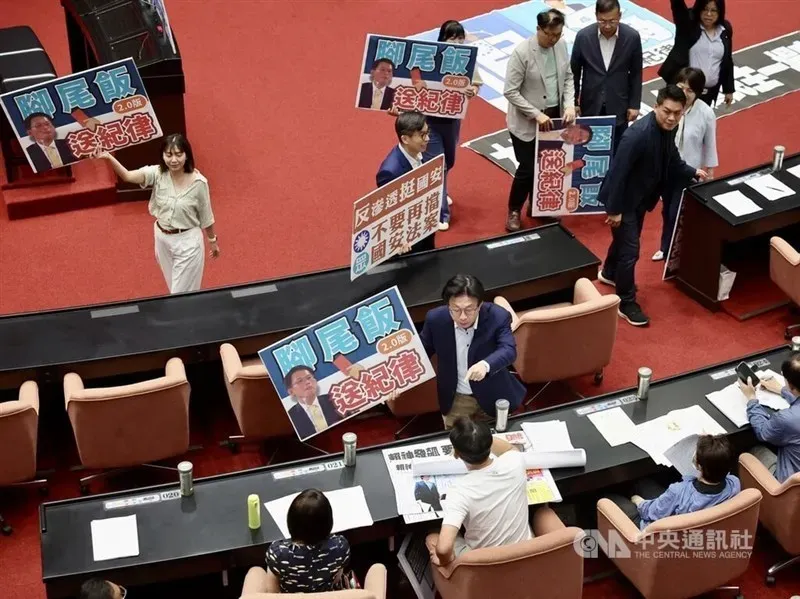
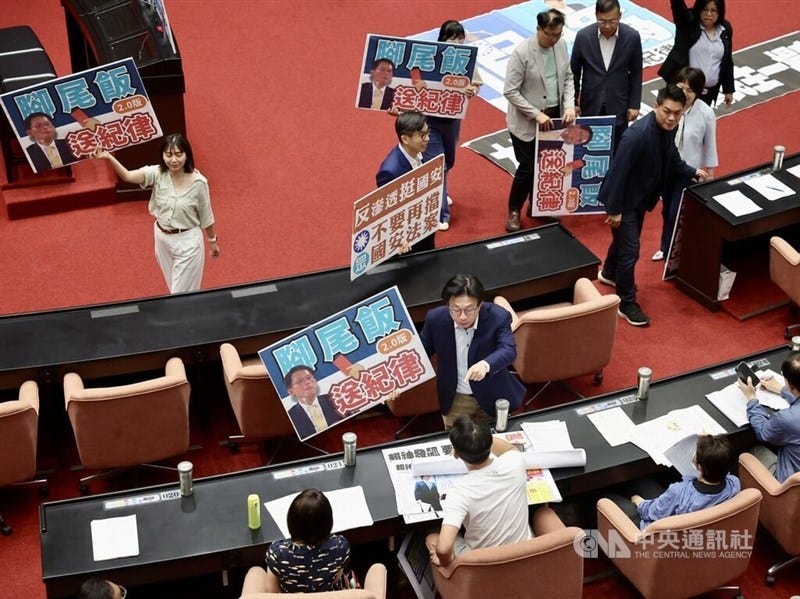
Opposition legislators call for TPP chairman’s referral to the discipline committee. SOURCE: CNA.

The audio, which purported to show prosecutorial misconduct against a suspect named “Mr. Chu,” appeared to feature a prosecutor conducting a harsh interrogation using threatening language, but Huang later admitted to having created the recording himself. Fellow TPP legislator Zhang Qi-kai (張啓楷) complicated matters by claiming to have listened repeatedly to “the entire Ko Wen-je case prosecutor interrogation CD” — implying there had been misconduct in the case against the former Taipei mayor and TPP leader.

The Taipei District Prosecutors Office has opened an investigation into potential document forgery. Critics, meanwhile, compare the incident to Taiwan’s “funeral rice” (腳尾飯) scandal of 2005, in which Taipei city councilor Wang Yu-cheng (王育誠) was found to have staged video purporting to show that funeral parlor workers were selling leftover “funeral rice” (food offerings set beside corpses during funerals) to civilian restaurants — an apparent bid to embarrass the KMT city administration of then-mayor Ma Ying-jeou (馬英九).