

In early September 2025, 26 foreign leaders from around the world descended on Beijing for its Victory Day Parade, marking the 80th anniversary of the end of the Second World War in Asia. The week was packed with diplomatic festivities positioning China as the leader of a new multipolar world, including the 2025 summit of the Shanghai Cooperation Organization (SCO) in Tianjin.
But one diplomatic development on the schedule evaded international media attention. That week, Cuba’s ambassador to China, Alberto J. Blanco Silva, signed a wide-ranging joint media cooperation program with China — covering journalist training, academic exchanges, and documentary production — called the “Media Action Plan for Jointly Building a Sino-Cuban Community with a Shared Future.” The plan was signed not as bilateral agreements generally are, with a Chinese government ministry or state media authority, but with the Communication University of China (CUC), an institution that has shaped generations of journalists for Chinese state media.
A readout released by CUC said the action plan, a roadmap for deeper media cooperation, would build media talent and capacity in Cuba through a series of programs, including the “Global South Media Development Summer School” and a “Sino-Cuban Media Young Scholars Program.” Rather than centering on journalism, however, the mutual goals were defined as “deepening the cooperation [of] China and Cuba and telling a compelling story about a community with a shared future for mankind.”
This phrase, combining one of China’s top slogans for global propaganda with a core Xi Jinping foreign policy concept, perfectly captures the dual mission of a little-known academic institute that is quietly building a worldwide network of university partners to legitimize China’s vision of global governance. The initiative has a familiar antecedent in China’s network of Confucius Institutes, state-funded Mandarin teaching programs embedded in universities around the world that have come under intense scrutiny in recent years. But by contrast, the fast-developing network of the CUC’s Institute for a Community of Shared Future (ICSF) has largely flown under the radar.
Who Needs Confucius?
Established in 2019, the CUC’s Institute for a Community of Shared Future (人类命运共同体研究院), or ICSF, is tasked with promoting the international acceptance of Xi Jinping’s chief foreign policy and global governance concept, the “community of shared future for mankind,” a proposed normative framework that for all of its apparent interest in shared human benefit is a Trojan Horse of foundational authoritarianism — placing the sovereignty of regimes above the rights of individuals. At its core, the concept suggests that all nations should submit to a China-led vision of global harmony in which development, security, and “civilizational” coexistence replace the liberal international order’s emphasis on human rights, democratic governance, and rule of law.
Through its growing global academic network, the CUC’s Beijing institute is serving as a launchpad, spreading Chinese state framing and talking points under the auspices of academic exchange — and developing a global cohort of young journalists and thinkers more amenable to this vision.
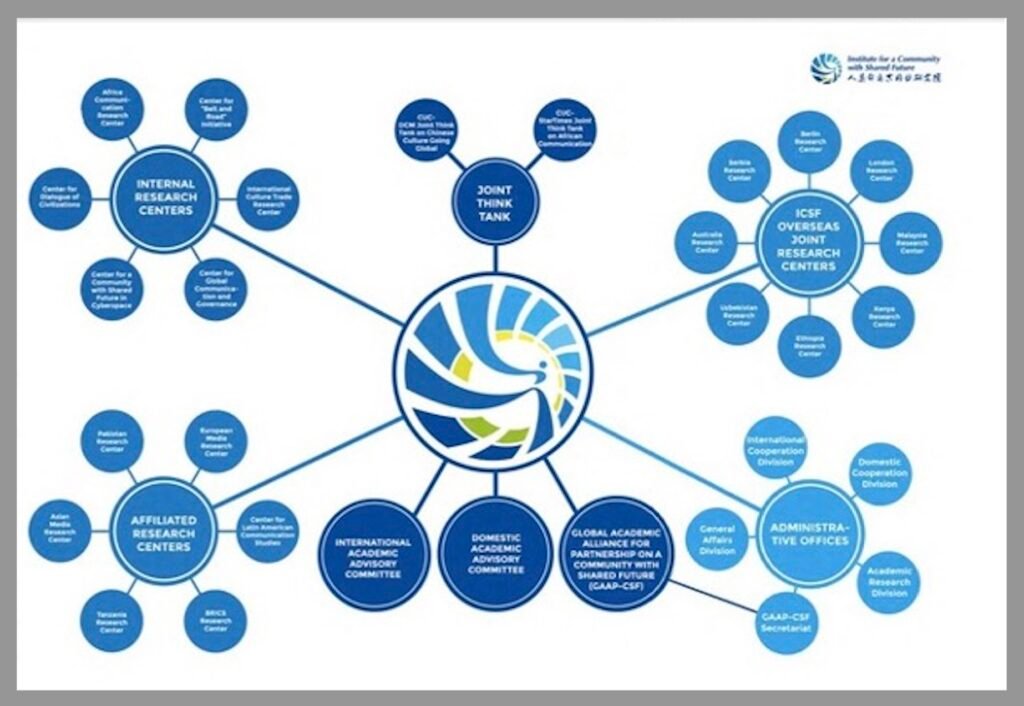
Since 2019, the ICSF has opened 23 Research Centers for Community with a Shared Future, or RCCSFs, across five continents, with the most active in countries such as Pakistan, Venezuela, Ethiopia, and Malaysia that are members of Xi Jinping’s signature Belt and Road, a global trade and infrastructure development initiative.
Most of these are located within media and communication studies or China studies departments of universities and are headed by a single local faculty member. In some cases — such as in Ethiopia and South Korea — the center is established with a state media authority, providing a more direct channel to international media cooperation. The ICSF also offers an English-taught doctoral program in international communication and governance and claims an “international academic network for a community with shared future” with nine member institutes.
China’s interest in the ICSF research center network is neither academic nor journalistic. The ICSF is a prime case study in how the leadership is implementing its strategy to seek greater influence globally — in what officials and state media have repeatedly called a “smokeless war” for “international discourse power.” The Chinese Communist Party’s abiding concern is that China has historically lacked a strong international voice, hampering its ability to push its global agendas. The answer under Xi Jinping over the past decade has been a radical transformation of the infrastructure for what the Party has historically called “external propaganda,” and which Xi has called “telling China’s story well.”
A key aspect on the media side of Xi’s restructuring of China’s discourse architecture is the country’s growing network of more than 200 “international communication centers” (国际传播中心), or ICCs, which fall under the leadership of regional and local propaganda departments. CUC’s Institute for a Community of Shared Future, which comes under the direction of the Ministry of Education (MOE), targets global academic and think tank sectors by outsourcing the research and execution of localized communication strategies to international partners. The goal is to boost China’s discourse power by pushing back — particularly in regions where China is an active trade and development partner — against critical narratives about environmental and community impact, crippling development loans, lack of transparency, and other legitimate concerns that the leadership routinely dismisses as Western journalistic frames intended to undermine China.
There is no need to speculate about China’s intentions for the ICSF. In a signed article late last year, ICSF Director Li Huailiang described his center as “a new path for the international dissemination of China’s knowledge system.”
A Two-Way Street for the China Story
While the ICSF/RCCSF model is reminiscent of China’s Confucius Institutes, whose teachers have long been encouraged to “tell China’s story well,” the ICSF seeks to transcend the “one-way” communication model of the CI system by inviting local stakeholders to generate their own localized knowledge outputs that echo and accommodate the “knowledge system” to which Li Huailiang referred — including promotion of Xi Jinping’s “community of shared future for mankind” as a normative global framework, and breaking through “Western discursive hegemony.”
Nevertheless, familial ties with the CI system remain. In some cases — as in Austria, for example — local RCCSF directors are concurrently directors of their university’s Confucius Institutes, and often collaborate on events.
In Mexico and Pakistan, local RCCSF directors have published books about Xi’s vision for a community with a shared future in collaboration with the CUC. Others have worked with the Central Compilation and Translation Press, directly under the Party’s Central Committee, to publish translated editions of Xi Jinping’s book on a community with a shared future. Venezuela’s RCCSF runs a Spanish-language podcast titled “A Look Towards a Shared Future,” which discusses the two countries’ shared history and culture, and also — in a way reminiscent of state propaganda — lionizes China’s international role in combatting COVID-19.
RCCSF directors also publish columns in local media in their respective countries that praise the accomplishments of the Belt and Road Initiative, and promote Xi’s shared future concept. Directors are regularly sought for contributions to Chinese state media.
Director Li Huailiang has described this cooperation as a kind of propaganda feedback loop in which international scholars not only become “disseminators of Chinese knowledge” but also provide continuous feedback on successful regional communication approaches that can then be applied in those regions.
The Africa Laboratory
RCCSFs have been most abundant and active in Africa, where Chinese media is already deeply intertwined with long-standing development initiatives such as journalist training programs through the China-Africa Press Center (CAPC), low-cost smartphones pre- installed with Chinese news aggregation apps, and campaigns to bring cable connectivity to rural villages operated via StarTimes, a Chinese multinational media company founded in 1988, and headquartered in Beijing, that offers television services across Africa.
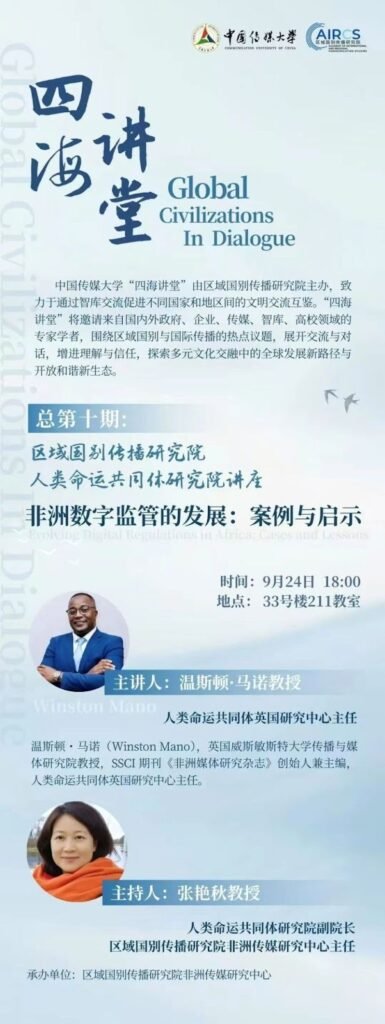
The depth of that entanglement becomes clear when tracing the ICSF’s overlapping institutional connections on the continent. When the ICSF was founded in November 2019, it announced the joint creation of the CUC-StarTimes Joint Media Research Think Tank (中传-四达非洲传媒联合研究智库) in cooperation with StarTimes, though little information about this body and its activities has been made available since that announcement. Other promotional materials on the ICSF’s website mention an African Media Research Center (中国传媒大学非洲传媒研究中心), or AMRC, sometimes identified in English as the African Communication Research Center. The center, which was initially established at the CUC in 2012, now appears to be under the direction of the CUC’s Academy of International and Regional Communication Studies (区域国别研究院), founded sometime around 2022. A single CUC professor, Zhang Yanqiu (张艳秋), holds the roles of ICSF deputy dean and AMRC director. She often hosts exchanges and events identifying herself with both titles.
In addition to the AMRC, the African continent now has five RCCSFs — in Ethiopia, Tanzania, Angola, Nigeria, and Egypt. These cooperate with the AMRC and regional media authorities to organize collaborative academic forums. In August 2025, a group of doctoral students from the CUC visited Ethiopia on a trip led by Zhang Yanqiu under the ICSF. In addition to local Chinese businesses and the Chinese embassy, the students visited the Ethiopian Media Authority, which hosts the RCCSF — and refers to itself as an “autonomous government organization” — as well as the Ethiopian News Agency and Fana Media Corporation, both state news organizations that have close relationships with Chinese state media.
Like the vast majority of China’s academic and media-related engagements, the visit in Ethiopia was chiefly diplomatic. During the visit, Dr. Samson Mekonnen, director general of the Ethiopian Media Authority, stressed that Ethiopian journalism students who had trained at the CUC played an important role in shaping media practices in the country — a candid acknowledgment of how deeply Chinese media training has penetrated Ethiopia’s broadcasting establishment.
In July 2025, at an “Integrated Voice” (融声行动) event, the AMRC and ICSF became founding members of the “China-Africa International Media Alliance” (中非国际传播媒体聯盟), a body that falls under the direct guidance of the Changsha Municipal Propaganda Office and the state-run Changsha Media Group. The alliance’s 63 founding members are an eclectic range of organizations — among them the Changsha Evening News International Communication Center (长沙晚报国际传播中心), the Changsha City New Media Association, a provincial art museum in Hunan, and the African Chamber of Commerce. It is a roster that illustrates the all-of-society architecture China brings to its global communication efforts.
The alliance’s “Integrated Voice” initiative is structured around three pillars — media, universities, and enterprises — and aims to integrate both official and non-governmental communication resources to establish a “multi-faceted, collaborative” mechanism operating across sectors. As of July last year, it had established media cooperation bases in six countries, enlisted more than 100 “African International Social Media Communication Officers” (非洲籍国际社交媒体传播官), and produced a reported 500-plus videos. That Changsha anchors an Africa-focused media alliance is no accident. The city has cultivated unusually strong ties to the continent in both media and trade, and has become a hub for the regionally targeted ICCs that are central to China’s international communication strategy.
This convergence of ICSF and ICC activities in Africa offers the first documented case of the two systems operating in formal institutional concert — though it is far from surprising given China’s all-of-society approach to communication, soft power, and diplomatic engagement. CMP researchers have used the term “Centralization+” to describe this multi-tiered system of media organizations and propaganda networks (including local digital production centers) that coordinate on messaging while working together with horizontal partners in business, academia, and media to maximize their reach (download the report below).
The ICSF functions as one of many horizontal partners, tied together with other bodies by international communication alliances, or ICAs, like those described above. Aside from the China-Africa International Media Alliance, ICAs have been established in Luoyang, Ningxiang, the Beijing-Tianjin-Hebei corridor, Wuxi, Wenzhou, Zhejiang, and even at the district level in the case of Changsha’s Yuhua district.
In Africa and beyond, the “community of shared future for mankind” has become a primary frame for diplomatic cooperation between China and developing nations, and the ICSF has begun to play a more active role in these diplomatic developments in countries like Cuba. During last year’s Victory Day festivities, as the CUC and Cuba’s ambassador signed the media action plan, Cuba’s President Miguel Díaz-Canel Bermúdez met with Xi Jinping. The two agreed to “accelerate the construction of the Cuban-Chinese Community of Shared Future.”
Southeast Asia is another key focus. In July 2025, China inaugurated an RCCSF in Malaysia that targets the ASEAN countries, and that was first mentioned in a joint statement signed by Xi Jinping and Malaysian Prime Minister Anwar Ibrahim called “Building a High-level Strategic Malaysia-China Community with a Shared Future.” Its establishment was widely publicized in Malaysian media as well as by regional RCCSF directors in their respective national media outlets.
Far from being a footnote to China’s international media strategy, the ICSF’s expanding footprint is integral to it. Since 2013, Xi Jinping’s approach to “external propaganda” has centered on the imperative of “telling China’s story well” — which means pushing back against more critical narratives that might undermine the country’s global ambitions, and projecting a vision of Chinese governance and global order that is, as David Mrisho, director of the East African RCCSF, writes, friendly and constructive. The ICSF network extends this mandate into media and academic institutions across the world, recruiting a chorus of foreign voices that can sing in close harmony with China’s own.
________________________
CMP’s “Centralization+” report maps the growing network of international communication centers, academic partnerships, and cross-sector alliances China is deploying to reshape global narratives — and what it means for information integrity worldwide.