

When the Party declared in 2020 that Mongolian-language education would be pulled out of the curriculum throughout schools in China’s Inner Mongolia region, the reaction from the public was immediate. Parents protested by keeping their children at home. Students gathered outside schools in tears, according to an account from one human rights monitoring site, and chanted: “Our mother tongue is Mongolian — until death, we are Mongolian.”
The movement of civil disobedience spread rapidly, drawing in artists, civil servants and even Mongolian-ethnic police officers who refused to carry out orders. Thousands of arrests followed, as well as the closure of many local media. Today, China continues its campaign of assimilation, moving against digital communities maintained by Mongolian speakers.
Soyonbo Borjgin was one of the journalists working forInner Mongolia Life Weekly (內蒙古生活週報) when the crackdown occurred. A reporter who had spent years doing sports coverage, and writing feature stories about Mongolian life under Chinese rule, Borjigin quickly became enmeshed in the social movement. After publishing an interview about the need for mother-tongue education, the newspaper was accused of “narrow nationalism.” With the Weekly shuttered and his career in Chinese journalism over, Borjigin left for the United States, landing at Voice of America’s Mongolian service.
In early 2026, he launched PropagandaScope, a data platform that tracks Chinese state media in real time — monitoring which political figures appear, which phrases are amplified. One particular area of interest for him is how various regions are targeted with specific variances in ideological messaging. Borjigin spoke with Lingua Sinica about the gradual decline of the Mongolian cultural space within China, the abrupt violence in 2020, and how AI tools can help us better understand China’s media messaging.
Throughout this interview, Borjigin uses the term “Southern Mongolia” (南蒙古) to refer to his place of birth. This is a term preferred by Mongolian activists, diaspora communities, and many ethnic Mongolians who reject the framing embedded in “Inner Mongolia” (内蒙古).
Dalia Parete: Earlier this year, you launched the online platform PropagandaScope, and we’ll get to that. But before we do, let’s go back. You worked as a journalist for Inner Mongolia Life Weekly. What did the Mongolian-language media landscape look like back then? How many outlets existed, and what kind of journalism was possible?
Soyonbo Borjgin: The Mongolian-language media system in Southern Mongolia is similar to the Chinese-language media ecosystem, but also affiliated to mainstream society. When you become an ethnic minority, you are very marginalized, so a lot of what we do depends on what Chinese-language media do. But to a certain degree, we do have our own small space to write interesting stories.
The Inner Mongolia Life Weekly (内蒙古生活周报) was born in 2000, during the urbanization phase of Chinese news media. We also had the Inner Mongolia Daily (内蒙古日报), that was filled with feature writing, of similar style to the Guangzhou-based newspaper Southern Weekly (南方週末), famous for its investigations and social commentaries. We didn’t work quite on that level, but we tried to do something similar in the ethnic minority language space.
We did feature writing. We did sports. We had a “Modern Love” column written by our readers, which was my idea, stolen from the New York Times. And we did a little bit of economics reporting, because the local propaganda office wanted us to report on local economic development. We didn’t really cover a lot when it came to politics. Only during the Two Sessions, or maybe when Xi Jinping attended a military parade. Then we’d have a big picture of him. Otherwise, our editor-in-chief actually told us: You guys, this newspaper is not designed for political reporting — so you should actually write less about politics. We were all very happy about that. When reporting about politics, you don’t have the independence to write whatever you want because you have to translate it from the official Chinese sources. And, because we were a Mongolian newspaper, we had a very small chance to actually interview political figures.
In Southern Mongolia, the media is organized by level — provincial and county. The higher your media outlet is in the hierarchy, the more respect you get. When I showed my press ID from a provincial-level outlet, the propaganda office treated me well. County-level journalists were treated worse. Journalists from Xinhua, China’s top state news agency, were treated the best. Basically, the Communist Party’s ranking system runs through the entire media world.
DP: As early as 2006, two Mongolian-language websites were shut down. This was fourteen years before the 2020 crackdown. From your point of view, did the erosion feel gradual, or did 2020 come as a rupture?
SB: I see it happening both ways. At the infrastructure level, it happened gradually. In 2020, it happened all of a sudden.
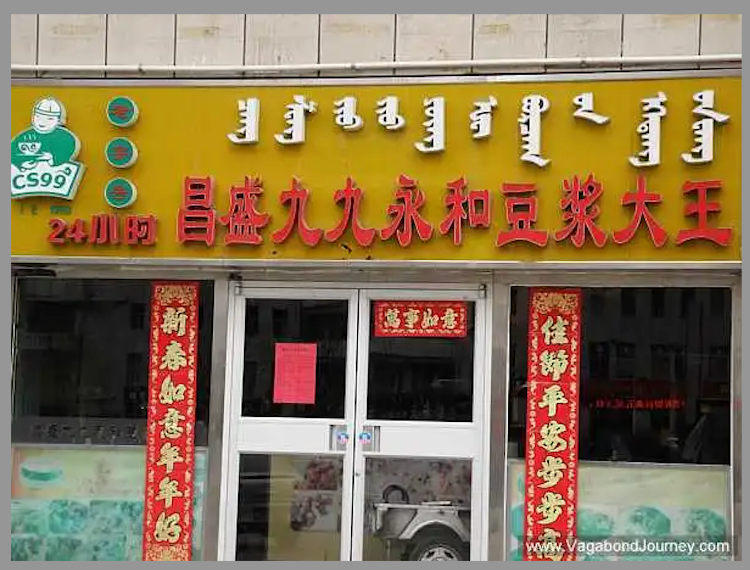
Before 2020, local law required all public signs to be bilingual, Chinese and Mongolian, in equal size. But when I was growing up, a lot of translations (into Mongolian) were wrong. Many Mongolians talked about this. They sent letters to the local government saying this sign is translated incorrectly, that sign is translated wrong. And the government actually took some measures to require the person responsible to adjust it to the correct form. But this was really gradual. It happened very slowly.
From kindergarten through college, I learned Mongolian, but my class was really small. I grew up in Hohhot, the capital, and we only had 29 kids. I didn’t even have a same-desk classmate (同桌). And we had only two Mongolian schools in the whole city, for three or four million Mongolians in the region. If we spoke Chinese, parents became concerned, and teachers were upset.
Even as a reporter much later, my press ID read “Inner Mongolia Life Weekly — Mongolian edition” (内蒙古生活周报, 蒙古文版) and once they saw that word, the local propaganda office would ignore me. The Chinese edition just says “Inner Mongolia Daily” (內蒙古日報), no Chinese label needed. So we had trouble being taken seriously. I was in my 20s, from the Mongolian edition of our newspaper, and nobody cared.
Marginalization has always been there. Even outside of work, if you spoke Mongolian on the bus, Chinese people would refer to it as a “bird language” (鳥語), meaning it sounded to them like gibberish. It just felt that you couldn’t belong to mainstream society. But of course you still had to be very involved in it. You watched CCTV. You were on Weibo and WeChat. You were living in society, even as society pushed you away.
If we spoke Chinese, parents became concerned, and teachers were upset.
DP: And how did that change in 2020?
In 2020, it shifted suddenly. They shut down our newspaper and officials started to ask questions like how many Chinese friends you had, or what your opinion was on such and such a policy.
But the policy change wasn’t the worst part. People changed too. And relationships changed overnight. A re-education teacher — who had worked at the Daily for over 30 years, an old colleague of our editor-in-chief, someone who used to say “Hi” in the hallway — told me the Mongolian language was so backward that it lacked vocabulary for scientific terms. Modern science only existed in Chinese, they said. All of a sudden, these people were looking down on you.
I think my parents’ generation felt this shift more deeply because they’d lived through the Cultural Revolution. In Southern Mongolia, more than 16,000 people were officially killed, tortured, and killed in many different ways. Every family has a traumatic story. In 2020, a professor from Inner Mongolia University whispered to me: “This is the Cultural Revolution.” People like me, we didn’t know what that really meant. But older people were terrified. They would put their phones in the microwave and then come in and talk. Eleven people committed suicide during the 2020 protests. Thousands were arrested. And people like me, we were marked for “re-education.”
DP: In 2020, as part of the CCP’s crackdown on the Mongolian language, Inner Mongolia Life Weekly was shut down. Can you walk us through how that unfolded?
SB: In April 2020, we heard that the National Ethnic Affairs Commission (中華人民共和國國家民族事務委員會) had submitted a document to the Two Sessions committee, saying that the level of governance in some autonomous regions had already transgressed the constitutional level, meaning they were too independent. We knew that after Xinjiang and Tibet, it was going to be us. At first, I couldn’t believe it. The bilingual education policy, which guarantees the Mongolian language and identity, had been protected since 1984 under the Regional Ethnic Autonomy Law (民族區域自治法).
I’m the generation that grew up during globalization. My stereotype of society was becoming increasingly open. And all of a sudden, they were going to cancel Mongolian education. So we decided to have a meeting at Inner Mongolia Life Weekly, where we agreed we would report on the incoming education policy. Our deputy editor-in-chief said at the time something like: If we cannot speak the language, who are we going to be? We need to do this for our kids. We all have kids. We have to fight for the Mongolian language. We are human. Why don’t we do something? And then we all agreed we had to do something about it.
DP: And how did that go?
SB: There’s a rule in the media — that as long as the propaganda office didn’t say you could not report something, you can. They never banned us from reporting on the education policy because they were never going to admit there was a language reform coming.
So we interviewed a professor from Inner Mongolia University. We couldn’t say the policy was taking effect in September. Instead, we asked: Is it better to be educated in your native language or a foreign language? Of course, he said, there are a lot of benefits to learning in your mother tongue.
The video was 30 minutes long. Within two days, it had 100,000 clicks. Generally, the average is around just 1,000 or 2,000 for Mongolian-language media. On the third day, the propaganda office called us directly — something unprecedented — and ordered us to delete it immediately. My colleague Munkhbayar also took my name off the video so I could eventually leave the country.
A re-education teacher told me the Mongolian language was so backward that it lacked vocabulary for scientific terms.
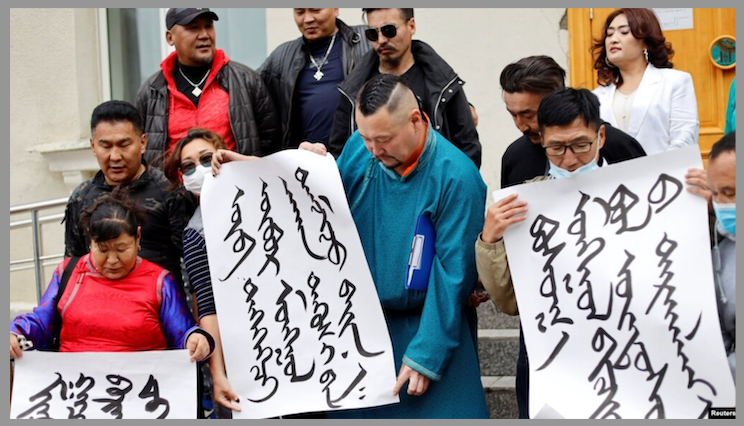
On August 26th, the Mongolian social media app Baiju was shut down. People moved to WeChat group chats, sending voice messages and pictures, and started gathering. Then kids began to protest. High schoolers left their campuses. Parents kept primary school children home. Authorities pressured state workers to keep their kids in school. So people took the extreme step of filing fake divorces to avoid guardianship of their kids, and make sure they weren’t held legally responsible for keeping kids in class. The government responded by suspending all divorces from September to December.
I remember that youth tied signs to their bikes reading “Save the Mongolian Language” and rode through the streets. Shamans performed curses against the state. People raised the black banner in Mongolian tradition, in which the white banner means peace and the black banner is a declaration of war. It was a stunning display of civil society in action.
On the third day, the propaganda office called us directly — something unprecedented — and ordered us to delete it immediately.
DP: Can you tell me what happened to you and your colleagues at Inner Mongolia Life Weekly after the 2020 protests?
SB: On October 31st, I got a phone call from the authorities. They told me the newspaper had a serious political problem, what they called “narrow nationalism” (狹隘民族主義), meaning prioritizing loyalty to an ethnic group over the Chinese state. I understood this to be their way of pointing at “separatism” (分裂主義) without actually using that word. In China, ‘separatism’ carries weight and it is a charge with severe consequences, so they never said it directly.
The Central Commission for Discipline Inspection (中央紀律檢查委員會) told us something we were not expecting, that our wrongdoing was regarded as more serious than that of the Inner Mongolia TV station staff — who had actually filmed a petition signing during the protests and uploaded it to YouTube. YouTube, they said, carries no state authority. Our newspaper did. What we published, the state published, they said. We had never thought of our masthead that way. Three people at the TV station were expelled. Our editor-in-chief, deputy editor-in-chief, and a colleague were transferred to night-shift proofreading.
After that, Mongolian media became really scared. You can sense it today in everything they write. The Inner Mongolia TV station’s Mongolian WeChat account uploads Xi Jinping’s golden sentences every day. Articles are no longer written by Mongolian journalists. There are only translations of work by Chinese journalists. The front page never carries a Mongolian name. The literature page is entirely translations of Chinese poems into Mongolian.
Sometimes I now see my former colleagues’ names in the newspaper, and they are now working as proofreaders only.
For people who are not familiar with PropagandaScope, could you introduce it? And why did you start it?
James Leibold, a professor at La Trobe University who studies Chinese ethnic policy, wanted to find out how many Mongolian schools were being renamed. His idea was to use Baidu Map APIs — Baidu has far more geolocation data in China than Google Maps. I tried to register, but couldn’t. The idea stayed with me, though, of using computational tools to understand Chinese society.
Around that time, I started experimenting with AI-assisted coding. I had some basic programming knowledge, enough to understand how it works, but not enough to write it by hand. But I realized I could actually build things.
I’d always been fascinated by Kremlinology, the practice of reading political signals through official state media. I thought: this is exactly what AI should do. Feed it key terms, run it every day, watch what state media says and doesn’t say. I built a tool. A lot of people liked it and it became PropagandaScope.
What are one or two trends you’re seeing right now in what Chinese state media is saying?
The first thing I searched for in PropagandaScope was “forging a common sense of the Chinese nation” ( 中華民族共同體意識). The idea is that you are not Mongolian, not Uyghur, not Tibetan, you are part of the “Chinese nation” (中華民族). I wanted to see which provincial media were pushing this narrative the hardest.
For the platform, the People’s Daily, the Party’s flagship newspaper, is the baseline. I found that, for every time it uses “Chinese nation” once, Xinjiang Daily, for example, uses it 18.5 times. For Tibet Daily, its 16 times. For Inner Mongolia Daily, 11 times. But in places like Zhejiang, Guangdong, and Fujian — the more economically developed coastal provinces — the use is just 0.7 times. The targeted audience is obvious. Those coastal provinces are talking about Trump, trade wars, sanctions, and oil prices. We are being told who we are.
The second trend I’ve followed is the return of the term “people’s leader” (人民領袖), a sign that the language around Xi Jinping is getting even stronger. It is an unusually strong honorific, the kind I never heard growing up.
Soyonbo Borjgin is a journalist and writer from Southern Mongolia (Inner Mongolia Autonomous Region), based in New York City. A former reporter at Inner Mongolia Life Weekly, he later worked for VOA’s Mongolian language service. He is the founder of PropagandaScope,a platform that maps how the Communist Party’s messaging moves through Chinese state media. His work examines language politics in contemporary China and their impact on minority communities.

