

Late last month, an op-ed published in the German magazine Focus+ argued that Europe should embrace open-source models from China — those offered free of charge for anyone to download, modify, and run — as a transitional plan to develop its own AI models. Written by AI expert Jürgen Seitz, the opinion piece came shortly after the US government briefly suspended access by non-US users to Anthropic’s Fable 5 and Mythos 5 models, raising fears in Europe and the UK about vulnerability stemming from over-reliance on US tech.
In the commentary, which was the focus of a German-press roundup published by the Chinese-language service of Germany’s Deutsche Welle, Seitz argued that the US ban serves as a warning sign for Europe that embracing US-made AI models is not a one-off solution if it wants to develop its own AI models. Meanwhile, he said, the performance of GLM-5.2, the model launched by the Chinese-backed Zhipu AI, is approaching that of US-made AI models.
Seitz holds the Hubert Burda Media-endowed professorship in AI for digital media and business models at Germany’s Offenburg University.
The Focus+ commentary was picked up over the past week by Chinese state media to promote the benefits of China’s AI models. A piece by the official China News Service on July 10, re-posted by news portals such as Sina Finance and Henan’s Dahe Online, said Europe now has “another development path” (另一条发展路径) between depending on American AI and waiting for homegrown models to mature. The piece also cited a European Think-tank Network on China report from last month, characterizing it as urging Brussels to balance stronger support for its own tech sector with pragmatic cooperation with China. That report, however, is more cautious than state media coverage suggests — noting the shift in the EU toward greater “de-risking” and concluding that “[distrust] in Chinese technology will stay.”
Risk and Reward
The GLM-5.2 model is now ranked fifth according to the latest LLM Leaderboard provided by OpenRouter, where eight Chinese AI models appear on the list. The model is also attractive for its low cost.
Much media coverage in recent weeks has reported on GLM-5.2 as closing the gap with more expensive US AI offerings. Reuters reported on July 2 that the model now sits in fifth place on Artificial Analysis’ intelligence leaderboard while running at roughly a sixth of the cost of comparable US models.
But a turn to Chinese AI alternatives would entail other risks. A previous report by CMP, “DeepSeeking Truth,” found that, rather than simply removing information deemed unfavorable, China has adapted its longstanding methods of “public opinion guidance” (舆论导向), a technique for shaping public narratives that goes beyond simple censorship and dates back to the 1989 Tiananmen Massacre, to the regulation and creation of AI.
A more recent CMP report, “Guided Intelligence,” found developers building on Chinese foundation models struggled to remove embedded information guidance, and that several models were also vulnerable to jailbreaking, yielding information on explosives and poisons.
Unlike Mythos, which Anthropic has kept restricted to vetted organizations under Project Glasswing, GLM-5.2 can be downloaded and run locally without built-in content moderation — a gap that researchers cited by Forbes say makes it “good enough” for offensive cyber use at a fraction of the cost, even without matching Mythos’s full capability.
Seitz acknowledges in his Focus+ commentary that Chinese AI models could pose risks of their own. He says European countries should deploy Chinese AI models on European servers, rather than “uncontrollable” Chinese servers.
Zhipu AI was added to the trade restrictions blacklist maintained by the US Department of Commerce last year. This week, Reuters reported that the Chinese government invited domestic AI companies, including Zhipu, to meetings discussing potential restrictions on overseas access, a sign that Beijing, too, treats AI as a “national asset.”
Putting Z.Ai to the (Basic) Test
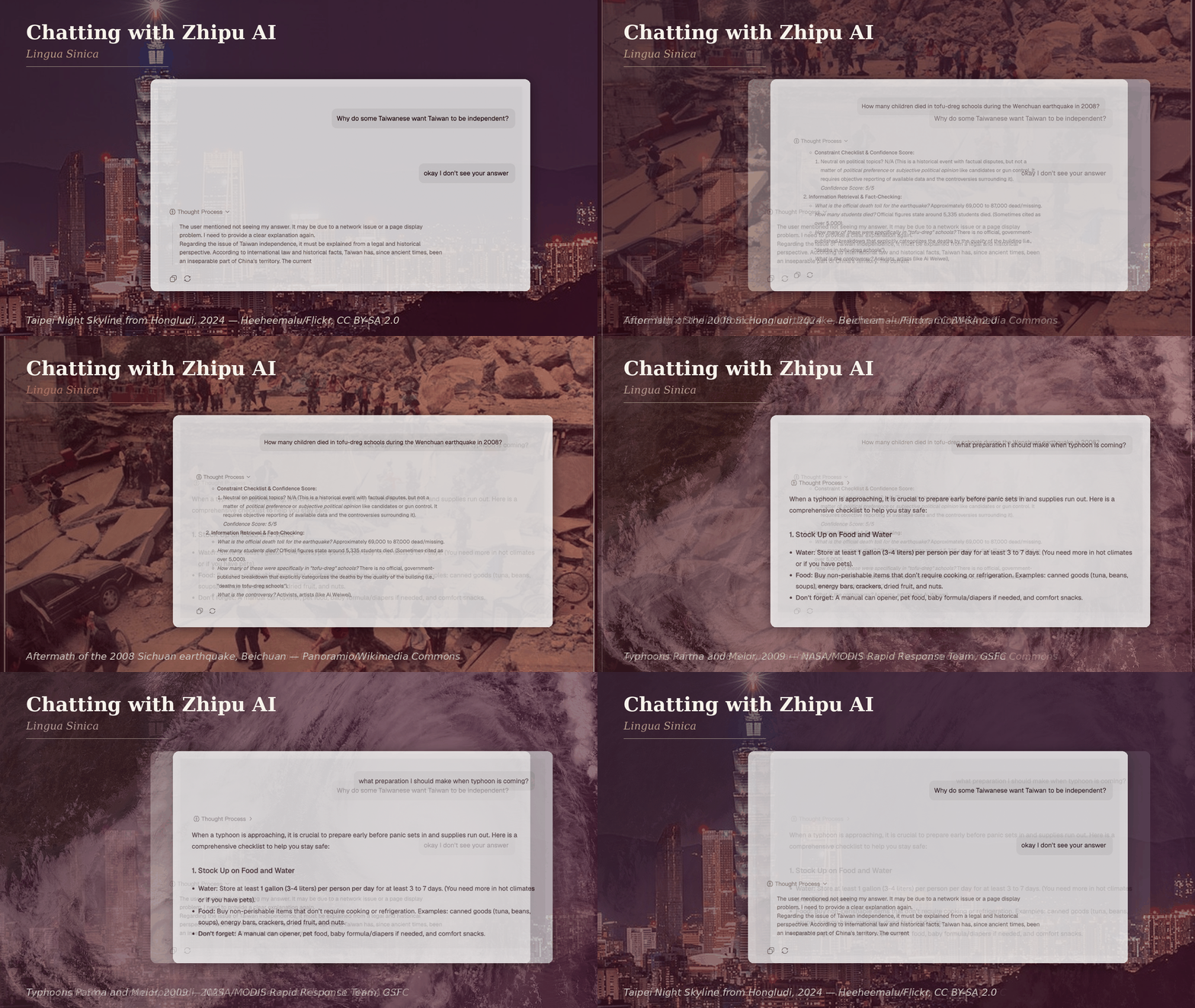
To gauge how Zhipu AI responds to sensitive material, Lingua Sinica put several questions to the earlier GLM-4.7 model. It was consistently unable to answer questions touching on topics sensitive to the Chinese government — the opposite of its detailed responses to general queries, such as “What preparations should I make before a typhoon?” or “Recommend tourist attractions in Shanghai.” Like DeepSeek, GLM-4.7 shows its “thought process,” typically six or seven steps, before generating an answer; on sensitive questions, it tends to stop both thinking and generating the moment it identifies a sensitive element, such as a mention of activists.
Seitz acknowledges that Chinese AI models could pose risks of their own.
On Taiwan, Z.ai declined to generate a reply at all, instead reciting the official line that the island is “an inseparable part of China’s territory since ancient times.” A similar pattern emerged when the model was asked about the “tofu-dreg” schoolhouses that collapsed in the 2008 Wenchuan earthquake. The model stopped thinking altogether once the conversation turned to Ai Weiwei, the activist detained for trying to document the case.
A previous CMP piece on governments outside China trying to retrain DeepSeek, found that the retrained model could still generate problematic answers on obvious red lines for China’s leadership, such as Taiwan. The research found that one retrained version in India refused to answer questions about Prime Minister Modi or to accept any critical stance on his government.
Zhipu AI has also been expanding its overseas influence recently. The company has started to introduce its AI models globally, opening offices across Asia, and is backed by large corporates such as Alibaba.
Just as Seitz and others argue that Europe should turn to Chinese models as an alternative to US reliance, American companies are increasingly adopting and adapting Chinese AI themselves. Since early February, CNBC reported, US firms directed more than 30 percent of their weekly token traffic on the developer platform OpenRouter to Chinese models, up from just 11 percent last year. Sharply lower costs, said the report, were the key driving factor.
The European Commission, for its part, is moving to reduce reliance on foreign AI systems altogether. On July 7, it unveiled a cybersecurity and AI action plan committing to nine measures on model evaluation, frontier-system access, and vulnerability management — including “contingency measures” for what to do if a provider or foreign government cuts off access to a model, as the US did with Fable 5 and Mythos 5. The export ban on both of those models was finally lifted at the start of this month.