

From April 11 to April 15, 2026, Spain’s Prime Minister Pedro Sánchez visited China — his fourth official trip to the country in just over three years. The relationship between China and Spain has gradually become one of the most substantial among EU member states, with Madrid actively positioning itself as a bridge between Beijing and Brussels at a moment when the European Union’s relations with the United States are under strain. Sánchez signed a number of economic deals in Beijing as well as an agreement on strategic diplomatic dialogue — a tangible sign that ties continue to deepen.
But another key component of China’s deepening relationship with Spain in recent years has been increased cooperation and engagement on media and information. China’s growing media engagement in Spain, involving a range of actors, has unfolded as the country’s media landscape is already under significant strain amid commercial pressures, political polarization, and the spread of disinformation.
Through cooperation agreements with the Agencia EFE and Europa Press news agencies, China has steadily gained access to Spanish audiences. At the same time, diaspora media outlets — some aligned with or closely linked to Chinese associations — serve both as platforms for Chinese-speaking communities and as channels for Chinese state messaging. Adding further complexity to this landscape is the role of the Chinese Embassy, which has directly intervened in political and academic settings, pressuring universities and lobbying parliament on matters it regards as being in China’s strategic interests, including Taiwan.
Lingua Sinica sat down with Shiany Pérez-Cheng (鄭夏霓), an analyst specializing in China’s information manipulation and interference, to examine how these dynamics intersect, mapping the architecture of Chinese influence in Spain.
Dalia Parete: For those who aren’t so familiar with Spanish media, what does the media landscape look like in the country today, and what are the biggest challenges facing it?
Shiany Perez-Cheng: The current media landscape in Spain is marked by a high degree of concentration within large media groups, an increasing reliance on public subsidies, and a critical juncture defined by political polarization, declining levels of public trust, and ongoing digital transformation. Television and the internet remain the dominant channels of media consumption, while digitally native platforms are progressively gaining influence
The main challenge is the shift from print to digital. Traditional media have to make that migration and still turn a profit — without losing readers to platforms like TikTok, especially younger audiences. And the speed of those platforms creates its own problem: anyone with a smartphone can record a video, post it, and it spreads before any journalist can verify what actually happened. Reporters still do the due diligence — fact-checking, verifying sources — but that takes time, and disinformation doesn’t wait. On top of that, Spain’s media is concentrated in a few groups that are deeply politically polarized. So it’s hard to find reporting that isn’t aligned with one camp or another, either backing the government or undermining it.
DP: Can you give an example of how disinformation plays out in practice?
SPC: Two years ago, we had a devastating landslide in Valencia, the worst crisis since the pandemic. In just 24 to 48 hours, heavy storms killed 205 people. And immediately, there was disinformation. People were saying no help was coming, that the armed forces weren’t being deployed. There was one case that really caught my attention. About a week after the landslide, the King visited the zone. That same day, regions across Spain were sending resources in solidarity — civil protection, police convoys. And someone filmed a convoy arriving and posted it, claiming it was the King’s security detail, as if the government only acted because of his visit. That wasn’t what happened at all, but the video spread instantly.
This is especially dangerous during disasters or conflicts. Now the same thing is happening with the 2026 war in Iran. Even traditional media with reporters on the ground in the Middle East get accused of relying on US propaganda, and the reporters have to defend themselves, saying, “No, we are here, this is what’s actually happening.”
DP: And how would you characterize media concentration in Spain? I understand there are a number of media conglomerates.
SPC: There aren’t that many media groups. That’s the problem. And international politics in Spain tend to get filtered through a domestic political lens. You get two polarized camps and not much room for anything else. Again, take the war in Iran. Spain has been the most vocal country against it. And all you find is one side supporting the government’s position, and the other one opposing it. Two camps, no middle-ground analysis.
DP: Has it always been like this, or do you think it changed?
SPC: I think here in Spain, international politics tend to be built around the domestic perspective. Political parties and their respective friendly media use it to undermine political opposition on domestic grounds. They don’t try to explain things to the domestic audience. They adapt the narrative of the international situation to domestic issues.
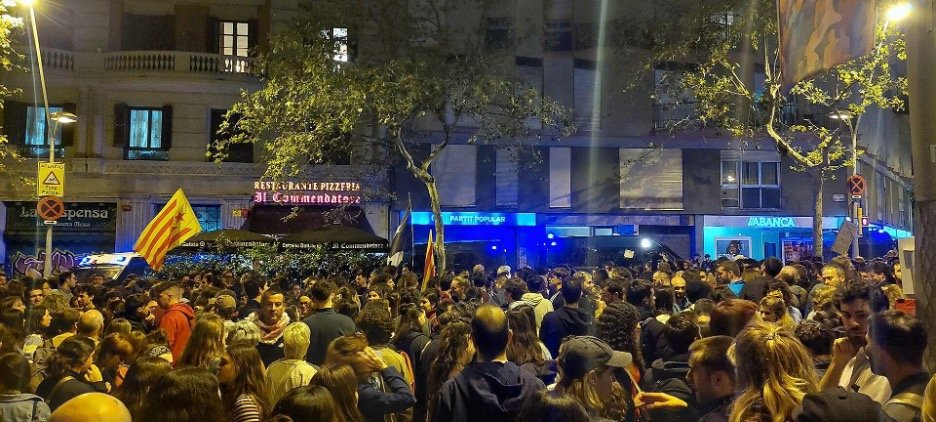
Protestors in Valencia oppose the government’s handling of the 2024 landslide. SOURCE: WikimediaCommons.

DP: So, within this broader picture, what does the Chinese-language media landscape in Spain look like — newspapers, radio, digital platforms?
SPC: As for diaspora media, there are two main ones — Ouhua News (歐華報) and La Voz China (歐洲僑聲報). On digital media, you also have Xinhua Español and the Spanish-language version of China Radio International. These have the most reach among the diaspora.
The diaspora outlets cover Chinese news, mainly news directly from Beijing. And there’s another section about the Chinese diaspora in Spain. They cover, for example, activities by the Chinese embassy: who they met with, which events the ambassador attended. They also provide in-depth coverage of Chinese associations, meetings, or events, especially those involving Spanish officials. For example, the Chinese Business People’s Association inviting officials from the Valencia region.
DP: Do you think the diaspora media actually serves the community?
SPC: It does have that side too, in the form of a public announcement platform. For example, the Spanish police have used it to notify the community about telephone fraud rings targeting the Chinese diaspora. And lately they also translate Spanish-language news related to Chinese issues in Spain, and cover community stories, like a China-born young man now serving in the Spanish armed forces who said in an interview, “I have sworn my loyalty to Spain, and I will die for Spain.”
DP: Lingua Sinica has been looking at other groups, such as Cátedra China or friendship associations, and business groups. When diaspora media cover their meetings with Spanish officials so extensively, what’s the purpose? Is there a structure behind it?
SPC: China’s business people’s associations are part of united front work. That’s well established. And that’s exactly why they cover these meetings so thoroughly, saying, “we met with officials from Madrid, from Barcelona, from wherever.” It’s a way of signaling: look how deep our connections run into Spanish institutions.
The whole thing is vertical. It starts with the United Front Work Department in Beijing, runs through the propaganda apparatus, and comes into Spain through the embassy. From there, it branches into diaspora associations, diaspora media, and Chinese students and scholars’ associations. And when you read what the Spain-based groups are publishing — these exhaustive reports, “we met with this official, attended that event” — it reads like an activity report written for Beijing, so someone back home knows who deserves credit.
DP: Can you give an example of what that looks like?
SPC: Sometimes it’s really interesting because if you know how to look for information, they are very open. They tend to report interference operations without calling it that.
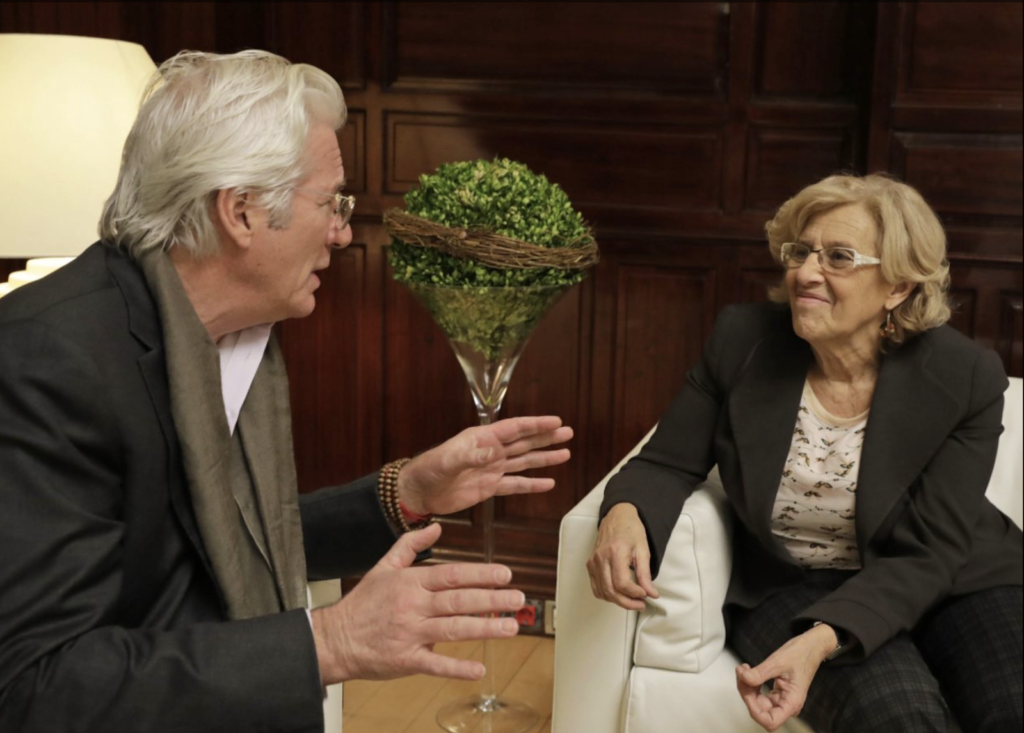
For example, in 2017, Richard Gere came to Spain. He’s involved with the Tibet cause and the Dalai Lama. He met with then-Madrid Mayor Manuela Carmena, who was co-organizing a forum on urban violence. Carmena said she wanted to invite the Dalai Lama to attend and asked Gere to pass along the invitation. This was all public.
When you read what the Spain-based groups are publishing ,it reads like an activity report written for Beijing, so someone back home knows who deserves credit.
Just days later, the Association for the Promotion of the Peaceful Reunification of China in Spain (西班牙中國和平統一促進會), whose president also heads one of the main business people’s associations, sent a small delegation to the Madrid town hall with a letter for the mayor. The letter was bilingual, Chinese and Spanish. I have it. The first half was propaganda about Tibet and the Dalai Lama. The second half was essentially: we know how friendly our ties are; we’re investors; we send a lot of tourists; and Carmena should bear that friendship in mind. The implicit message was clear: receive the Dalai Lama, and the relationship will suffer.
The diaspora media covered it proudly: “Look what we did, we delivered this letter to the town hall, the Dalai Lama did not come.” What’s remarkable is that they documented the whole operation themselves — who participated, how it was conducted. They just didn’t call it interference.
DP: Across Europe, we’ve seen Chinese state media sign content-sharing deals with local outlets. Is anything similar happening in Spain — whether through formal agreements or other channels?
SPC: Yes, it is the same here. Agencia EFE, the public newswire, has signed a cooperation agreement with Xinhua. Europa Press also has one. Radio Televisión Española has a signed agreement with CCTV. And even some minor news groups. I’ve tracked several agreements.
But it goes beyond media deals. Think tanks are another channel. The Observatorio de Política China, for example. Its former director, Xulio Ríos, signed a collaboration agreement with Xinhua in 2014. Interestingly, this same group publishes reports and newsletters about Taiwan, and is both under the Instituto Galego de Análise e Documentación Internacional (IGADI), a Spain-based think tank, and ‘Casa Asia’, Spain’s main public diplomacy institution on Asia-Pacific (supported by the Ministry of Foreign Affairs, Catalonia Government, and Madrid and Barcelona town halls). They sometimes get invited to events by TECO Madrid — the Taiwan Economic and Cultural Office — or co-organize them.
What’s remarkable is that they documented the whole operation themselves — who participated, how it was conducted. They just didn’t call it interference.
DP: How do Chinese media develop their relationships with Spanish journalists?
SPC: Some media CEOs are directly invited to China through initiatives like the Maritime Silk Road Media Cooperation Platform – a Chinese initiative aimed at fostering cooperation among media organizations of nations participating in the Belt and Road Initiative (BRI). It organizes events, and Spanish media are invited to attend. More locally, the embassy and the consulate organize events around key moments. For example, after the two sessions [political meetings in Beijing], they invite all media groups. And just recently, Catedra China, an organization closely aligned with China, organized an event specifically targeting the media, focused on how China is portrayed in Spain.
China also adapts the narrative for each country, even within Spain, to each region. Spain has its own territorial issues, and that’s the pressure point China uses when approaching Taiwan, for example. So, through these events, they befriend media groups, even without formal cooperation agreements, and use them as platforms to reach the Spanish public and political institutions with their narrative.
DP: What role does the Chinese embassy play in Spain? In 2017, the embassy reportedly pressured the University of Salamanca to cancel “Taiwan Cultural Days” and the events were ultimately called off. How did that unfold?
SPC: What happened was that the Taiwan representative was invited to give the opening speech at this “Taiwan Cultural Days” event, and somehow the embassy knew the exact content of his remarks. So they must have had someone on the inside. My take is that they were informed through the university’s Chinese Students and Scholars Association. The president of that association was also lecturing on the same master’s program where the cultural days were organized, so he would have been in the room for the opening session.
There’s another case I’ve been told about at a private university. They organized an event with the ambassador and put up a background map of Asia, provided by the university, in which Taiwan was shown separately from China, perhaps in a different color. The ambassador refused to give his speech until they either replaced the map or took it down.
But the embassy’s reach goes beyond academia and into the political sphere, too. When a motion was tabled at the Foreign Affairs Commission at Spain´s Parliament in February 2025 to discuss China’s manipulation of UN Resolution 2758 (which Beijing uses to claim Taiwan has no right to participate in international organizations) the Chinese Ambassador wrote an op-ed in El Periódico just a week later, followed by the Consul General in Barcelona publishing another op-ed in Catalan media a couple of months after, both arguing that Taiwan is China. The embassy also sent a note warning that debating the motion would affect the traditional friendship relations between China and Spain. The pressure worked. The motion disappeared from the commission’s agenda entirely, and the president of the Foreign Affairs Commission traveled to China for a week-long visit that same May.
DP: Spain and China have grown closer in recent years. More trade, more high-level engagement. Is that reflected in how Spanish media cover China?
SPC: From what I’ve been tracking, there are two threads. One is economic. New Chinese electric-vehicle brands appear in Spain almost daily, and investment stories appear two or three times a month. Spain is the first country in Europe to sell these vehicles, so there’s a steady stream of coverage of that kind.
Then there’s the media scrutinizing the political ties between the Spanish establishment and China. But because the media is so polarized, those stories are basically used as ammunition against the government. The reporting itself isn’t wrong — they try to be exhaustive. They track former president Zapatero and all his connections with China, for instance. But the purpose is to attack the current government, since there’s a widespread perception that Sánchez’s China policy is inspired by Zapatero.
What’s missing is the other side of the equation. They’ll report that a Spanish politician has pro-China connections and meets with this or that official. But they never ask the next question: how can this politician reach those specific Chinese officials in the first place? China already has the structure in place. They know exactly how to identify useful individuals in each country. Spanish media only tracks the Spanish half of the story.