

The abrupt cancellation last week in Zambia of RightsCon, the world’s largest digital rights summit, has ignited a discussion about who bears responsibility — and the answer to that question has major repercussions for global civil society.
If, as the organizer, Access Now, reports, the decision by the Zambian government resulted from Chinese diplomatic pressure over planned participation by researchers and civil society representatives from Taiwan, this is a serious application of sharp power by China, and a woeful precedent. “We see this unilateral decision, and the way it was taken, as evidence of the far reach of transnational repression targeting civil society,” Access Now said in its statement.
Others have cautioned against taking the facts presented by the digital rights organization at face value, including the claim that Zambia’s Ministry of Technology and Science, the group’s primary government partner, relayed that “diplomats from the People’s Republic of China (PRC) were putting pressure on the Government of Zambia.” Eric Olander of the China Global South Project wrote that human rights groups were “quick to blame China for the event’s cancellation, despite providing no evidence to support the claim.” Zambian scholar Sishuwa Sishuwa went further on social media, arguing that the Chinese pressure narrative was too convenient — a pretext, he suggested, that allowed the government of President Hakainde Hichilema to conceal domestic political motivations.
The facts of the RightsCon debacle are crucial to get right. More than 2,600 participants from over 150 countries and 750 institutions had planned to attend in person, with another 1,100 joining online. For many smaller civil society organizations and individual activists, the last-minute cancellation meant unrecoverable costs — flights, accommodation, and event bookings that cannot easily be written off. The costs to global civil society engagement and solidarity are even higher, and the unfortunate situation could point to similar forms of transnational repression in the future.
But the broader context of China’s engagement on speech issues in Zambia is also informative. In fact, this is not the first time that pressure connected to the interests of the Chinese state has been brought to bear on critical voices in Zambia. The case last year involving News Diggers, one of Zambia’s first multimedia outlets dedicated to investigative journalism, offers a telling precedent.
After News Diggers shared a teaser on social media on May 20, 2025 for a documentary examining the consequences of Chinese commercial activity in Zambia, the Chinese Chamber of Commerce in Zambia filed a defamation complaint against the outlet. The Lusaka High Court issued a gag order on May 22 — the day before the film was due to air, and without notifying News Diggers.
The injunction held for two months, through a June 26 hearing in which News Diggers was able to present its case, and a July 18 ruling, before being revoked. The court found that the chamber had not even been directly targeted by the alleged defamation. In a report on the case, Reporters Without Borders noted that this was apparently the first documented case of “a Chinese entity attempting to silence critical reporting through strategic lawsuits against public participation (SLAPPs) in the country.”

The News Diggers case raises the question of transnational repression, though some might object. Is the Chinese Chamber of Commerce in Zambia (CCCZ) not simply a local nonprofit? It describes itself as such on its official Facebook page, though registration records could not be independently verified. For a nuanced look at the case, see the discussion here between Eric Olander and C. Géraud Neema of the China Global South Project.
The reality, however, is that the chamber has long functioned, as have Chinese chambers globally, as at the very least a natural partner for official Chinese diplomatic functions. The chamber is a classic instance of how Chinese state agendas are routinely pushed abroad through proxy groups and cloaked connections, a pattern documented broadly in the Lingua Sinica database. In May 2025, as part of that longstanding alignment of priorities, China’s ambassador attended the inauguration of the CCCZ’s second board of directors and delivered remarks alongside Zambia’s Minister of Trade, jointly presenting certificates to incoming board members.
The current leadership of the CCCZ also links it to another organization in the country that shows active engagement on the issue of Taiwan — with clear echoes of the issue recently cited by some as being at the root of the RightsCon cancellation.
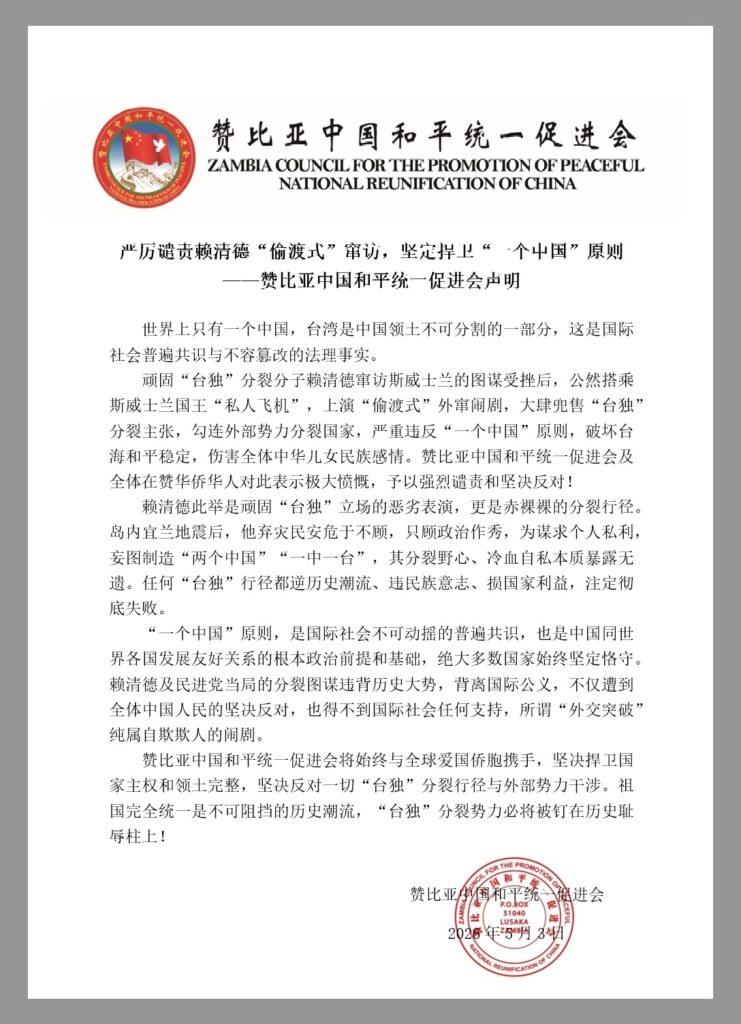
Li Tie (李鐵), the CCCZ’s president, re-elected to the position in May 2025, also heads the Zambia Council for Promotion of Peaceful National Reunification of China (贊比亞中國和平統一促進會). Far from a grassroots civic body, the council is a node in a vast CCP-led network of so-called “peaceful reunification” associations. Its parent, the China Council for the Promotion of Peaceful National Reunification (中國和平統一促進會), is led directly by Wang Huning (王滬寧), the fourth-ranking member of the Chinese Communist Party’s Politburo Standing Committee. Despite its efforts to present itself as a “community,” it is a stretch — to put it generously — to regard Li Tie’s organization as a grassroots body.
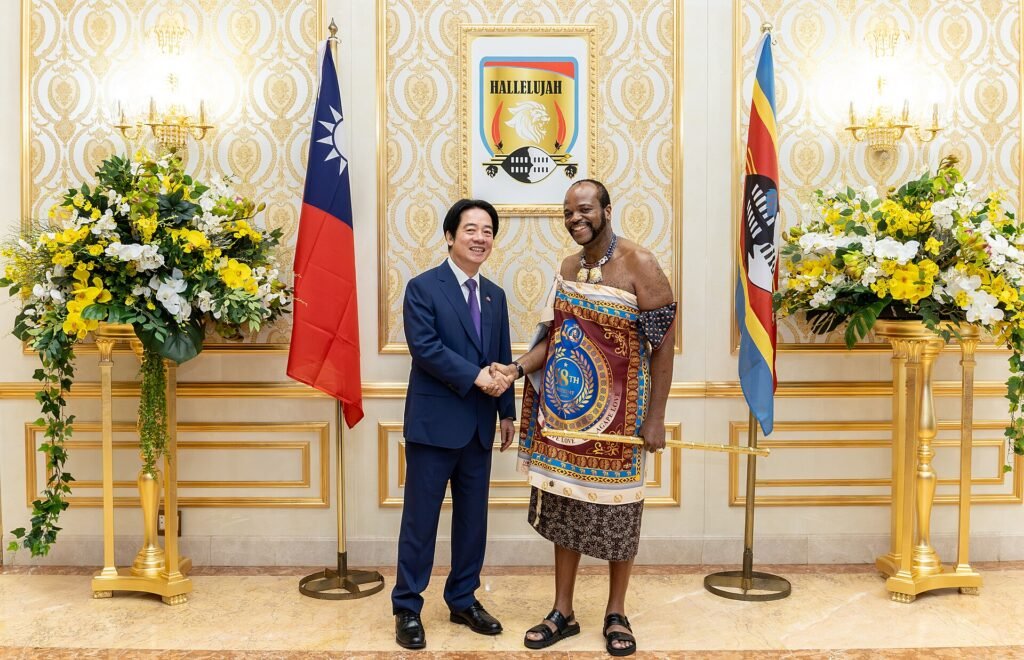
After China pressured three countries to deny airspace transit to Taiwan’s President Lai Ching-te (賴清德), blocking an initial visit on April 21 to Eswatini, one of just 12 countries that maintain formal diplomatic ties with Taiwan, Lai reached the kingdom by an alternative route on May 2. China’s foreign ministry condemned the trip as a “scandal and a farce.” In response, the Zambia reunification council issued a formal statement on May 3 condemning Lai for what it called a “sneak entry” (偷渡式) into the kingdom.
Tellingly, this ostensibly independent statement from the Zambia Council for Promotion of Peaceful National Reunification of China was issued through the website of the Forum on China-Africa Cooperation (FOCAC), a China-led consultation mechanism. FOCAC’s official online platform is website number seventeen on the ICP list operated directly by China’s Ministry of Foreign Affairs (MFA), suggesting quite convincingly that there is little daylight between the MFA and the CCCZ.
This ambiguity is to a large extent by top-down design on China’s part. So the facts, yes, are important to get as clear as possible in the case of RightsCon 2026, which will live on as an empty space in the calendar of global civil society. But there is also an urgent need for broader awareness, research and knowledge sharing of the kind that can provide crucial context about China’s state-backed and state-aligned proxies and the local partners that enable their agendas, all of which increasingly map against a global pattern of repression and interference that challenges free thought and free speech everywhere.