

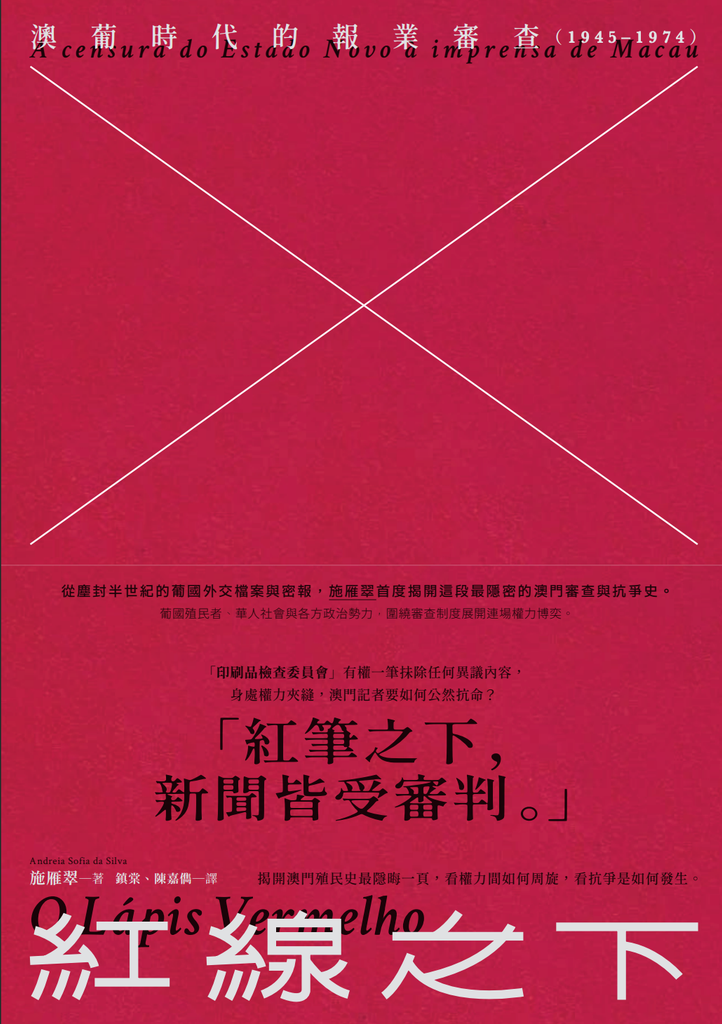
In a newsletter just last month, Lio Chi-Fai (廖志輝), one of the writers behind the independent Macau-based academic research platform Macaology (澳門學16號), informed readers that he was hunkering down with the final edits for his forthcoming book Under the Red Line (紅線之下), a history of press censorship in Macau under Portuguese rule from 1945 to 1974. As though to illustrate a deeper point about today’s diminishing media space in the former Portuguese colony — which has been a special administrative region (SAR) of China since 1999 — Macaology formally ceased publishing on September 30.
For the past five years, Macaology, which announced itself as a platform for “social science research and commentary from Macau and the Greater China region, along with the authors’ musings,” explored the city’s history and society through essays for paying subscribers and a podcast that ran to 112 episodes. Its mission, it said, was three-fold: to showcase high-quality research on Macau; to promote a culture of paid knowledge; and to introduce “the real Macau” to the Chinese-speaking world beyond Macau.
Macaology displayed a degree of critical openness that has been rare in Macau, a territory that has, like neighboring Hong Kong, undergone a sharp tightening of media and intellectual space under national security legislation tightened in 2023, and extended with a new national security law in March this year. In one podcast episode in May 2024, Macaology spoke with a professional journalist for Initium Media (端傳媒) about where Macau’s “red lines” now lie.
The Macaology team had floated the possibility — perhaps inevitability — of its closure a year ago. The recent announcement brings finality. But the new book on colonial press censorship, which readers have already pre-ordered, will be released through One Paper Culture (一紙文化), a new imprint launched by the writers. In a farewell post on Facebook, the team thanked its supporters and bid them farewell. “There is a time to gather and a time to part,” they wrote. “We wish you all a good life, and good reading.”


