Archives: Dispatches

All Lingua Sinica Dispatches

Federation of Khmer Chinese in Cambodia

The Federation of Khmer Chinese in Cambodia , established on December 26, 1990, is a civilian organization serving Cambodia’s ethnic Chinese community. Based in Phnom Penh at No. 19, Road 154, the Federation serves as “the highest leadership organization” coordinating Chinese community affairs across Cambodia, claiming to unite five major Chinese associations, provincial Chinese councils, and clan associations. The organization says it aims to “promote Chinese language education” and strengthen connections among ethnic Chinese across Cambodia. Under current Chairman Fang Qiaosheng (方僑生), who donated 3,000 square meters of land, the Federation has established a new headquarters on the east bank of the Tonle Sap River in Phnom Penh’s Chroy Changvar district.

Global CAMG Media

Global CAMG Media Group was an Australian-based media conglomerate that served as the Asia-Pacific arm of China Radio International’s covert global broadcasting network. According to Reuters, the Melbourne-based company had ownership stakes in or supplied programming to at least eight radio stations across the region. The company was 60 percent owned by Guoguang Century Media Consultancy, which was wholly owned by a subsidiary of China’s state-run China Radio International. Led by Tommy Jiang, CAMG operated numerous Chinese-language radio stations and publications across Australia, broadcasting pro-China programming while hiding Beijing’s control of the company.

Communications Ministry of Malaysia

The Ministry of Communications of Malaysia (Kementerian Komunikasi Malaysia) is a government ministry responsible for communications, multimedia, broadcasting, media, film industry, telecommunications services, broadband, and content development. Established on December 12, 2023, after the reorganization of the former Ministry of Communications and Digital, it is headed by Minister Fahmi Fadzil (法米法兹) with Teo Nie Ching (張念群) as Deputy Minister. The ministry oversees several key federal departments including Radio Television Malaysia (RTM), Department of Information Malaysia, and Community Communications Department, along with statutory agencies such as the Malaysian National News Agency (Bernama), National Film Development Corporation (FINAS), and Malaysian Communications and Multimedia Commission (MCMC).

Chinese Embassy in Mexico

The Embassy of the People’s Republic of China in Mexico is China’s chief diplomatic mission to the United Mexican States, located in Mexico City. The mission’s origins trace to the establishment of diplomatic relations between the People’s Republic of China and Mexico on February 14, 1972, when Mexico recognized the People’s Republic of China following UN Resolution 2758, which led to Mexico’s break with Taiwan. This significant step positioned Mexico among the early Latin American nations to establish diplomatic ties with the People’s Republic of China during the Cold War era. The embassy is currently located in Mexico City, Mexico. As of 2025, the embassy continues to serve under China’s Ministry of Foreign Affairs (外交部), actively engaging in media diplomacy through initiatives such as co-hosting the “China-Mexico and China-Latin America Relations in the New Era” (新時代的中墨、中拉關係) forum with China Today (今日中國) and the Mexican Senate. The embassy works to strengthen bilateral ties in a relationship that has grown significantly since formal relations began, with China now serving as Mexico’s second-largest trading partner globally.

International Political Research Center

The International Political Research Center (古巴国际政治研究中心), or CIPI, is an attached unit of Cuba’s Ministry of Foreign Affairs established in November 2010 as a think tank for international political and relations research. Directed as of 2025 by José Ramón Cabañas Rodríguez (何塞·拉蒙·卡瓦尼亚斯·罗德里格斯), former Cuban Ambassador to Washington (2012-2021), the center publishes the quarterly academic journal Nuestra América and conducts research supporting Cuban foreign policy objectives under MINREX oversight. The center focuses on analyzing international relations, particularly Cuba’s diplomatic engagement with countries like China, positioning itself as an academic platform for promoting Cuba’s “socialist” international cooperation initiatives and bilateral relationship development within broader geopolitical frameworks.

Communication University of China

The Communication University of China is a public university in Chaoyang District, Beijing (北京市朝陽區), affiliated with China’s Ministry of Education (教育部). Originally established as a training center for the Central Bureau of Broadcasting Administration on March 3, 1954, it was upgraded to Beijing Broadcasting Institute (北京廣播學院) in April 1959 and adopted its current name in August 2004. The university is known for producing media professionals for China’s broadcasting industry, including news presenters, journalists, and television hosts for major networks like China Central Television (中央電視臺). According to official assessments by the Ministry of Education, the institution ranked first nationally in “Journalism and Communication” (新聞傳播學) and “Drama, Film and Television Studies” (戲劇與影視學) in 2012. The institution operates three Confucius Institutes (孔子學院) globally—in Belgrade, Groningen, and Brazil—and serves as a center for foreign language education.

Association of Polish Journalists

Association of Polish Journalists (波兰记者协会), known as SDP, is a non-governmental journalistic organization established in 2002 and headquartered in Warsaw, represents journalists, editors and publishers from across Poland with over 2,500 members. The SDP has also created the Council of Media Ethics (Rada Etyki Mediów), a non-governmental organization that monitors ethical standards in Polish media. According to online listings, key officers of SDP have included Krystyna Mokrosinska, a television journalist and journalism educator who was previously a member of the journalism faculty at the University of Warsaw and worked at Telewizja Polska before being removed for political reasons during martial law, and Grazyna Ogrodowska, a former deputy editor at Pro Medico. The SDP should not be confused with the Polish Media Association, which has had longstanding engagement with official PRC media and CCP entities.

Ministry of Science and Technology of China

The Ministry of Science and Technology functions as a cabinet-level department under China’s State Council. Originally established as a commission in 1958, it was elevated to ministry status in 1998. The ministry says it is responsible for “formulating guidelines and related policies for science and technology” in China. In 2023, the ministry underwent significant restructuring, with officials stating it would shift away from managing specific research projects to focus on supervisory and guiding roles. The reorganization included the transfer of several key offices, including the State Administration of Foreign Experts Affairs to the Human Resources ministry and the Biotechnology Development Center to the National Health Commission. The ministry reports an annual budget of $51 billion for 2024 and maintains international research partnerships with various entities, including the European Union and United Nations.

Wenzhou International Communication Center

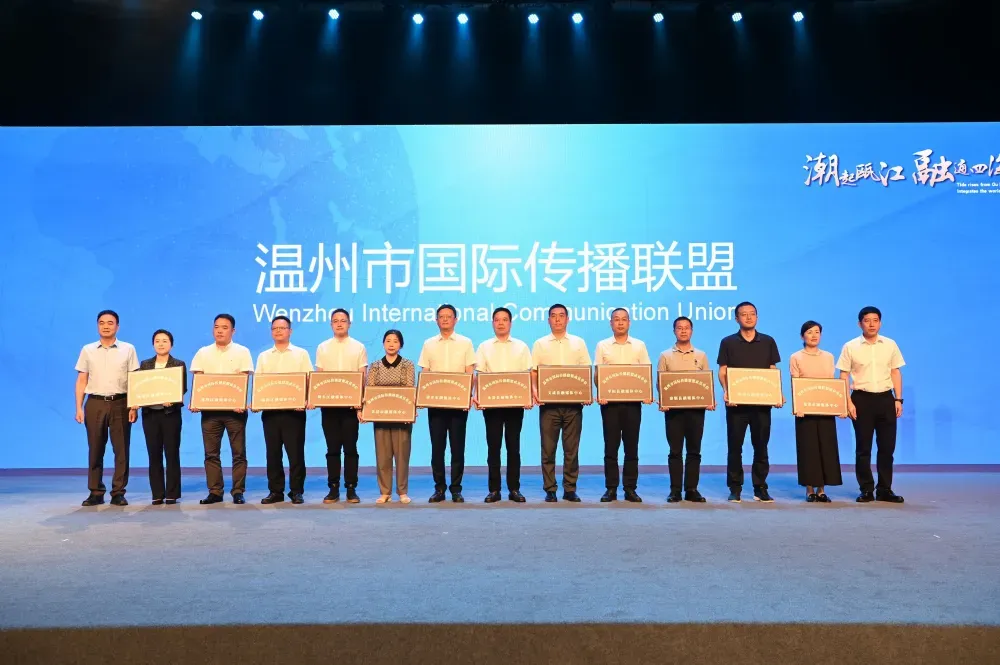
The Wenzhou International Communication Center, launched in May 2024, is led by the propaganda office of the Wenzhou Committee of the Chinese Communist Party. The center works with the Wenzhou News Media Center (温州市新闻传媒中心), a local government-run media office founded in 2023 — and identified at the time as a “new milestone in the development of [the city’s propaganda work.” It is part of a growing national network in China of ICCs meant to strengthen China’s global communication by harnessing the strength of local media groups and propaganda offices.