Archives: Dispatches

All Lingua Sinica Dispatches

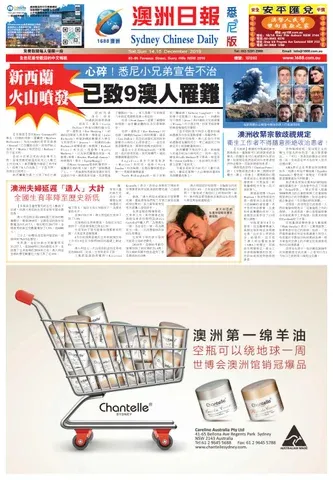
Sydney Chinese Daily

The Sydney Chinese Daily is published by the Chinese News and Media Group, which describes itself as “the largest 100% Australian Owned and Independent Chinese Media Company.” The group’s flagship publication, the Daily Chinese Herald (澳洲日報), was established in 1986, with the company operating a portfolio that includes Chinese Melbourne Daily and Queensland Chinese Daily. The company’s website states that the Sydney Chinese Daily is “Sydney’s most influential and widely-read Chinese language publications” and “the first and only free daily newspaper to cover Sydney based local news.”

Thai Chinese New Generation Business Association

The Thai Chinese New Generation Business Association, founded on July 1, 2002, is Thailand’s first Chinese youth organization representing new immigrants and overseas Chinese youth from various regions of China, including Hong Kong and Macau. Members work across industries, including manufacturing, finance, trade, technology, real estate, construction, jewelry, medical treatment, insurance, e-commerce, and tourism. The association claims to “serve as a bridge for the new generation of overseas Chinese, helping members integrate into Thai society, building business relationships, and protecting legitimate rights”. In 2020, marking its 18th anniversary, the organization underwent leadership changes and expressed support for China’s Belt and Road Initiative, RCEP, and the Guangdong-Hong Kong-Macao Greater Bay Area development plan.

Danish Film Institute

The Danish Film Institute, established in 1972, is Denmark’s national agency for supporting and promoting film and cinema culture. Located in Gothersgade in central Copenhagen, this cultural cornerstone—also known as Filmhuset (“the film house”)—operates under the Danish Ministry of Cultural Affairs. The institute focuses on three main areas: production and development of films, distribution and communication of film culture, and archives and museum activities. Its public facilities include a comprehensive library with 55,000 books and Cinemateket, Denmark’s national film museum, featuring three cinemas showcasing classics and quality films.

Danish Ministry of Culture

The Danish Ministry of Culture is a government ministry responsible for overseeing Denmark’s cultural, sports, and media sectors. Established in 1961 with Julius Bomholt as its first minister, the ministry plays a crucial role in shaping Danish cultural policy. Its historic headquarters is located at Gammel Strand on Nybrogade in Copenhagen, in a building dating back to 1729 that was expanded in 1765 with a canal-facing wing designed by architect Philip de Lange. Through its various departments and agencies, including the Danish Film Institute, the ministry works to preserve and promote Denmark’s rich cultural heritage while supporting new artistic endeavors.

Economic Social and Cultural Council of Cambodia

Cambodia’s Economic, Social and Cultural Council (ECOSOCC) is a government body established in 2009, attached to the Office of the Council of Ministers. Originally known as the “Economic, Social and Cultural Observatory” (OBSESC) from 1996, it was transformed into its current form by Royal Decree in February 2009. The Council monitors economic, social, and cultural developments, researches challenges, reviews draft legislation related to these sectors, and provides recommendations to the Royal Government. The General Secretariat, established by Sub-Decree No. 44 in March 2009, handles daily operations and is headed by a Secretary-General with the rank of Secretary of State or Under Secretary of State.

58 Lao

58 Lao (老撾資訊網), established in 2012 in Vientiane, Laos’ capital, is one of the country’s first Chinese-language media platforms. The platform claims to have become “one of the most influential Chinese-language media in Laos” by 2019. The network operates as part of Laos Future Media Co., Ltd., with technological support from Shenzhen Wangce Technology Co., Ltd. (深圳网策科技有限公司). The platform’s mission involves serving the Chinese community in Laos by delivering news, policy updates, business information, and lifestyle content through WeChat and print media. The company claims to be “currently the only Chinese information classification and publishing platform that has obtained filing permits from both China and Laos.”

Aajkaal

Aajkaal is a Bengali-language daily newspaper founded in 1981 by Abhik Kumar Ghosh and headquartered in Kolkata, India. The broadsheet publication, owned by Aajkaal Publishers Pvt. Ltd., covers business, entertainment, politics and other subjects with what it describes as “political neutrality” and “strong principles and authentic reporting.” The newspaper includes an evening edition Sandhya Aajkaal and maintains regional editions in Siliguri and Agartala, Tripura state, in addition to its online presence. Chief Editor Gour Kishore Ghosh, described as “a veteran journalist and socialist,” helped establish the paper’s early credibility, while current Editor-in-Chief Ashok Dasgupta brings sports journalism experience. In May 2021, Aajkaal Tripura correspondent Samir Dhar was attacked by alleged ruling party supporters, marking his third such incident since 2018, prompting demands for investigation from professional associations.

Office for Media of the President of the Republic of Serbia

The Office for Media Relations of the President of Serbia operates as the official media communications arm of the Serbian presidency. It manages press communications through various channels including press releases, news conferences, and social media. The office coordinates with both domestic media and accredited foreign correspondents in Belgrade, providing advance notice of presidential activities and handling interview requests. 

Ministry of Commerce of the People’s Republic of China

The Ministry of Commerce of the People’s Republic of China, or “MOFCOM,” serves as China’s primary state organ for domestic and international trade policy. Established in 2003 through institutional consolidation, MOFCOM merged the former Ministry of Foreign Trade and Economic Cooperation with select functions from the State Development Planning Commission and State Economic and Trade Commission.
The ministry’s extensive mandate encompasses both domestic commercial regulation and international economic diplomacy. Current Minister Wang Wentao (王文濤), appointed in 2020, oversees operations from the Beijing headquarters at 2 East Chang’an Street. MOFCOM’s institutional evolution reflects China’s economic transition – from centrally-planned trade apparatus (1952-1982) to market-oriented commercial governance. Key responsibilities include formulating trade policies, managing foreign investment approvals, conducting WTO negotiations, and coordinating anti-dumping investigations. The ministry also administers China’s foreign aid programs and oversees special economic zones. Recent organizational changes in 2018 transferred antitrust enforcement to market regulators and foreign aid coordination to the newly created National International Development Cooperation Agency, indicating ongoing institutional refinement within China’s economic governance structure.