Archives: Dispatches

All Lingua Sinica Dispatches

Australia-China Relations Institute

The Australia-China Relations Institute at the University of Technology Sydney (UTS) exemplifies China’s efforts to shape public discourse in Australia, according to critics. Established in 2014 with A$2.8 million from Chinese entrepreneurs, including Huang Xiangmo (黃向墨), questions persist about ACRI’s independence despite its claims of being “nonpartisan.” James Leibold of La Trobe University argues it produces “one-sided” materials while facilitating media tours transmitting “China’s voice” to Australian audiences. Former Foreign Minister Bob Carr was appointed as ACRI’s director, working “near full-time” according to UTS. The institute represents one facet of Beijing’s broader influence campaign in Australia, critics say, which includes direct political lobbying, media pressure, and economic leverage. This influence allegedly extends beyond academia, with Chinese officials reportedly organizing supportive rallies and attempting to suppress criticism—activities that prompted Australia’s 2018 overhaul of espionage laws prohibiting undisclosed foreign influence in politics.

Chinese Newspaper in Romania

Chinese Newspaper in Romania was founded in 1999 as Romania’s oldest Chinese-language publication under the Romania Huayang Media Group (羅馬尼亞華揚傳媒集團). This weekly newspaper, published every Friday, covers Romanian local news, culture, Chinese news, economics, society, military observations, international news, and health topics. The publication claims to be “Romania’s largest Chinese-language publication” with “high visibility and influence in Romania’s Chinese community and mainstream society.” The newspaper maintains collaborations with Chinese publications including People’s Daily Overseas Edition (人民日報海外版), Tianjin Evening News (天津晚報), and Hong Kong’s Wen Wei Po (香港文匯報), while also operating digital platforms including the China-Europe Communication Network (中歐通訊網), a WeChat public account, and the Romania Chinese Headlines (羅馬尼亞華人頭條).

China Daily

The China Daily (中國日報) is an English-language newspaper operated by the Information Office of China’s State Council, which is essentially the same office as the Central Propaganda Department (中共中央宣傳部) of the Chinese Communist Party. Published in multiple languages, the newspaper and its associated outlets are a key aspect of China’s official communication strategy toward the world. It claims to have “the widest print circulation of any English-language newspaper in China” — a misleading claim as all such publications are closely regulated and controlled. The U.S. State Department designated China Daily as a “foreign mission” in 2020, while scholars describe it as “an instrument of China’s public diplomacy.” The newspaper produces sponsored content called “China Watch” for Western publications and has faced accusations of spreading disinformation about Hong Kong protests, COVID-19, and Uyghur issues. Former staff have described working there as prioritizing making “the Chinese government look good” over journalism.

Contemporary World Magazine

Contemporary World magazine is published by the Contemporary World Publishing House (當代世界出版社), established in September 1993, a Beijing-based publishing house under the management and operation of the International Department of the Central Committee of the Chinese Communist Party (中共中央對外聯絡部). Under Contemporary World Publishing House Co., Ltd (當代世界出版社有限公司) since February 2011, its current legal representative is Li Shuangwu (李雙伍). The company is listed as 100 percent owned by the State Council of the People’s Republic of China. Contemporary World (當代世界), now the company’s flagship journal, first launched in 1981 as “Selected Translations of Communist Movement Materials” (共運資料選譯), and underwent name changes in 1989 and 1995. The publication claims to “analyze international relations and world party politics” while delivering information on global political, economic, military, social, and cultural developments. The journal’s main sections include situation commentary, special focus, interviews, expert forums, and global perspectives.

Chinese Embassy in Laos

The Embassy of the People’s Republic of China in the Lao People’s Democratic Republic is China’s chief diplomatic mission to Laos, located in Vientiane. The mission’s origins trace to the establishment of diplomatic relations between the People’s Republic of China and Laos on April 25, 1961, when Laos switched recognition from the Republic of China (Taiwan) to the PRC government in Beijing. However, diplomatic relations experienced significant challenges, with Laos severing diplomatic relations with the PRC in May 1962 and restoring relations with the Republic of China, before recognition was changed again in 1975 when the new Lao communist government came to power. Relations were fully normalized in 1989, and diplomatic ties were restored to the ambassadorial level in June 1988. The embassy is currently located at Wat Nak Road, Sisattanak, Vientiane, Lao P.D.R. The current ambassador is Fang Hong (方红).

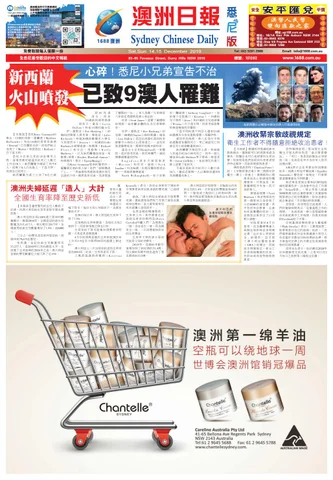
Sydney Chinese Daily

The Sydney Chinese Daily is published by the Chinese News and Media Group, which describes itself as “the largest 100% Australian Owned and Independent Chinese Media Company.” The group’s flagship publication, the Daily Chinese Herald (澳洲日報), was established in 1986, with the company operating a portfolio that includes Chinese Melbourne Daily and Queensland Chinese Daily. The company’s website states that the Sydney Chinese Daily is “Sydney’s most influential and widely-read Chinese language publications” and “the first and only free daily newspaper to cover Sydney based local news.”

Thai Chinese New Generation Business Association

The Thai Chinese New Generation Business Association, founded on July 1, 2002, is Thailand’s first Chinese youth organization representing new immigrants and overseas Chinese youth from various regions of China, including Hong Kong and Macau. Members work across industries, including manufacturing, finance, trade, technology, real estate, construction, jewelry, medical treatment, insurance, e-commerce, and tourism. The association claims to “serve as a bridge for the new generation of overseas Chinese, helping members integrate into Thai society, building business relationships, and protecting legitimate rights”. In 2020, marking its 18th anniversary, the organization underwent leadership changes and expressed support for China’s Belt and Road Initiative, RCEP, and the Guangdong-Hong Kong-Macao Greater Bay Area development plan.

58 Lao

58 Lao (老撾資訊網), established in 2012 in Vientiane, Laos’ capital, is one of the country’s first Chinese-language media platforms. The platform claims to have become “one of the most influential Chinese-language media in Laos” by 2019. The network operates as part of Laos Future Media Co., Ltd., with technological support from Shenzhen Wangce Technology Co., Ltd. (深圳网策科技有限公司). The platform’s mission involves serving the Chinese community in Laos by delivering news, policy updates, business information, and lifestyle content through WeChat and print media. The company claims to be “currently the only Chinese information classification and publishing platform that has obtained filing permits from both China and Laos.”

Ministry of Commerce of the People’s Republic of China

The Ministry of Commerce of the People’s Republic of China, or “MOFCOM,” serves as China’s primary state organ for domestic and international trade policy. Established in 2003 through institutional consolidation, MOFCOM merged the former Ministry of Foreign Trade and Economic Cooperation with select functions from the State Development Planning Commission and State Economic and Trade Commission.
The ministry’s extensive mandate encompasses both domestic commercial regulation and international economic diplomacy. Current Minister Wang Wentao (王文濤), appointed in 2020, oversees operations from the Beijing headquarters at 2 East Chang’an Street. MOFCOM’s institutional evolution reflects China’s economic transition – from centrally-planned trade apparatus (1952-1982) to market-oriented commercial governance. Key responsibilities include formulating trade policies, managing foreign investment approvals, conducting WTO negotiations, and coordinating anti-dumping investigations. The ministry also administers China’s foreign aid programs and oversees special economic zones. Recent organizational changes in 2018 transferred antitrust enforcement to market regulators and foreign aid coordination to the newly created National International Development Cooperation Agency, indicating ongoing institutional refinement within China’s economic governance structure.