Archives: Dispatches

All Lingua Sinica Dispatches

NDR and CGTN Air Joint Talk Show

In June 2017, the German public broadcaster NDR (Norddeutscher Rundfunk)  launched a joint talk show with CGTN (中國環球電視網), the English-language channel of China Central Television, to be aired twice a year. Called “Dialog mit China” (Dialogue with China), the hour-long programs featured NDR television chief Andreas Cichowicz and CGTN host Yang Rui (楊銳) co-moderating discussions on political and economic topics with guests from both countries. In June 2019, an episode recorded in Guangzhou focused on the Guangdong-Hong Kong-Macao Greater Bay Area development plans, German business investment in high-tech sectors, and “one country, two systems” governance, aired on the Television Station, creating backlash. Critics, including German lawmaker Margarete Bause said that the format avoided human rights violations, Hong Kong’s mass protests, and Tiananmen anniversary commemorations despite their contemporaneous relevance.

Chinese Ambassador Meets Montenegro Minister of Media

On December 5, 2025, Chen Xufeng (陈绪峰), China’s ambassador to Montenegro, paid a visit to Media and Culture Minister of Montenegro Tamara Vujović. According to a readout from China’s Ministry of Foreign Affairs, Ambassador Chen said that the “traditional friendship” between China and Herzegovina has lasted for a long time, and people-to-people exchanges have “achieved remarkable results.” China, said Chen, attaches “great importance to strengthening exchanges and cooperation with Montenegro in the field of culture and media,” with a series of related events planned for the 20th anniversary of diplomatic relations in 2026. The MFA readout quoted Vujović as having praised the achievements of “Chinese-style modernization.” According to Hungarian reports, Vujović and Chen were also guests at a cultural festival in the town of Herceg Novi in September 2025. 

Deutsche Welle-CCTV Cooperation Agreement

In August and September 2014, Deutsche Welle (德國之聲) Director General Peter Limbourg announced cooperation agreements with China Central Television (中央電視台), including co-productions in music and business programming. Just months later, in early 2015, Deutsche Welle announced it would temporarily suspend the partnership after it came under scrutiny from the German Bundestag, according to testimony given by journalist Su Yutong before a hearing of the US Congressional-Executive Commission in 2016. Su’s CECC testimony alleged that Deutsche Welle had softened the stance of the network’s Chinese-language coverage on China after a meeting between Chinese Ambassador to Germany Shi Mingde and Peter Limbourg. The announced 2014 cooperation between Deutsche Welle and CCTV also drew strong criticism at the time from Reporters Without Borders Germany, which called it “incompatible” with DW’s mission, noting CCTV’s role in China’s “repressive apparatus” against journalists.

Xi Jinping Pens Article for Die Welt

In July 2017, Chinese President Xi Jinping (習近平) published a signed article titled “To Make the World a Better Place” in the German newspaper Die Welt ahead of his state visit to Germany and attendance at the G20 Hamburg Summit. The article, distributed by Xinhua News Agency (新華社), outlined the bilateral cooperation between China and Germany and called for “strategic synergy” between China’s Made in China 2025 initiative—a state-led industrial policy aimed at upgrading China’s manufacturing capabilities in high-tech sectors—and Germany’s Industry 4.0 strategy, which focuses on digitalization and smart manufacturing. Xi emphasized expanding Belt and Road cooperation and described the relationship as a “comprehensive strategic partnership,” building on language from his first visit to Germany as head of state in 2014. 

Chinese Ambassador Pens article in German Media

On September 1, 2025, the German media outlet Table Media published a signed article by the Chinese Ambassador to Germany in its Table Briefings channel titled “Learning from History – Guided by Values into the Future” (鑒往昔而知來 行正道以致遠). The article employed official Chinese Communist Party terminology to commemorate the 80th anniversary of the end of World War II, characterizing it as the victory of the Chinese People’s War of Resistance Against Japanese Aggression and the World Anti-Fascist War (中國人民抗日戰爭暨世界反法西斯戰爭勝利80周年). This framing, which differs from international usage of “Second Sino-Japanese War” or “World War II,” serves to bolster the CCP’s historical legitimacy and its narrative placing itself at the center of the defeat of fascism. The article further invoked the phrase “Liberation of Taiwan” (光復台灣) to assert Chinese sovereignty over Taiwan, declaring that “the one-China principle has been a global consensus since World War II” (一個中國原則已然是二戰後的世界共識).

Chinese Consul Pens Article for Italian Media

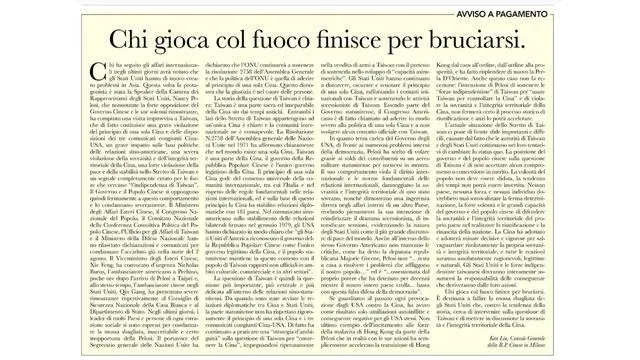
On August 5, 2022, Corriere della Sera published a paid half-page article written by the Chinese Consul General, titled “Chi gioca col fuoco finisce per bruciarsi” (“He Who Plays with Fire Risks Getting Burned”). The piece attacked US House Speaker Nancy Pelosi for her August 2-3 visit to Taiwan, echoing Chinese President Xi Jinping’s warnings at the time to President Joe Biden. The consul general claimed Pelosi’s visit was a “serious violation of the one-China principle” and predicted it would “accelerate” reunification rather than prevent it. The publication of the article prompted immediate criticism from the Lombardy Association of Journalists, whose president called it “embarrassing” for the Italian press to publish such paid propaganda “with no contradictory opinion.” 

Guang Ming Daily

The Guang Ming Daily (光明日報) — not to be confused with the PRC publication of the same name — is the third-largest Chinese-language newspaper in Malaysia, established initially as Sin Pin Jit Poh (星檳日報) in the northern Malay Peninsula by entrepreneur and philanthropist Aw Boon Haw (胡文虎). After Sin Pin Jit Poh closed due to financial difficulties in 1986, a group of journalists and businesspeople founded Guang Ming Daily on December 18, 1987, for the Chinese community in northern Malaysia, particularly in Penang. The newspaper changed ownership several times during its first five years before being acquired by Tiong Hiew King (張曉卿) in November 1992. The publication, which is today challenged by the rise of digital platforms and apps popular among younger Malaysian Chinese, reports on news, health, culture, and local affairs for Malaysia’s Chinese-speaking readers, with a stated mission of “speaking for ordinary people” and a focus on community issues and social advocacy. 

Malaysia China Insight

Malaysia China Insight (馬中透視) is a Malaysian media platform established in 2013 that focuses on Malaysia-China business news through multiple channels including a trilingual news app, a newspaper, a bilingual English-Chinese magazine, and KenaliTV, a video channel offering content in Malay and English. Based in the capital of Kuala Lumpur, the platform provides news coverage in English, simplified Chinese, and Bahasa Malaysia, positioning itself as a platform for bilateral business information between Malaysia and China.

NDR

NDR (Norddeutscher Rundfunk) is a German public radio and television broadcaster headquartered in Hamburg, established on January 1, 1956. NDR creates Germany’s most-watched national news program Tagesschau and operates multiple radio stations, including NDR 2, a popular music station; NDR Kultur, an arts and culture station that plays classical music; and N-Joy, a music station, as well as the regional television channel NDR Fernsehen. The broadcaster employs approximately 3,400 permanent staff and is funded through mandatory German household broadcasting fees.