Entity Type: Domestic Party or Government Institution

Secretariat of Media and Public Communication

Argentina’s Federal System of Public Media and Content (Sistema Federal de Medios y Contenidos Públicos) was created on December 10, 2015, through Decree 12/2015 under President Mauricio Macri. Initially headed by Hernán Lombardi, the system oversees Argentina’s public media ecosystem, including Télam news agency, public television and radio networks, digital channels, and cultural centers. In 2018, it was downgraded from ministerial status to secretariat level. Following President Javier Milei’s inauguration in December 2023, the secretariat was transferred to the Communication and Press Secretariat of the Presidency through Decree 45/2023. The entity manages platforms including TV Pública, Radio Nacional, and the Centro Cultural Kirchner.

Thailand TV5

Thailand TV5, officially the Royal Thai Army Radio and Television Station, is Thailand’s second-oldest television station, launched in January 1958 by the Royal Thai Army. Owned and operated by the Royal Thai Army, the network is headquartered at 210 Phaholyothin Road in Phaya Thai District, Bangkok. Originally known as HSA-TV Channel 7, the station transitioned to color broadcasting and adopted the Channel 5 name in 1974. Academic research notes that Thailand’s “Army Signal Corps and MCOT operate Channels 5 and 9” within the country’s military-controlled broadcasting structure. Channel 5 ceased analog broadcasting in 2018 as part of Thailand’s digital television transition. The station broadcasts news, military affairs programming, documentaries, drama series, and variety shows to audiences nationwide.

South African Government

The South African Government, established in 1968, operates as a parliamentary republic with a three-tier system and independent judiciary. The national government consists of three branches: the legislative (Parliament with National Assembly and National Council of Provinces based in Cape Town), the executive (President, Deputy President and 32 Ministers based in Pretoria), and the judicial (Constitutional Court, Supreme Court of Appeal, and High Court). The second tier comprises nine provincial governments, each with legislatures and executives led by Premiers. The third tier consists of local governments organized as metropolitan, district, and local municipalities. All levels operate under the Constitution through a cooperative governance model, with each having distinct yet interdependent powers, operating with an annual budget of R2.37 trillion (2024).

Nauru Media Bureau

The Nauru Media Bureau functions as the island nation’s public broadcaster and media regulator, operating under the state-owned Nauru Broadcasting Service. The bureau was established in 1998 through the merger of television and radio services, evolving from Nauru Television, which was first established in 1991. The organization provides essential broadcasting services for Nauru’s approximately 12,000 residents across its 21-square-kilometer territory. The bureau houses Nauru Television (broadcasting 24 hours daily), Radio Nauru, and publishes the monthly newspaper Mwinen Ko (roughly translated as “Let’s Talk about It”), which was introduced in 2009. Following Nauru’s resumption of diplomatic relations with China in January 2024, China Media Group (中央廣播電視總台), has opened a Bureau in the country and conducted interviews with Nauruan officials as part of expanded bilateral cooperation.

Government of Malaysia

The Government of Malaysia, officially the Federal Government of Malaysia (Kerajaan Persekutuan Malaysia), operates as a constitutional monarchy under the Westminster parliamentary system. Established in 1963, it functions through three branches: the executive led by Prime Minister Anwar Ibrahim, the bicameral Parliament consisting of the House of Representatives (Dewan Rakyat) and Senate (Dewan Negara), and an independent judiciary headed by the Federal Court. While the Yang di-Pertuan Agong (King) serves as the ceremonial head of state, effective executive power resides with the Cabinet. Based primarily in Putrajaya (with Parliament located in Kuala Lumpur), the federal government administers national affairs while respecting the autonomy of Malaysia’s 13 states and three federal territories. Each state maintains its own government with executive councils led by Chief Ministers or Menteri Besar, creating a federated system unified under the supreme Federal Constitution.

Government of India

The Government of India, established in its current form on January 26, 1950, is the national authority of the Republic of India. Led by President Droupadi Murmu (de jure) and Prime Minister Narendra Modi (de facto), it comprises 54 ministries and 93 subordinate departments. The government has three primary branches: legislative (bicameral Parliament), executive (Union Council of Ministers), and judiciary (Supreme Court of India). Modeled after the Westminster system, it functions as a parliamentary democracy where the Council of Ministers is responsible to the Lok Sabha (lower house). The government operates under the Constitution of India, which replaced the colonial Government of India Act when India became a republic, transitioning from its previous status as a dominion of the Commonwealth.

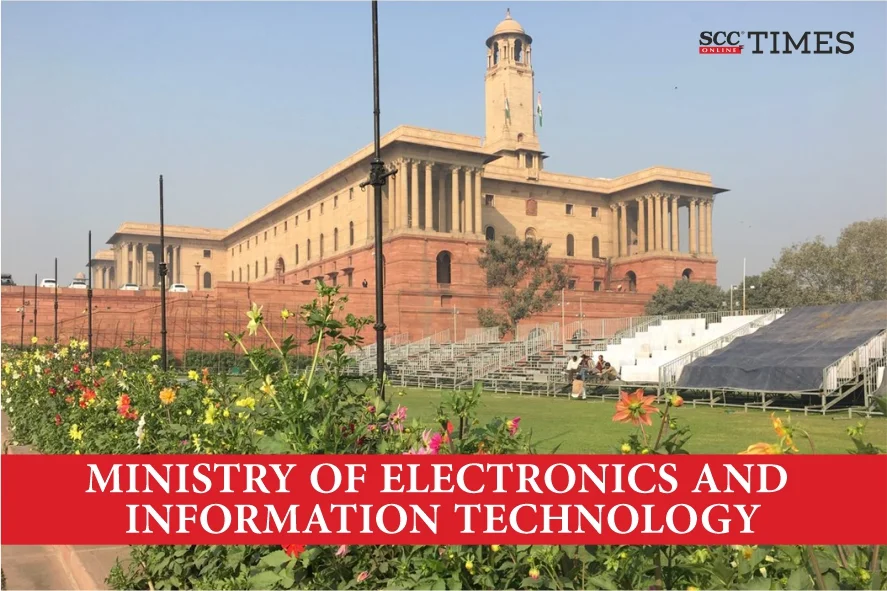
Government of India Ministry of Electronics and Information Technology (MeitY)

The Ministry of Electronics and Information Technology (MeitY) is a standalone Indian government agency responsible for developing and implementing policies for the electronics and IT sectors. Its mission focuses on promoting digital governance, inclusive growth of electronics and IT industries, enhancing India’s role in internet governance, developing human resources, promoting R&D, and ensuring cybersecurity. MeitY’s objectives include providing e-government infrastructure, promoting electronics manufacturing, implementing R&D frameworks, supporting e-learning, securing cyberspace, promoting inclusive growth through ICT, advancing India Stack, and strengthening India’s position in global internet governance. Its functions encompass IT policy matters, digital transaction promotion, e-governance assistance, IT education, cyber laws administration, semiconductor manufacturing, international IT cooperation, bridging the digital divide, standardization, and overseeing organizations like NIC and UIDAI.

Lao People’s Democratic Republic

The Lao People’s Democratic Republic operates as a unitary Marxist-Leninist one-party socialist republic, one of the world’s few remaining communist states. The Lao People’s Revolutionary Party (LPRP) maintains absolute political control through its general secretary, who concurrently serves as president—currently Thongloun Sisoulith, the first civilian without military background to hold this position since his appointment in 2021. The government structure consists of a National Assembly legislature, with Vice Presidents Bounthong Chitmany and Pany Yathotou, Prime Minister Sonexay Siphandone, and National Assembly President Saysomphone Phomvihane completing the senior leadership. Since overthrowing the monarchy in 1975 after years of civil conflict during the Vietnam War era, the LPRP has gradually opened the economy while maintaining strict political control. Despite significant economic reforms and infrastructure development, particularly through Chinese investment in projects like the Laos-China Railway, the country remains classified as a least developed country by the UN, though it maintains membership in regional organizations including ASEAN and participates in the Greater Mekong Subregion economic cooperation program.