Tag: ICC

Another Chinese Propaganda Outpost for Italy

Last month, a provincial government in eastern China opened a new office in Milan to promote its image to European audiences. It is the latest outpost in an expanding network of Chinese state-linked media operations across Europe. The office, feted as the “European outpost” (欧洲站) of the Anhui International Communication Center (安徽国际传播中心), or AICC, is the third such office to open in Italy, and the second to open in the city of Milan. Another ICC “liaison office” opened in Prato in 2025, the city with one of the highest populations of Chinese immigrants in Italy.

AICC was founded in 2021 by the Anhui New Media Group, a conglomerate directly under the leadership of the provincial committee of the Chinese Communist Party, to strengthen the province’s “external communication work,” according to a report issued by the group. It was among the first ICCs formed in China under a new push from the central leadership. 

Run by local media groups and operating under regional and local propaganda departments, ICCs have ballooned in number since 2018 and are one of Xi Jinping’s signature initiatives to improve China’s image abroad and expand its “discourse power” (話語權). 

In a report for Sweden’s Psychological Defence Agency earlier this year, the China Media Project identified 149 total ICCs. The addition of Anhui’s ICC in Italy makes a total of only seven outside of China, with almost half of those based in Italy alone. Two others are in France; one ICC “liaison station” (聯絡站) is in South Africa and another is in Egypt. Italy’s ICCs are not anchored in partnerships with the media, but rather operate through business networks.

Inaugurated on September 21 during a visit by a delegation from the Anhui ICC, the new “Anhui ICC Europe Station” (安徽國際傳播中心歐洲站) was described by the Anhui Media Group’s Anhui News as an “important step” in extending the center’s overseas reach and expanding its “circle of friends” (朋友圈), or willing partners, to amplify Chinese messaging in Europe. The delegation was hosted by the China Chamber of Commerce in Italy. The center aims to promote the Anhui Province and will also provide communication support for Anhui firms entering European markets.

A Global Propaganda Laboratory

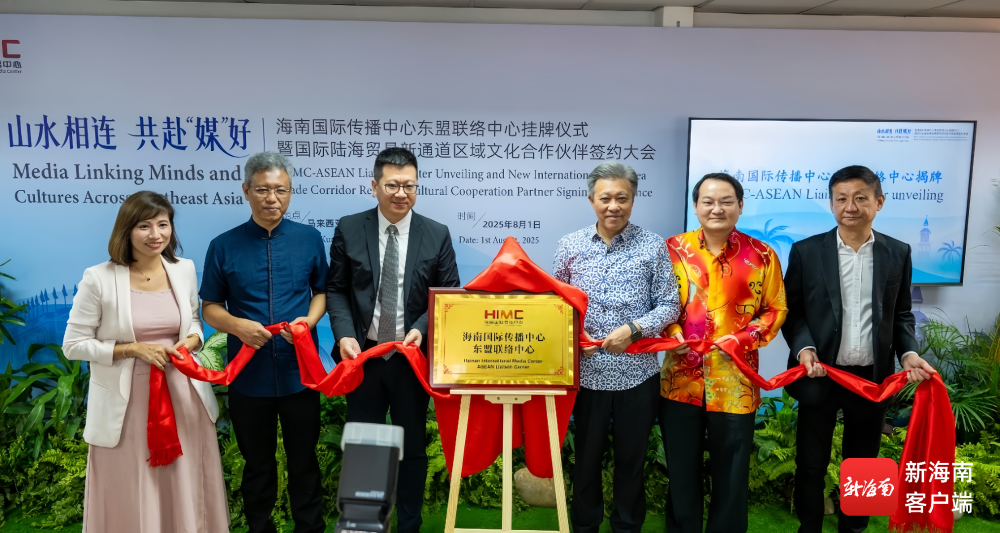
Hainan province, long China’s testing ground for economic and policy innovation, has emerged as a key experimental front in Beijing’s latest campaign — leveraging local and regional media to boost the country’s global “discourse power.” Earlier this summer, the Hainan International Media Center (HIMC), an office directly under the province’s propaganda office, unveiled a liaison center in Dubai, planting its flag in the Middle East. In Kuala Lumpur on Friday, it opened a new ASEAN Liaison Center (東盟聯絡中心), staking out Southeast Asia as a priority region for outreach.

Established in 2019, the HIMC was among China’s earliest provincial-level international communication centers (ICCs), following on the heels of the municipality of Chongqing, which launched its ICC in June 2018. The province’s unique position as a trade port experiment along what the CCP leadership has in recent years dubbed the “Maritime Silk Road” makes it a natural laboratory for President Xi Jinping’s “centralization+” approach to international messaging. It is also a key military region in the South China Sea from which China presses its territorial claims, a constant agitation for many ASEAN member states.

The launch ceremony for the HIMC liaison hub was attended by more than 60 guests under the theme “Media Linking Minds and Cultures Across Southeast Asia,” including Datuk Seri Wong Chun Wai (拿督斯里黃振威), chairman of the Malaysian National News Agency, Teh Hao Ran (鄭豪然), executive editor of Kwong Wah Yit Poh (光華日報), and Niu Xiaomin (牛曉民), deputy editor-in-chief of Hainan Daily Media Group (海南日報報業集團). The formation comes as Hainan prepares for the December 18 start of its free trade port’s closed-loop operation (封關運作), a development that officials say will dramatically increase connections with ASEAN countries. ASEAN has been Hainan’s largest trading partner since 2021.

The center, guided by Hainan’s provincial propaganda department and led by Hainan Daily Media Group, aims to serve as what officials described as a “comprehensive cooperation bridge” linking Hainan with ASEAN countries through international communication, economic cooperation, cultural exchange, and think tank collaboration.

The overseas expansion reflects Xi’s 2021 directive to “tell China’s story well” (講好中國故事) — terminology that has been core to the party’s international communication objectives since August 2013 — and make China “credible, lovable and respected” (可信、可愛、可敬), as Xi urged in a May 2021 speech to a collective study session of the CCP Politburo on “external propaganda” (外宣). Officials at the Kuala Lumpur ceremony invoked the same language, emphasizing the center’s mission to “tell good stories of China and Hainan” (講好中國故事、海南故事) to ASEAN audiences.

Guangxi Seeks Vietnamese Media Partners

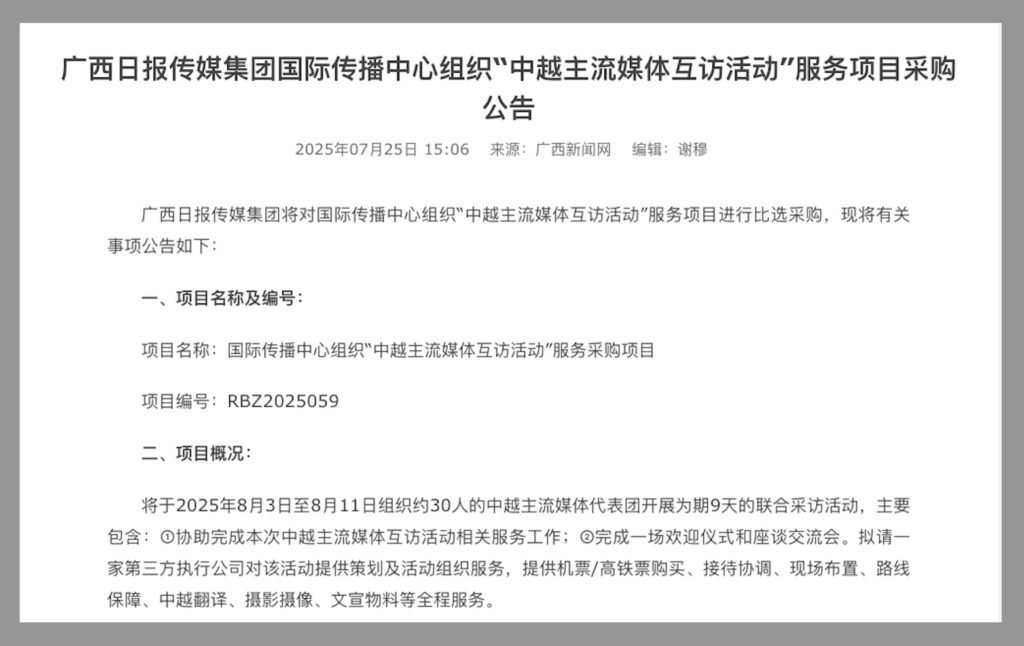
Offering an inside look into how China is using provincial-level media resources to strengthen external propaganda, the official Guangxi Daily (广西日报) issued a call for bidding this month for an exchange program with Vietnamese journalists.

The procurement notice, published July 25, seeks a third-party contractor to organize a nine-day joint reporting activity from August 3-11 involving approximately 30 Chinese and Vietnamese mainstream media representatives. The program will include coordinated interviews, a welcome ceremony, and exchange sessions, with services covering transportation, translation, photography, and promotional materials.

A procurement notice from the Guangxi Daily Media Group is posted on July 25, 2025.

The initiative is being organized by the Guangxi Daily International Communication Center (广西日报国际传播中心), part of the Guangxi Daily Media Group. The center represents a key component of China’s expanding external messaging apparatus at the subnational level.

The formation of international communication centers, or ICCs, at the provincial, city and even county levels across the country responds to a call from Xi Jinping to remake the nation’s system for what the Chinese Communist Party has typically called “external propaganda” (外宣).

The idea driving the policy is that the leadership might, by empowering provincial and local media entities to establish their own international communication centers, leverage more direct knowledge of cross-border dynamics, shared cultural ties, and economic partnerships that national-level outlets might overlook.

This approach reflects a calculated shift from China’s traditional reliance on centralized state media to a more distributed network that can exploit regional advantages. The dispersed structure — which might be called “centralization+” — enables the party to maintain unified messaging while appearing to offer diverse perspectives, creating what officials describe as “singing an international communication ‘chorus'” (唱响国际传播”大合唱”).