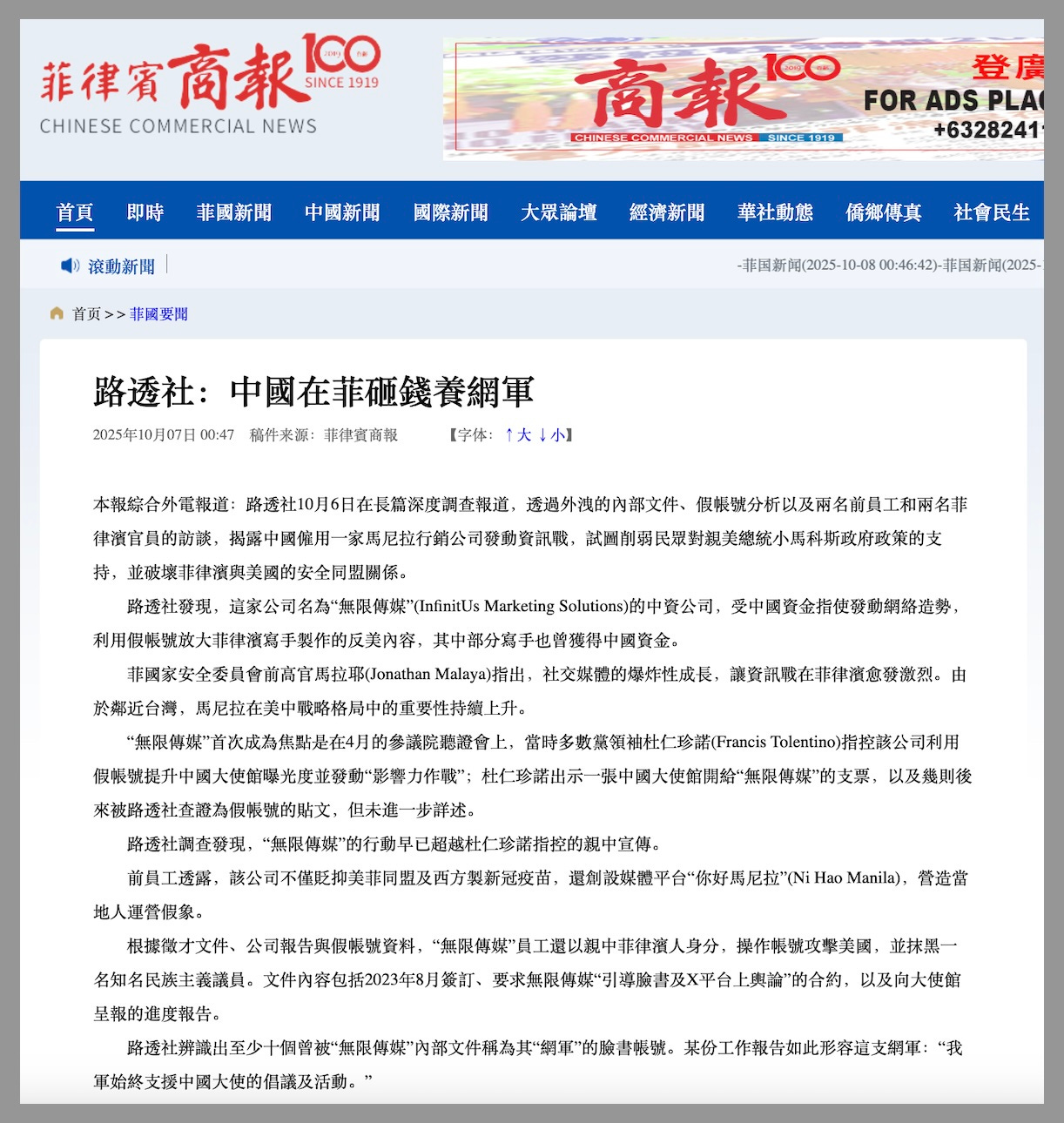
The long-established Filipino Chinese newspaper Chinese Commercial News (菲律賓商報) devoted substantial coverage in its October 7 print edition to a Reuters investigation published on Monday alleging China hired a Manila-based marketing company to conduct information operations in the Philippines. The report detailed how InfinitUs Marketing Solutions allegedly used fake social media accounts to undermine support for President Marcos’s pro-U.S. policies and weaken the Philippines-U.S. security alliance. The newspaper’s prominent treatment of the story is notable given that it is generally seen as China-leaning and lists the Chinese embassy, China News Service, and other official Chinese media as “friendly links” on its website.
The Chinese Commercial News republishes the Reuters investigation on its website Tuesday.
Chinese propaganda broadcasts from Fujian People’s Broadcasting Station (福建人民廣播電台) — a station under the state-run Fujian Radio Film and TV Group — have infiltrated Taiwan’s airwaves with unprecedented clarity, according to recent reports in the Liberty Times (自由時報). PRC programming has managed to reach even remote mountain areas, including the 2,000-meter-high Daxueshan Forest Recreation Area (大雪山森林遊樂區). The FM 96.7 frequency, normally reserved for Taiwan’s Uni Radio (環宇廣播), which reaches audiences in the Taoyuan, Hsinchu and Miaoli areas, now carries Beijing-directed content throughout the eastern districts of Taichung, the country’s second-largest city.
Due to distance, it’s generally difficult to receive a clear signal from Uni Radio in the Taichung area, and frequencies without broadcasts from a major station can be considered open channels that smaller local stations can occupy to air their programming. Lawmakers in Taiwan have demanded a swift investigation into possible domestic collaboration with actors from China, as well as enhanced countermeasures against what officials describe as an escalating cognitive warfare campaign targeting Taiwan’s airwaves.
More information on China’s infiltration of Taiwan radio frequencies can be found in this April 2023 report from the Mainland Affairs Council (MAC).
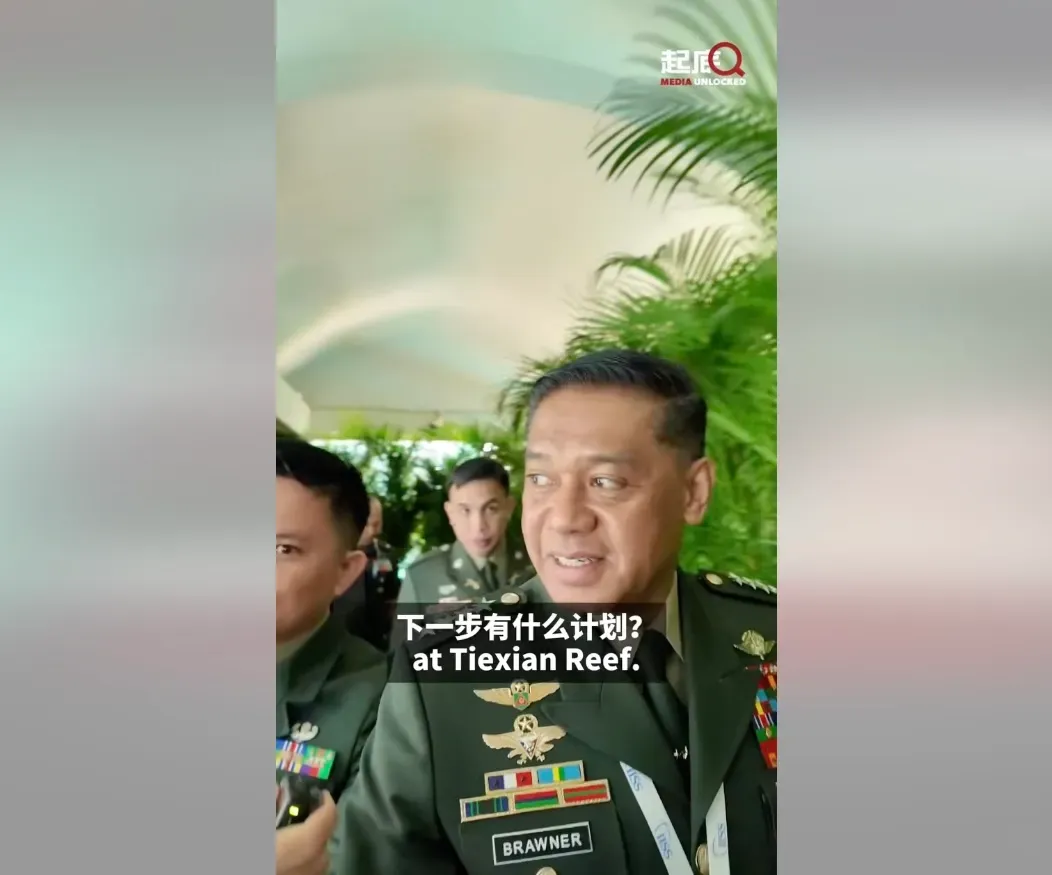
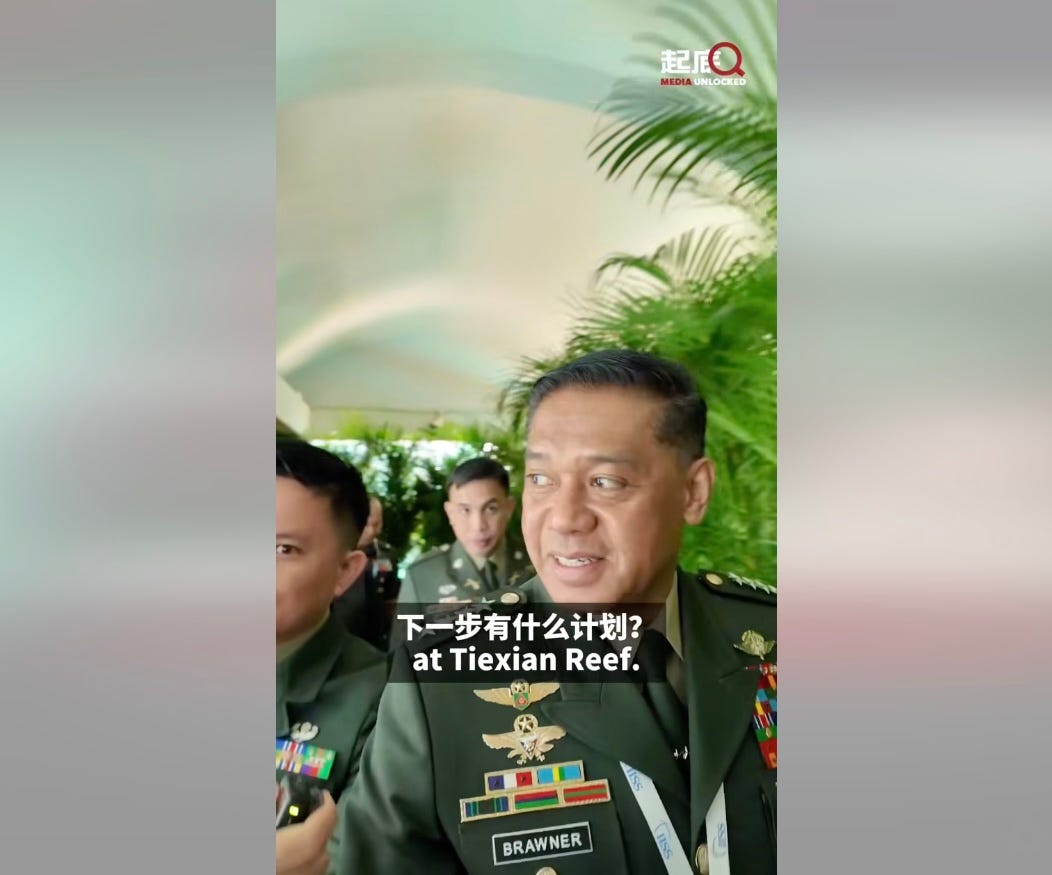
The Armed Forces of the Philippines dismissed as “propaganda” a China Daily video showing General Romeo Brawner Jr. allegedly avoiding reporters at Singapore’s Shangri-La Dialogue, held May 30-June 1. The video was posted online yesterday by “Media Unlocked” (起底), a social media brand of China Daily that takes a shallow and confrontational approach while purporting to explore topics more deeply. In the video, the “Media Unlocked” reporters appear to have not clearly identified themselves as reporters. They then allege that Brawner “dodged the question” about what they characterize as “the Philippines’ recent provocations in the South China Sea.”
A screenshot of the China Daily “Media Unlocked” video in which Brawner and others are cornered for questions about territorial disputes.
Defense Secretary Gilberto Teodoro Jr. noted that China had not sent an official delegation to the security forum, where he addressed Beijing’s assertions in the West Philippine Sea (西菲律賓海) — referring to the portion of the South China Sea claimed by the Philippines.
The incident in Singapore reflects how maritime disputes between the Philippines and China over the South China Sea have intensified in recent months and spilled over into the information space, becoming a contest of narratives. But it also offers an illuminating look at how Chinese state media go on the attack — seeking to create and distribute propaganda and disinformation on issues of core interest through prescribed proxy media brands and viral content. The “Media Unlocked” video was produced by Meng Zhe (孟哲) and Xupan Yiru (徐潘依如), who are identified elsewhere as reporters for “the Unlocked Media Studio of China Daily” — though not in the video itself. The “Unlocked” brand is part of a growing social media “studio” system implemented by central CCP-run media in recent years, partly to distance core state media brands from more provocative statements and conduct, and partly to disguise their state affiliation on social media platforms. Notably, the military delegation from the Philippines was approached at the same time by a reporter from Yutuantantian (玉渊谭天), a social media brand under the CCP-run China Media Group. In April 2023, a top CMG executive said the account had been “planned in advance and prepared over the long term to deliver powerful punches at critical moments.”