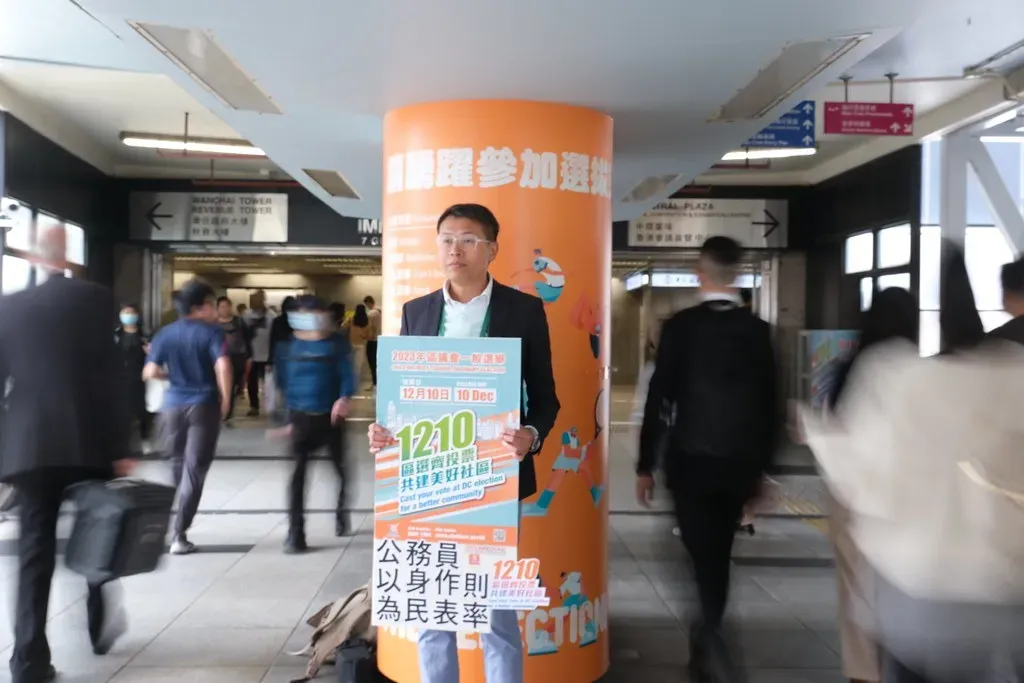
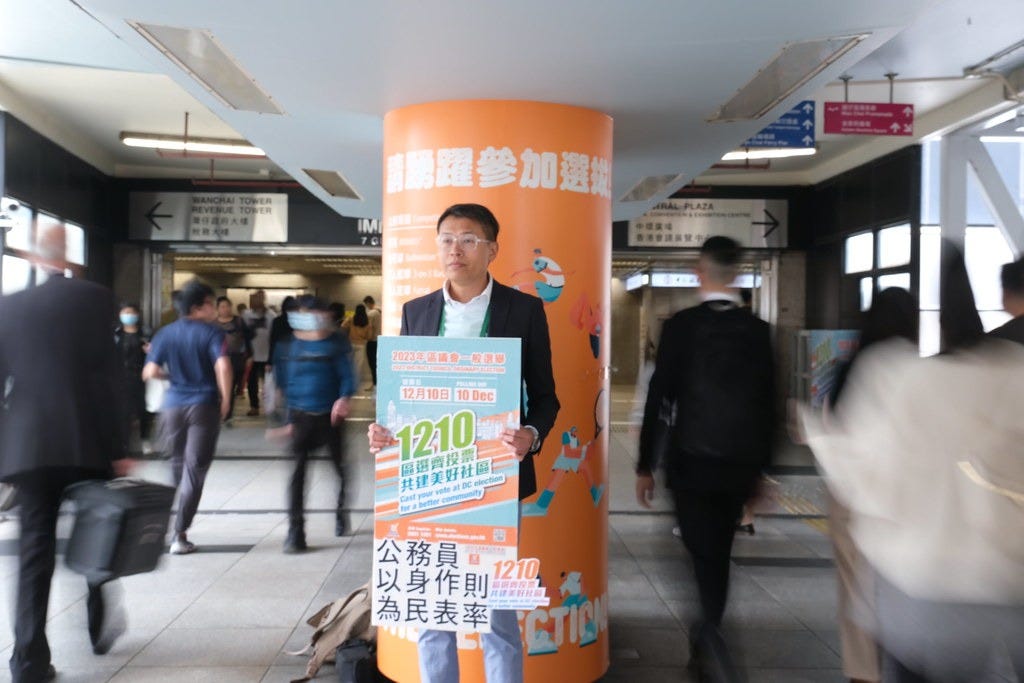
Hong Kong Chief Executive John Lee Ka-chiu (李家超) sent a letter to all civil servants on October 28 urging them to vote in the December 7 Legislative Council election, calling it “a concrete way to demonstrate their oath to uphold the Basic Law.” The pro-governmentTa Kung Pao (大公報), controlled by the Liaison Office, responded with an editorial stating civil servant votes should be “iron votes” (鐵票) — unwavering support for the new electoral system. The case illustrated how civil servants face mounting pressure, including in state-backed media, to demonstrate political loyalty through voting.
The 2025 Hong Kong Legislative Council election will be held on December 7. IMAGE: InMediaHK.
Sun Shangwu (孫尚武), deputy editor of the state-run China Daily (中國日報) newspaper, will become deputy director of China’s central government Liaison Office (中聯辦) in Hong Kong, according to a report by Hong Kong’s Sing Tao Daily. The 56-year-old Sun, the paper reported, has “extensive foreign propaganda experience” (外宣經驗豐富) and will oversee external communication work for the office, which also closely controls such outlets as the Ta Kung Pao (大公報). This “extensive” experience is an apparent reference to Sun’s launch in 2021 of China Daily’s “Media Unlocked” (起底) studio, a combative social media brand that claims to produce “investigative documentaries” (调查纪录片) but more often peddles outright disinformation targeting critics of China in the West. “Media Unlocked” recently launched a personal attack on Simon Fraser University’s Darren Byler, who has criticized internment camps in Xinjiang.
Former Chinese University of Hong Kong assistant professor Simon Shen (沈旭暉), a political scientist who studied at Oxford under Sinologist Rana Mitter and is now a visiting scholar at National Sun Yat-sen University (中山大學) in Taiwan, faces accusations of selling pro-Hong Kong independence materials through his Global Hong Kong Library (國際香港圖書典藏館).
Wen Wei Po (文匯報), a paper controlled by China’s central government in Hong Kong, alleged that Shen’s online platform promoted separatist agendas while displaying and selling items from the 2019 protests — disguised (the paper said snidely) as “precious collections” (珍貴藏品).
Pro-Beijing politician Elizabeth Quat Pei-fan (葛珮帆) warned that sharing such content on social media could violate the National Security Law. Barrister Ronny Tong Ka-wah (湯家驊), a non-official member of Hong Kong’s Executive Council, a formal body of advisors to the chief executive, raised the specter of transnational repression, warning that violators anywhere in the world could face police pursuit. At the Bastille Post (巴士的報), columnist Lai Ting Yiu (黎廷瑤) described Shen as “playing with fire.” The Global Hong Kong Library website states it hopes to preserve Hong Kong collections and ensure “the truth will not be revised.” For more on the crucial role of archives in information freedoms, be on the lookout for today’s edition of our companion publicationTian Jian (田間), or read their recent interview with Ian Johnson.
Donald Trump’s use of the National Guard and US Marines to quell protests in Los Angeles against his immigration policies became a major story across Chinese media last week. Op-eds filled with images of turbulence interpreted the news as pointing toward imminent “civil war,” words used in several reports. Pursuing their long-term goal of discrediting the US political system, Chinese state media are now pushing at a door the Trump administration has opened wide.
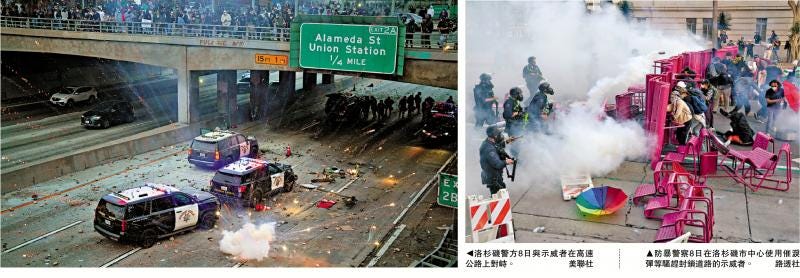
Scenes of aggressive police action in LA are reported by Hong Kong’s government-run Ta Kung Pao.
China’s state-run Xinhua News Agency reported that its journalists had been injured while covering the protests. The article purported to deliver the will of the protesters, quoting them as saying they were “hard-working local community residents who wanted to express their opinions peacefully.” The report reached second-place on the Baidu search engine’s list of hottest news topics on June 9. The same day, another trending post from a prominent self-media account predicted that the events in California were a “prelude” to deeper conflict. “America’s ‘civil war’ has begun” (美国”内战”开始了), the author declared, calling the unrest “the first large-scale street conflict of the Trump 2.0 era” and comparing downtown Los Angeles to “a Middle Eastern war zone.” The post received close to 1.6 million reads.
In Hong Kong, media similarly mirrored these narratives of American decline. The online news outlet HK01 and state-backed newspaper Ta Kung Pao (大公报) both framed the conflict as a consequence of long-term social divides within the US, with HK01 warning that without resolution, America would “eventually fall into the abyss.”
For more on Chinese media portrayals of protests in the United States, and our perspective at CMP on how Trump administration actions have been a huge assist for China’s external propaganda efforts, read “A Trump Card for China’s Media.”