Tag: Xi Jinping

Is Xi’s Grip Holding?

Speculation about Xi Jinping’s waning influence intensified late last month following news of his planned absence from this week’s BRICS summit in Rio, on top of reports suggesting his presence in China’s state-run media has declined. Willy Wo-Lap Lam at the Jamestown Foundation’s China Brief noted that “citations of Xi’s name have become thinner and thinner in authoritative official media,” raising questions about potential leadership changes as China approaches its next Party congress.

However, our analysis of front-page headlines in the Party’s official People’s Daily challenges this narrative. Comparing the second quarters of 2024 and 2025, we found that Xi appeared in headlines 177 times versus 157 times respectively — a modest decline likely explained by incomplete June 2025 data. More significantly, Premier Li Qiang, Xi’s closest competitor, showed virtually no change with 45 appearances in 2024 and 43 in 2025.
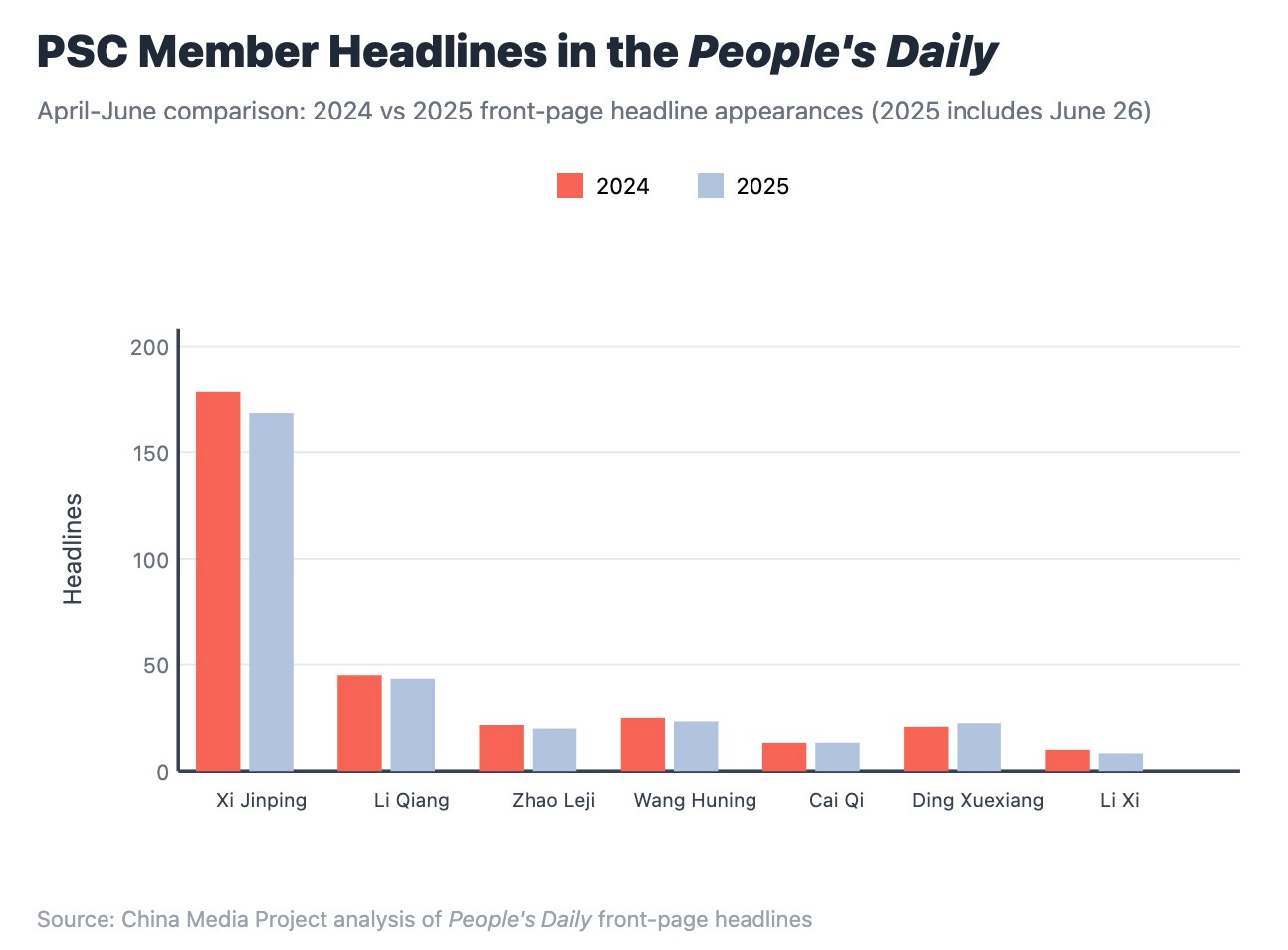
While these headline counts cannot capture insider dynamics or leadership effectiveness, they hardly suggest a power shift in the Party’s most important publication. Xi’s dominance in China’s authoritative media remains intact — contradicting speculation about his declining grip on power. The data suggests China’s most powerful leader in generations continues to command overwhelming media attention. Read more on this at the China Media Project website.

Viral Valedictions

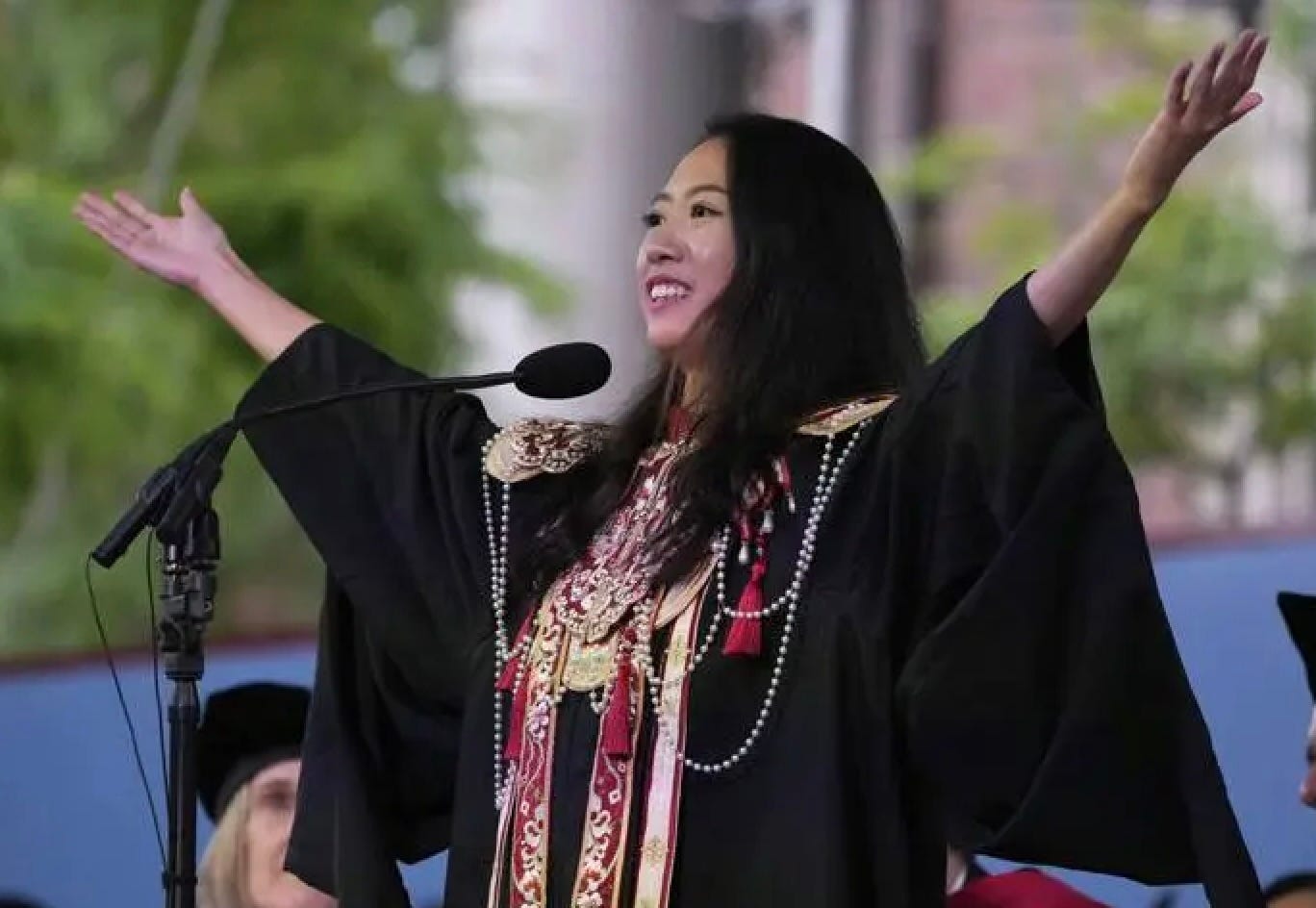
The World Journal (世界日報), a Chinese-language outlet with online and print editions across the United States, reported that graduating Harvard University student Yurong “Luanna” Jiang (蔣雨融), who is from China, received polarized reactions to her graduation address at the Ivy League institution. While some Chinese netizens praised the “international vision” shown in Jiang’s speech — titled “Safeguarding Our Humanity” — others criticized her message as a false story of inspiration for ordinary families. Not surprisingly, perhaps, Jiang’s background was scrutinized after her speech went viral in China. Netizens found that she is the daughter of Jiang Zhiming (蔣志明), executive director of the Chinese state-backed environmental organization China Biodiversity Conservation and Green Development Foundation (中國生物多樣性保護與綠色發展基金會). Given Harvard’s annual tuition and living costs would demand around 700,000-800,000 yuan, or between 96,000 and 110,000 dollars, they questioned Jiang’s claim to have come from an “ordinary” family and suggested — without proof, mind you — that her admission may have benefited from elite connections. Over on his Substack account, the exiled Hong Kong activist Nathan Law Kwun-chung (羅冠聰) noted Jiang’s used in her speech of the words “shared future” in close proximity to the word “humanity” — suggesting possible echoes of one of Xi Jinping’s core foreign policy concepts.

A Loyal Megaphone on Labor

May 1 is a red-letter day for the Chinese Communist Party, which continues to see worker’s rights as at the heart of its identity and legitimacy — even, or especially, in a period when well-paying jobs are in short supply and workers are over-qualified. International Labor Day this year also marks the 100th anniversary of the founding of the All-China Federation of Trade Unions (中华全国总工会), a vehicle for strengthening proletarian unity and a CCP power base in the Party’s early days. The anniversary celebrations on April 28 made the front page of the People’s Daily, with Xi Jinping making a speech about how the federation had been able to “unite and mobilize the working class to follow in the Party’s steps.”

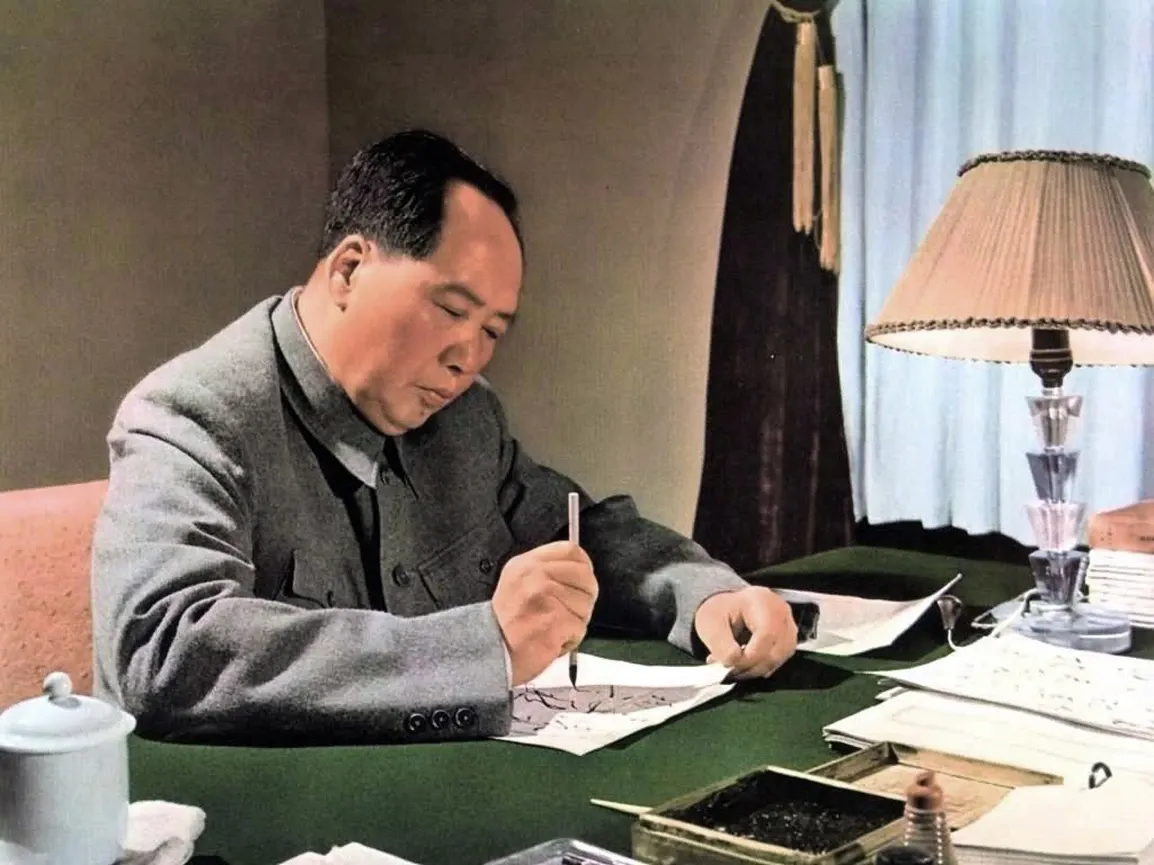
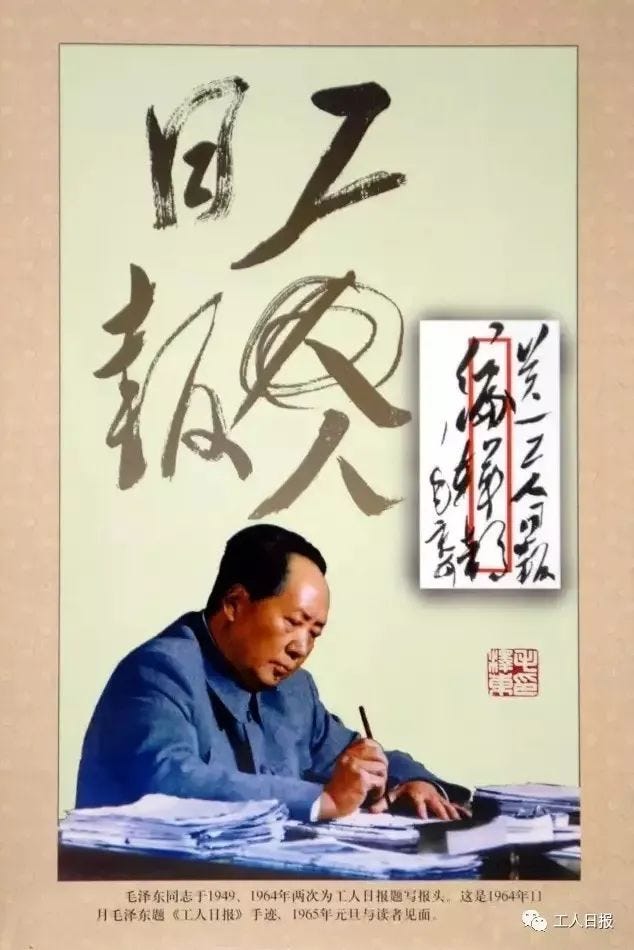
A portrait of Chairman Mao Zedong working at his desk in 1964, with calligraphy showing “工人日報” (Worker’s Daily) displayed prominently above. This image was originally photographed in 1964 and later published in the newspaper in 1965. SOURCE: All-China Journalist’s Association.

One way they have tried to do so is through their newspaper, the Worker’s Daily (工人日报). From the first days after its launch in July 1949, the outlet aimed to serve an audience of blue-collar laborers not used to the heavy ideological prose of the People’s Daily. Then-head of the Federation, Li Lisan (李立三) — who had spent his early days as a labor organizer in China’s coal mines — imagined a newspaper that could better guide workers on Party thinking by being relatable. Xinhua bulletins, for example, were re-written for the paper in simpler Chinese, with authors selected from among workers across the country.

Relatable propaganda is an idea Xi Jinping has tried to resurrect from the earliest days of his presidency. “Wherever readers are, wherever viewers are, that is where propaganda reports must extend their tentacles,” he told an audience at the PLA Daily in 2015. Like the rest of state media, Worker’s Daily has rolled out a news app and accounts on everyday Chinese apps like Douyin, posting videos of heart-warming stories about the toils of modern blue-collar workers across the country.

Painting Macau Red

Macau is intensifying patriotic education efforts targeting young people through “different levels and aspects,” according to a report on March 26, 2025, by All About Macau (論盡) — an independent news outlet launched in May 2013 that focuses on in-depth reporting on social issues in Macau. At a closed-door Youth Council meeting held on March 25, Social and Cultural Affairs Secretary O Lam (柯嵐) emphasized that “President Xi Jinping is very concerned about the development of Macau’s youth.” She outlined such initiatives as “red root-seeking journeys” (紅色尋根之旅) — essentially, junkets for youth from Macau that involve trips to “red tourism” sites like the birthplace of Mao Zedong.

According to All About Macau, the territory’s Education and Youth Development Bureau said it would promote patriotism through methods “appealing to young students,” cultivating the core social value of “loving the country and loving Macau.” This case exemplifies the ongoing efforts in both Hong Kong and Macau to systematically integrate mainland Chinese patriotic education — equating love of country with unconditional support for the CCP regime.