

Since Xi Jinping addressed a Politburo Standing Committee session five years ago calling for a reinvention of China’s global propaganda and communication efforts, provinces and cities across the country have jumped headlong into the project. The result, documented in CMP’s Centralization+ report last year, is a centrally conceived and managed plan to leverage media groups and propaganda offices at the local and regional level to bolster the national campaign to “tell China’s story” globally — meaning to spread positive facts and narratives to international audiences about China’s actions, its political system and its role in the world (on top of its food and traditional culture).
The national network of international communication centers, or ICCs, has exploded in China over the past three years to more than 200 spanning provincial, municipal, and county levels nationwide. It has become, some sources tell CMP, a hugely wasteful initiative, even burdening some governments at a time when local debt is already a concern. Nevertheless, China’s leadership remains committed to the approach in what it sees as a period of strategic opportunity.
An article in the Chinese Communist Party’s official Seeking Truth journal earlier this year made a not-so-subtle jab at the United States, saying that as the credibility of “some Western countries” erodes (公信力持续下滑), China must seize the initiative to reshape the international information order in its favor. The article called on central-level media including the government-run China Daily to deepen coordination with international communication centers across the country, using what it called a “media plus think tank” and “central media plus local” approach to amplify China’s global messaging. This “stacking effect” (叠加效应), as the article called it, is precisely the kind of layered, centrally orchestrated approach that CMP’s “Centralization+” framework describes.
But beyond the strategizing and the theory, which CCP journals and official speeches prattle on about endlessly, what exactly are China’s ICCs doing? What are they prioritizing?
A job posting published this week by Chongqing’s Western International Communication Center (西部国际传播中心), or WICC, the center established in 2018 as a pilot for the national system that followed, offers a rare glimpse into its operations — and indicates how other ICCs may be thinking about their efforts to advance what China’s leadership calls “external propaganda.”
The following is a summary of what we can glean from the post, which we offer as a bilingual PDF at the end of this article.
Influence and Amplify
English language remains the global priority. The fact that two of the WICC’s content roles, that of multimedia reporter and social media editor, demand near-native English fluency — with English Band 8 or an IELTS score of 7 or above — suggests a strong focus on English-language content production remains. The job ad even specifies for these positions that applicants will be favored if they have experience of overseas study in a native English-speaking country. The center is recruiting people who can produce original English-language content and social media posts.
AI is already at the heart of production. Journalists and content creators around the world may be soul-searching about the implications of AI and the necessary role of humans in the process. For Chongqing’s ICC, there is no such fretting. Candidates clearly need to arrive ready to work in a fully AI-enabled production environment. According to the ad, the English-language reporter must be able to independently complete what it calls “AI news editing and AI video full-process production” (AI新闻采编与AI视频全流程制作落地). Meanwhile, social media editors are expected to use generative AI across content planning, multilingual copy, short video editing, and live-streaming. Another position, the studio engineer, needs to have proficiency in Unreal Engine for XR and virtual production environments, and must be able to apply AI visual generation tools to scene design and content rendering. Chongqing is likely ahead of the curve nationally on the use of media tech — but this tells us what direction content production is heading. And AI is central.
Overseas influencer networks are a priority in getting the message out. Another of the positions advertised, the "media cooperation specialist" (媒体合作专员) role, is about a core role of many ICCs nationwide — the systematic cultivation of foreign voices. This specialist will be tasked with recruiting and managing what the posting calls "overseas Big Vs" (海外大V) — "Big Vs" being a Chinese term hanging over from 2010-2013, when "verified" users with huge domestic followings on platforms like Weibo were labelled in this way because they had a "V" for verified label next to their account name. Big Vs refers in this case to foreign social media figures with strong fan networks. The ICC apparently plans to target them for organized visits and co-production arrangements, tasked with "developing and maintaining cooperative relationships with overseas social media KOLs, industry influencers, well-known media outlets, and like-minded platforms" (拓展并维护海外社媒KOL、行业达人、知名媒体及同频平台的合作关系).
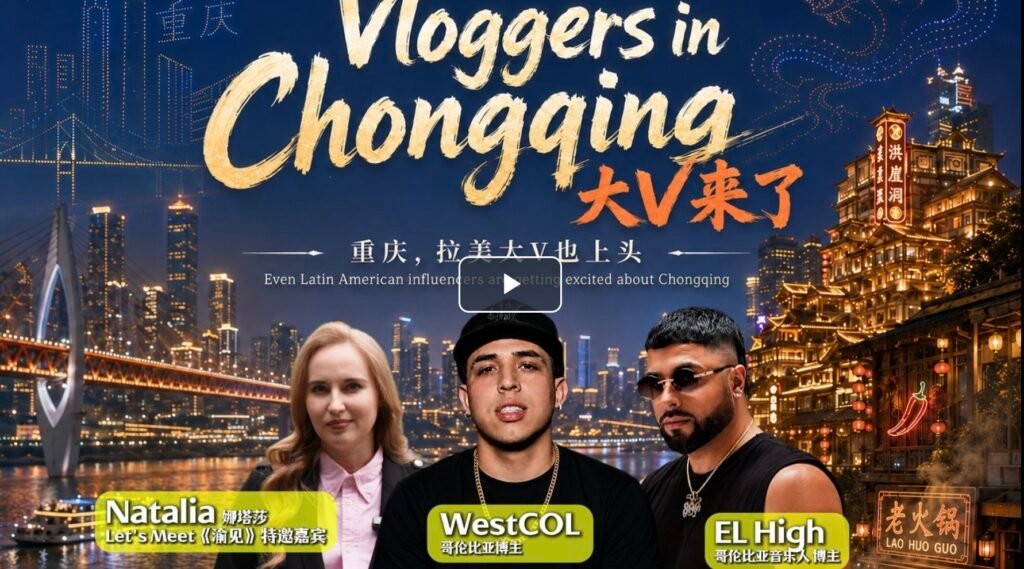
The new hire is likely to bolster what the WICC has already been actively doing. Last month, the center brought three Colombian influencers to Chongqing on an organized visit. They included WestCOL, whose real name is Luis Fernando Villa Álvarez and who is among Latin America's most-followed streamers, with nearly two million subscribers on YouTube. Their reactions to the city's nightlife, architecture and food culture were recorded and produced for the WICC's Let's Meet program.
The financial arrangements behind visits like this are not public, but the pattern of organized itineraries with a geographical focus (three influencers at once all from Colombia) suggest the ICC is at least bearing the cost of travel and accommodation. The goal here is a modern-day reinvention for the social media era of China’s classic approach to manufacturing “friends” as those who uphold the country’s interests and advance its image. Influencers are not just ready peddlers of attention, ready to ooh and aah over novelty; they bring existing audiences who trust them, and over whom they have a quantifiable level of influence.
Once the influencer content has been produced, the role of the "media cooperation specialist" is also to ensure that it is further distributed through the ICCs growing global network. For a case in point we need look no farther than the recent triangle of Colombian influencers. Coverage of their visit was subsequently distributed by the Sri Lanka Mirror, a Colombo-based news outlet that launched a dedicated Let's Meet channel in April 2025.
China is beginning to look more seriously at results. Among the advertised hires is the position of a media data specialist whose job it will be, according to the post, to monitor sentiment across overseas mainstream media and social platforms. This work will involve the use of AI tools for multilingual assistance and what the posting calls "public opinion analysis" (舆情研判). The idea is that the findings will be filtered back into the center’s international communication strategy.
Historically, China’s efforts at international communication have not been very audience responsive. There are many reasons why this is the case, not least the fact that communication is often stuck in a vertical feedback loop in which there is more consideration and concern about how Chinese government bosses perceive communication efforts than there is of how audiences actually respond — or don’t. Public opinion monitoring has been a booming industry at home for decades now. With the assistance today of powerful AI models, the possibility cannot be ruled out that China might now be able to gain real insight into how impactful certain approaches are toward different audiences, and that messages and narratives might be more tailored.
Behind the job advertisement itself, however, there looms an even more fundamental question for Chongqing, and for China's ICCs — the question of talent. In late 2024, a CMP review of ICC hiring drawing on a report from the magazine Young Journalist (青年记者) found that ICC positions were struggling to attract applicants, with one job ad for Zhejiang’s provincial-level ICC receiving fewer than 200 engagements on WeChat. Even Shanghai struggled to recruit much-needed foreign talent, with one employee telling Young Journalist: "After the epidemic, there has been a huge loss in overseas talent, and everyone faces similar difficulties."
Can Chongqing, or any other regional hub, actually find the high-level talent required to make this strategy work? That remains a costly question mark for a system already burdened by local debt — an issue we will return to in a future report. But even if China matches its global ambitions with robust domestic financing, it remains to be seen whether this "borrowed boat" approach of letting foreign influencers ooh and aah over novelty can pay real dividends in terms of international influence.
Proponents of China's growing role in global public opinion, like Fudan University's Zhang Weiwei (张维为), who delivered the lecture at the Politburo Study Session five years ago, talk grandiosely of a coming era of “post-Western discourse” (后西方话语) and the dominance of a unique “Chinese discourse system” (中国话语体系). Those bold claims have an odd ring against the backdrop of much of the content emerging from the country's first, and self-proclaimed foremost, ICC. As Colombia's WestCol exclaims over insects sold as snacks in a Chongqing food market, or as American influencer iShowSpeed eats ice cream with local Donald Trump impersonator Ryan Chen, what exactly is the grand vision?
Even if China has our attention — is there anything more meaningful it feels at liberty to say?
____________________________________________