

Earlier this month, more than 400 delegates from over 40 countries gathered in the southern city of Shenzhen for the Asia-Pacific Media Forum, a sprawling conference event billed by China as a must-attend meeting of media industry movers and shakers. The official China News Service announced on Facebook that “a batch of important cooperation agreements were reached.”
Read the fine print, however, and it is clear that China wanted attendees to play another key role — as norm shifters.
China is investing heavily in global and regional media engagements, both inside China and around the world, and the goal is not just to drum up media business, or push responsible AI use, but to shape the way media, journalists, state leaders and others understand the nature and purpose of journalism and media. China wants everyone to know, and to believe, that the primary role of the media is not to serve readers or to hold power to account, but to promote shared diplomatic goals among nations.
This push to shape norms is why the hosts of the Asia-Pacific Media Forum (亚太媒体高端论坛) used the opportunity to loudly proclaim the “Shenzhen Consensus” (深圳共识), a document committing participants to the broader goal of “jointly building a healthy communication ecosystem” among media across the Asia-Pacific region and around the world.
As media ecosystems, and particularly journalism cultures, around the world face myriad challenges from a perfect storm of collapsing business models, vanishing support for public-service and independent media, rising authoritarianism, and the disruptions of AI — it is crucial to see past the deals and the breakout sessions to exactly what China is actually offering.
So who exactly is introducing this consensus, and what do they mean by “healthy”?
All in Favor Say “China”
The introduction of “consensus” and “declaration” documents at China-hosted forums and other gatherings, even when they are decidedly subnational in nature, is a common tactic China employs to manufacture apparent accord over its core values and propositions.
The most infamous incidence of this manufactured consensus was the “Wuzhen Declaration,” a document literally slipped under the doors of participants just before midnight before the final day of the first “World Internet Summit” hosted by China in 2014. China’s first cyber czar, Lu Wei (鲁炜), insisted at the time that because some attendees had agreed to the document, it was not incorrect to call it a consensus.
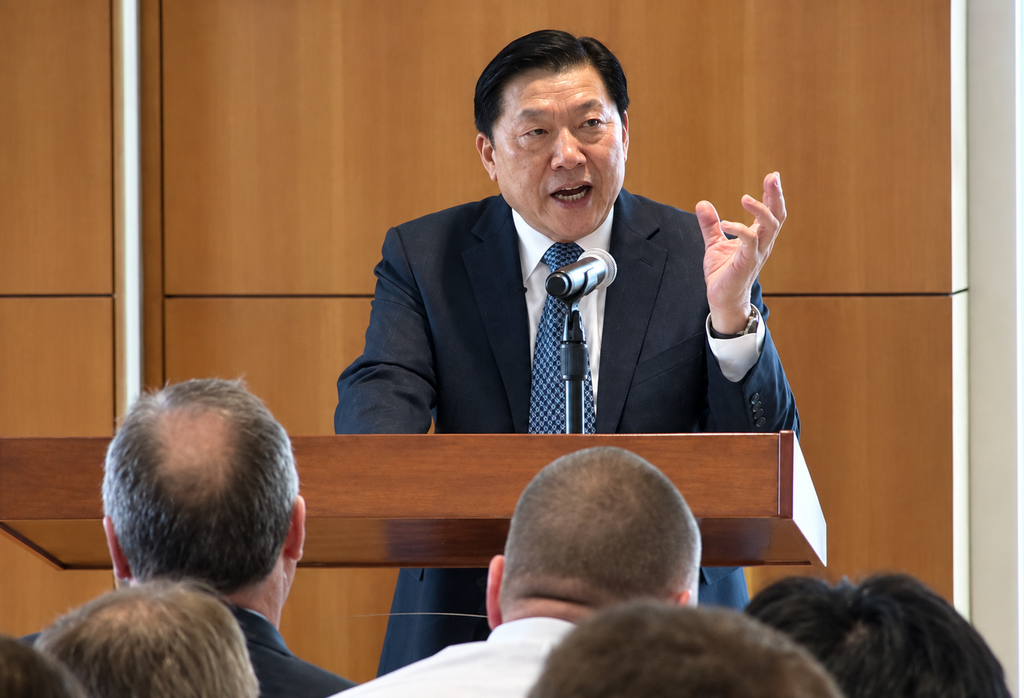

While the Asia-Pacific Media Forum was nominally associated with the “China Year” events line-up at APEC — the 21-nation grouping of economies around the Pacific Rim that is a non-binding forum — the event was in fact organized by the Chinese Communist Party’s Central Propaganda Department, the political body under the Central Committee charged with aligning news media, publishing, and cultural output with Party ideology and messaging. Other partners included the government-run Xinhua News Agency and the Guangdong Provincial Government.
These are not bodies that have a primary vested interest in media development, open information, the future of AI integration, and so on. Their interest lies elsewhere, in maintaining what the CCP calls “public opinion guidance” at home, and “discourse power” abroad. China’s leadership, through these and other actors (explore the LS database), pursues that influence because it believes global public opinion is essential to its economic and political standing in the world as well as its political stability at home.
While several official Chinese sources have said that the “Shenzhen Consensus” was “passed by representatives” at the forum, suggesting a formal voting process, others report more accurately that the consensus was “released” (发布). In line with China’s typical practice, this document was not a product of constructive deliberation, but something created and disseminated by the above-mentioned CCP hosts.
This may on its face sound ridiculous — another declaration slipped under the door at midnight. But the mechanics of this process are often entirely opaque to participants at China-hosted events, putting them at risk of being unwitting confederates in China’s bid to redefine media values. Given the close coordination of these events by core CCP entities at the national, provincial and even municipal levels, participants must have greater situational awareness about how their participation can amount to tacit endorsement.
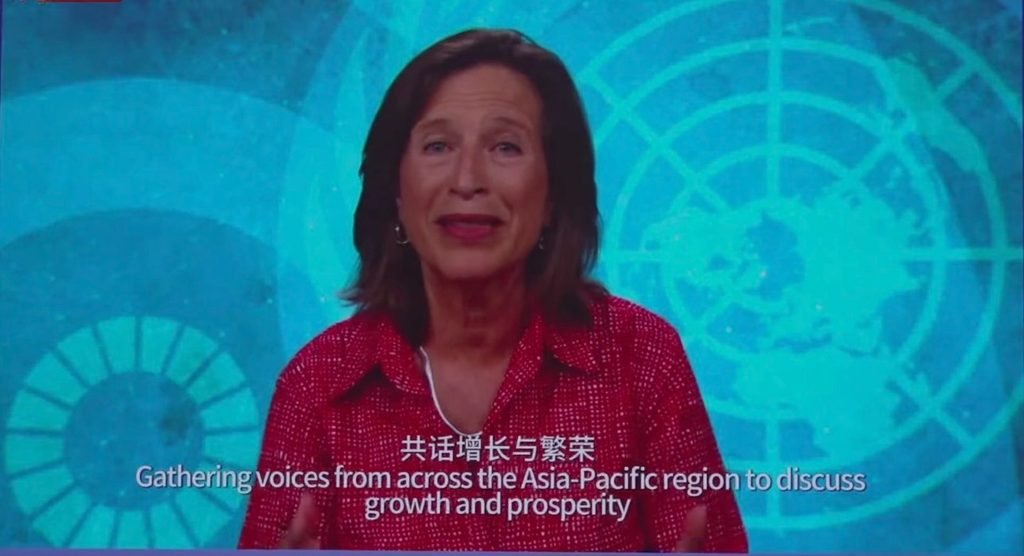
A case in point is Melissa Fleming, the American head of the United Nations Department of Global Communications, whose mandate is “trusted, objective information” about UN aims. Fleming has spoken out against disinformation and threats to truth globally, pledging to “stem the tide of disinformation” and to “counter attacks on human rights.” In her address at the Asia-Pacific Media Forum, she sounded the right note in speaking about “robust and critical coverage of the problems we face.” But the context was entirely wrong. For the second time in less than a year, Fleming is participating in a regional media conference where a “consensus” declaration is imposed by the hosts — with values that are antithetical to those of the office she heads.
Almost exactly one year ago, Fleming was a speaker at the Global South Media and Think Tank Forum in Kunming, where delegates were said to have “produced” the Yunnan Consensus. Awkwardly, the full text of that consensus was never made public, but coverage by the Global Times, an outlet affiliated with the CCP’s official People’s Daily, reported that the document “[united] Global South media against hegemonies and for a new world order.” The Chinese foreign policy underpinnings of such statements should be obvious. Under Xi, China has promoted the idea of “journalism with Chinese characteristics” (中国特色新闻学), the leadership’s clearly stated aim being to “transcend the journalism discourse hegemony constructed by the West” (超越西方构建起的新闻话语霸权) around ideas like freedom of the press. The Xi-era world view of the press is directly opposed to the very notion Fleming advanced in Shenzhen this month, that journalists serve the public through “robust and critical coverage.”
Fleming, herself a former journalist who worked for Radio Free Europe/Radio Liberty, the US state-funded news operation broadcasting in more than 20 languages, has stepped right into the trap — repeatedly. The basic threshold for her office should be clear: do not lend UN credibility to events where China converts her presence into the appearance of multilateral endorsement for its unilateral positions. It should further concern Fleming — and other participants like CNN Senior Vice President Konstantinos Oikonomou, who spoke in Shenzhen of the media’s responsibility ultimately being to the public — that the texts of these consensus declarations remain undisclosed.
Whatever these documents say, is there any clearer declaration of China’s values with regard to information than the fact that they have not been made public?
Has Anyone Seen My Consensus?
Given that more than 400 global delegates — and, yes, China has referred to them as “representatives” (代表) — participated in a forum, there should be a great deal of chatter about the “Shenzhen Consensus.” But there is none. While identical official read-outs reporting the “release” of the document have emerged from multiple state-run media and overseas proxies — even, via PR Newswire, reaching Taiwan’s English-language Taiwan News, owned by the conglomerate i-Mei Foods — no full draft of the consensus has been published anywhere.
Whatever these documents say, is there any clearer declaration of China’s values with regard to information than the fact that they have not been made public?
Consider how strange this is by the standards of consensus decision-making anywhere else in the world. More than 400 delegates from more than 40 countries gather for an international forum. A consensus document is announced — but never shown. China has not released it, nor has any outlet from the countries that reportedly sent delegates.
Students of China’s political system should recognize the parallels immediately. In fact, no other aspect of this whole affair marks the “Shenzhen Consensus” so clearly as a product of the CCP’s Central Propaganda Department as this presence of propaganda in the absence of disclosure. In the Chinese political context, it is standard operating procedure to announce in read-out form the outcome of supposed deliberations and decisions, while providing no public access to the underlying texts.
What, then, can we make of this “Shenzhen Consensus” no one has seen?
The best we can suppose is that this text closely mirrors in its basic propositions the “Declaration of China-Cyprus-Europe Media Forum,” which emerged last October from the Chinese Embassy in Cyprus amid an event that brought together more than 100 representatives from the media, government, diplomatic missions, universities, and think tanks. Among the several propositions that document made — with a clear reference to the foreign policy of Xi Jinping — was the conviction that “the media need to act as active builders of China-Cyprus and China-EU relations, helping to enhance mutual trust and understanding, foster consensus, and lay a sound foundation of public support for the steady growth of bilateral relations.”
Amid this friendly language of “mutual trust and understanding” is the demand that media suspend what Fleming called “robust and critical coverage.” Such critical reporting, particularly as it pertains to China, does not suit the goal — which, China says, should be at the core of media work — of advancing China-EU relations and trade. Journalists, in other words, must find their future as diplomats in a China-led multilateral system.
In the next line, and in an unmistakable echo of China’s domestic press control policies, the “Cyprus Declaration” states that: “The media are expected to foster an objective and reasonable public opinion environment.”
These same values are visible in the readouts from Chinese state media announcing the “Shenzhen Consensus,” which report language about the need to “uphold the principles of truthful, objective, and impartial communication, and jointly foster a healthy communication ecosystem.” Only at their peril do journalists and media bosses understand these as the shared values of global journalism. In this context, truth, objectivity and impartiality are not about the reporting or the facts — they are about the perceived “fairness” of coverage toward China’s national interests, and about the objective truth of how China sees itself in the world.
A healthy communication ecosystem, meanwhile, is a space in which bilateral and regional relations can progress without the encumbrance of “negative” public opinion — about heavy metal contamination in the Mekong River basin, or the impact of Chinese hybrid vehicle exports on the European Union.
So far, there has been near total silence on the “Shenzhen Consensus” outside the Chinese state media, and its array of accounts on social media like Facebook and YouTube that are banned inside the country. That should offer cold comfort, unless we are capable of seeing China’s values at face value — and speaking up about our own.
One lone comment came, interestingly, from Journalism Pakistan, which tracks media freedom in that country, one of China’s longstanding allies. Summing up the events in Shenzhen based on coverage from Xinhua News Agency and the Associated Press of Pakistan, the writer noted that the “Shenzhen Consensus” touched on a “wider editorial question.”
“The consensus places media cooperation alongside the promotion of regional trade and development policies,” they noted, teasing out the contradictions apparent in the lip-service to recognizable journalism values. “News organizations will need to maintain a clear distinction between reporting on those agendas and advocating for them if the declared principles of accuracy, objectivity and accountability are to carry practical weight.”