
Manufacturing Dissent

AI-generated protest videos on TikTok blur reality, showing how disinformation cuts in many directions.
|

TikTok, often criticized in Western capitals as a vector for Chinese disinformation, has become a platform for distributing fake news about protests within China itself. Following the suspicious death of actor Yu Menglong (于朦朧) and what appeared to be a government cover-up in September, AI-generated videos falsely depicting mass anti-government rallies circulated widely on the platform, according to AFP’s fact-checking service. The terrifyingly realistic clips — betrayed at points only by slightly distorted faces and nonsensical Chinese characters — bore the watermark for Sora, the visual generation software from OpenAI. They originated from an account called “Team Taiwan Value” and garnered hundreds of thousands of views and comments.

Many users believed the fabricated protests were genuine, with commenters expressing solidarity. No evidence exists of actual large-scale rallies in China over Yu’s death, which Beijing police attributed to an accidental fall, prompting widespread questioning from fans, and related reports in Chinese-language outlets globally. The videos, including this one and this one, were taken down Tuesday afternoon.
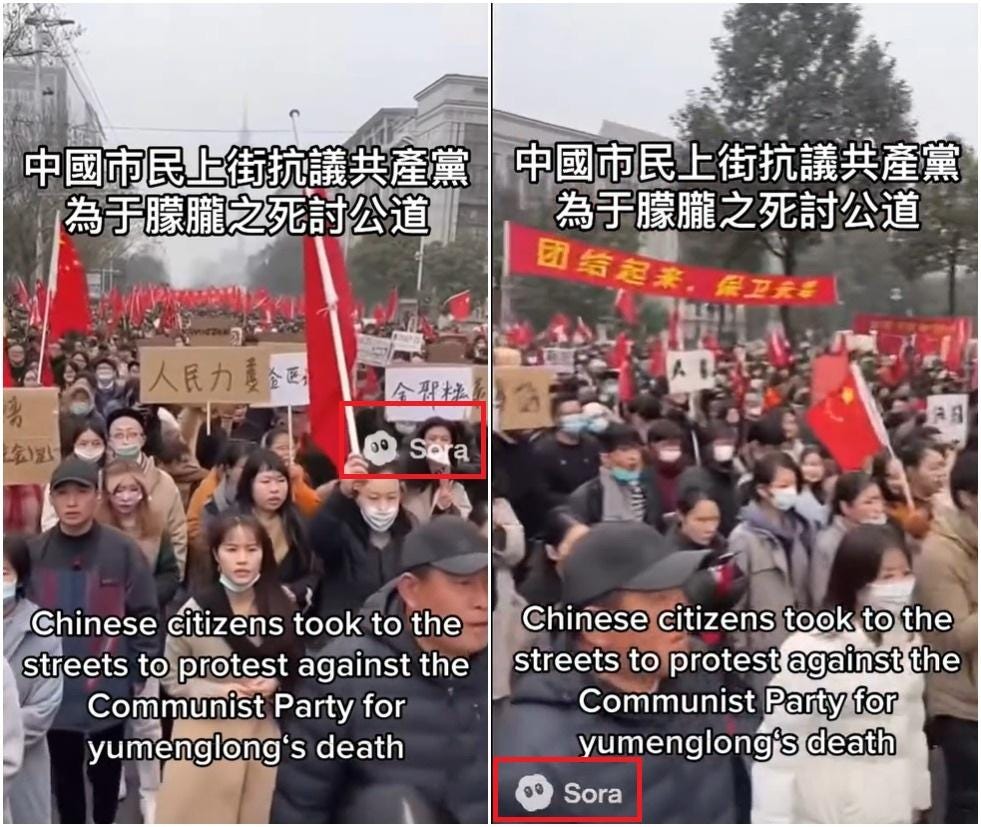
SOURCE: AFP Factcheck.

Alex Colville is a researcher for the China Media Project. He has written on Chinese affairs for The Economist, The Financial Times, and The Wire China. He has a background in coding from a scholarship with the Lede Program for Data Journalism at Columbia University. Based in Beijing from 2019 to 2022, Alex’s work as a Staff Writer for The World of Chinese won two SOPA awards. He is still recovering from zero-Covid.

More Stories from this Region

Two recent cases in Hubei province suggest authorities are shifting from targeting VPN operators to punishing ordinary users.
An open-source website built to help AI systems understand the island has drawn visitors from over 100 countries in its first week.
The Ministry of Digital Affairs plans guidelines on AI-generated content, deepfakes, and web crawling, with a framework due by year’s end.
As China’s leaders gathered in Beijing to chart the country’s future amid economic uncertainty, state media sought to shift the focus — bottling up more critical coverag…
China is shutting down hundreds of local TV and radio channels — and rebuilding its propaganda apparatus online.
China’s leader maintained a commanding lead in the headlines of the CCP’s flagship People’s Daily in 2025, despite a substantial decline over the past year. What do thes…