

On many or even most days, the front page of the People’s Liberation Army Daily (解放軍報), the flagship newspaper of China’s top military leadership body, the Central Military Commission (CMC), is a mirror of the Party’s People’s Daily. But on Monday this week one of the most prominent pieces was an oddly unique report about — would you believe it? — how “proper writing wins battles.”
No, this was not an argument about information warfare (which the PLA pursues actively), and certainly not about how the pen is mightier than the sword. This was a message from the PLA leadership about the need to cut down on bureaucratic jargon, lest it have real consequences on the battlefield. What we can glean from this cautionary article is that official verbosity — a byproduct of China’s highly politicized military and leadership apparatus — is a genuine concern within the upper ranks.
The commentary promotes improved “writing styles and speaking styles” (文风话风) within the military, and argues that clear, concise communication directly impacts military effectiveness. To support its case, the piece claims that Communist military orders during the Civil War were terse compared to verbose Nationalist communications. While noting the problem as a general concern, the piece praises certain PLA units for adopting “concise, practical and new” (短实新) directives, with one unit limiting command documents to a single page and cutting message processing time by 50 percent. These examples demonstrate, the piece argues, that “proper writing and speaking styles can win battles” (好的文风好话风能够打胜仗).
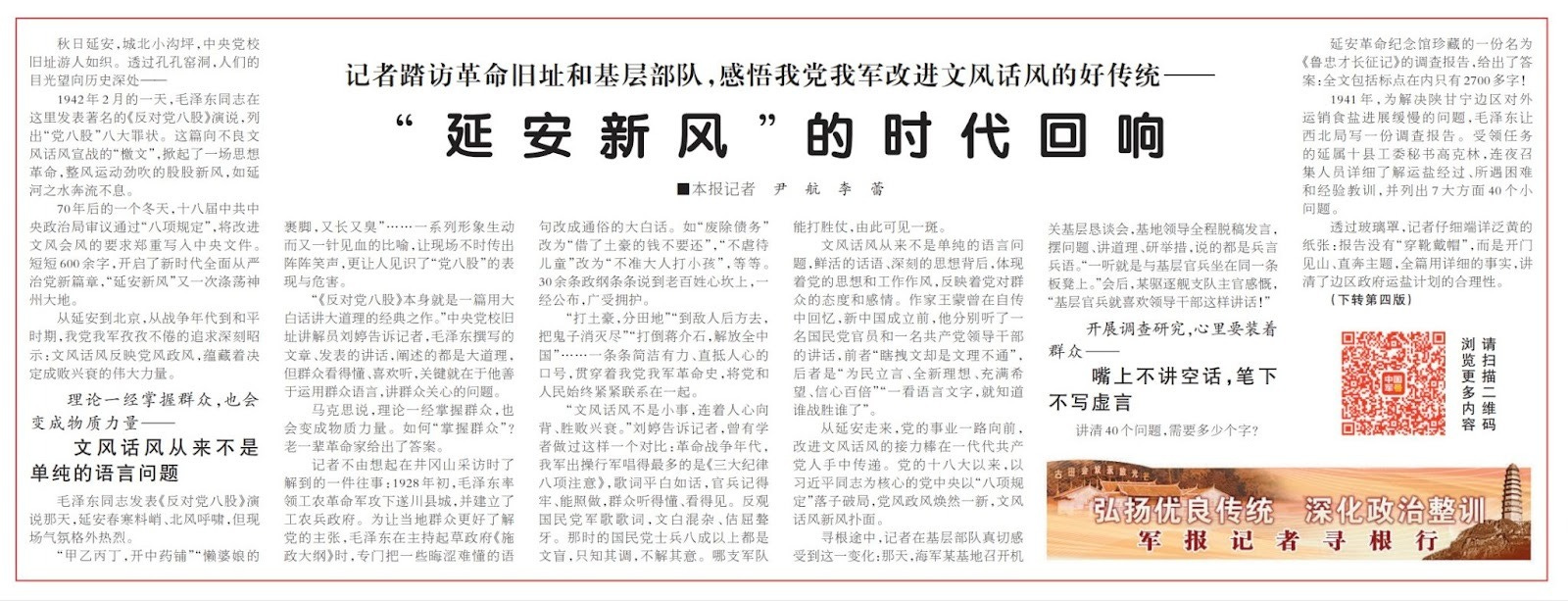
The piece traces a direct lineage from Mao Zedong’s 1942 “Oppose Party Formalism” (反对党八股) speech in Yan’an — which attacked bureaucratic jargon using folksy language — to Xi Jinping’s 2012 “Eight-Point Regulation” (八项规定) that sought to curb official rhetoric. But this may be a losing battle. After all, specialized political jargon, which gives rise to verbosity and ritualistic repetition, is hardwired into the system.
“The style of our writing is the style of our troops; the efficiency of our language is the efficiency of our combat. The battlefield has no room for niceties and nonsense — a few wasted words, a single wasted minute, could mean more bloodshed and sacrifice.”


