Activity Category: Media Engagement Activity

Vietnam-China Friendship Journey Media Tour

Guangdong Radio and Television (廣東廣播電視台) organized a week-long propaganda tour for Vietnamese journalists, media representatives, and scholars from December 22-29, 2025, traveling through Guangxi and Guangdong provinces. The “Vietnam-China Friendship Journey” (Hành trình hữu nghị Việt-Trung) coincided with the 75th anniversary of China-Vietnam diplomatic relations and Vietnam’s Year of People-to-People Exchanges with China. Participants visited “red sites” connected to Vietnamese revolutionary history and Ho Chi Minh’s activities in Guangdong, framing China’s historical role in Vietnam’s communist revolution. Vietnamese Consul General in Guangzhou Nguyen Viet Dung (阮越勇) emphasized the tour implements the “six improvements” framework for bilateral relations, particularly “building a more solid social foundation” through media and academic exchanges. The itinerary combined revolutionary heritage sites with visits to modern Chinese media centers in Shenzhen, Dongguan, and Guangzhou to “share experiences in content production and technology application” for external communication—coordinating propaganda approaches between Chinese and Vietnamese state media under the banner of friendship, a term the CCP uses to condition relationships on accommodating China’s core interests.

China-Vietnam Border Media Coordination Meeting

Chinese and Vietnamese propaganda officials met in Lao Cai Province, Vietnam on February 2, 2026 to establish formal mechanisms for cross-border media cooperation. The Chinese delegation was led by the Overseas Chinese Affairs Federation (紅河僑聯) of Honghe Prefecture in talks with Lao Cai’s Propaganda and Mass Mobilization Department (老街省委宣傳與民運部) and provincial media outlets including Lao Cai Newspaper and Radio-Television Station (老街省報紙與廣播電視台). Participants agreed to create “regular mutual visit and information sharing mechanisms” focused on coordinating coverage of cross-border cooperation, cultural heritage, and development issues. The meeting emphasized using “new media to innovate communication forms” and expand influence, framing media as a “key bridge” for “consolidating China-Vietnam traditional friendship.” The arrangement represents localized implementation of CCP strategy to build propaganda coordination infrastructure with Vietnamese counterparts.

People’s Daily Takes Part in Saudi Media Forum

The Saudi bureau of the Chinese Communist Party’s official People’s Daily established a booth at the fifth Saudi Media Forum (第五届沙特媒体论坛), which convened in Riyadh, Saudi Arabia, from February 2-4, 2026, focusing on “Media in an Evolving World.” The event attracted over 300 media professionals and experts from more than 20 countries. Running concurrently with the forum, the Future Media Exhibition featured participation from over 250 local and international institutions and companies. The forum provided a platform for discussing media transformation amid technological and geopolitical changes, reflecting Saudi Arabia’s efforts to position itself as a regional media hub while expanding ties with international media organizations, including Chinese state outlets.

Chinese Ambassador Meets President of El Moudjahid

On January 25, 2026, Chinese Ambassador to Algeria Dong Guangli (董广利) met with Taharoubt, president of El Moudjahid, Algeria’s oldest official media outlet, to discuss bilateral relations, regional issues, and media cooperation. Ambassador Dong emphasized China’s commitment to Africa, noting that Chinese foreign ministers have begun each year with visits to Africa for 36 consecutive years, a tradition demonstrating, he said, enduring “friendship” — a term the CCP frequently uses in diplomatic contexts to signal accommodation of China’s interests. He highlighted China’s “zero-tariff” policy as a signature of China-Africa cooperation and promoted 2026 as the “Year of China-Africa People-to-People Exchanges.” Dong expressed willingness to strengthen cooperation across all sectors, including media. Taharoubt praised China’s modernization achievements and affirmed Algeria’s commitment to deepening media collaboration, describing the Algeria-China friendship as “profound, solid, and ever-renewing.”

Berliner Zeitung Runs Article from China’s CCTV

On November 30, 2024, German daily Berliner Zeitung published the second installment of “China Perspective” (中國視角), a column created through a partnership with the Europe bureau of China Media Group (CMG), the media conglomerate under the CCP’s Central Propaganda Department. The article was a signed piece by a CCTV journalist titled “Becoming a Major Global Player.” It focused on China’s aviation industry, presenting the country’s commercial aircraft development as evidence of its shift “from technological catch-up to international competition.” The piece also highlighted China’s work on electric and hybrid aircraft and sustainable aviation fuel. The Chinese report on the placement of the article mentioned the promotion of “China solutions” (中国方案) for global development. 

Chinese Ambassador Hosts Chinese-language Media at Embassy in Manila

On January 8, 2026, the Chinese Embassy in Manila convened an event for Chinese-language media in the Philippines, hosted by Ambassador Jing Quan and later reported by CNTV Philippines on January 14. Framed around foreign policy and bilateral relations, the meeting emphasized the role of Chinese-language media in supporting China–Philippines cooperation, with language stressing “close cooperation” (密切配合) with the embassy. According to CNTV, Jing praised media outlets for promoting friendship, Chinese culture, and the Belt and Road Initiative, while calling for properly managing maritime disputes and restoring bilateral ties to a cooperative track. He described China’s development as an opportunity for the Philippines and urged expanded people-to-people exchanges, trade cooperation, and joint efforts against transnational crime. Media representatives in attendance included the World News (世界日報), Chinese Commercial News (菲律賓商報), United Daily News (聯合日報), Chinoy TV (菲華電視台), FilChiOC (菲華工商總會), and Chinatown TV (唐人街電視台). The event concluded with a luncheon and group photo.

Communication University Hosts China-South Korea Media Dialogue

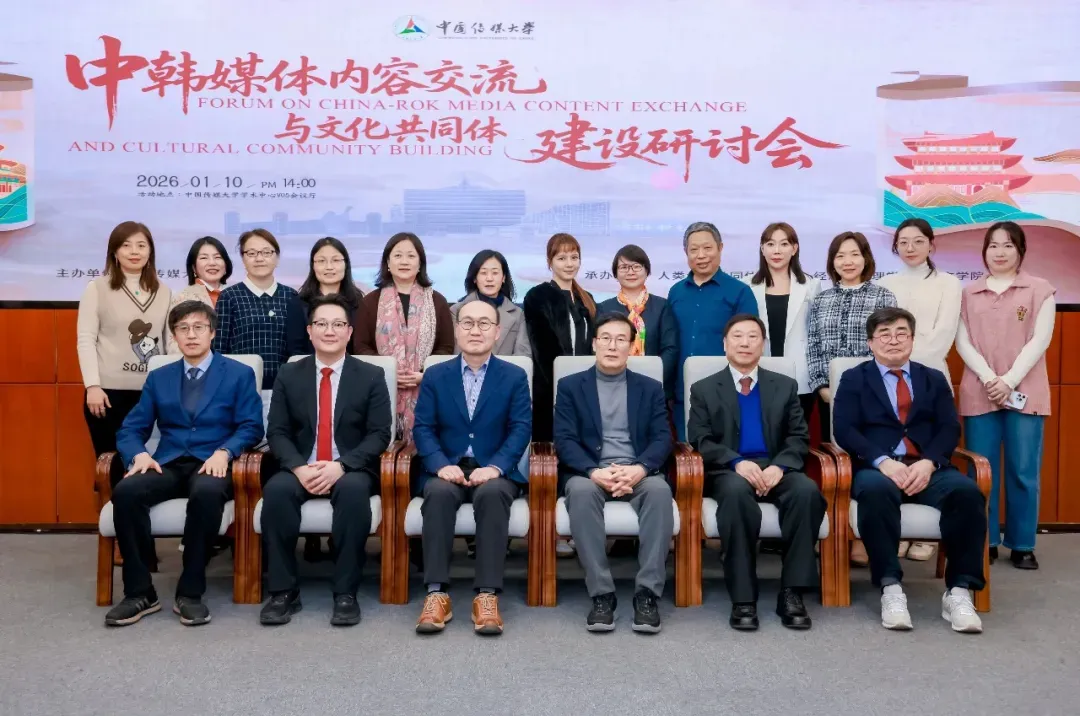
On January 10, 2026, a symposium on China-South Korea media content exchange and “cultural community building” (文化共同體建設) — a term referencing Xi Jinping’s shared future foreign policy concept — was held at the Communication University of China (中國傳媒大學). Organized by the university’s Institute for a Community of Shared Future (人類命運共同體研究院), the event brought together scholars from both countries to discuss the dissemination of cultural products (referring to media content broadly, including films and television shows) and cooperation in the digital age. Participants analyzed media policy between the two countries, compared the strengths of the film industry, discussed the reception of Korean cultural products in China, and called for expanded distribution of Chinese content in Korean and Southeast Asian markets, while acknowledging persistent challenges, including asymmetric market access and content restrictions (which were not specified). Li Huailiang (李懷亮), director of the Institute for a Community of Shared Future for Mankind, said that China and South Korea should build “bridges of mutual trust” through media collaboration. Participants from South Korea included Joo Jung-min (朱定珉), president of the Korean Association for Media Policy and dean of the School of Media and Communication at Chonnam National University; Jung Hye-yoon (郑惠允), research fellow at the Center for Social Issues Research at Korea University; Ha Joo-yong (河周容), dean of the College of Social Sciences and director of the Institute of Social Science Research at Inha University; Lee Heon-yul (李宪律), dean of the School of Media Studies at Korea University; Lee Seung-hyun (李承炫), director of student affairs and dean of the International Education Institute at Dong Seoul University; and Chae Jung-hwa (蔡廷和), research professor at the ICT Law and Economics Research Institute at Sogang University.

Foreign Influencers Visit Shantou

On January 16, 2026, more than 100 foreign content creators from around 30 countries took part in a Chinese New Year event in Shantou, Guangdong Province, organised by the Guangdong Provincial Department of Culture and Tourism (廣東省文化旅遊廳) as part of a broader provincial campaign to promote the region ahead of the Lunar New Year. The Shantou gathering centred on traditional Chaoshan activities (this being a local language and culture group) including the traditional Yingge Dance (英歌舞). The event gathered influencers from the United Kingdom, the United States, Germany, Russia, Mexico, South Korea, Egypt, Turkey, the Netherlands, and Singapore, among others. The event was promoted through South (南方國際傳播中心), the branded name of Guangdong’s government-run international communication center (ICC), and travel and expenses were likely covered by the ICC or the tourism department — though this could not be confirmed. 

German Paper Runs Chinese Op-Ed on Taiwan

On May 17, 2024, Chinese Ambassador to Germany Wu Ken (吳懇) published an op-ed in the Berlin-based newspaper Berliner Zeitung, arguing that respecting “core interests” is essential for “de-risking” China-Europe relations. The article defended China’s position on Taiwan and criticized Western countries for allegedly supporting the forces of “Taiwan independence”  — an accusation frequently levelled by China’s Ministry of Foreign Affairs. The ambassador’s piece followed Chinese President Xi Jinping’s state visits to France, Serbia, and Hungary from May 5-10, 2024, and German Chancellor Olaf Scholz’s trip to China in April 2024.