The National Broadcasting Corporation of the Kyrgyz Republic (KTRK), Kyrgyzstan’s state broadcaster, signed a letter of intent for joint cultural exchange activities with China Media Group on September 2, 2025, during the Shanghai Cooperation Organization (SCO) summit in Tianjin. The agreement was among 14 bilateral media cooperation deals CMG struck with broadcasters from 13 countries during the summit, covering news reporting, joint programming, cultural activities, technological innovation, industry development, personnel exchanges, and media resource sharing. The CMG partnership with KTRK is part of China’s broader efforts to strengthen SCO media cooperation.
On September 5, 2026, Xinhua News Agency (新華社), together with other Chinese media and media organizations from across Asia, announced the establishment of the Asia-Pacific Media Partnership Organizing Committee (亞太媒體合作夥伴計劃籌備委員會). It was one of several new media initiatives announced at the Asia Pacific Media Forum (亞太媒體高端論壇) in Shenzhen, a gathering of over 400 journalists, media scholars, academics, and officials from the Indo-Pacific under the theme of “building a prosperous Asia-Pacific community: consensus and action.” The committee has sixteen founding members: eight from China and eight foreign media. The Chinese founders, all official Party media, are the CCP’s flagship People’s Daily(人民日報), the state official wire service Xinhua News Agency (新華社), the central broadcaster China Media Group (中央廣播電視總台), the English-language China Daily (中國日報), the state foreign language publisher China International Communications Group (中國外文局), the United Front Work Department’s China News Service (中國新聞社) and two provincial media groups, Nanfang Press Media Group (南方報業傳媒集) and Shenzhen Press Group (深圳報業集團). The foreign founders are Russia’s national agency TASS, the party-owned Vietnam News Agency, Indonesia’s Antara News Agency, Malaysia’s Bernama news agency, Peru’s Andina News Agency, Canada Daily News, Cambodia’s official Agence Kampuchea Presse, and the Pakistan Broadcasting Corporation. The program’s secretariat will be based at Xinhua.
On July 5, 2024, Khovar News Agency, Tajikistan’s official news agency, and the government-owned Narodnaya Gazeta newspaper published an op-ed by Chinese President Xi Jinping titled “Working Together for a Brighter Tomorrow of China-Tajikistan Relations” (共創中塔關係美好明天). The article outlined five points for deepening China-Tajik relations in areas from “people-to-people exchanges” to top-down governance and border security enforcement. Xi’s proposals were broadcast across Chinese government websites and circulated by official news outlets including [Xinhua](https://regional.chinadaily.com.cn/gnfccru/2024-07/05/c1002506.htm) (新華社), People’s Daily (人民日報), and the international-facing China Global Television Network (中國環球電視網). The article was published on the same day that People’s Daily, the official “[mouthpiece](https://chinamediaproject.org/theccp_dictionary/mouthpiece/)” of the Central Committee of the Chinese Communist Party, signed an MOU with Khovar News Agency to deepen cooperation in areas like content sharing and talent exchanges.
On July 5, 2024, during President Xi Jinping’s third visit to Tajikistan since assuming office in 2012, Khovar News Agency, Tajikistan’s national news outlet, signed a memorandum of understanding with People’s Daily (人民日報), the official “mouthpiece” of the Central Committee of the Chinese Communist Party. The memorandum aims to establish a “regular cooperation mechanism” to deepen news content exchange, joint events, and talent exchange between the two outlets. The signing took place on the same day that an op-ed by President Xi Jinping, titled “Working Together for a Brighter Tomorrow of China-Tajikistan Relations” (共創中塔關係美好明天), was published by the Khovar News Agency and the government-owned Narodnaya Gazeta newspaper, outlining a “new blueprint” for China-Tajik relations framed by the countries’ shared border and historic connection via the Silk Road.
The state-run Kazakhstan President’s TV and Radio Complex and China Media Group (中央廣播電視總台), also known as the “Voice of China,” signed a memorandum of understanding during the Second China-Central Asia Summit in June 2025, a diplomatic meeting between China and five Central Asian countries. The agreement, according to a report by the national broadcaster China Central Television (中央電視台), which is owned by CMG, will facilitate technology and content exchange between China Media Group and Kazakhstan President’s TV as part of the China-Kazakhstan Permanent Comprehensive Strategic Partnership (中哈永久全面戰略夥伴關係). Kazakhstan President’s TV and CMG also signed a cooperation agreement to develop a singing competition gathering contestants from Central Asia and China called “Silk Way Star” (絲路之星), planned to air on Chinese and Kazakh television channels.
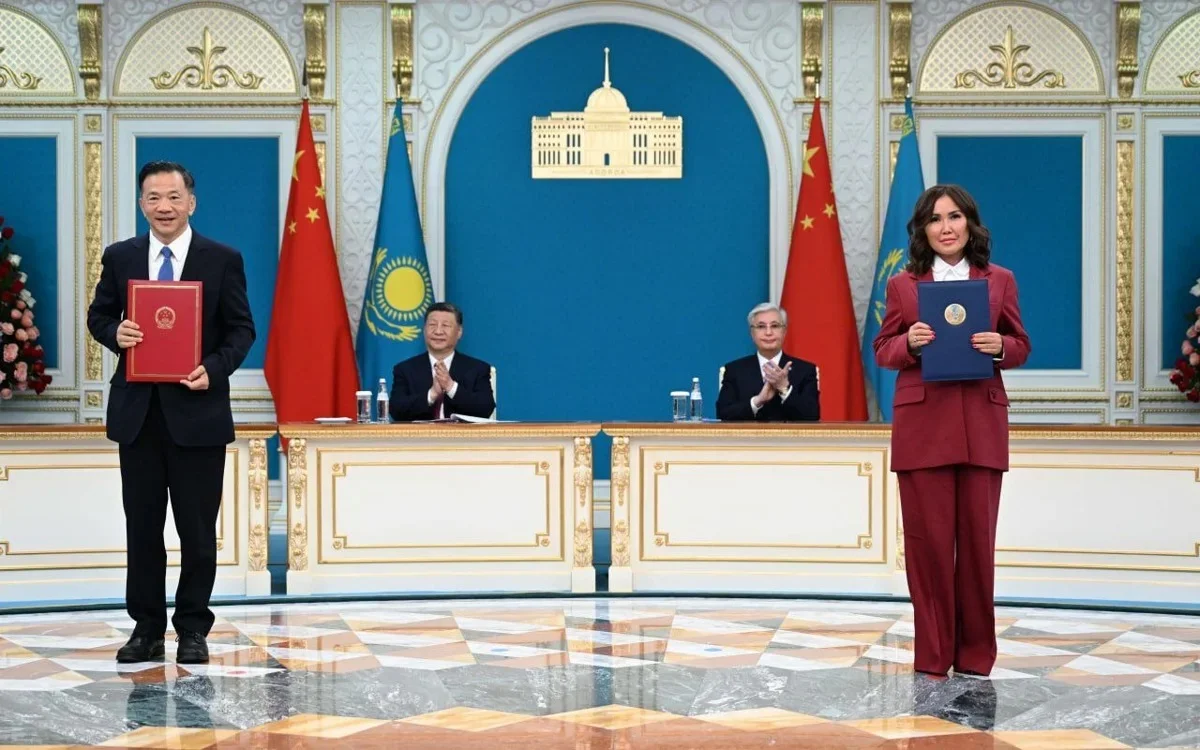
On June 16, 2025, during the second China-Central Asia Summit, a diplomatic meeting between China and five Central Asian countries first held in 2023, the state-run Kazakhstan President’s TV and Radio Complex and China Media Group (中央廣播電視總台) signed an agreement to jointly produce “Silk Way Star” (絲路之星), a singing competition gathering contestants from Central Asian countries and China, planned to air on the Kazakh national Silk Way TV channel and China Global Television Network (中國國際電視台), or CGTN. Raushan Kazhibayeva, the director at Kazakhstan President’s TV and Radio Complex, and Shen Haixiong (慎海雄), CMG’s president, signed the agreement in a ceremony that was attended by both Kazakh President Kassym-Jomart Tokayev and Chinese President Xi Jinping. A report on the agreement by state-run media Kazinform noted that both parties have a history of content exchange and cooperation on projects related to the China-led Shanghai Cooperation Organization. During Xi’s visit to Kazakhstan, both media also signed a memorandum of understanding on content and technology sharing.
On February 24, 2020, Yao Fei (姚飛), China’s then-charge d’affairs to Spain, was interviewed by Spanish radio broadcaster Onda Cero’s program “Más de uno” (“More Than One”) about the coronavirus pandemic. Acknowledging that the virus had caused a major public health crisis in China, Yao stated in the interview that China maintained a “policy of complete transparency” in its response to the virus in response to criticisms of the Chinese government’s secrecy around the virus that had emerged both domestically and internationally. Yao gave the interview shortly after the death of Li Wenliang (李文亮), the Chinese doctor who raised early alarms among his colleagues before dying of the virus himself. Asked about Li, Yao responded that the right to disclose information resides solely with the government and that “no individual citizen has the right or freedom to disclose this type of information,” which “can cause excessive panic in society.” The charge d’affairs also commented that measures taken to curb travel and trade with China were “excessive.”
On June 16, 2025, during the Second China-Central Asia Summit, a diplomatic meeting between China and leaders from five Central Asian countries, China Media Group (中央廣播電視總台) signed a memorandum of understanding with the Khabar Agency, one of Kazakhstan’s largest state broadcasters owned wholly by the Ministry of Culture. The MoU aimed to broaden exchanges in areas such as news content and technology sharing. According to a report from the CMG-owned China Central Television (中央電視台), or CCTV, the agreement would contribute to the development of the China-Kazakhstan Permanent Comprehensive Strategic Partnership (中哈永久全面戰略夥伴關係) initially signed in 2019. This MoU was one of three agreements signed between CMG and Kazakh media during the summit.
China Media Group (中央廣播電視總台), the state broadcaster operating under the direct control of the Chinese Communist Party’s Central Propaganda Department, launched a multilingual version of its television program “Ping ‘Yu’ Jin Ren: Classical Sayings Favored by Xi Jinping” (平’語’近人──習近平喜歡的典故) at a ceremony in Bishkek on August 30, 2026. The launch coincided with Chinese President Xi Jinping’s state visit to Kyrgyzstan ahead of the Bishkek summit of the Shanghai Cooperation Organization (SCO), the regional economic and security grouping founded in 2001 by China and Russia. Kyrgyz President Sadyr Japarov sent a congratulatory letter marking the occasion of the propaganda broadcast. The program, which presents classical Chinese texts quoted by Xi in speeches and writings, began airing the same day on state and mainstream broadcasters across nine SCO member and dialogue partner states, including Kyrgyzstan’s national broadcaster, Pakistan Television Corporation, Iran’s Islamic Republic News Agency, and Russia’s Rossiyskaya Gazeta, alongside additional state outlets in Belarus, India, Kazakhstan, Tajikistan, and Uzbekistan, according to the state-run China Central Television (CCTV). CCTV said the program was designed to help SCO-region audiences “better understand Chinese culture” (讀懂中國文化) and “sense Chinese wisdom” (感知中國智慧). A brief Xinhua item on the launch also ran in the newspaper eye (報眼), the small box beside the masthead reserved for high-priority items, on page one of the People’s Daily on August 31, 2026.