Activity Type: Branch or Group Formation

Cangzhou Opens New York Communication Hub With Xinhua

On August 24, 2022, Xinhuanet (新華網), the publicly listed online platform of China’s government-run news agency, Xinhua, signed a cooperation agreement in Beijing with the government of Cangzhou, a port city in Hebei province, and unveiled the Cangzhou International Communication Center (滄州市國際傳播中心). According to Xinhuanet, the launch opened a North America branch of the center in New York offering “24-hour international communication services.” The propaganda office of the Cangzhou CCP Committee later said the branch was unveiled in Times Square, part of a strategy of “borrowing a boat to go out to sea” (借船出海) through central media’s overseas resources. Chinese scholars have noted that the branch drew on the “advantages” (優勢) of Xinhua’s overseas branch offices. Xinhua’s North America regional bureau has occupied offices in Times Square since 2011. Xinhuanet also operates a wholly owned subsidiary in the region, Xinhuanet North America Corporation. Xinhuanet chairman Liu Jian (劉健) said the center would “spread Cangzhou’s good voice” (傳播滄州好聲音). He added that it would create a favorable “public opinion atmosphere” (輿論氛圍) for attracting investment, language rooted in CCP doctrine on guiding public opinion. Hebei state media later claimed that the center’s content had reached 1.63 billion people in more than 100 countries, a figure that has not been independently verified.

Jinan Opens Propaganda Hub in Frankfurt

On December 2, 2024, the Jinan International Communication Center (濟南國際傳播中心), a municipal external propaganda platform guided by the propaganda office of the Jinan CCP Committee (濟南市委宣傳部), opened a German branch in Frankfurt together with the German bureau of Nouvelles d’Europe (歐洲時報). Sun Shihui (孫世會), then executive deputy head of the propaganda office, and Hu Xudong (胡旭東), editor-in-chief of the paper’s German bureau, attended the unveiling. Jinan named Hu an honorary overseas promoter of “Spring City culture” (泉城文化海外推薦官), after the city’s nickname, formally enlisting a newspaper editor to market Jinan abroad. The two sides also signed an international communication agreement. According to the Jinan Daily (濟南日報), the official newspaper of the Jinan CCP Committee, the center had placed more than 30 articles promoting the city’s “high-quality development” in Nouvelles d’Europe since 2023, echoing a Xi Jinping slogan that the leadership has treated as the fundamental requirement for economic policy since 2017. The report said the branch would widen Jinan’s international “circle of friends” (朋友圈), invoking a CCP notion of friendship that ties foreign goodwill to alignment with China’s positions, and that the center would “tell China’s story well” (講好中國故事). The Jinan Daily called Nouvelles d’Europe Europe’s “most influential” Chinese-language daily. The Paris-based paper is in fact owned by a company controlled by the CCP’s United Front Work Department. The Jinan center is one of many local international communication centers that Beijing has promoted since 2018 to raise China’s “discourse power.”

Cangzhou Opens Brussels Hub With Xinhua

On August 24, 2022, Xinhuanet (新華網), the publicly listed online platform of China’s government-run news agency, Xinhua, signed a cooperation agreement in Beijing with the government of Cangzhou, a port city in Hebei province, and unveiled the Cangzhou International Communication Center (滄州市國際傳播中心). According toXinhuanet, the launch opened a Europe branch of the center in Brussels offering “24-hour international communication services.” The propaganda office of the Cangzhou CCP Committee later said the branch was set up in Brussels as the “seat of the EU headquarters,” part of a strategy of “borrowing a boat to go out to sea” (借船出海) through central media’s overseas resources. Chinese scholars have noted that the branch drew on the “advantages” (優勢) of Xinhua’s overseas branch offices. Xinhua’s Europe regional bureau has been based in Brussels since 2004. Li Shengjiang (李生江), chief of the bureau, pledged “full support” for the branch’s operations, saying it would build Cangzhou’s reputation in Europe and set an example for others. Xinhuanet also operates a wholly owned subsidiary in the region, Xinhuanet Europe B.V. Xinhuanet chairman Liu Jian (劉健) said the center would “spread Cangzhou’s good voice” (傳播滄州好聲音). He added that it would create a favorable “public opinion atmosphere” (輿論氛圍) for attracting investment, language rooted in CCP doctrine on guiding public opinion.

Tajik Journalists Union Signs ACJA Cooperation Agreement

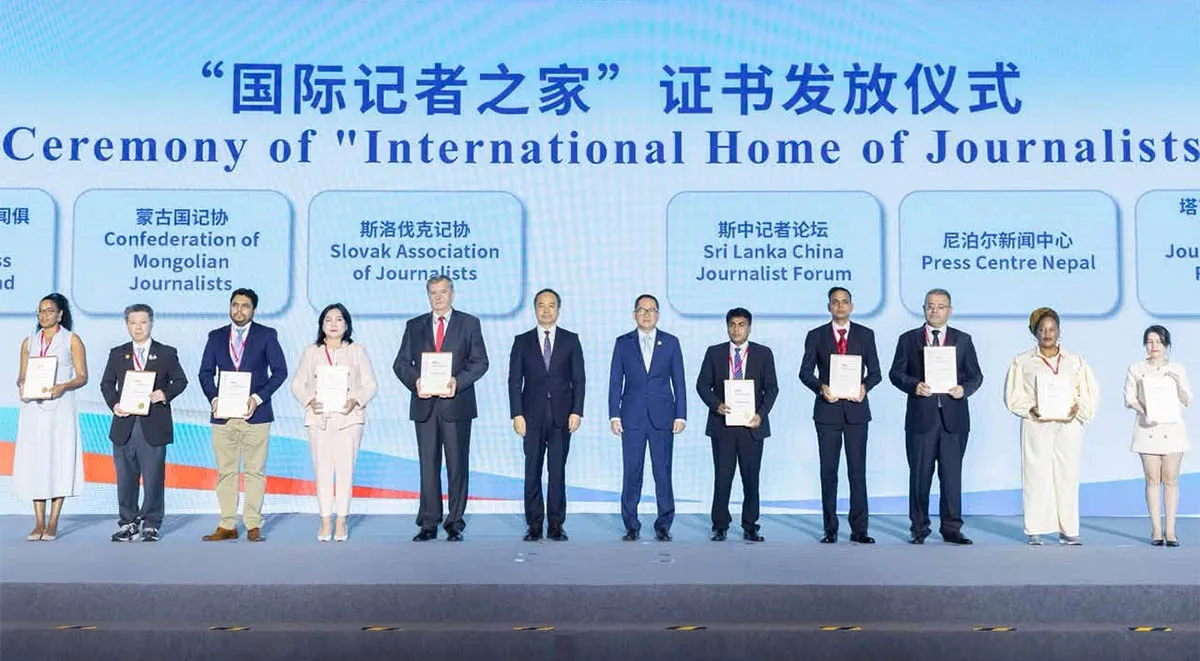
On October 16, 2026, the Union of Journalists of Tajikistan (塔吉克斯坦記者聯盟) signed a cooperation agreement with the All-China Journalists Association (中華全國新聞工作者協會), or ACJA, in Nanjing, according to Tajikistan’s state news agency Khovar, citing the union. The ACJA is an ostensible professional media association that works as a key part of China’s press control apparatus. In its own declarations, the ACJA openly pledges support for the principle of the Chinese Communist Party managing the media (黨管媒體), and for the key censorship principle of “correct public opinion guidance” (正確輿論導向). Union Chairman Zinatullo Ismoilzoda and ACJA President He Ping (何平) signed the five-point agreement. It provides for strengthening cooperation and exchange of experience in the media sphere, reciprocal visits by media representatives, journalist forums, professional development courses for journalists and journalism instructors, internships for media workers, and cultural events. Khovar reported that the agreement would also help create and develop a joint “Tajikistan and China Journalists’ Home” mechanism, a name that mirrors the ACJA’s International Home of Journalists (國際記者之家). The next day, the union was among 10 organizations to receive International Home of Journalists certificates at the 2026 Belt and Road Journalists Forum. Khovar attributed the strengthening relations between the two countries to the “far-sighted policy” of Tajik President Emomali Rahmon and Chinese President Xi Jinping.

Brazil’s National Journalists Federation Joins Chinese Network

On July 19, 2025, Brazil’s National Federation of Journalists, or FENAJ, the chief labor and professional organization representing journalist unions and media workers across the country, received a certificate recognizing it as an “International Home of Journalists” (國際記者之家) at the 2025 Belt and Road Journalists Forum in Ganzhou, in China’s Jiangxi province. The International Home of Journalists is an initiative of the All-China Journalists Association (中華全國新聞工作者協會), or ACJA, an ostensible professional media association that works as a key part of China’s press control apparatus. In its own declarations, the ACJA openly pledges support for the principle of the Chinese Communist Party managing the media (黨管媒體), and for the key censorship principle of “correct public opinion guidance” (正確輿論導向). The outlet that carried the report, Forum Macao (中國—葡語國家經貿合作論壇), is a Macau-based platform backed by the Chinese government. The report noted that the Brazilian Press Association had received the same recognition in 2024. The title commits FENAJ to hosting foreign journalists from the Belt and Road Journalists Network (一帶一路記者組織合作平台) who visit or work in Brazil. FENAJ President Samira de Castro said the recognition highlighted journalists’ unity in the face of digital challenges and threats to press freedom, a framing that sits uneasily with the program’s role in China’s press control apparatus. FENAJ was one of 11 organizations to receive certificates at the forum, which also launched a volunteer program under the initiative. FENAJ had already signed a 2018 agreement with the ACJA to exchange news about the Belt and Road Initiative and to jointly run seminars, interviews and awards.

Cabo Verde Journalists Association Joins Chinese Network

On October 17, 2026, the Association of Journalists of Cabo Verde, or AJOC, received an International Home of Journalists (國際記者之家) partnership certificate at the 2026 Belt and Road Journalists Forum in Nanjing, according to the Cabo Verdean outlet Mindel Insite. The International Home of Journalists is an initiative of the All-China Journalists Association (中華全國新聞工作者協會), or ACJA, an ostensible professional media association that works as a key part of China’s press control apparatus. In its own declarations, the ACJA openly pledges support for the principle of the Chinese Communist Party managing the media (黨管媒體), and for the key censorship principle of “correct public opinion guidance” (正確輿論導向). AJOC was one of 10 organizations to join the program at the forum, alongside journalist bodies from Chile, Mongolia, and Zambia. Founded in 1990, AJOC is a journalists’ union and a national partner of the Media Foundation for West Africa, an Accra-based press freedom organization, which describes AJOC as independent of the state and political parties. AJOC joined two months after Clóvis Silva, Cabo Verde’s minister responsible for media, signed a cooperation agreement with China in Beijing. That agreement covers the exchange of radio, television and online audiovisual content and the training of media professionals. The Nanjing forum was held under the ACJA-led Belt and Road Journalists Network (一帶一路記者組織合作平台), and it also launched a Global South Journalists Workshop Program.

Brazilian Press Association Joins Chinese Journalist Network

On August 31, 2024, the Brazilian Press Association (ABI), founded in 1908 and one of Brazil’s oldest press organizations, received a membership certificate for the International Home of Journalists (國際記者之家) at the 2024 Belt and Road Journalists Forum in Chongqing. According to a related announcement from the Brazilian association, ABI Director of Journalism Moacyr de Oliveira Filho accepted the certificate from He Ping (何平), president of the official All-China Journalists Association (中華全國新聞工作者協會), or ACJA, a Chinese Communist Party-led professional association that serves a key role in implementing press control policies. The forum opened with remarks by Mo Gaoyi (莫高義), deputy head of China’s Central Propaganda Department. The ABI reported that He urged members to build new narrative structures that would “transcend ideology, social systems and levels of development.” The ABI was among 22 organizations approved for the program that year. The association said its ties with the ACJA date back to 2023, and that its admission to the International Home of Journalists would deepen cooperation. In November 2024, the West China International Communication Organization opened a Bridging News liaison office at the ABI to support news services for Chinese companies seeking to expand in Brazil. In June 2025, the ABI signed a memorandum of understanding with the ACJA in Rio de Janeiro.

Anhui ICC Europe Station Opens in Milan

On September 21, 2026, a delegation from the Anhui International Communication Center (安徽国际传播中) inaugurated the “Anhui ICC Europe station” (安徽国际传播中心欧洲站). Anhui News Online described the development as an “important step” in extending the center’s overseas reach and expanding its “circle of friends” (朋友圈), or willing partners, to amplify Chinese messaging in Europe. The delegation was hosted by the China Chamber of Commerce in Italy. The center aims to promote Anhui Province and will also provide communication support for Anhui firms entering European markets. Based in Milan and “radiating across Europe,” the station will work with local media, chambers of commerce, enterprises, and cultural institutions. It will also produce multimedia content that promotes Anhui technology, marketing, and tourism, showing a “modern and beautiful image of Anhui.”

Chongqing ICC Opens Bridging News Bureau in Lima

On November 5, 2024, the Western China International Communication Organization (西部國際傳播中心), or WCICO, opened a Lima liaison office for Bridging News (陸海財經), a communication brand of the Chongqing international communication center intended for global external propaganda (外宣). It was the second such office after Rome. The local partner was Classic Media China Internacional SAC (經典傳媒中國國際有限公司). The company describes itself as the branch of a Chinese company supplying audiovisual material to television broadcasters, and in April 2024 it renewed a friendship agreement with EcuadorTV, Ecuador’s public broadcaster. WCICO also signed a strategic partnership agreement with the Peru edition of [Chinese Headlines](https://play.google.com/store/apps/details?id=com.cooby.headline&hl=enUS) (華人頭條), a news app for overseas Chinese run by the Fujian-based company Fujian Kebi Information Technology (福建可比信息科技有限公司). Guan Hong (管洪), executive deputy head of the propaganda office of the Chongqing CCP Committee, presented Classic Media with a plaque designating it the Peru base of First Sight TV, a Chongqing video brand. The office was opened at a “China: An Opportunity, Chongqing Brands” promotion event at the Centro de la Amistad Peruano China. That venue, built with a 20-million-yuan donation from the Chinese government, is managed by a Chinese-Peruvian civil association presided over by Erasmo Jesús Rolando Wong Lu Vega (黃業生), a businessman and former civil engineer. Wong founded the Asociación Peruano China in 1999, and his business group holds a majority stake in the Peruvian broadcaster Willax Televisión. Wong also appears in the Panama Papers as a shareholder of a British Virgin Islands company incorporated in 2014. WCICO claimed more than 200 attendees and live coverage by RPP TV. The same week, Chongqing Jiazuo Media (重慶佳左影視文化傳媒有限公司), which WCICO’s iChongqing platform called Chongqing Masterwork Media in a related report, [signed a “China Time Slot” agreement](https://web.archive.org/web/20261012043628/https://gbdsj.gd.gov.cn/zxzx/hydt/content/post4522146.html) with Willax to air Spanish-dubbed Chinese television series and documentaries. The agreement was signed under the guidance of China’s State Council Information Office and National Radio and Television Administration.