Activity Type: Media Partnership or Co-Production

Chinese Ambassador Gives Interview to Proletären

On December 8, 2022, the Swedish newspaper Proletären published an exclusive interview with Cui Aimin (崔愛民), China’s ambassador to Sweden. The questions posed by Proletären included many that effectively served as invitations to share PRC state talking points, such as the concept of “Chinese-style modernization,” China’s efforts in “poverty alleviation,” China’s position on the Taiwan issue, the United States’ military deployments in the Indo-Pacific region, China’s rule over Xinjiang, and “socialism with Chinese characteristics.”
Cui addressed Sweden’s decision to exclude the Chinese tech giant Huawei from its 5G network infrastructure, and also strongly criticized what he called “Taiwan independence forces” (a common narrative tactic from China) and what he characterized as “American hegemony and violence.” Meanwhile, he praised what he characterized as China’s success in poverty reduction — without addressing human rights or other international concerns regarding China.

Nya Dagbladet Runs Article Promoting the CCP’s Governance of Tibet

On August 22, 2025, Cui Aimin (崔愛民), China’s ambassador to Sweden, published a signed article promoting China’s governance of Tibet in the Swedish media outlet Nya Dagbladet. The article, called “The Plateau Takes on a New Look, the Snow-Covered Land Tells Its Story — A Colorful Picture of Tibet’s Economic and Social Development,” marked the 60th anniversary of China’s invasion of Tibet, which the CCP regards merely as the its incorporation as an autonomous region. Cui’s article argued that the region is currently developing well under Xi Jinping’s leadership, and also claimed that the wealth and education levels of Tibet’s population have seen significant improvements, framing the entire piece through a Chinese state narrative. This stands in sharp contrast to the widely documented international concerns regarding China’s governance of Tibet, which include cultural assimilation, forced Mandarin language instruction, suppression of dissidents, the erosion of religious freedom, and pervasive high-tech surveillance.

Chinese Ambassador Meets Dagens Nyheter Editor-in-Chief

On April 25, 2022, Chinese Ambassador to Sweden Cui Aimin (崔愛民) met with Peter Wolodarski, Editor-in-Chief of Sweden’s daily Dagens Nyheter, according to the Chinese Embassy. Cui had arrived in Sweden in December 2021, succeeding Gui Congyou (桂從友), whose tenure was marked by repeated threats to Swedish journalists and calls from multiple parties for his expulsion. Cui offered to help Swedish media report on China in an “objective, impartial, and comprehensive manner” – language commonly used by Chinese officials to encourage coverage aligned with Beijing’s narratives. Wolodarski was quoted as saying Dagens Nyheter was “willing to maintain close communication with the Embassy.” Wolodarski, who is reported to have begun his career in journalism at the age of 12 as a cub reporter for a youth news outlet, became editor of the Dagens Nyheter in 2013. He is the son of Polish immigrants to Sweden in the 1960s. 

Chinese Embassy in Sweden’s Chargé d’Affaires ad interim pens an article to promote China’s economy

On February 13, 2026, Wan Degang (萬德剛), the acting head of the Chinese mission in Sweden in the absence of a formal ambassador, published a signed article in the Swedish outlet Nya Dagbladet arguing that China’s economic rise benefits the global economy while criticizing US tariff policies for disrupting world trade. The article, titled “China’s Prosperous Development Injects Powerful Momentum into Global Economic Growth,” said that China’s GDP growth would reach 5 percent and that its contribution to the global economy would reach 30 percent. The article also referenced the December 18, 2025, launch of island-wide customs operations at the Hainan Free Trade Port (海南自由貿易港) as evidence of China’s opening up. He noted that Sweden was the first country to establish diplomatic relations with China. More precisely, Sweden was the first Western country to do so, on May 9, 1950, and the two nations have served as each other’s largest trading partners in Asia and Northern Europe respectively.

Chinese Ambassador Publishes Article in FokusKina

On October 8, 2023, Cui Aimin (崔愛民), Chinese ambassador to Sweden, published a signed article in the Swedish magazine FokusKina, titled “Witnessing Half a Century of Mutually Beneficial China-Sweden Economic and Trade Cooperation” (見證半個世紀中瑞經貿互利友好合作). The article centered on the story of Italy-born, Sweden-based businessman Peppino Cocozza and his decades of participation in the Canton Fair (廣交會) as a framing device for China’s economic transformation. Cui highlighted bilateral trade figures, stating that in 2022 China-Sweden goods trade totaled 20.6 billion dollars, with top categories including machinery, vehicles, pharmaceuticals, instruments, and furniture. He also noted growing cooperation in new energy, electric vehicles, and infrastructure, and employed characteristic Chinese state-media framing to describe the two countries’ economies as “highly complementary” (高度互補) with “enormous potential” (潛力巨大) for development, and appealing to China’s “Swedish friends” (瑞典的朋友們). 

Chinese Ambassador to Sweden Gives Interview to NewsVoice

On May 7, 2025, Cui Aimin (崔愛民), China’s ambassador to Sweden, gave an interview with Stockholm-based online outlet NewsVoice, which published the transcript on June 2. Marking the 75th anniversary of diplomatic ties, Cui promoted a broad vision of China-Sweden cooperation spanning trade, green technology, and people-to-people exchanges, portraying China as a stable and forward-looking partner. He criticized US tariff policies, calling both China and the EU “victims” of Washington’s violation of “economic rules and market principles,” and urged Sweden to join the Belt and Road Initiative (BRI), Xi Jinping’s signature economic development and infrastructure program abroad, which he called “one of the most widely welcomed global public goods.” Cui also praised the intergovernmental organization BRICS as a vehicle for Global South cooperation. Notably, NewsVoice joined the TV BRICS International Media Network in March 2025.

China and Iran Sign Film Cooperation MoU

In June 2021, China’s National Film Administration (國家電影局) and Iran’s Cinema Organization (سازمان سینماییی ایران) signed a memorandum of understanding on cinema cooperation. The MOU was signed by the director of the Cinema Organization of Iran, Hossein Entezami, and Wang Xiaohui (王曉暉), the director of the China Film Administration, the agency inside the Central Propaganda Department that reviews films throughout the production process. The MOU covered co-productions, expert exchanges, and mutual film screenings. The agreement was valid for three years and extendable. In February 2022, Chinese Ambassador to Iran Chang Hua (常華) met with Mohammad Khazaei, director of the Cinema Organization, to discuss implementation of the agreement, according to the Chinese Embassy in Tehran.

Iran’s State News Agency Launches Chinese-Language Website

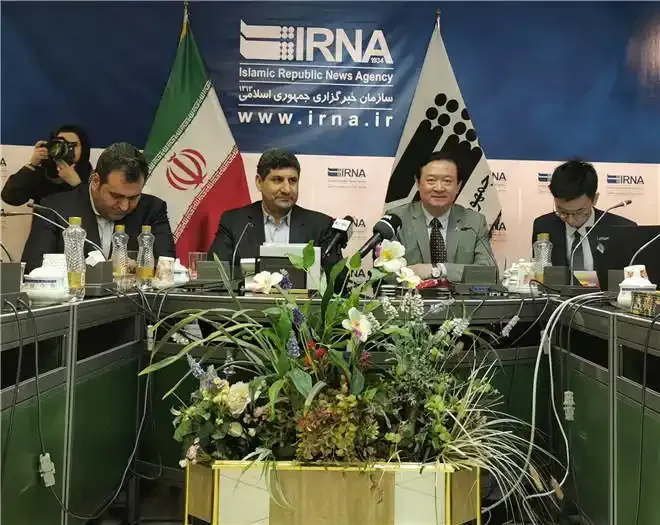
On August 26, 2019, Iran’s state news agency, the Islamic Republic News Agency (IRNA), launched a Chinese-language website at a ceremony in Tehran. According to CRI Online (國際在線), IRNA Director General Seyed Zia Hashemi and Chinese Ambassador to Iran Chang Hua (常華) jointly activated the site, with Hashemi calling the launch a “historic turning point” for bilateral media cooperation. The launch was consistent with a broader pattern: Chang made routine visits to IRNA and used the agency to amplify Chinese perspectives. The event came three years after Chinese President Xi Jinping’s January 2016 visit to Tehran, during which the two countries established a comprehensive strategic partnership.

Chinese Consul General Meets with IRNA

On June 3, 2025, Xu Wei (徐煒), China’s consul general in Bandar Abbas, met with a representative of the bureau of the Islamic Republic News Agency (IRNA) in Hormozgan Province. In his meeting with IRNA, Iran’s official state news agency, Xu discussed opportunities for media cooperation, saying that China values media exchanges with Iran and is willing to deepen cooperation with IRNA and other outlets to foster “mutual understanding and friendship” (互了解与友谊), terms typically used by the Chinese leadership to signal engagement while adhering to China’s values and framing. Reflecting the typical way China emphasizes the duty to healthy bilateral relations — rather than journalistic values or news consumer-focused demand — in its media-related dealings, The IRNA representative expressed support for joint efforts to promote China-Iran ties.