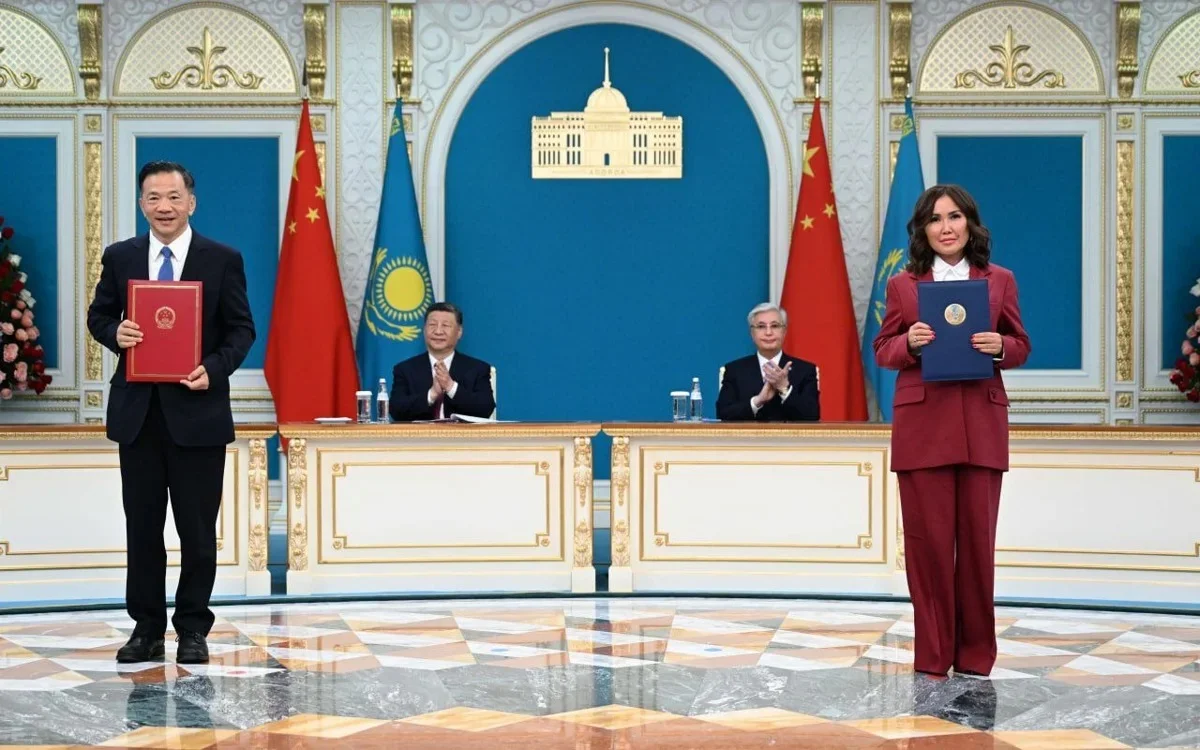
Activity Type: Media Partnership or Co-Production

Kazakh President’s TV and Radio Complex and China Media Group Announce Joint TV Program

On June 16, 2025, during the second China-Central Asia Summit, a diplomatic meeting between China and five Central Asian countries first held in 2023, the state-run Kazakhstan President’s TV and Radio Complex and China Media Group (中央廣播電視總台) signed an agreement to jointly produce “Silk Way Star” (絲路之星), a singing competition gathering contestants from Central Asian countries and China, planned to air on the Kazakh national Silk Way TV channel and China Global Television Network (中國國際電視台), or CGTN. Raushan Kazhibayeva, the director at Kazakhstan President’s TV and Radio Complex, and Shen Haixiong (慎海雄), CMG’s president, signed the agreement in a ceremony that was attended by both Kazakh President Kassym-Jomart Tokayev and Chinese President Xi Jinping. A report on the agreement by state-run media Kazinform noted that both parties have a history of content exchange and cooperation on projects related to the China-led Shanghai Cooperation Organization. During Xi’s visit to Kazakhstan, both media also signed a memorandum of understanding on content and technology sharing. 

France’s CSA Approves Broadcast License for Mandarin TV

On November 8, 2021, Mandarin TV (歐視TV+), a French-Chinese bilingual TV channel, held a launch ceremony in Paris with the Chinese embassy to celebrate its license from the French national broadcasting regulator, the Conseil supérieur de l’audiovisuel (CSA), to extend its broadcasts across Europe under the brand “Europe TV.” The outlet reported that it would use satellite transponder capacity leased from the European satellite operator Eutelsat. Addressing the ceremony by video, China’s ambassador to France, Lu Shaye (盧沙野), described Mandarin TV as the first Chinese broadcaster in France to hold a CSA license. The license and the network’s European expansion, he said, advanced “friendship” between the two countries. According to China News Service, some 300 attendees were present at the launch, including French political and business figures, Chinese and French media representatives, and members of the Chinese diaspora in France. Station director Chen Chen (陳晨) said the expanded signal would reach an estimated 135 million households, with future programming to target European countries with sizable Chinese communities, including Spain, Italy, the United Kingdom, and Germany.

Phoenix Television and Hong Kong Police Release Fourth Annual Documentary

In December 2024, Phoenix Television (鳳凰衛視) and the Hong Kong Police Force released Hong Kong Police Story 2024 (香港警察故事2024), a 60-minute documentary co-produced by the two organizations and also broadcast on public broadcaster RTHK. The documentary profiles police officers and cadets across four chapters covering maritime, air, and land units, as well as recruitment, and highlights the force’s use of AI-assisted patrol robots and camera-equipped armored vehicles, according to Phoenix’s program description. Phoenix Television’s largest shareholder is Bauhinia Culture Holdings, a company wholly owned by China’s central government, with China Mobile Hong Kong holding a further stake. The documentary is part of an annual series the two organizations have co-produced since at least 2021, when an edition covered prosecutions under the Hong Kong National Security Law, including the cases of Tong Ying-kit and Jimmy Lai.

Hong Kong Police Distribute Video Series Via Local Broadcasters

Since November 1, 2023, the Hong Kong Police Force’s Public Relations Branch has produced “Offbeat 360” (警聲360), a six-minute video program livestreamed weekly on Wednesday evenings via the force’s Facebook and YouTube accounts, according to a program description on the force’s website. The force distributes the program for rebroadcast to three local television outlets, including public broadcaster RTHK, i-CABLE’s HOY TV, and Phoenix Television (鳳凰衛視), as well as to more than 1,500 physical screens across the territory. Phoenix Television’s largest shareholder is Bauhinia Culture Holdings, a company wholly owned by China’s central government, with China Mobile Hong Kong holding a further stake. The program’s Chinese name references its Wednesday 6 p.m. broadcast slot, six-minute runtime, and stated aim of delivering crime and fraud prevention information and “telling Hong Kong police stories well” from “360 degrees,” according to the police description.

Hong Kong and RTHK Mark National Security Education Day With Student Drama

On April 15, 2025, Hong Kong’s Committee for Safeguarding National Security (香港特別行政區維護國家安全委員會) and public broadcaster RTHK marked the opening ceremony of the territory’s tenth National Security Education Day, held at the Hong Kong Convention and Exhibition Centre, with a short student drama, according to a government press release. The ceremony was jointly supported by the Liaison Office of the Central People’s Government and the Office for Safeguarding National Security, and Xia Baolong (夏寶龍), director of the central government’s Hong Kong and Macao Work Office, delivered keynote remarks by video link. Zheng Yanxiong (鄭雁雄), the Liaison Office’s director, attended in person in his capacity as the committee’s National Security Adviser, a role the Hong Kong National Security Law requires be designated by China’s central government, alongside Chief Executive John Lee (李家超). The drama, titled “Students’ Hearts, Motherland’s Feelings” (學子心祖國情), later aired on RTHK channel 31, according to a program archive on its website.

TVB and Hong Kong Police Launch Recurring Series on Police Work

Beginning November 20, 2022, Television Broadcasts Limited (TVB) began co-producing a recurring segment series with the Hong Kong Police Force’s Public Relations Branch, airing weekly on TVB’s Jade Channel and other TVB channels, according to the Sing Tao Daily. The series, titled “Police Voice, 120 Seconds” (警聲百二秒), depicts police duties through dramatized “real-life scenarios” meant to introduce the force’s internal workings and break down public stereotypes, according to a program description on the Hong Kong Police Force’s website. Episodes have covered topics including intelligence gathering, counter-infiltration, and counter-terrorism work, presenting the Hong Kong National Security Law as a matter concerning the wellbeing of every resident. TVB’s largest shareholder, Young Lion Holdings, holds a stake tied to mainland Chinese investment firm China Media Capital, whose founder Li Ruigang (黎瑞剛) serves as a TVB board director.

Hong Kong Security Bureau and i-CABLE Launch National Security Series

On June 30, 2026, Hong Kong’s Security Bureau launched NS Files: Decoded (國安檔案解密), a five-episode television series produced directly by the bureau to mark the sixth anniversary of the Hong Kong National Security Law’s implementation. The series revisited five prosecuted national security cases, including that of motorcyclist Leon Tong Ying-kit (唐英傑), the law’s first convicted defendant. It aired on Hong Kong broadcaster i-CABLE’s HOY78 channel, hosted by television personality Ken Chan (陳啟泰) alongside National Security Department Chief Superintendent Steve Li Kwai-wah (李桂華). Security Secretary Chris Tang (鄧炳強) said the program aimed to remind the public that national security risks persist. In clear coordination of the campaign with PRC state media, the bureau confirmed to the Global Times, an outlet under the Chinese Communist Party’s official newspaper, the People’s Daily, that each episode was also uploaded to its official Douyin account, extending the series to mainland Chinese audiences, while China News Service reported on the launch by citing Hong Kong media coverage. Hong Kong’s National Security Law was imposed directly by China’s National People’s Congress Standing Committee in 2020. Because the law has a direct impact on the media environment and media freedoms in Hong Kong, and because the territory’s national security enforcement operates in coordination with central government bodies, this database treats media and national security cooperation in Hong Kong as a cross-territory engagement.

RTHK and China’s Foreign Ministry Office Produce Diplomacy Contest Series

On June 22, 2025, Hong Kong’s public broadcaster RTHK aired coverage of the 17th Hong Kong Cup Diplomatic Knowledge Contest (香港盃外交知識競賽), part of an ongoing diplomacy-knowledge education program the broadcaster produces annually. Running since 2007, the contest is jointly organized by the Office of the Commissioner of China’s Ministry of Foreign Affairs in the Hong Kong Special Administrative Region, Hong Kong’s Education Bureau, and the Better Hong Kong Foundation, and is aimed at secondary and primary school students. RTHK’s coverage, linked above, described its content as built around “diplomatic knowledge, the Basic Law, and the Greater Bay Area,” intended to deepen public understanding of China’s diplomacy and its relevance to Hong Kong. A launch ceremony for the 17th edition was held in December 2024 at the Foreign Ministry’s Hong Kong office, officiated by Deputy Commissioner Li Yongsheng (李永勝), Better Hong Kong Foundation chief executive Sonia Tang Shuk-tak (鄧淑德), and then-RTHK Director of Broadcasting Cheung Kwok-choi (張國財).

Sing Tao News Corporation and HK Police Run National Security Youth Contests

Hong Kong’s National Security Department, a unit of the Hong Kong Police Force, organized NStudio (NStudio同心‧共創‧護國安), a national security-themed marketing proposal competition for primary and secondary school students, with Sing Tao News Corporation Limited listed as a supporting organization alongside the Security Bureau, the Home and Youth Affairs Bureau, and the Hong Kong Federation of Education Workers. Students submitted creative campaigns built around the concept of a “holistic national security outlook” (總體國家安全觀), and under the competition’s official rules, copyright of entries was assigned to police, who could then edit, translate, and redistribute the material without further consent or payment. At an awards ceremony, Security Secretary Chris Tang and acting Police Commissioner Simon Kan Kai-yan (簡啟恩) attended to honor winning entries, which included AI-generated game cards and virtual-reality role-play scenarios. Sing Tao’s English-language paper, The Standard, covered a related police-run video contest, NStory, whose judging panel has included film director Lee Lik-chi and legislator Tang Fei. Hong Kong’s National Security Law was imposed directly by China’s National People’s Congress Standing Committee in 2020. Because the law has a direct impact on the media environment and media freedoms in Hong Kong, and because the territory’s national security enforcement operates in coordination with central government bodies, this database treats media and national security cooperation in Hong Kong as a cross-territory engagement.