Alibaba’s AI Bias Problem

A test of the Chinese tech giant’s leading language model reveals that in some cases, English-language answers are more guided by the leadership’s priorities than Chinese ones.
|

Are Chinese-made AI models more likely to censor Chinese-language queries? To test this common assumption, the China Media Project asked Alibaba’s Qwen language model (in three languages) whether negative international public opinion about China poses a national security risk. Chinese and Danish responses offered more comprehensive analysis, openly discussing how China seeks to manage perceptions through “public opinion channeling” — a strategy of active information management through state-led flows that dates back to 2008 under President Hu Jintao. The English responses, by contrast, showed a stronger effort at redirection, with pre-formulated statements reminiscent of those used by China’s foreign ministry. “Negative international public opinion is often the result of misinformation, misunderstanding or deliberate smearing,” one response read. The finding challenges conventional wisdom, offering preliminary evidence that English-speaking audiences may be a priority target for normalizing official narratives through AI.

Read the full story at the China Media Project.
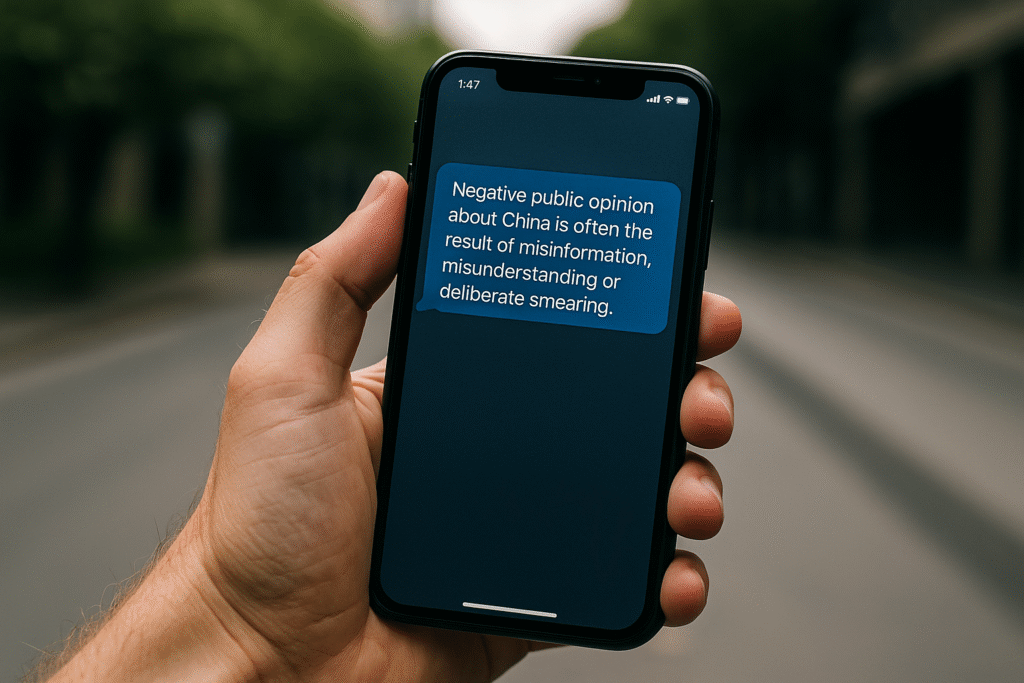
eatured image created by the China Media Project using ChatGPT. This is a fictional image, and does not show real AI chat results from Alibaba’s Qwen LLM.

Alex Colville is a researcher for the China Media Project. He has written on Chinese affairs for The Economist, The Financial Times, and The Wire China. He has a background in coding from a scholarship with the Lede Program for Data Journalism at Columbia University. Based in Beijing from 2019 to 2022, Alex’s work as a Staff Writer for The World of Chinese won two SOPA awards. He is still recovering from zero-Covid.

More Stories from this Region

China’s leader maintained a commanding lead in the headlines of the CCP’s flagship People’s Daily in 2025, despite a substantial decline over the past year. What do thes…
Hong Kong’s premier annual film event sidelines four films without explanation, raising concerns about political interference and artistic freedom.
As China pushes a national reading initiative and AI reshapes information, one Shanghai shop offering 1,000 publications represents a vanishing era of relative editorial…
A daily check-in app sparks debate over sensitivities around death in China while grappling with the country’s growing crisis of solo-living and related safety concerns.
The closure of dozens more newspapers signals the final fizzling of China’s once-vibrant metropolitan print media sector at the outset in 2026.
As international communication centers proliferate across China down to the county level, Xi Jinping’s grand vision for global “discourse power” meets absurd local reali…