
Beijing Bristles

As the US-China trade war deepens, China’s messaging is cranking into high gear, with coordination across all media platforms.
|

Ever since April 2, when President Donald Trump announced the imposition of deep tariffs from White House Rose Garden as a “Liberation Day” for America, China has pushed back hard, framing the United States as bullying, inflexible, and ultimately harmful to the world and itself. The rallying cry from the Ministry of Foreign Affairs (MFA) three days later set the tone of defiance: “The world needs justice, not hegemony!” (世界要公道,不要霸道).

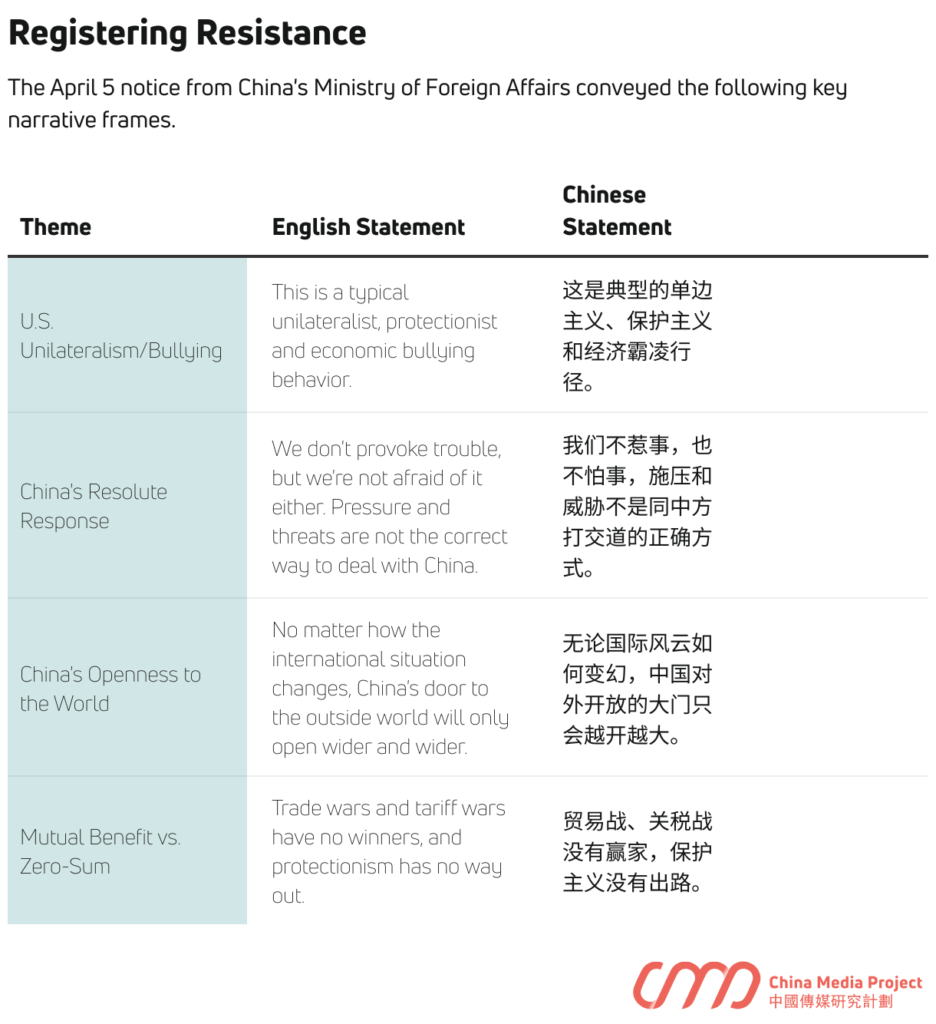
Filtered out through an official notice, or tonggao (通稿), from Xinhua News Agency, the MFA’s language accused the US of “economic bullying” and “zero-sum game playing,” and warned that “pressure and threats are not the correct way to deal with China.” The message reverberated throughout the media inside China, from the leadership’s People’s Daily (人民日報), to provincial mouthpieces like Guangdong’s Nanfang Daily (南方日報), and on to more commercial outlets like Caixin Media (財新) and the 21st Century Business Herald (21世紀經濟報道). In perhaps the subtlest sign of pique, the professionally-minded Caixin labeled the notice “Authorized by Xinhua for Release” (新华社受权发布). Translation: We were ordered to run this.

For a more detailed look at China’s framing of the US tariffs, stay tuned for our full analysis next week. Until then, here is a breakdown of the key narrative frames driving official coverage over the past two weeks — all evident in the original MFA release.

Alex Colville is a researcher for the China Media Project. He has written on Chinese affairs for The Economist, The Financial Times, and The Wire China. He has a background in coding from a scholarship with the Lede Program for Data Journalism at Columbia University. Based in Beijing from 2019 to 2022, Alex’s work as a Staff Writer for The World of Chinese won two SOPA awards. He is still recovering from zero-Covid.

More Stories from this Region

While journalism cultures around the world grapple seriously with the impact of AI, China’s closed and repressive media system can only celebrate the trend as a technolo…
On the eve of International Women’s Day this month, China shut down at least ten WeChat accounts — part of a widening censorship campaign tied to Beijing’s push to rever…
Two recent cases in Hubei province suggest authorities are shifting from targeting VPN operators to punishing ordinary users.
As China’s leaders gathered in Beijing to chart the country’s future amid economic uncertainty, state media sought to shift the focus — bottling up more critical coverag…
China is shutting down hundreds of local TV and radio channels — and rebuilding its propaganda apparatus online.
China’s leader maintained a commanding lead in the headlines of the CCP’s flagship People’s Daily in 2025, despite a substantial decline over the past year. What do thes…