When a 27-year-old township official drowned during a fishing outing in rural Hunan one year ago, local investigators concluded his death was an accident. It was only months later, after unlocking his phone, that his family discovered a much darker tale of pressure and corruption within the local government. That story, revealed earlier this month in a lengthy exposé by Guangdong’s Southern Weekly (南方周末), historically one of China’s most outspoken news outlets, was deleted shortly after publication.
While the case underscores the strict limits facing anti-corruption reporting in China, it is also a reminder that Chinese media continue to pull against the reins, pursuing tougher stories even when they run the constant risk of censorship.
Southern Weekly’s June 15 deep dive into the fate of Wang Linming (王林明) was a classic example of what in China’s official press has since the late 1980s called “supervision by public opinion” (舆论监督) — referring to the role of the news media in uncovering issues of official corruption and abuse of power, particularly at lower levels of the bureaucracy. Reporting of this kind soared in China in the early 2000s, during the heyday of the commercial press, when Southern Weekly was the most outstanding example of an emerging professional journalism movement unfolding even under strict political limitations. It has become much rarer under the leadership of Xi Jinping, who has emphasized the need to reassert the Chinese Communist Party’s control over the press.
The June 15 report on Wang Linming was a rare return to form for a publication that had long staked out a reputation for accountability reporting. Wang, a civil servant in a rural township in the southern Hunan province, drowned on June 30, 2025, while fishing with a top local official. An investigation at the county level dragged on quietly for months, before finding in May 2026 that his death had been accidental. Southern Weekly’s report this month, drawing on family interviews and phone records, told a far more complicated story.
Wang’s WeChat messages, expense logs, and transfer histories documented systematic misconduct by township leaders. Officials had engaged in illegal banqueting and drinking, run gambling sessions inside the local police station, and pressured Wang to file false expense reimbursements to cover the costs. Official dining expenses at four local restaurants had surged from 70,000 yuan in 2022 to nearly 200,000 yuan (approximately 28,000 dollars) in 2023, the report found. Gambling transfers from a single overnight session in January 2024 exceeded 70,000 yuan (roughly 10,000 dollars).
While the case underscores the strict limits facing anti-corruption reporting in China, it is also a reminder that Chinese media continue to pull against the reins, pursuing tougher stories even when they run the constant risk of censorship.
The misconduct had already been flagged, according to Southern Weekly. A county inspection team cited Hengtang Town (横塘镇) in 2023 for illegal drinking at work meals, after which all township officials signed pledges not to drink.
Article 303 of China’s Criminal Law explicitly prohibits gambling gatherings, and last year the Chinese government tightened guidelines restricting alcohol consumption and lavish banquets among officials. Noting the deletion, a report by Hong Kong’s Ming Pao (明報) on June 18 captured public reaction inside China, with some commenters online alleging that Wang Linming had been killed not by the river, but by the country’s “small circle culture” (小圈子文化) of grassroots officialdom.
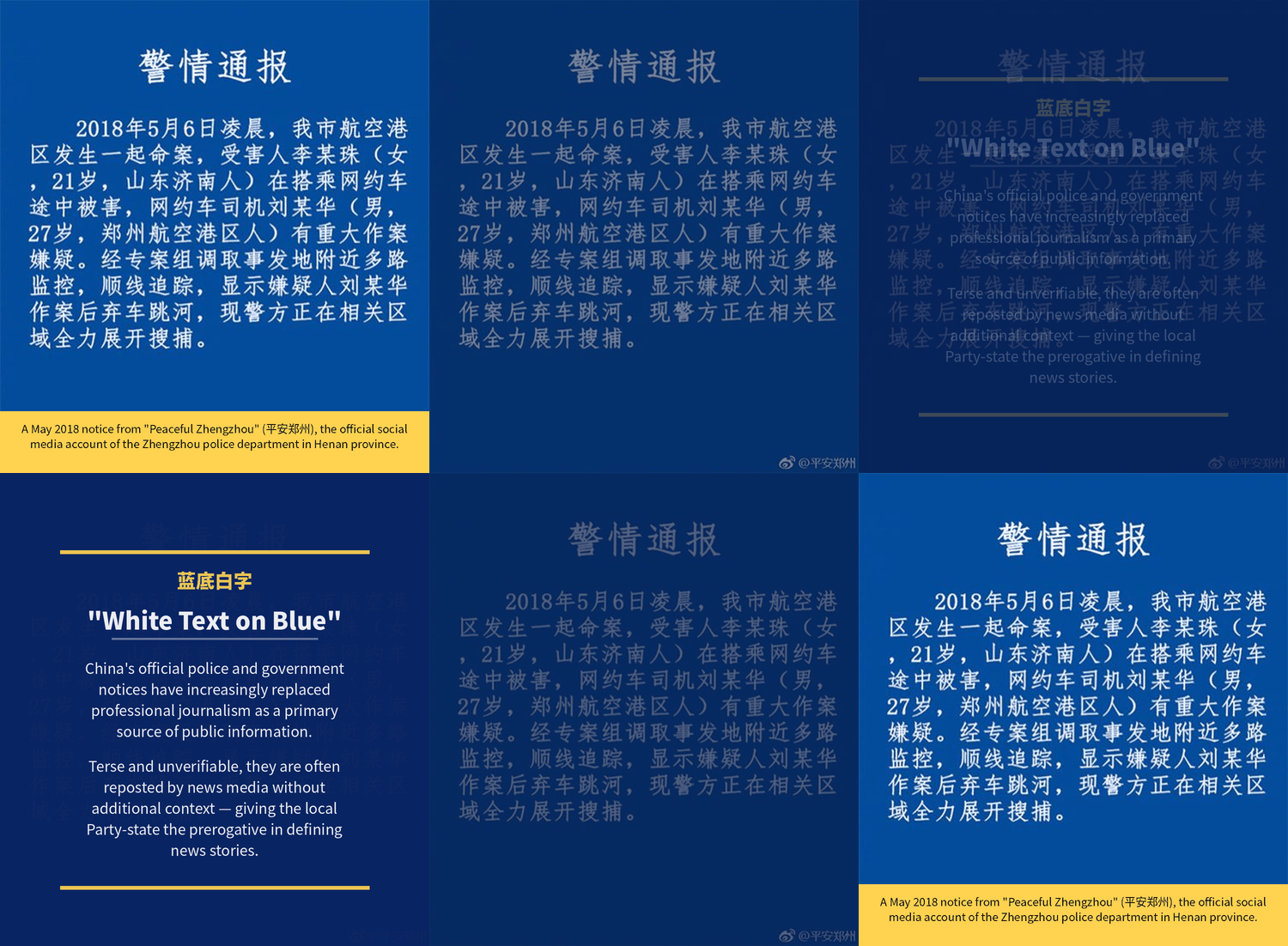
Since coming to power in late 2012, Xi Jinping has made anti-corruption a defining feature of his leadership, disciplining more than two million officials. That campaign, however, has unfolded alongside a dramatic consolidation of CCP control over the press. Paradoxically, these controls have put the power of exposure squarely back in the hands of local officials, making it far harder to expose the kind of local misconduct Xi has pledged to root out.
Based in Guangzhou, Southern Weekly has long been considered one of China’s most outspoken professional news outlets — a reputation that has made it a persistent target of official pressure. In a notorious 2013 incident, the Central Propaganda Department forced revisions to the paper’s New Year’s editorial. Since then, the paper has faced relentless pressure and has been far less vocal than it was in the 2000s and early 2010s. Nevertheless, the deletion of this month’s report is a reminder that the paper continues to pursue harder-hitting stories.