Bonnier News, established in 2016, is a major Swedish news media company and a subsidiary of the Bonnier Group, a conglomerate spanning media, real estate and investment services that has been wholly owned by the Bonnier family since its founding in 1804 in Copenhagen. Headquartered in Stockholm, the company publishes flagship Swedish dailies Dagens Nyheter, Expressen, and Dagens industri, alongside over 200 other brands spanning local newspapers, magazines, and digital services across northern countries, including Sweden, Denmark, Norway, and Finland. In spring 2022, Bonnier News was merged into Bonnier Publications.
Dagens Nyheter is a Swedish daily morning newspaper founded on December 23, 1864 by publisher and journalist Rudolf Wall in Stockholm. It was Sweden’s first modern morning newspaper, and Wall served as editor-in-chief until 1889. Since 1909, Dagens Nyheter has been owned by the Bonnier Group, a Swedish media conglomerate controlled by the Bonnier family and operating across 12 countries. The paper covers national and international affairs, foreign news, domestic political coverage, and arts, and is widely considered Sweden’s largest morning newspaper by circulation. Its editorial stance is described as independently liberal, a position it has formally held since distancing itself from Sweden’s liberal party establishment in 1972. The paper is published both in print and digitally.
The Communist Party of Sweden (Kommunistiska Partiet) is a far-left Marxist-Leninist political party founded in 1970. It emerged from a series of splits within the Swedish communist movement during the late 1960s, when pro-Beijing factions broke away from the mainstream Left Party over ideological disagreements. Headquartered in Gothenburg, the party was officially registered in 1977 and adopted its current name at its 14th Party Congress in January 2005. As of March 2026, it held no seats in the Swedish parliament and did not contest national elections. The party historically has roots in the Maoist movement but has since distanced itself from that orientation. Its official organ is the weekly newspaper Proletären, which it has published since 1970.
FokusKina is a Swedish association that publishes a quarterly journal of the same name — formerly called Kinarapport — covering Chinese history, culture, politics, economics, and society, anddescribes itself as “the only journal in Sweden focused entirely on China.” In addition to the journal, the association organizes lectures, cultural events, and member trips to China.Founded in 1952 as the Swedish-Chinese Association (Svensk-kinesiska föreningen), the organization was “officially non-political” but in practiceacted as “a link to the Embassy of China in Sweden” and “a kind of watchdog over Swedish discourse on things Chinese,” protesting when Swedish media departed from the PRC line, according to a monograph published by the Cambridge University Press. By the 1960s and 1970s, it had become closely intertwined with the Swedish New Left, sharing many members with the pro-Beijing Maoist party “Kommunistiska Förbundet Marxist-Leninisterna” (KFML) and partially financing its operations through its close ties with the Chinese embassy and the sale of books and other products from China. It renamed itself the Swedish-Chinese Friendship Association (Svensk-kinesiska vänskapsförbundet) in 1971, then reverted to its original name after the 1989 Tiananmen Square massacre to distance itself from the regime. In the discourse of the Chinese Communist Party, “friendship” carries explicit political expectations — alignment with China’s foreign policy positions and non-interference in its internal affairs — and is routinely cultivated through institutional proxies, including associations and think tanks, that lend the appearance of grassroots exchange to what are in practice state-directed relationships. This group’s function and history — even before its rebranding as FokusKina in 2017 — reflects this pattern closely. Today the association describes itself as “politically, religiously, and economically independent” and is funded primarily by membership fees and grants from the Arts Council. In April 2025, its editor attended a Chinese embassy-hosted event, and the Chinese embassy in Sweden featured on its website a 2022 FokusKinainterview with Ambassador Cui Aimin (崔愛民).
In June 2021, China’s National Film Administration (國家電影局) and Iran’s Cinema Organization (سازمان سینماییی ایران) signed a memorandum of understanding on cinema cooperation. The MOU was signed by the director of the Cinema Organization of Iran, Hossein Entezami, and Wang Xiaohui (王曉暉), the director of the China Film Administration, the agency inside the Central Propaganda Department that reviews films throughout the production process. The MOU covered co-productions, expert exchanges, and mutual film screenings. The agreement was valid for three years and extendable. In February 2022, Chinese Ambassador to Iran Chang Hua (常華) met with Mohammad Khazaei, director of the Cinema Organization, to discuss implementation of the agreement, according to the Chinese Embassy in Tehran.
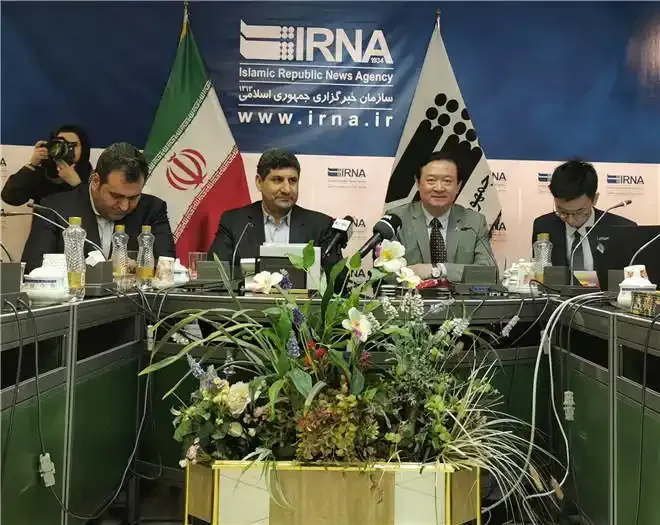
On August 26, 2019, Iran’s state news agency, the Islamic Republic News Agency (IRNA), launched a Chinese-language website at a ceremony in Tehran. According to CRI Online(國際在線), IRNA Director General Seyed Zia Hashemi and Chinese Ambassador to Iran Chang Hua (常華) jointly activated the site, with Hashemi calling the launch a “historic turning point” for bilateral media cooperation. The launch was consistent with a broader pattern: Chang made routine visits to IRNA and used the agency to amplify Chinese perspectives. The event came three years after Chinese President Xi Jinping’s January 2016 visit to Tehran, during which the two countries established a comprehensive strategic partnership.
On June 3, 2025, Xu Wei (徐煒), China’s consul general in Bandar Abbas, met with a representative of the bureau of the Islamic Republic News Agency (IRNA) in Hormozgan Province. In his meeting with IRNA, Iran’s official state news agency, Xu discussed opportunities for media cooperation, saying that China values media exchanges with Iran and is willing to deepen cooperation with IRNA and other outlets to foster “mutual understanding and friendship” (互了解与友谊), terms typically used by the Chinese leadership to signal engagement while adhering to China’s values and framing. Reflecting the typical way China emphasizes the duty to healthy bilateral relations — rather than journalistic values or news consumer-focused demand — in its media-related dealings, The IRNA representative expressed support for joint efforts to promote China-Iran ties.
On June 19, 2025, Cui Aimin (崔愛民), China’s ambassador to Sweden, published a signed article titled “Strengthening the Dialogue Among Civilizations, Creating a Better Future Together” in the Swedish media outlet The Nordic Times. In the article, Cui noted recent celebrations for the International Day for the Dialogue Among Civilizations, a UN initiative jointly proposed by China, with eventual support by more than 80 countries. The notion of civilizational exchange is a political concept dating back in its contemporary CCP sense (“Xivilization”) to the 20th National Congress in 2022, when Xi Jinping and the top leadership used it to trumpet the supposed success of the CCP-led development model and argue that China has created “a new form of human civilization” (人類文明新型態). Cui called on China and Sweden to uphold the spirit of civilizational exchange and to move forward together toward the vision of building a “community with a shared future for mankind,” as proposed by Xi Jinping.
On December 2, 2021, the Embassy of China in Iran and Iran’s Art Research Institute co-hosted a seminar in Tehran to mark the 50th anniversary of China–Iran diplomatic relations, focusing on film cooperation. Chinese Ambassador to Iran Chang Hua (常華) said that the memorandum of understanding the two countries signed the same year on film exchanges had laid a solid foundation for bilateral collaboration. Iranian participants included director Majid Majidi and representatives from Iran’s film sector. According to the same report, speakers pointed to the festival screenings in Shanghai and Beijing, as well as the presence of Chinese films at Iran’s Fajr International Film Festival, as signs of strengthening connections within the film industry.