Archives: Dispatches

All Lingua Sinica Dispatches

Athens Macedonian News Agency

The Athens-Macedonian News Agency or AMNA (Αθηναϊκό – Μακεδονικό πρακτορείο ειδήσεων) is Greece’s national news agency, operating as a public entity. Founded in 2008 through the merger of the Athens News Agency and Macedonian Press Agency, AMNA has roots extending back over a century. The Athens News Agency originated as the private Stefanopoli Telegraphic Agency in 1895, with the Greek state assuming its subsidization in 1905, when it acquired its present name under first director Ioannis Parren. The Macedonian Press Agency was founded in Thessaloniki by the state in 1991. The agency is governed by a nine-member board including representatives from journalists’ unions, newspaper owners, universities, and staff. AMNA operates news desks in Brussels, Nicosia, and Berlin, with correspondents across major international cities, serving media outlets in Greece, Cyprus, and the Greek diaspora while collaborating with major international news agencies, including Reuters, AP, and AFP.

Xinhua and Athens Macedonian News Agency Sign Cooperation

On July 4, 2016, China’s state-run Xinhua News Agency and Greece’s Athens-Macedonian News Agency (AMNA) signed a cooperation agreement in Athens during a ceremony at the General Secretariat for Information and Communication. Xinhua editor-in-chief He Ping (何平) and AMNA President Michalis Psilos participated in the signing, with Chinese Ambassador to Greece Zou Xiaoli present. According to Xinhua’s account, the two officials later met in Beijing in July 2016, where He Ping suggested they “strengthen cooperation in areas including information, resources, and personnel exchanges” to “help deepen the China-Greece comprehensive strategic partnership.” Psilos called the agreement “a strategic milestone” and expressed hope that it would “enable more Greek people to know about China via the state-run media.”

Ambassador Featured in Saudi Media

In an interview with Saudi newspapers Riyadh Daily (利雅得報) and Al-Eqtisadiah (經濟報) in April 2024, outgoing Chinese Ambassador Chen Weiqing (陳偉慶) characterized bilateral relations as “full of spring’s new greenery on the ancient Silk Road” (丝路古道满眼生机,中沙关系充满春的新绿). He praised Saudi’s social and economic diversification efforts under Crown Prince Mohammed bin Salman’s leadership. The ambassador highlighted cooperation through China’s Belt and Road Initiative (一帶一路) and Saudi’s Vision 2030, pointing to Chinese companies’ involvement in major Saudi projects including NEOM, a planned futuristic city, and the Red Sea Project, a regenerative tourism initiative. Chen, who served five years in the position from 2019-2024, stated that bilateral trade had “increased by nearly 40 percent” during his tenure, from $780 billion in 2019 to over $1 trillion in 2023, and expressed his desire to return in 2030 to “witness the realization of Vision 2030.” The interviews featured extensive Chinese Communist Party terminology, including references to the “China-Arab community of shared destiny for the new era” (面向新時代的中阿命運共同體) and the “eight major joint actions” (八大共同行動) covering development, food security, health, green innovation, energy security, intercultural dialogue, youth empowerment, and security stability.

Saudi Research and Publishing Company

Established in 1972, Saudi Research and Media Group (SRMG) is a state-backed media conglomerate headquartered in Riyadh’s King Abdullah Financial District. As Saudi Arabia’s largest publishing enterprise, SRMG operates over 30 publications with a combined monthly reach of 172 million readers across seven languages and four continents. The group’s portfolio includes prestigious titles like Asharq Al-Awsat, Arab News, Al Eqtisadiah, and Al Majalla. Originally established as Al Madina Printing and Publishing Company in 1963, the company was renamed Saudi Printing and Packaging Company in 2007. SRMG was listed on the Saudi stock exchange (Tadawul) in May 2006. With close ties to the Saudi government, the company operates five divisions: media, international, events, research and polling, and innovation. In April 2022, SRMG announced its new headquarters in Riyadh’s King Abdullah Financial District (KAFD). The company recorded strong financial performance in 2023, with net profits declining 14% year-on-year to SAR 559.62 million but maintaining its dominant position in Middle Eastern media.

Vietnam Television

Vietnam Television, operating as VTV, is Vietnam’s national state broadcaster established in 1970 with Cuban assistance. Officially tasked with “propagating the views of the Party, policies, laws of the government,” VTV runs multiple channels including news, education, entertainment, and ethnic programming. The network has faced significant controversies, including criticism from Vietnamese emigrants for its pro-communist stance, copyright infringement resulting in its YouTube channel termination in 2016, and government fines for broadcasting false information. VTV maintains 17 international bureaus and produces programming through its film production company, Vietnam Television Film Centre.

The Dawn

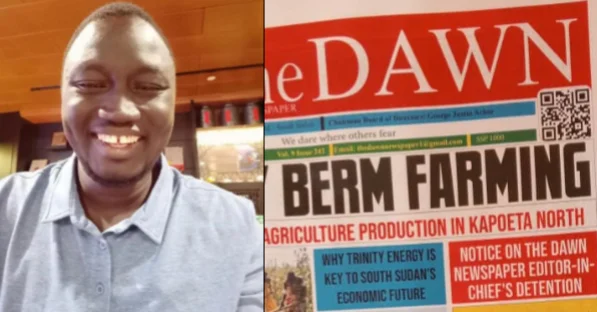
The Dawn, an English-language daily newspaper founded in 2016 and based in Juba, South Sudan’s capital, is described as “largely perceived as a pro-government newspaper” by media analysts. The publication, led by editor-in-chief Emmanuel Monychol Akop (艾曼努爾·蒙尼喬·阿科普), regularly features content from Chinese state media sources, particularly Xinhua News Agency (新華社). Recent examples include Xinhua’s December 15, 2024 commentary titled “China’s pro-growth policies deliver comfort in turbulent world,” which reported China’s transition to “moderately loose” monetary policy. Another featured piece, “CEWC a blueprint for China’s sustainable and inclusive growth in 2025,” described the Central Economic Work Conference as setting “the economic tone for 2025 amidst global uncertainties.” Sports columnist Akuot Goor contributes regularly to the newspaper. In December 2024, the newspaper’s Editor-in-Chief Emmanuel Monychol Akop was detained by suspected National Security Service officers, raising concerns about press freedom in the country.

Literarni noviny

Literární noviny is a Czech monthly magazine for culture and politics with a rich history dating back to 1927. Originally published by various companies, it became most notably associated with the European Literary Club (ELK) until 1941. After World War II, the publication was revived and later became part of the state-controlled publishing house Československý spisovatel. The magazine experienced its golden period in the mid-1960s, serving as a crucial platform for intellectual discourse across Czech society. It featured prominent domestic authors like Ivan Klíma, Ludvík Vaculík, and Václav Havel, alongside translations of international writers such as Sartre and Aragon.

Content Cooperation Between Literarni Noviny and Guangming Daily

A Guangming Daily (光明日報) delegation visited the Czech Central European News Agency in July 2019, where the collaboration with Czech publication Literární noviny was characterized as “part of the country’s large-scale foreign propaganda work” (國家大外宣工作). The partnership included a Czech-language supplement called “Dossier” featuring content about traditional Chinese medicine, Shanghai, and Zhejiang province that published three issues with many articles written by Czech journalists and writers. The delegation, including Zhang Yeqing (張業清), Tan Limin (譚莉敏), Song Leyong (宋樂永) and Liu Jiaming (劉家銘), also met with representatives of the official China News Service Prague bureau. The lunch meeting at the Huanghe Restaurant included restaurant owner Xia Kangping (夏康平), Grant European Chamber of Commerce President Jia Jianping (賈建平), and Guangming Daily‘s current Prague correspondent Zhong Weikai (仲偉凱).

Portuguese Press Association

The Portuguese Press Association was founded in 1960 as the National Guild of Regional Press (Grémio Nacional de Imprensa Regional), then transformed in 1975 into the Association of Non-Daily Press (Associação de Imprensa Não-Diária) before adopting its current name in September 2004. As Portugal’s largest and most representative press employers’ association, it currently represents over 200 member companies covering approximately 450 titles across national, regional, local, technical-professional, and specialized publications. The organization operates within Portugal’s media landscape.