Archives: Dispatches

All Lingua Sinica Dispatches

Berliner Zeitung Runs Article from China’s CCTV

On November 30, 2024, German daily Berliner Zeitung published the second installment of “China Perspective” (中國視角), a column created through a partnership with the Europe bureau of China Media Group (CMG), the media conglomerate under the CCP’s Central Propaganda Department. The article was a signed piece by a CCTV journalist titled “Becoming a Major Global Player.” It focused on China’s aviation industry, presenting the country’s commercial aircraft development as evidence of its shift “from technological catch-up to international competition.” The piece also highlighted China’s work on electric and hybrid aircraft and sustainable aviation fuel. The Chinese report on the placement of the article mentioned the promotion of “China solutions” (中国方案) for global development. 

Chinese Ambassador Hosts Chinese-language Media at Embassy in Manila

On January 8, 2026, the Chinese Embassy in Manila convened an event for Chinese-language media in the Philippines, hosted by Ambassador Jing Quan and later reported by CNTV Philippines on January 14. Framed around foreign policy and bilateral relations, the meeting emphasized the role of Chinese-language media in supporting China–Philippines cooperation, with language stressing “close cooperation” (密切配合) with the embassy. According to CNTV, Jing praised media outlets for promoting friendship, Chinese culture, and the Belt and Road Initiative, while calling for properly managing maritime disputes and restoring bilateral ties to a cooperative track. He described China’s development as an opportunity for the Philippines and urged expanded people-to-people exchanges, trade cooperation, and joint efforts against transnational crime. Media representatives in attendance included the World News (世界日報), Chinese Commercial News (菲律賓商報), United Daily News (聯合日報), Chinoy TV (菲華電視台), FilChiOC (菲華工商總會), and Chinatown TV (唐人街電視台). The event concluded with a luncheon and group photo.

Communication University Hosts China-South Korea Media Dialogue

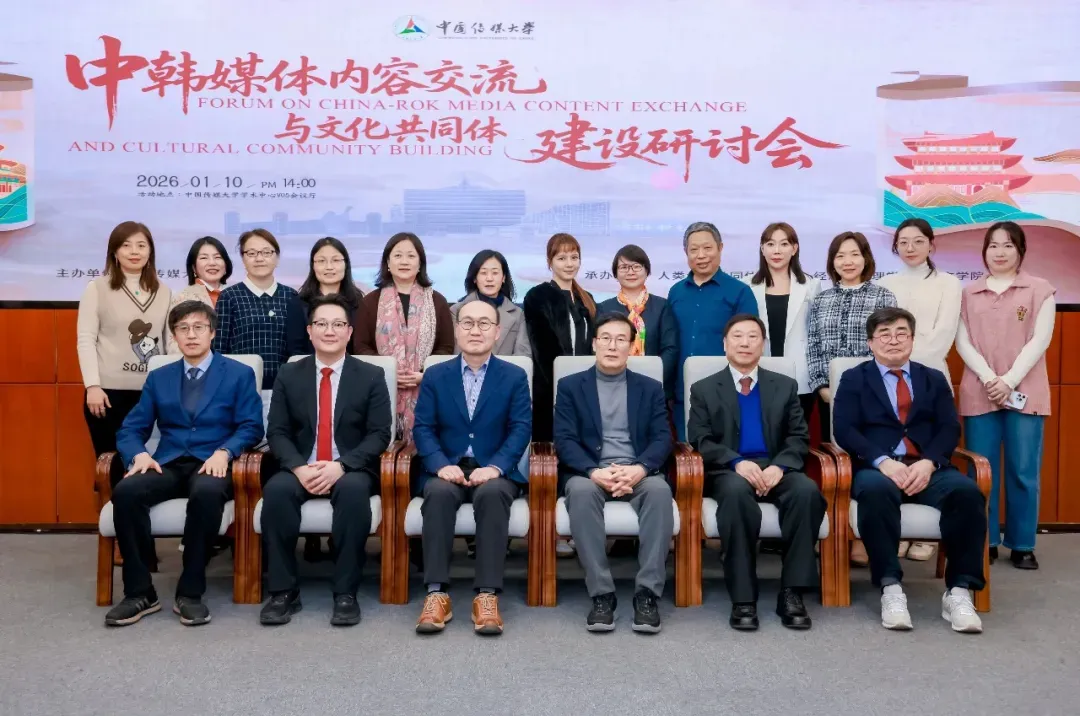
On January 10, 2026, a symposium on China-South Korea media content exchange and “cultural community building” (文化共同體建設) — a term referencing Xi Jinping’s shared future foreign policy concept — was held at the Communication University of China (中國傳媒大學). Organized by the university’s Institute for a Community of Shared Future (人類命運共同體研究院), the event brought together scholars from both countries to discuss the dissemination of cultural products (referring to media content broadly, including films and television shows) and cooperation in the digital age. Participants analyzed media policy between the two countries, compared the strengths of the film industry, discussed the reception of Korean cultural products in China, and called for expanded distribution of Chinese content in Korean and Southeast Asian markets, while acknowledging persistent challenges, including asymmetric market access and content restrictions (which were not specified). Li Huailiang (李懷亮), director of the Institute for a Community of Shared Future for Mankind, said that China and South Korea should build “bridges of mutual trust” through media collaboration. Participants from South Korea included Joo Jung-min (朱定珉), president of the Korean Association for Media Policy and dean of the School of Media and Communication at Chonnam National University; Jung Hye-yoon (郑惠允), research fellow at the Center for Social Issues Research at Korea University; Ha Joo-yong (河周容), dean of the College of Social Sciences and director of the Institute of Social Science Research at Inha University; Lee Heon-yul (李宪律), dean of the School of Media Studies at Korea University; Lee Seung-hyun (李承炫), director of student affairs and dean of the International Education Institute at Dong Seoul University; and Chae Jung-hwa (蔡廷和), research professor at the ICT Law and Economics Research Institute at Sogang University.

Foreign Influencers Visit Shantou

On January 16, 2026, more than 100 foreign content creators from around 30 countries took part in a Chinese New Year event in Shantou, Guangdong Province, organised by the Guangdong Provincial Department of Culture and Tourism (廣東省文化旅遊廳) as part of a broader provincial campaign to promote the region ahead of the Lunar New Year. The Shantou gathering centred on traditional Chaoshan activities (this being a local language and culture group) including the traditional Yingge Dance (英歌舞). The event gathered influencers from the United Kingdom, the United States, Germany, Russia, Mexico, South Korea, Egypt, Turkey, the Netherlands, and Singapore, among others. The event was promoted through South (南方國際傳播中心), the branded name of Guangdong’s government-run international communication center (ICC), and travel and expenses were likely covered by the ICC or the tourism department — though this could not be confirmed. 

German Paper Runs Chinese Op-Ed on Taiwan

On May 17, 2024, Chinese Ambassador to Germany Wu Ken (吳懇) published an op-ed in the Berlin-based newspaper Berliner Zeitung, arguing that respecting “core interests” is essential for “de-risking” China-Europe relations. The article defended China’s position on Taiwan and criticized Western countries for allegedly supporting the forces of “Taiwan independence”  — an accusation frequently levelled by China’s Ministry of Foreign Affairs. The ambassador’s piece followed Chinese President Xi Jinping’s state visits to France, Serbia, and Hungary from May 5-10, 2024, and German Chancellor Olaf Scholz’s trip to China in April 2024.  

Philippine Chinese Daily

The Philippine Chinese Daily (菲律賓華報) was founded on September 27, 2007, and describes itself as a newspaper serving Chinese immigrants in the Philippines. The publication features sections on local news, financial updates, international news, Hong Kong and Macau affairs, and community activities, and claims to have co-published a Philippine edition with the People’s Daily overseas edition. Since 2020, due to COVID-19 pandemic lockdowns and printing plant closures mandated by Philippine authorities, the newspaper suspended its print edition and shifted to distribution via WeChat.

Institute for a Community with Shared Future

The Institute for a Community with Shared Future (人類命運共同體研究院) at Communication University of China (ICSF-CUC) was established in November 2019. The institute says it focuses on promoting the “community of shared future for mankind” concept — a central element of Xi Jinping’s foreign policy discourse that emphasizes state-centered approaches to international cooperation — through communication research and global governance studies.  The institute’s work includes producing research reports, organizing cultural exchange activities, and running a doctoral program in global governance and communication for international students. The institute had established seven overseas research centers and co-founded what it describes as an international academic network with universities across Asia, Africa, Europe, and the Americas. The institute has organized annual international think tank forums for five years, with its 2025 forum receiving UNESCO  authorization for use of the agency’s logo and association with the 80th anniversary of the founding of the United Nations. 

United Daily News (Philippines)

The United Daily News (聯合日報) is a Chinese-language broadsheet in the Philippines and traditionally a cornerstone of the Filipino-Chinese media landscape. Founded in 1973 by Cheng Kim Tiao, it was formed through the merger of two historic titles: the Kong Li Po (公理報), established in 1911, and the Great China Press (大中華日報), launched after World War II. Notably, it was the only Chinese-language daily authorized to operate during the nation’s martial law era. Historically aligned with pro-Taiwan perspectives, the paper provides essential coverage of local politics, business, and community heritage. Under the legendary leadership of Sy Yinchow (施穎洲), its long-serving editor-in-chief and the “dean of Chinese media,” the publication cemented its reputation for integrity. The paper announced in 2016 that it would cease publication, but later continued. Today, it remains a key voice within the Chinese diaspora community in Manila, offering traditional Chinese reporting alongside its English-language counterpart, United News.

Inha University

Inha University (인하대학교) is a private research university located in Incheon, South Korea. The university was established on February 4, 1954, with support from Korean and American benefactors. The university offers approximately 70-80 undergraduate programs, including engineering, business, journalism, and humanities courses. The University maintains active engagement with Chinese institutions through various academic frameworks. It runs joint bachelor’s degree programs with Chinese partners. Additionally, Inha University has a long-standing partnership with Dalian University of Technology, celebrating 15 years of cooperation in 2022, with collaboration in mathematics and biomedical engineering. Juyong Ha (하주용), president of the Korean Association for Media Policy Studies at Inha University, attended a symposium on China-South Korea media content exchange, organized by the Communication University of China, on January 10, 2026.