
Archives: Dispatches

All Lingua Sinica Dispatches

China Signs AI Cooperation Pact with Brazil

During a diplomatic meeting in Brazil on July 5, 2025, China’s National Development and Reform Commission (国家发展改革委) signed a series of agreements with Brazilian government agencies, including an artificial intelligence cooperation pact witnessed by both nations’ leaders. The memorandum of understanding establishes what the Chinese government describes as a “China-Brazil Artificial Intelligence Application Cooperation Center” (中国-巴西人工智能应用合作中心), with stated goals of “strengthening AI development foundations, providing open-source services, enhancing industrial innovation partnerships, and promoting talent development.” Vice Chairman Liu Sushe (刘苏社) represented China’s DRC in signing the bilateral agreements with Brazil’s Ministry of Science, Technology and Innovation and the Presidential Office’s Civil Affairs department.

SBS Australia Signs Deal With Chinese State Broadcaster

SBS Australia struck an agreement with the CCP-run media conglomerate China Media Group (中央广播电视总台), or CMG, in March 2018, to broadcast news bulletins on its SBS World Watch channel, including 30-minute Mandarin-language bulletins from China Central Television (中国中央电视台, CCTV) and 15-minute English-language bulletins from CGTN (中国环球电视网), the broadcaster’s global arm. CMG operates under the Chinese Communist Party’s Central Propaganda Department with the mandate of “propagating the party’s theories, directions, principles and policies” and “telling China’s stories well.” SBS defended the arrangement by stating it clearly identified content sources and would monitor international news services to ensure compliance with its codes of practice, while providing balance through its own locally produced news and SBS Mandarin radio programming. SBS suspended the CGTN and CCTV broadcasts in March 2021 following complaints from Safeguard Defenders alleging the channels had broadcast forced confessions.

Indonesian and Malaysian Journalists Visit Xinjiang

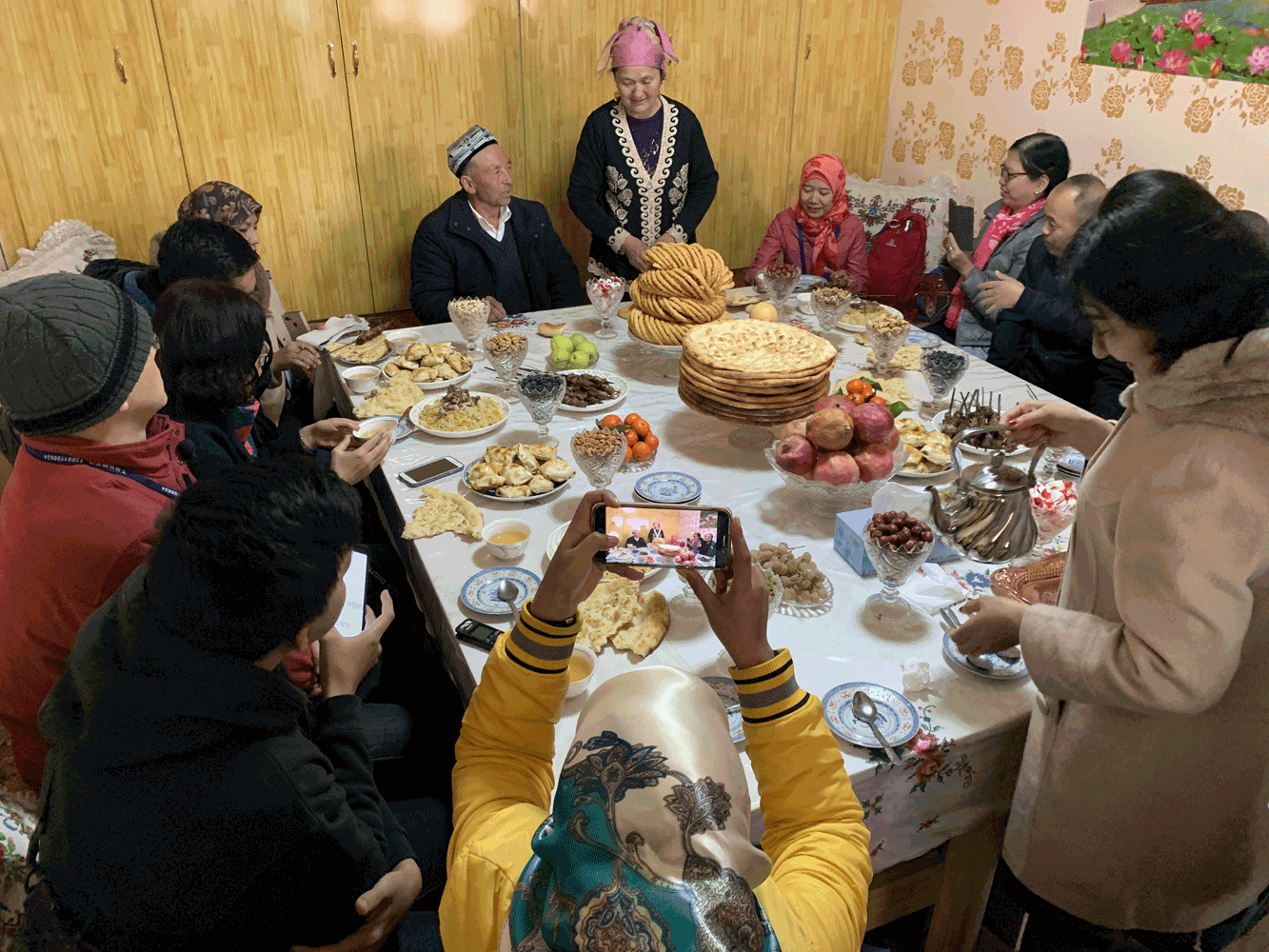
Journalists from Indonesia and Malaysia visited the Xinjiang Uygur Autonomous Region from February 22-27, 2019, as part of the ASEAN Elites China Tour 2019. According to a report by Xinhua News Agency, the group included a senior editor from the Indonesian newspaper Kompas, an assistant editor from the Malaysian newspaper Sinar Harian, the chief editor of the Indonesian digital platform IDN Times, and representatives from Liputan6, Metro TV,  and Antara (Indonesia’s national news agency). The journalists visited what Chinese authorities described as “vocational education and training centers” in the eastern Shule and Hotan County. Participants were quoted describing facilities as having “spacious buildings” and being “well-equipped,” with one journalist quoted by Xinhua saying that it was “not as reported by some news outlets.” Human rights organizations have criticized such government-organized tours as highly controlled and designed to counter international reporting that has documented serious human rights abuses in Xinjiang. International organizations, including the United Nations Human Rights Office, have documented that more than one million Uyghurs and other Muslims have been arbitrarily detained in these facilities since 2017, with torture and other abuses reported by former detainees.

Rimbunan Hijau Group

The Rimbunan Hijau Group is a Malaysian multinational logging and diversified conglomerate founded in 1975 by Tan Sri Datuk Tiong Hiew King (張曉卿). Headquartered in Sibu, Sarawak, Malaysia, the group has an estimated annual turnover exceeding US$1 billion and operates across multiple countries including Malaysia, Indonesia, Papua New Guinea, Equatorial Guinea, Gabon, Russia, Australia, Canada, China, Hong Kong, Korea, Singapore, and the United States. The company is involved in forestry, oil palm plantations, media, information technology, hospitality, aquaculture, general trading, biotechnology, plastic manufacturing, mining, property development, and human capital development. In Papua New Guinea, Rimbunan Hijau is the largest single logging operator and owns one of the country’s major newspapers, The National, which it established in 1993. The company has faced criticism from environmental groups, with a World Bank report estimating that up to 70 percent of logging in Papua New Guinea is illegal, though the company maintains it operates within legal frameworks.

Forum on China-Africa Cooperation (FOCAC)

Established in 2000, the Forum on China-Africa Cooperation (中非合作论坛) functions as China’s primary multilateral mechanism for engaging with 53 African nations, excluding only Eswatini which maintains ties with Taiwan. While Beijing presents FOCAC as a partnership of equals guided by its “Five Nos” policy—including non-interference and no political conditions on aid—critics note these principles often serve China’s strategic interests in securing resources and diplomatic support. Since 2018, FOCAC has been explicitly folded into China’s Belt and Road Initiative, with Beijing making headline-grabbing financial pledges ($60 billion in both 2015 and 2018) that combine loans, investments, and limited grants, though actual disbursement figures remain difficult to verify independently. The FOCAC Office is located within the Department of African Affairs of the Ministry of Foreign Affairs (MFA).

Filipino-Chinese Amity Club Runs Photo Event on WWII Victory

On July 14, 2025, the Filipino-Chinese Amity Club (菲華聯誼總會), a Philippines-based overseas Chinese organization with close ties to China’s United Front Work Department (UFWD), hosted a photo exhibition commemorating the 80th anniversary of victory in the “World Anti-Fascist War” (世界反法西斯戰爭) — the official Chinese Communist Party framing of World War II — at the Philippine Cultural College (菲律賓僑中學院) in Manila. The event was co-organized by the Philippine Association of Descendants of the “Huazhi” (菲律賓「華支」後裔聯誼會), a group representing descendants of the Chinese anti-Japanese resistance in the Philippines, and was reported by China News Service (中國新聞網), an official PRC newswire under the UFWD. Club Chairman Cai Mingfeng (蔡明豐) told attendees that “countless forebears exchanged their lives for today’s dawn of peace,” and called on younger generations to “see the cruelty of war” through the 123 photographs on display. Li Xiangzhao (李向昭), chairman of the Huazhi descendants association, said the exhibition aimed to “take history as a mirror.” The event followed the same organizational template as a similar exhibition held the following month in Angeles City, also organized by the club.

Filipino-Chinese Amity Club Hosts Photo Exhibit with Angeles University Foundation

On August 18, 2025, the Filipino-Chinese Amity Club (菲華聯誼總會), a Philippines-based overseas Chinese organization with close ties to China’s United Front Work Department, co-hosted a photo exhibition at Angeles University Foundation (紅溪禮示大學) in Angeles City, together with the university’s Confucius Institute (孔子學院) and the Club’s Central Luzon branch (中呂宋分會). The exhibition commemorated the 80th anniversary of victory in the “World Anti-Fascist War and War of Resistance Against Japan” (世界反法西斯戰爭暨抗日戰爭) — the official Chinese Communist Party framing of World War II. More than 400 attendees included the mayor of Angeles City, university officials, representatives of Chinese enterprises in Central Luzon, and local students. The event was reported by People’s Daily Online (人民網). Speakers invoked shared Sino-Philippine wartime history and called on younger generations to “cherish the hard-won peace” (珍愛和平) — stock language in PRC commemorative diplomacy that consistently emphasizes China’s historical war narrative (emphasizing the CCP’s role to the exclusion of the Republic of China) while cultivating relationships with local Chinese elites.

Filipino-Chinese Amity Club Visits Embassy

On January 21, 2026, a delegation from the Filipino-Chinese Amity Club (菲華聯誼總會) visited the Chinese Embassy in Manila, meeting with People’s Republic of China Ambassador to the Philippines Jing Quan (井泉). The delegation, framed around cultural exchange was led by Club Chairman Cai Mingfeng (蔡明豐) and included multiple honorary chairmen and vice chairmen. Cai told the ambassador that the Club had spent its 52-year history “promoting friendship” between the Philippines and China and advancing bilateral trade and cultural exchange. Ambassador Jing “fully affirmed” the Club’s efforts toward Sino-Philippine friendship. Attendees pledged to “consolidate” ties, invoking a “thousand-year history” of traditional friendship and vowing to give the ties “vigorous new life” in the “new era” — a direct reference to Xi Jinping’s terminology for the period corresponding to his rule. The club, which is listed formally as a “patriotic organization” (愛國團體), invokes friendship in its very name — a term carrying specific political weight in CCP discourse, and essentially meaning the accommodation of China’s official lines and positions — and operates, by its own account, “under the strong support of the Chinese embassy in the Philippines.” Wu Zhongzhen (吳仲振), the club’s “permanent honorary chairman” (永遠名譽理事長), serves as publisher of The World News (菲律賓世界日報), which calls itself the Philippines’ largest Chinese-language daily. The paper is the direct institutional descendant of the Club’s own Lianyi Weekly (聯誼週刊).

Fijian Broadcasting Corporation

The Fijian Broadcasting Corporation (FBC) is Fiji’s national radio and television broadcaster, starting operations in 1935. The corporation operates six FM radio stations broadcasting in iTaukei, Hindustani, and English, with Radio Fiji One and Radio Fiji Two functioning as public service broadcast stations under a government contract. In November 2011, FBC launched Fiji’s first free-to-air television service from the national broadcaster. FBC is wholly government-owned with a board of directors appointed by its shareholders.