Archives: Dispatches

All Lingua Sinica Dispatches

CCTV and RTVE Sign Cooperation Agreement

On January 30, 2009, Spain’s public broadcaster, Spanish Radio and Television Corporation (RTVE) and China Central Television (CCTV) signed a cooperation agreement during former Chinese Premier Wen Jiabao’s (溫家寶) official visit to Spain. Signed by then RTVE president Luis Fernández and the director of CCTV, the agreement covered the exchange of news programming, documentaries, and a range of cultural content, as well as co-productions and training exchanges for professionals from both stations. The broadcasters also committed to organizing themed broadcast weeks: “TVE China Week” and “Spanish Week at CCTV” — and planned musical collaborations between the RTVE Orchestra and Choir and Chinese artists.

Xinhua President Meets With Agencia EFE President

On September 5, 2024, Fu Hua (傅華), the president of China’s state-run Xinhua News Agency, met with Miguel Ángel Oliver, president of Spain’s state-owned agency Agencia EFE, in Beijing. As the two counterparts met, Fu stressed that the agencies have cooperated since the 1970s, though the earliest documented contact appears to date back to 2015. Fu expressed interest in expanded exchanges in news content, personnel, and new media. Oliver, appointed president of Agencia EFE in December 2023, said the agency “looks forward to deepening cooperation” with Xinhua. During the meeting, Fu also promoted the World Media Summit, a forum launched by Xinhua in 2009 that presents itself as a multilateral platform but was conceived, organized, and funded by Xinhua as a direct initiative of the CCP leadership. The summit convenes international media leaders to discuss industry cooperation, news exchange, and technology — and serves as a channel for the Chinese state’s framing of global media responsibilities and values. At the 2024 edition of the World Media Summit, held in Urumqi, the capital of the Xinjiang region, in October 2024, Chinese officials used the platform to dismiss Western reporting on Uyghur human rights abuses as “fabricated lies.” 

SCO Tianjin Summit Statement on Deepening International Cooperation in Artificial Intelligence

The 25th Council of Heads of State of the Shanghai Cooperation Organization (上海合作組織), convening in Tianjin on August 31–September 1, 2025, adopted the Tianjin Declaration (天津宣言) alongside a dedicated “Statement on Further Deepening International Cooperation in Artificial Intelligence” (上海合作組織成員國元首理事會關於進一步深化人工智能國際合作的聲明) — one of five thematic statements issued at the summit. Attended by more than 20 heads of state including Chinese President Xi Jinping, Russian President Vladimir Putin, and Indian Prime Minister Narendra Modi, the summit affirmed that “all countries have equal rights to develop and use artificial intelligence” and committed member states to improving the security, accountability, transparency, and fairness of AI systems. The statement invoked the “Shanghai Spirit” (上海精神) — the SCO’s governing motto emphasizing “mutual trust, mutual benefit, equality, and consultation” as a counterweight to what Beijing frames as Western-led hegemonic norms — as the normative foundation for AI cooperation, while pledging to pursue AI that is “open, inclusive, universally beneficial, fair, and for good” (開放、包容、普惠、公平、向善), a formulation echoing Xi’s Global AI Governance Initiative. Member states also committed to developing “trustworthy AI systems” (可信賴的人工智能系統) while “respecting national sovereignty” (尊重國家主權), a phrase that in CCP discourse typically signals state-centered regulatory standards over those that emphasize citizens and other stakeholders. Member states endorsed the Roadmap for the Implementation of the [SCO Member States’ Cooperation Program on Artificial Intelligence Development](http://web.archive.org/web/20251125061238/https://paper.people.com.cn/rmrb/pc/content/202511/20/content30115908.html)_ (上合組織成員國人工智能領域合作發展規劃實施路線圖), agreed in Chengdu on June 12, 2025, and Xi proposed building a joint AI Application Cooperation Center, extending the proposal first floated at the China-SCO AI Cooperation Forum in Tianjin in May 2025.

Hunan Broadcasting System Signs Memorandum with DMSZ

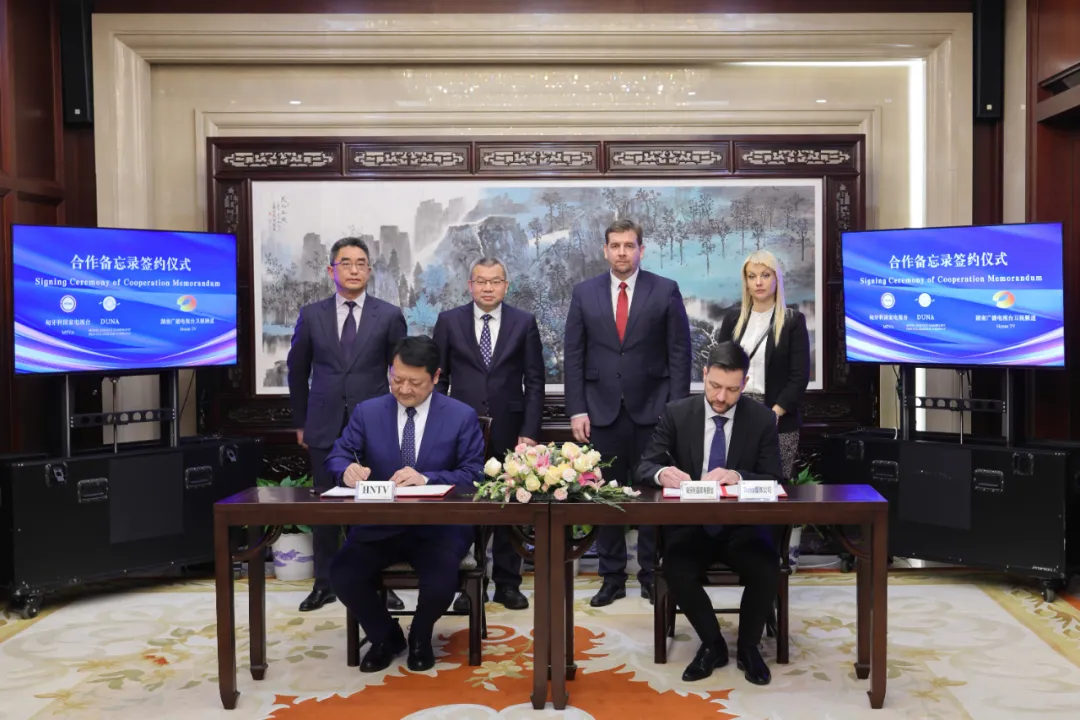
On February 26, 2025, Duna Médiaszolgáltató (DMSZ) and Hunan Satellite Television (湖南衛視) signed a memorandum of cooperation in Changsha, the capital of Hunan province, covering a range of media co-productions and exchanges. According to a Hunan Broadcasting press release, the memorandum was signed by a DMSZ executive and Song Dian (宋點), director of Hunan Satellite Television, in the presence of the Hungarian Consul General in Chongqing and Hunan Broadcasting chairman Gong Zhengwen (龔政文). The agreement covers co-production of China-related documentaries and food programs, cultural exchanges, and talent training. The deal builds on a July 2023 cooperation pact signed in Budapest, through which Hunan Broadcasting cited its variety show Chinese Restaurant (中餐廳) — whose seventh season was filmed in Budapest that year — and claimed to have aired several original productions in Hungary. While DMSZ presents itself as Hungary’s public broadcaster, analysts describe it as a shell entity under effective government control, whose CEO holds no functional autonomy. In recent years it has been strongly criticized within the EU as a pro-government outlet.

Hunan Broadcasting System

Hunan Broadcasting System (湖南廣播電視台) is a state-owned media conglomerate headquartered in Changsha, Hunan Province, operating under the Propaganda Office of the Hunan Provincial Committee of the Chinese Communist Party. It was established on June 28, 2010, through a restructuring of the former Hunan Radio, Film and Television Group. The group operates multiple television channels and radio frequencies, and its most prominent outlet, Hunan Television (湖南衛視), is widely regarded as China’s second-most-watched channel after CCTV-1. Its official streaming platform, Mango TV (芒果TV), was launched in 2006 and hosts original and licensed content. Among the group’s best-known productions was Happy Camp (快樂大本營), a long-running variety show that aired from 1997 until it ceased broadcasting in late 2021.

Japan Business Federation

The Japan Business Federation, known as Keidanren, is a powerful corporate membership federation that is one of Japan’s three major economic organizations, formed in May 2002 through the merger of the Japan Federation of Economic Organizations (established 1946) and the Japan Federation of Employers’ Associations. According to its own description, as of 2025, the federation comprises 574 leading Japanese companies, 106 national industry associations, and regional economic organizations covering all 47 prefectures. The Federation is regarded as Japan’s most powerful business lobby, as it builds consensus among its members on policy issues — from taxation and energy to trade and labor — and channels those positions to the government through formal proposals and political engagement. Its current chairman as of April 2026 is Yoshinobu Tsutsui (筒井義信), former chairman of Nippon Life Insurance Co., who maintains a close relationship with China, regarding it as a vital economic market. In January 2026, Tsutsui stressed the need to “find an opportunity for dialogue at the economic level”  amid tensions over Chinese export restrictions on dual-use items targeting Japan.

Duan Press

The Duan Press was founded in 1996 in Tokyo by Duan Yuezhong (段躍中), also known as “Yakuchū Dan,” who previously worked at China Youth Daily (中國青年報), the official newspaper of the Communist Youth League of China. Duan arrived in Japan in 1991 and later established the press, which describes itself as promoting “mutual understanding” between the peoples of China and Japan, language that is often used by publications close to the Party. It publishes China-themed books in Japanese, and since 2004 has released a book each year around August 15, the date Japan identifies as marking its WWII surrender. The volume compiles testimonies from Japanese soldiers who participated in the war against China. Since 2005, the press has also hosted a Japanese-language essay competition for Chinese students, for which it received an Ambassador’s Commendation from Japan’s Embassy in Beijing in 2023. Duan and the press have received consistently favorable coverage from Chinese state media outlets, including China Daily, Beijing Review, and the Global Times. Duan Yuezhong is also listed as a researcher with the Charhar Institute (察哈爾學會), which describes itself as China’s leading non-governmental think tank on public diplomacy and international relations — though its own promotional PDF from 2017 notes that the “institute completes one or two research tasks assigned by the United Front Work Department of the [CCP] Central Committee every year.” The bio for Duan at the Charhar Institute also lists him as an overseas adviser to the Qingdao Federation of Returned Overseas Chinese (青島市僑聯海外顧問) — a front organization under the CCP-run All-China Federation of Returned Overseas Chinese — and as an editorial board member of China News Service’s World Chinese Media Yearbook, published under the aegis of the World Chinese Media Cooperative Union, a front organization operated by the UFWD through China News Service. 

Duna Médiaszolgáltató

Duna Médiaszolgáltató (DMSZ) is Hungary’s sole public service broadcaster, established on July 1, 2015, and headquartered in Budapest. While DMSZ carries the formal designation of a public service broadcaster, analysts describe it as a shell entity under effective government control, whose CEO holds no functional autonomy. The network has been strongly criticized within the EU in recent years as a pro-government outlet indicative of a general slide in media freedoms in the country. DMSZ was created through a merger of four previously separate public media entities — Magyar Televízió (MTV), Magyar Rádió (MR), Duna TV, and the news agency Magyar Távirati Iroda (MTI) — under reforms carried out during the third government of Prime Minister Viktor Orbán (2014–2018). The broadcaster currently operates six television channels — including its flagship generalist channel Duna and the news channel M1 — seven radio stations, the MTI news agency, and online services. The broadcaster is also a member of the European Broadcasting Union (EBU).

Keizei Koho Center

The Keizai Koho Center (KKC), also known as the Japan Institute for Social and Economic Affairs, was established in 1978 as an affiliate of Keidanren (日本經濟團體連合會), a corporate membership federation that is one of Japan’s three major economic organizations. KKC describes itself as a “platform” for the Japanese business community to engage with domestic and international stakeholders, conducting programs through which some 700 companies and 40 industry associations seek to develop ties with lawmakers, government officials, scholars, journalists, business executives, and educators. KKC also analyzes public policy and the Japanese economy, publishes expert commentary and organizes meetings with foreign media to facilitate exchanges between journalists and its member corporations.