

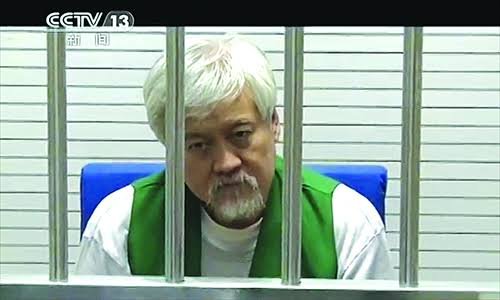
“I understand the things I did seriously harmed the country.” With these words last month, a contrite Leon Tong Ying Kit (唐英傑), the first person convicted under Hong Kong’s National Security Law in 2021, opened the debut episode of “NS Files: Decoded,” a televised series that reviews five separate cases that have been prosecuted as national security crimes. First airing on June 30 to mark the law’s sixth anniversary, the series has been pushed prominently and insistently through public advertising and on government service websites in the territory.
Episodes two and three touch on the publication and distribution of the allegedly seditious children’s book Sheep Village, and the prosecution of Hong Kong radio producer Tam Tak-Chi (譚得志), arrested in 2020 for a public protest during which he shouted the slogan “Liberate Hong Kong! Revolution of our times,” which has been banned in the city. The same slogan is also at the core of Leon Tong’s case in episode one. On July 1, 2020, within hours of the national security law’s implementation, Tong rode a motorcycle through the city’s Wan Chai district flying a black flag bearing the slogan. He was arrested at the scene and charged with “incitement to secession” and “terrorist activities.” One year later, he was handed a nine-year prison sentence.
Prosecutions for such acts of protest have become a regular feature of political life in Hong Kong since 2020. “NS Files: Decoded” (國安檔案解密), a slick production cut with live footage of arrests and street violence and interviews with national security police, is a stark illustration of another growing trend over the past six years — the close coordination of national security police and local media outlets to dramatize such political prosecutions for viewing audiences.
Hosted by a seasoned media professional and a member of the national security establishment, “NS Files: Decoded” is a partnership that underscores the stark changes the national security push has brought for a media environment that once counted among Asia’s freest.
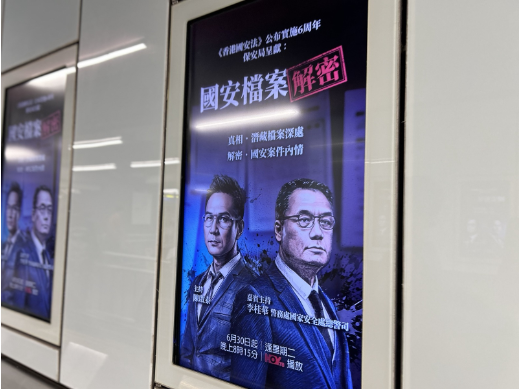
“NS Files: Decoded” is hosted by Ken Chan (陳啟泰), a veteran Hong Kong television host and actor, alongside Steve Li Kwai-wah (李桂華), chief superintendent of the National Security Department — a unit of the Hong Kong Police Force that answers, through the police commissioner, to the same Secretary for Security who oversees the bureau that produced the series.
A fairly recent development in Hong Kong, such partnerships, blurring the lines between media content production and political enforcement, have been a common practice in China for well over a decade.
The Playbook of Political Shame
In August 2013, days after Xi Jinping delivered a hardline speech on media policy and internet control, Chinese-American investor and social media commentator Charles Xue, known online as “Xue Manzi” (薛蛮子), was detained on charges of soliciting a prostitute. In what would quickly become a template for turning political prosecutions into public entertainment, Xue’s petty alleged infraction was treated as national news of huge import — justifying sweeping action against internet influencers, known as “Big Vs.”
At the time, Xue had more than 12 million followers on the popular microblogging platform Weibo, and was known for his sometimes outspoken views. As the pretext for his detention was quickly backgrounded, state media declared he had “toppled from the sacred altar,” meaning that his credibility as a public figure had been destroyed. In another sign of patterns to follow, Xue soon appeared on China Central Television, the state-run broadcasting network, expressing regret for how he had used his platform. “I was irresponsible,” he said. “I didn’t properly verify all the facts in my posts.”
One month later, the larger implications of Xue’s arrest became clear, as China’s Supreme People’s Court issued a judicial interpretation making defamation and several other offenses prosecutable when committed online, with posts viewed more than 5,000 times, or reposted more than 500 times, meeting the threshold for “serious circumstances” warranting charges. Xue’s case, amplified through a coordinated media campaign spanning outlets from the central to the local level and across every platform and format, became the justification for a sweeping tightening of controls over social media accounts nationwide. Months after his detention, however, no case had actually been brought against Xue for what would ordinarily be an administrative offense punishable by a 5,000-yuan fine and 10 to 15 days of detention. He was eventually released on bail in April 2014, without the case against him ever being formally dropped.
Public shaming campaigns like Xue’s, directly involving media outlets, police and prosecutors, would soon become a regular pattern. This would include scores of televised confessions. But police and other disciplinary bodies were also, at this time, expanding homegrown media operations, where content production merged directly with policing and political discipline.
Security and the New Media Economy
One early pioneer at the nexus of media content and policing had been Safe Beijing, a social media account operated by the capital city’s public security department, which first appeared on Weibo in July 2010. Provincial and municipal police departments across the country followed suit, building branded social media operations. The number of such accounts skyrocketed after 2017, when the Communist Party’s Central Political and Legal Affairs Commission (CPLC) made building them out an explicit national priority.
By 2020, nearly 140,000 such accounts across China’s political-legal system had generated more than 517 billion reads, according to a report from the Supreme People’s Procuratorate, China’s top prosecution authority. Weibo accounts within the political-legal system alone made up roughly a quarter of all government Weibo accounts nationally. The CPLC now runs annual competitions ranking the best-performing accounts, turning courts, prosecutors and police into content producers directly vying for views in the attention economy.
The move by Safe Beijing to the short-video platform Douyin, China’s homegrown version of TikTok, in May 2018, epitomized how law enforcement and other disciplinary actions have merged with monetized online entertainment. The account’s debut video, just 57 seconds long, walked viewers through a street-beating incident that had become viral online. It reviewed the case, the police response, and even the suspect’s own confession. Within 24 hours, the video had drawn 12 million views, more than 160,000 likes, and nearly 6,000 comments, numbers that would be the envy of any entertainment account. But the case was still ongoing. The man shown had only recently been taken into custody, and would not stand trial for another six months.
While the online products produced by police and other agencies in China can often touch on public service messaging, such as how to avoid fraudulent schemes online, many deal directly with arrests, prosecutions and anti-corruption cases, blurring the line between enforcement still in progress and entertainment produced for online audiences.
The most extreme expression of this blending of media and prosecution has been the televised confession. Since 2013, when British corporate investigator Peter Humphrey became the first foreign citizen to appear in a televised confession, aired on state broadcaster CCTV just weeks before the Xue Manzi case described above, there have been dozens of such cases. Between 2013 and 2018, 45 broadcast confessions involving lawyers, journalists, activists and foreign nationals were aired in China, according to the rights group Safeguard Defenders.
The practice reached Hong Kong indirectly about midway in that period, in February 2016, when Swedish publisher Gui Minhai (桂民海), who had been detained in mainland China after disappearing from Thailand months earlier, appeared on the Hong Kong-based Phoenix Television along with three colleagues from his Hong Kong bookstore, all confessing to illegally trading books banned on the mainland.
Familiar Trends and Transitions
Since the implementation of the national security law in Hong Kong in June 2020, continued moves to restrict the press and crack down on dissent have come alongside closer collaboration between media, police and national security authorities.
One of the most egregious cases was the airing in 2023 by TVB, a publicly listed broadcaster historically known for its television dramas, of the televised confession of the above-mentioned motorcyclist Leon Tong, TVB’s pro-China bias had by that point been the subject of questioning for nearly a decade, and the series that featured Tong’s confession, “National Security Law — the Cornerstone of Prosperity and Stability” (有法安國), left little doubt about the government’s hand in shaping its message. The credits closing each episode make the connection even clearer: “Information sponsored by the Hong Kong Police Force,” they read. The series was also uploaded to police’s own YouTube and Facebook pages.

Unlike the TVB series, which was co-produced by the network and police, “NS Files: Decoded” was produced directly by Hong Kong’s Security Bureau, positioning the government not just as a collaborator, but as the show’s producer. The five-episode series has aired each week on Tuesdays this month on HOY78, a 24-hour free-to-air news and information channel operated by the publicly-listed Hong Kong broadcaster i-CABLE, which claims to reach 99 percent of local households.
i-CABLE, the parent company of HOY TV, was once known for its independent, even at times adversarial journalism, including through its award-winning investigative program News Lancet.
That reputation collapsed in December 2020, when i-Cable fired at least 40 newsroom staff in a single morning, including the entire News Lancet team along with Wong Lai-ping (黃麗萍), deputy chief of the China News team, who had led its coverage of the emerging epidemic in Wuhan. The rest of the China News team, along with several senior editors, resigned in protest. More than 220 remaining news department employees signed an open letter calling the firings “an irreparable loss.” RFA reported that the changes had fueled concerns the network was “taking orders directly from Beijing’s Central Liaison Office in Hong Kong.”
Whatever the involvement of the Liaison Office, closer relationships and greater coordination between both public and private media and the Hong Kong government and police are a growing trend under the heightened sensitivities of the territory’s national security regime. The trend is aided along by growing integration with mainland Chinese media.
Hong Kong’s public broadcaster, RTHK, shuttered two of its last debate programs in January this year, continuing a years-long retreat from more substantive, even hard-hitting, programming — including a now-deleted investigative documentary on the 2019 protests. Angelina Kwan Yuen-yee (關婉儀), RTHK’s director of broadcasting, has pledged to help “carry forward patriotic spirit” (弘揚愛國精神) and strengthen public identification with China.
In January 2022, following a rapid collapse of the network’s independence through the previous year, RTHK was also one of the first media outlets in Hong Kong to directly collaborate with the government on national security content. That month it launched “National Security Law Case Files” (國安法事件簿), a series co-produced with the Security Bureau and Department of Justice. Now in its third season, the series has featured the Secretary for Justice and the Secretary for Security as guests.
The broadcast of “NS Files: Decoded” this month on i-CABLE’s HOY78 is the latest instance of deepening collaboration between privately-owned media and the territory’s national security apparatus. It follows other forms of media cooperation undertaken by a Hong Kong security establishment clearly determined to put national security enforcement at the heart of daily life in the city.
Since December 2025, the publicly listed Sing Tao News Corporation has supported NStudio, a competition launched by the National Security Department in which primary and secondary school students design marketing proposals to promote national security. Under the competition’s rules, students who submit entries surrender copyright of their work to the department, which may then edit, translate and redistribute the material without further consent or payment.
Shortly after the competition’s launch, Sing Tao’s English-language paper, The Standard, ran a promotional comic strip online instructing young readers on how to register. The strip featured two students discussing how “fun” (好好玩) and “appealing” (好吸引) a previous national security video competition had been. Last month, on the very same day the release of “NS Files: Decoded” was announced, the paper covered the competition’s conclusion, highlighting a colorful group of winning entries — including a 12-year-old contestant who gave a Chinese rap performance as a fictional journalist called “The Little Grape.” Sing Tao has also backed a related police-run student short-video competition on national security themes called “NStory.” Judges include the film director Lee Lik-chi (李力持) and sitting legislator Lawrence Tang Fei.
As the debut of the “NS Files: Decoded” series approached last month, promotional posters lined the pedestrian corridors of Hong Kong’s MTR transit system. “The truth is buried deep within the files,” read the logline over stiff-jawed images of the hosts — one a veteran media figure, the other a senior officer in Hong Kong’s national security establishment.
But the truth, not at all buried deep, is right there on the surface in this uncomfortable juxtaposition. As media in Hong Kong draw closer to powers they are meant to scrutinize independently, this show trial approach turns journalism into little more than a plot device. As this same partner, an increasingly assertive national security establishment, continues to pursue and criminalize journalists, publishers and others who have committed the crime of speaking out, no one in Hong Kong is safer.