In Taiwan, the pressures bearing down on the news industry are an open secret. Platform monopolies, cutthroat competition for clicks, and an advertising market that rewards sensation over substance have hollowed out public trust in journalism. Yet these are precisely the conditions that make the problems so hard to report on and so easy to ignore.
A public interest documentary released this month by the Hsiao Tung-tzu Culture Foundation (蕭同茲先生文化基金會), a Taipei-based foundation dedicated to journalism education and press culture, is now trying to raise awareness of these issues. Spark 5: A Virtuous Cycle (星星之火5:共好的循環), the fifth installment in the foundation’s ongoing Spark series, premiered on June 4 and aired the following evening on CTS (華視), a public broadcaster. The film is the first in the series to bring advertisers, ad-tech platforms, and international news credentialing systems into its examination of Taiwan’s news ecosystem. According to a 2025 report by the Reuters Institute for the Study of Journalism, public trust in news in Taiwan stands at just 30 percent, ranking 39th among 48 markets surveyed globally.
Interviewees, including journalists, technology platforms, advertising agencies and major Taiwanese brands, arrived at a shared conclusion, according to outlets reporting on the film — that the trust crisis facing Taiwan’s media is no longer a problem for the news industry alone, but a challenge facing the whole society.
Ming Pao Canada (加拿大明報), which since 2022 has been the country’s only locally published Chinese-language daily, ran its final issue last week, ending more than three decades of operations. The closure leaves Canada and its estimated 1.7 million population of Chinese origin without a locally published Chinese-language daily newspaper.
The closure is also a sign of the times, reflecting the accelerating collapse of print newspapers in Canada and right across the world.
Citing the broader shift of news consumers to digital platforms, Ming Pao’s parent company, Media Chinese International Limited (世界華文媒體有限公司), reported that its North American operations had losses of 1.7 million US dollars in the third quarter of 2025 alone. The Malaysian conglomerate, founded in 1995 by timber tycoon Tiong Hiew King (張曉卿) — who passed away in November last year — reported after-tax losses of 8.5 million US dollars for its global operations in the year to March 31, 2025, with a 6 percent decline in advertising revenue.
Launched in Toronto in May 1993 and in Vancouver in October 1993, Ming Pao Canada arrived to serve the wave of Hong Kong immigrants fleeing the 1997 handover, with immigration peaking at over 44,000 in 1994 alone. The newspaper competed with rival Sing Tao Daily (星島日報) — another paper with Hong Kong roots — for three decades until Sing Tao ceased print operations in 2022, leaving Ming Pao as Canada’s sole locally published Chinese daily.
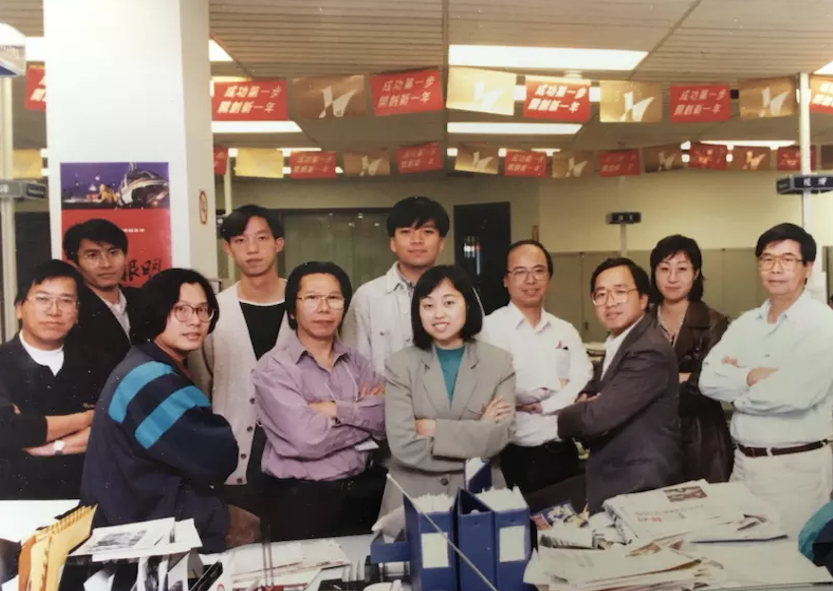
1994 staff photo of Ming Pao’s Western Canada edition editorial team. SOURCE: Singtao.
Lee Wai-Keung (李偉強), one of Ming Pao‘s earliest reporters who stayed for 24 years and rose to senior editorial director, witnessed firsthand how the paper’s workforce reflected changing immigration patterns. “We started by hiring Hong Kong immigrants from the 1990s,” he told Sing Tao (星島日報) in a lengthy online tribute to the closure. “Then came the ‘Hong Kong second generation’ born there but raised here, followed by mainland Chinese arrivals after 2010.” He described the closure as marking the end of an era dominated by Hong Kong immigrants in Canada’s Chinese community.
Teresa Wat (屈潔冰), a member of the Legislative Assembly of British Columbia who served as Ming Pao‘s news director in 1996 during the paper’s fierce rivalry with Sing Tao, wept when she heard the news. “Ming Pao has been more than a newspaper,” she wrote on Instagram. “It helped newcomers navigate housing, employment, language barriers, and integration, and it brought an immigrant perspective to Canadian issues while challenging stereotypes.” A deliveryman who spent 26 years distributing copies of Ming Pao to newsstands and subscribers told Sing Tao he learned of the closure only days beforehand. On social media, readers organized a gathering at the newspaper’s Richmond headquarters to bid farewell together.
The final edition carried a front-page message: “All things that begin must end; every conclusion is complete.”