
Tag: Chinese culture

Red Relics

In a dry publicity stunt meant to affirm the leadership’s staunch backing of arts and culture, China’s official People’s Daily published a letter on the front page earlier this month reportedly sent by Xi Jinping to eight “film artists” (电影艺术家). According to the paper, the artists had previously written to the leader to reflect on their decades in the field, and to pledge to help build China into a “cultural power” (文化强国). In his response, Xi lauded the filmmakers for their “love for the Party and people” (对党和人民的热爱). He urged them to continue serving as role models embodying “cultural confidence,” or wenhua zixin (文化自信).

But when it came to cultural currency there was just one problem. All of these “film artists” were veteran actors from the revolutionary cinema era of the 1950s to 1970s, far predating reforms. Chief among these old guard stars was Tian Hua (田华), the actress born almost a century ago who starred in the 1950 propaganda classic The White-haired Girl (白毛女).

In more news related to “cultural power” this week, state media report that China’s updated figure of 1.12 billion internet users, reached during the first half of this year, means it has “prowess in culture.”

Otherworldly Fraud

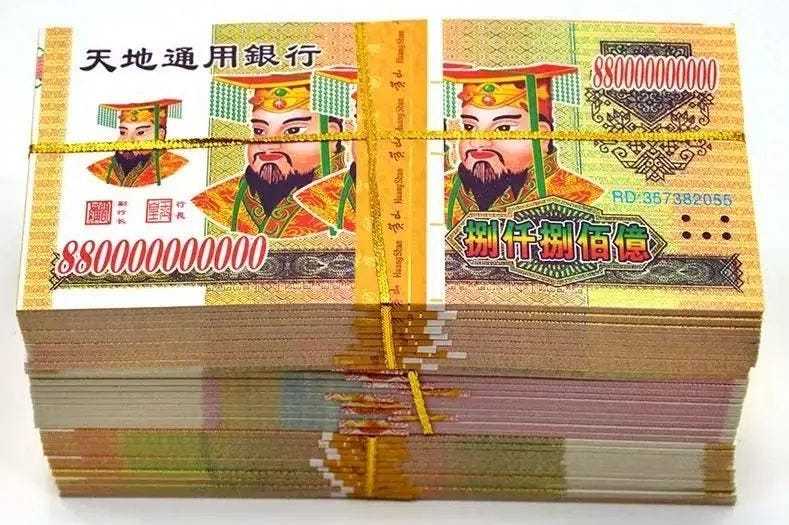
Last week, on the heels of Tomb Sweeping Day, or “Qingming” (清明), across the Chinese-speaking world, the technology media 36Kr reported on a racket that is out of this world. According to the outlet, authorities across the country must regularly crack down on unlicensed “fake ghost money” (假冥币) — the paper bills families burn for the departed.

Though China’s Regulations on Funeral and Interment Control focus primarily on cremation policies and facility management, some provincial and city-level regulations have added their own restrictions, including against “feudal superstition.” Liaoning Province, for example, explicitly prohibits the manufacture and sale of paper money and paper replicas — such as gold bars and sports cars — for funeral purposes. Enforcement varies widely by region, but police generally pursue three violations: operations without proper business licenses, products mimicking real Chinese currency, and use of toxic materials. Last year, police in Liaoning shut down an unlicensed workshop producing ghost money from recycled newspapers.

Ethereal levels of inflation are another problem outside the jurisdiction of authorities. These days, ghost bills feature astronomical denominations like 98 trillion yuan — more than two-thirds of China’s total GDP for 2024. In 2018, a lone developer created “Ethereum Ghost Money” (以太冥币) in an effort to “control inflation in the underworld.” This digital solution, however, has not yet supplanted traditional practices. For now, the deceased must make do with hyper-inflated spirit currency, proving that questionable monetary policy extends beyond our earthly realm.