

Borrowing Boats in Greece
COSCO’s acquisition of a 51 percent majority stake in the Port of Piraeus in 2016 was a prelude to the country joining Xi Jinping’s signature Belt and Road Initiative in 2018. But the ties between China and Greece run deeper than ports and trade agreements. Closer media engagement with Greece, and across southern Europe, has been a key element of China’s strategy to shape narratives about the relationship and secure broader political goodwill.
This engagement has unfolded according to a familiar playbook: content-sharing agreements with news agencies and broadcasters, working actively toward diaspora media aligned with official narratives, and a growing presence on social media through polished influencer accounts that promote a flattering image of China to Greek audiences.
These efforts have been directed at a media landscape in Greece that was already fragmented. The financial crisis that began in late 2009 gutted advertising revenues, accelerated consolidation, and left outlets increasingly dependent on a small number of powerful owners, says Plamen Tonchev, Head of Asia Unit at the Athens-based Institute of International Economic Relations (IIER). Lingua Sinica spoke with Tonchev about China’s media outreach in Greece — how it operates, who enables it, and what it means for one of the EU’s most economically and geopolitically vulnerable member states.
Dalia Parete: When we look at media landscapes globally, each country has its unique characteristics and challenges. What are the most important things to understand about how the media works in Greece today, and how the landscape has evolved — particularly since the financial crisis?
Plamen Tonchev: During the country’s financial crisis, which began in late 2009, many Greek media outlets experienced a collapse in advertising revenue. The economic meltdown of the 2010s explains, at least in part, why no Greek media outlet had a correspondent in Beijing or Shanghai, at a time when China was making headlines and becoming the second-largest power in the world. Notably, this is still the case today, and Greek media depend exclusively on foreign sources of information about China, including Chinese media. This contributes to the lack of a solid understanding of Beijing’s agenda and pursuits in Greece. This crisis also triggered a process of restructuring and consolidation of the country’s highly fragmented media landscape. Over the past 15 years or so, business groups have managed to enhance their sway over the media sector.
Added to Greece’s peculiarities, there have been rapid technological developments, the most obvious result being the steadily shrinking share of print media. There is an ever-accelerating process of digital transformation, as well as the dominance of online outlets and social media. As for human resources in this area, various forms of precarious employment have proliferated, and the number of freelance journalists has increased dramatically. Of course, some of these trends fit into broader patterns in Europe and across the globe.
No Greek media outlet had a correspondent in Beijing or Shanghai, at a time when China was making headlines and becoming the second-largest power in the world.
DP: How would you characterize China’s approach to media engagement in Greece? What does it look like on the ground — who are the key players, and how do they enter the space?
PT: In general, no Greek media outlet is directly controlled by Chinese interests.
However, what can be observed in the country is another policy by the Chinese authorities that encourages state-run media to establish cooperation agreements with overseas counterparts to promote China-friendly content. Using third-party outlets to mask Chinese propaganda has become such a common tactic that CCP officials have reportedly given it a name – “borrowing boats to go to sea”, meaning to use other actors’ resources to fulfill one’s goals. This explains Beijing’s strategy for projecting its narratives in Greece by targeting Greek media, both state-run and private, as useful allies and amplifiers, through a number of content-sharing agreements. Of course, there is a legal framework that sets necessary rules, but governments and competent public authorities cannot impose editorial or partnership policies on private media outlets or restrict freedom of speech. Greek state-run media, in turn, follow government policies that are largely meant not to antagonize Beijing.
Using third-party outlets to mask Chinese propaganda has become such a common tactic that CCP officials have reportedly given it a name -“borrowing boats to go to sea”, meaning to use other actors’ resources to fulfill one’s goals.
DP: One thing that seems distinctive about Greece is that major media outlets are owned by shipping families — and those same families have significant commercial ties with China. How does this overlap between media ownership and economic dependence on China shape the way the relationship is covered?
PT: Indeed, a relatively small number of magnates, active in shipping one way or another, control influential TV networks and other media outlets. Their business interests expand into other areas as well, such as energy, real estate, construction, sports, etc.
This applies to the owners of private media groups, in particular: the Kathimerini — one of Greece’s oldest broadsheets — and the cluster of Skai audiovisual platforms; the Naftemporiki — a business and financial newspaper — and its TV network; the To Vima and Ta Nea dailies — two national newspapers — the MEGA TV channel and some popular portals; and the Star TV, Alpha TV, and Open TV channels — three of Greece’s commercial free-to-air broadcasters. As for the public broadcaster Hellenic Broadcasting Corporation (ERT), with its three channels and related platforms, it also has a relatively positive stance towards China, not least because of Chinese investments in the country.
It is worth noting the extent of the Greek shipping industry’s exposure to China. Greek shipping companies account for an estimated 20% of China’s seaborne trade, and a large number of Greek-owned ships are built in Chinese shipyards, representing a substantial capital relationship with the country.
DP: We know that several Greek media, such as the Athens-Macedonian News Agency (AMNA) and Kathimerini, have signed cooperation agreements or partnerships with Chinese state media. What do these agreements look like in practice?
PT: Actually, the agreements signed with Chinese state media are many more. You are rightly pointing to the ones between Athens-Macedonian News Agency (AMNA) and Xinhua signed in 2016, and Xinhua and Kathimerini signed in 2017, but there are others worth highlighting.
For example, in 2017, AMNA signed a memorandum of understanding (MoU) with the China Economic Information Service (CEIS), an affiliate of Xinhua, to establish a Belt and Road Economic and Financial Information Service.
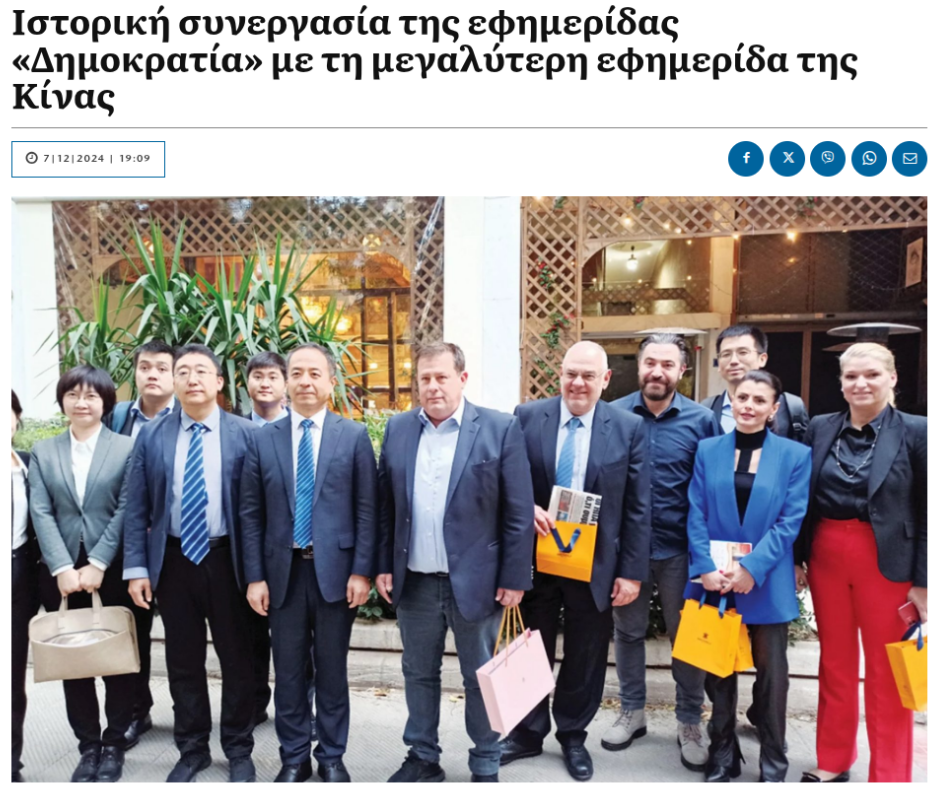
In 2019, during Xi Jinping’s visit to Greece, the state broadcaster Hellenic Broadcasting Corporation signed an MoU with China’s National Radio and Television Administration. Naftemporiki signed two agreements in 2023 – with the China Media Group and Economic Daily. The Nova pay-TV platform signed an agreement with CGTN in 2023, the shipping news platform Maritimes.gr with Xinhua in 2024, and the newspaper/portal Δημοκρατία (Dimokratia) with People’s Daily in 2024. Notably, all these agreements envisage content sharing and distribution, not the sale of stock or ownership rights.
DP: What kind of content do they actually cover?
PT: There have been two key narratives systematically projected by China in Greek media. One of them relates to China’s international standing as a “benign superpower.” China is portrayed as a country with no hidden agenda, simply promoting a new set of harmonious international relations based on rapid social and economic development.
The second narrative pertains to Sino-Greek relations, with China’s positive image carefully crafted as one of a true friend that offers assistance to Greece on a mutually beneficial basis.
To give you some examples, Naftemporiki regularly republishes articles from the Economic Daily (經濟日報). This particular Chinese newspaper is published by the Economic Daily Press, a deputy-ministerial-level institution, managed by the Central Propaganda Department of the Chinese Communist Party. Economic Daily articles invariably present China’s spectacular achievements and the bright prospects of its economy.
A comparative study of Greek and Chinese media released by the Institute of International Economic Relations finds that in 2020 alone, the English edition of the leading Kathimerini republished 66 Xinhua reports, roughly once every five days, or more than once a week. The topics of these reports ranged from rebuttals of claims that China is responsible for the COVID-19 outbreak to praise for the Belt and Road Initiative (BRI) to coverage of Beijing’s positions on various international issues. Occasionally, Greek media outlets interview the PRC ambassadors in Athens or host their op-eds.
DP: Despite Greece having a notable Chinese community, there seem to be relatively few diaspora Chinese-language media outlets in the country. Which are they, what kind of content do they produce, and how do they actually operate on the ground?
PT: It is true that there are very few Chinese-language media outlets in Greece, but then Chinese citizens have access to a number of online sources of information.
I take pride in the fact that at the Institute of International Economic Relations, we were the very first research team to carry out a study of Asian migrants in Greece in 2006. Back then, the officially registered Chinese citizens in the country numbered around 2,000, though the actual size of the Chinese community was much larger.
A lot of water has run under the bridge since then, not least because of the Greek Golden Visa scheme, which Chinese applicants have made extensive use of. As of November 2020, 75% of all Golden Visa holders in Greece were Chinese citizens, and while their share has been falling ever since, they are still the largest group of beneficiaries. As of 2026, the number of Chinese Golden Visa holders, including family members, is estimated at 45,000. The overall size of the community, including Chinese illegally residing in the country or naturalized Greek citizens, is less clear.
These communities have their own media sources in Chinese, including the South Europe Times (南欧时报) [a small print media outlet for Chinese shop owners], which covers issues relating to the daily life of Chinese migrants in Greece. The most prominent media outlet is China-Greece Times (中希时报), which clearly enjoys generous government support from Beijing.
It is true that there are very few Chinese-language media outlets in Greece, but then Chinese citizens have access to a number of online sources of information.
DP: Interesting! What can you tell us about China-Greece Times and its Chinese state news services?
PT: China-Greece Times, set in 2005, is a bilingual print media outlet and claims a circulation of 3,000 free copies distributed primarily in downtown Athens and the so-called Chinatown area. However, as print declines, the online extensions of China-Greece Times, for instance, on social media, are becoming increasingly significant.
It is run by the China Greece Cultural Media Group (中希文化傳媒集團) and has a content-sharing agreement with the Xinhua News Agency and People’s Daily, which explains why it consistently promotes official PRC narratives. The co-founder and editor-in-chief of China-Greece Times, Wang Peng, is also chairman of the Greek Council for the Promotion of Peaceful National Reunification of China (希腊中国和平统一促进会), though it is unclear why Greece should be involved in the process of China’s “national reunification”.
In a post to the official website of the United Front Work Department in October 2022, Wang praised the 20th National Congress of the CCP as “an extremely important meeting convened at a critical moment, as we embark on a new journey of comprehensively building a modern socialist country.” This kind of language indicates a strong political alignment with Beijing’s influence campaign in Greece.
DP: Are there any other forms of Chinese influence campaigns in Greece, particularly in the media sector?
PT: There is also the large-scale and richly endowed Greek program of China Radio International (CRI-Greece). But I would say that Chinese presence in the Greek media sector is much more substantive in the area of social media, because it is more innovative and sophisticated.
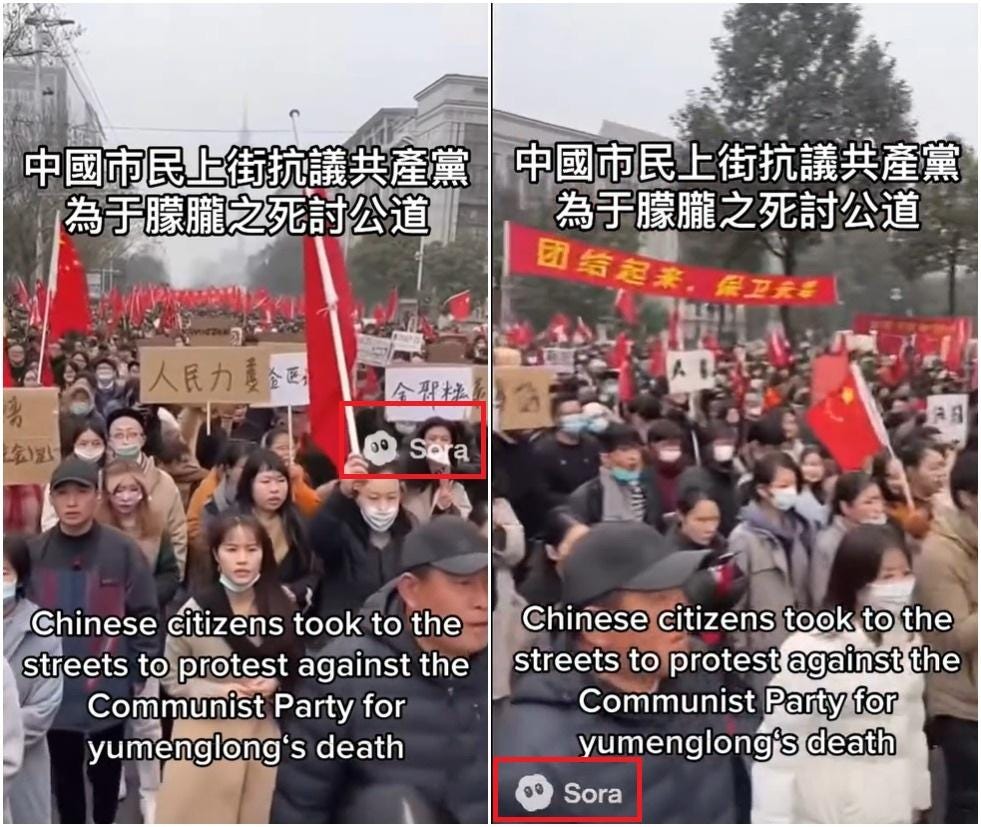
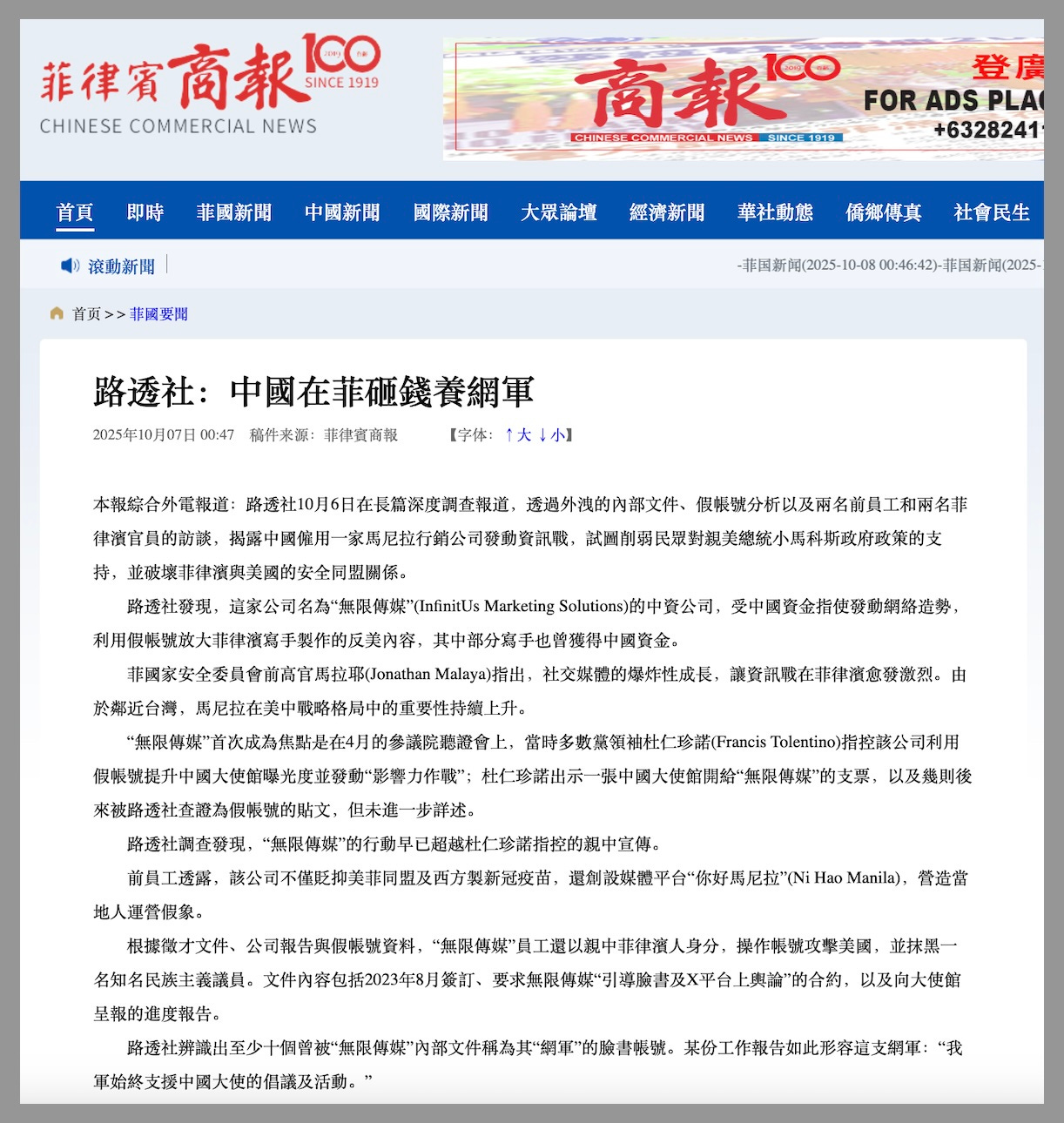
For instance, there are at least three female Chinese influencers who speak fluent Greek and have adopted Greek names: “Mariana”, “Elpida”, and “Iro”. They present themselves as travel vloggers, food bloggers, or individuals showcasing their lives in China and trips to Greece. The content of their pages is predominantly lifestyle-oriented, but with a consistent direction: to portray China in a positive light while avoiding or countering criticism of controversial issues. There have been videos painting a rosy picture of life in the Xinjiang Uyghur Autonomous Region, despite numerous reports of serious human rights violations there. In addition, these influencers frequently extol what they present as extremely promising prospects of Sino-Greek cooperation.
Notably, all their posts are highly professional and visibly polished. Two of these Facebook diaries are managed by a Hong Kong-based advertising company which specialises, among other things, in boosting the outreach of positive content about China. In the case of the third one, the advertiser is listed as a state-owned company which belongs to China’s Central Radio and Television (CMG/CCTV) and is a subsidiary of China Global Television Corporation. So much for the “individual” bloggers and vloggers from China.







.jpg)