Tag: Freedom of expression

(Un)Fair Exclusion

At least three independent Hong Kong bookstores, including Bluesky (藍藍的天) and Boundary Bookstore (界限書店), were rejected from participating in the Hong Kong Book Fair, which began last week and closes today. The restrictive moves follow actions last year requiring these outlets to remove works by journalist Allan Au (區家麟) from their displays. The Wen Wei Po (文匯報), an outlet run by China’s central government in Hong Kong, published a commentary asserting that after five years of the National Security Law, authorities “can no longer allow so-called ‘independent bookstores’ and ‘independent book fairs’ to act recklessly” (胡作非為). The reference to “so-called” is a common growling tactic used by Chinese state media. In response, the excluded bookstores have organized an alternative Independent Book Fair this month.


Romance Lockdown

According to reporting by Taiwan’s Central News Agency, scores of writers in China have been arrested or fined for publishing on the Taiwan-based adult fiction website Haitang Literature (海棠文學城), which allows authors to earn money through subscriptions and tips. More than 50 writers of “danmei” (耽美) — romantic fiction featuring male-male relationships typically written by women — have been detained since June 2024 in what critics call “remote fishing” (遠洋捕撈). This refers to the practice by the authorities of crossing jurisdictions to make arrests. Police in Anhui province initially targeted high-earning Chinese authors on the platform, while recent arrests in Lanzhou focused mostly on young writers, many university students, who made just a few thousand yuan through their online writings. Several writers implicated in the crackdown posted on Weibo about depression and suicidal thoughts before their accounts were deleted. CNA reports that lawyers in Beijing and Shanghai have formed pro bono legal aid teams to assist detained authors. So far, no coverage of this story has appeared in the media inside China.

Unmasking China’s Ranking Rejection

Chinese state-run outlets in Hong Kong have launched a coordinated response against Reporters Without Borders after it ranked Hong Kong at 140 on its 2025 World Press Freedom Index — downgrading the city to its “very serious” category for the first time. The Ta Kung Pao (大公報) criticized RSF for “distorting facts” and “misrepresenting the truth,” while the Wen Wei Po (文匯報) claimed RSF views Hong Kong through an “ideological lens” that deliberately magnifies isolated cases. Meanwhile, pro-establishment lawmaker Elizabeth Quat (葛珮帆) accused RSF of “double standards,” citing a survey by the Bauhinia Institute (紫荊研究院) claiming 62.5 percent of Hong Kong residents believe the Basic Law (基本法) effectively protects press freedom.

Citing this source may actually support RSF’s basic concerns, however. The Bauhinia Institute, founded in 2016, is closely associated with the central government’s Liaison Office in Hong Kong. The company’s director and 100 percent shareholder is Zhang Chunsheng (張春生), a former Xinhua News Agency journalist who later joined Wen Wei Po and for many years was a top executive at the central government-run Bauhinia magazine.

RSF defended its methodology, noting that at least 28 journalists have been prosecuted and 10 remain detained since the implementation of national security legislation in 2020.

A Not-so-Simple Question

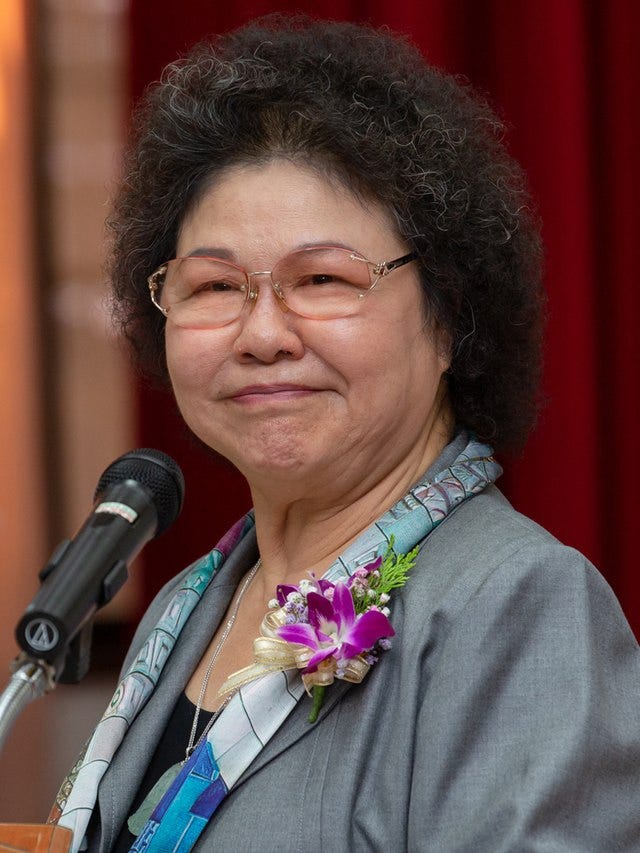
A Taiwanese woman was arrested on April 22 after she posted a simple question to social media inquiring whether one of the country’s most prominent political figures had passed away. The woman — oddly identified in local media reports as simply a “44-year-old unemployed woman” — was charged with violating Taiwan’s Social Order Maintenance Act (社會秩序維護法) by posting the question: “Has Chen Chu died?” on the PTT Bulletin Board System (批踢踢), the largest terminal-based bulletin board system in Taiwan. Chen Chu (陳菊), president of the Control Yuan and chairwoman of the National Human Rights Commission since 2020, is one of Taiwan’s most prominent political figures, and was jailed as a political dissident during the country’s martial law period. The woman facing charges for violating social order claimed that she was responding to an unspecified Threads post about “a celebrity passing away” while remembering news of Chen’s hospitalization. Kaohsiung Medical University Hospital “quickly denied the rumors,” according to a report from Central News Agency, stating Chen’s rehabilitation is “stable and continuously improving.” Police tracked the woman through her IP address within four hours. She later apologized, addressing Chen by a popular nickname, writing: “Flower Mom (花媽), I’m sorry to have caused you such a disturbance.”

Chen Chu pictured in August 2020. SOURCE: Wikimedia Commons.

|