Tag: media diplomacy

China Pushes Ahead with Media Diplomacy with Africa

China’s latest effort to advance its diplomatic influence across the media landscape on the African continent unfolded last week as some 400 representatives from 45 countries gathered in Beijing for the Seventh China-Africa Media Cooperation Forum (第七届中非媒体合作论坛). While topics discussed at the event included content innovation and AI integration in the broadcasting sector, the primary diplomatic role of the event was clear. Its stated goal, according to the official Beijing Daily newspaper, was to “create a favorable atmosphere ahead of the 2027 China-Africa Cooperation Forum.” 

Further emphasizing the foreign policy underpinnings of this ostensible media event, the People’s Daily, the official mouthpiece of the Chinese Communist Party (CCP), alluded to one of Xi Jinping’s core political concepts as it said that China’s media cooperation on the continent was moving toward “an all-weather China-Africa community of shared future for the new era” (全天候中非命运共同体). 

Attendees at the event reportedly pledged cooperation in a number of areas, including joint broadcasting, micro-drama co-production and youth exchange. The primary outcome of the event, however, was what China called a “joint declaration” (第七届中非媒体合作论坛共同宣言). According to state media reports, the declaration, which was not made public, commits partners to “work together to present a true, multi-dimensional and comprehensive image of China-Africa development to the international community.” This was an unmistakable reference to a core tenet of the CCP’s global media view, which holds that the goal of international journalism development — in contrast to ensuring greater independence or professionalism —is to ensure that stories and larger narratives are favorable to China and the Global South. 

Guangxi Seeks Vietnamese Media Partners

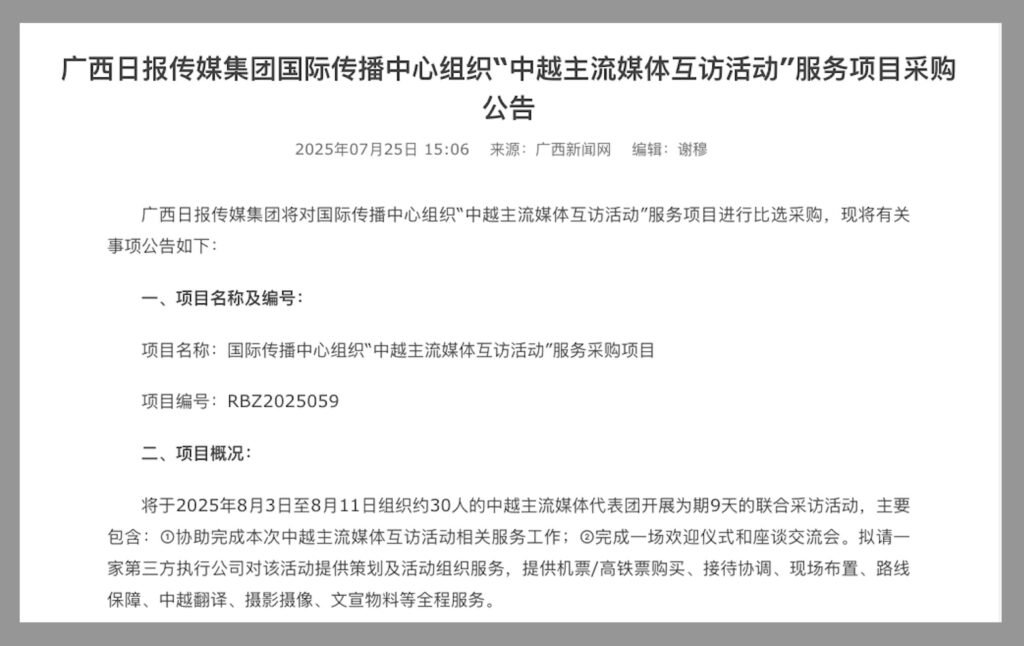
Offering an inside look into how China is using provincial-level media resources to strengthen external propaganda, the official Guangxi Daily (广西日报) issued a call for bidding this month for an exchange program with Vietnamese journalists.

The procurement notice, published July 25, seeks a third-party contractor to organize a nine-day joint reporting activity from August 3-11 involving approximately 30 Chinese and Vietnamese mainstream media representatives. The program will include coordinated interviews, a welcome ceremony, and exchange sessions, with services covering transportation, translation, photography, and promotional materials.

A procurement notice from the Guangxi Daily Media Group is posted on July 25, 2025.

The initiative is being organized by the Guangxi Daily International Communication Center (广西日报国际传播中心), part of the Guangxi Daily Media Group. The center represents a key component of China’s expanding external messaging apparatus at the subnational level.

The formation of international communication centers, or ICCs, at the provincial, city and even county levels across the country responds to a call from Xi Jinping to remake the nation’s system for what the Chinese Communist Party has typically called “external propaganda” (外宣).

The idea driving the policy is that the leadership might, by empowering provincial and local media entities to establish their own international communication centers, leverage more direct knowledge of cross-border dynamics, shared cultural ties, and economic partnerships that national-level outlets might overlook.

This approach reflects a calculated shift from China’s traditional reliance on centralized state media to a more distributed network that can exploit regional advantages. The dispersed structure — which might be called “centralization+” — enables the party to maintain unified messaging while appearing to offer diverse perspectives, creating what officials describe as “singing an international communication ‘chorus'” (唱响国际传播”大合唱”).

A Forum Fizzles

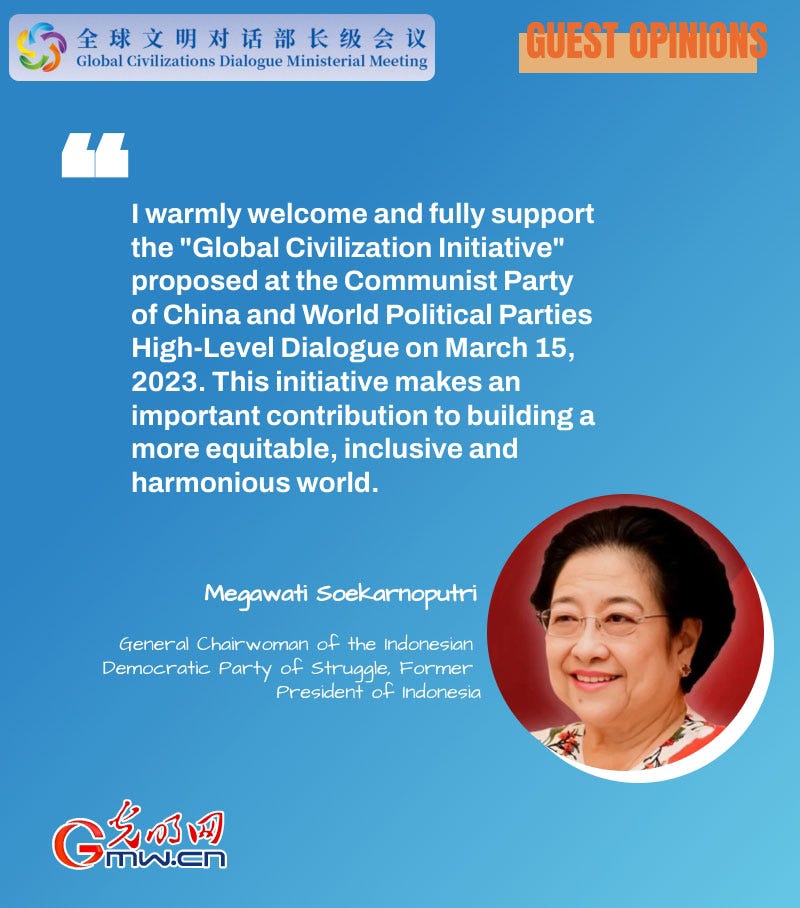
So the first Ministerial Meeting of China’s Global Civilization Initiative (GCI) didn’t top your news agenda? Despite the grandiose terms in which leaders have previously described this third initiative to signal the country’s global leadership in key areas — including also security (GSI) and development (GDI) — state media apparently made little effort to externally publicize what was meant to be its opening party of sorts. Just a smattering of English reports touted the gathering, which took place in Beijing on July 10 and 11. Serbia seemed the only nation to formally announce its participation as a diplomatic matter.

First introduced in March 2023, this initiative is built around a broader concept of “civilization” that Xi has trumpeted since the 20th National Congress of the CCP in October 2022 as a new grandiose concept to shore up his own domestic legitimacy [READ “China’s ‘Xivilizing’ Mission”]. So far, however, the GCI has been relatively understated as a foreign relations strategy. China’s leaders might have hoped to move it centerstage, but they seem not to have even preannounced the ministerial meeting.

Remarks shared by the Central Propaganda Department-run Guangming Daily on the GCI meeting from former Indonesian president Megawati Saekarnoputri.

Naturally, there was a bit of fuss about the meeting in the pages of the People’s Daily, where a congratulatory letter from Xi Jinping made the front page on July 11. In his message, Xi stressed that at this critical juncture in international affairs, civilizational dialogue must transcend isolation and conflict. According to state media, the event attracted more than 600 political, cultural and educational leaders from approximately 140 countries and regions. Among the participants, featured in a CCTV+ video that received a paltry 247 views, was “American Tai Chi practitioner Jake Pinnick,” who called for dialogue and cooperation.

Also emerging from the event was a global“action plan” (行动计划) for civilization. The plan shows a strong focus on developing nations in the Global South. More on that in due course.