Last year, an apparent drop in the frequency of appearances by President Xi Jinping in the state media — alongside cancelled participation in international gatherings such as the BRICS summit — invited speculation that China’s strongman was losing his grip on power. Closely observing the Chinese Communist Party’s flagship People’s Daily newspaper, we argued last July that these shifts were overstated. It was just too early to tell.
The headline results for 2025 are now in. So what observations can we now make about the standing of China’s top leader?
Before we jump into the analysis, it’s important to note again for those less familiar with CCP-run media that the People’s Daily is a constrained and consensus-based Party flagship paper with a high level of consistency in terms of pages and text density over its history — with highly formalized and repetitive language (more on that below). This is a key reason why the paper, a political signalling platform rather than a space for news or discussion, lends itself to frequency analysis.
The Center Holds
First off, we saw no change in the decisiveness of Xi-centric discourse, nor did we see any rising challenges from other members of the Politburo Standing Committee (PSC) — an important indicator of shifts at the top. In the full year 2025, Xi Jinping appeared in close to 600 headlines in the People’s Daily, more than three times the number of headlines logged by China’s premier, Li Qiang (李强), the country’s second ranking party official.
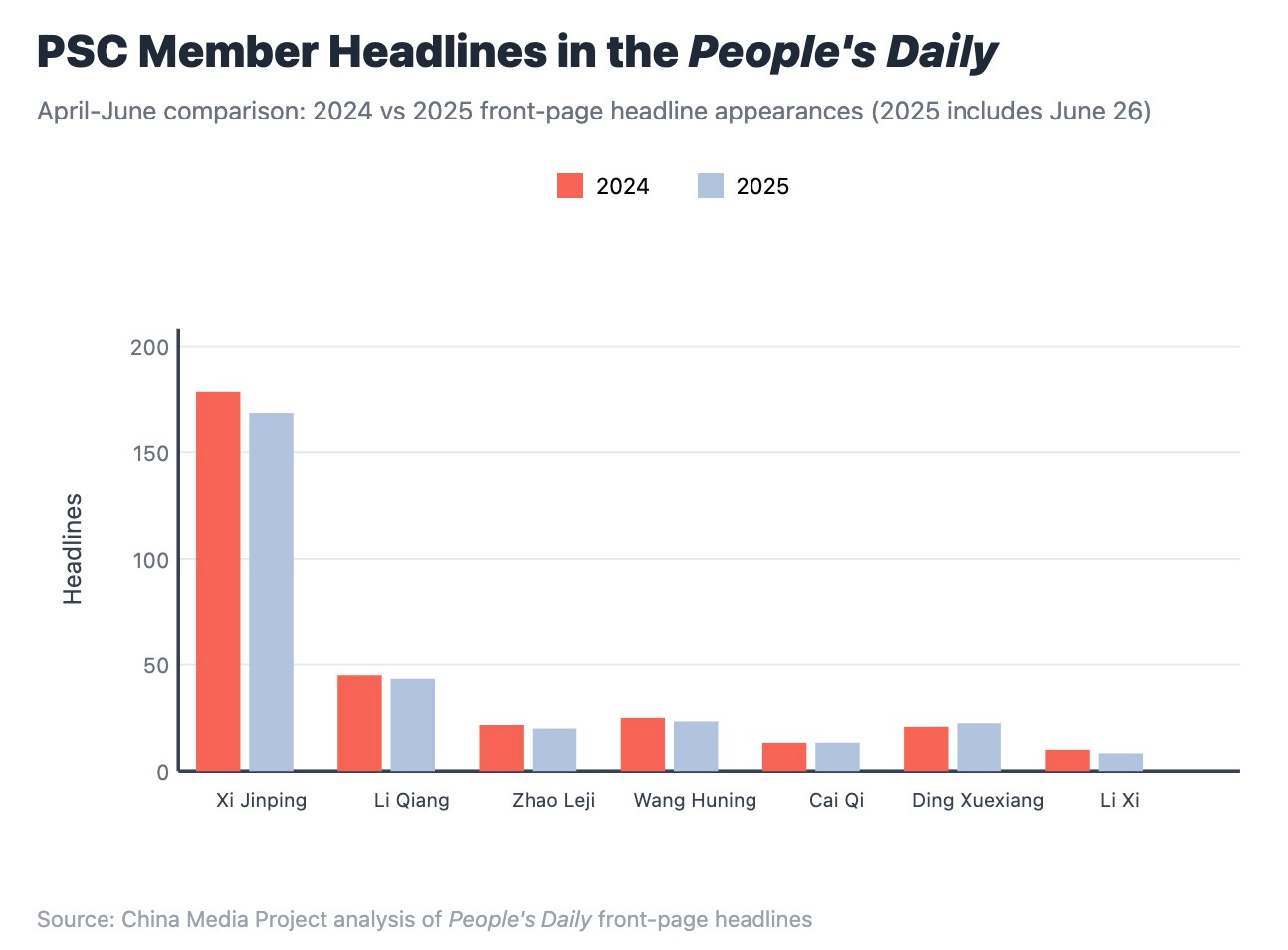
At no point during the past year did this performance gap narrow in the flagship paper. Xi’s lead remained commanding, as it has done throughout his tenure. As readers can see from the graph below, the performance of all PSC members remained steady in 2025, with moderate declines for both Li Qiang and Zhao Leji (as well as Li Xi) against 2024 levels.
You may notice that above we referred to Xi-centric discourse rather than Xi-centric “coverage.” This is an important distinction, and critical to understanding how CCP media operate within China’s political and media systems. The articles in the People’s Daily do not just “cover” events on the political calendar in the same way that media elsewhere in the world do.
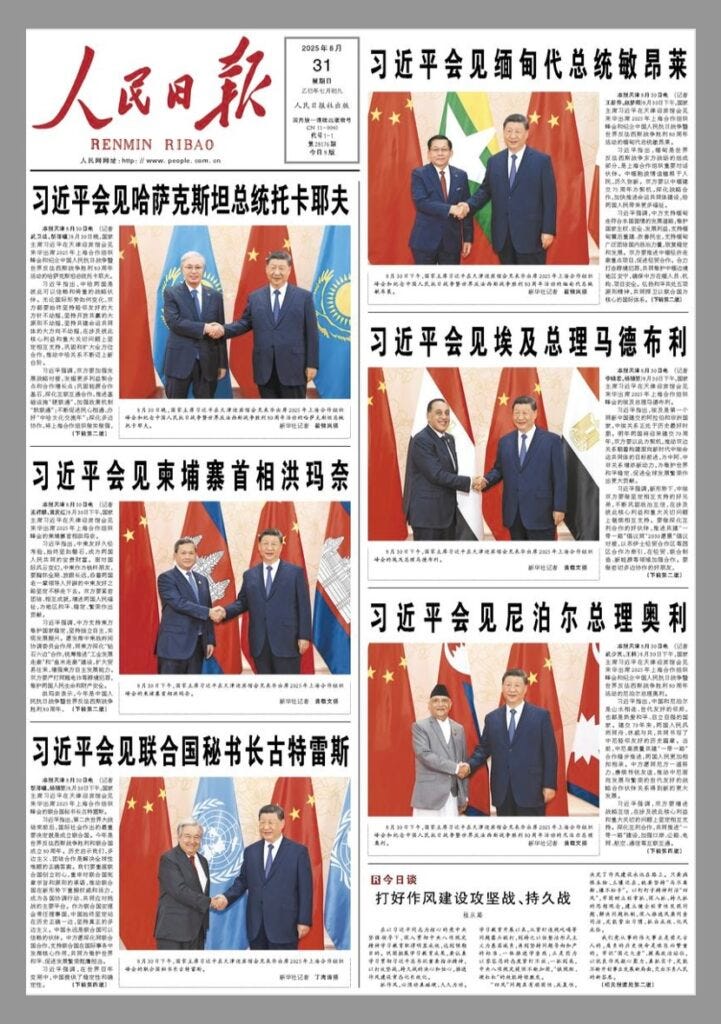
While coverage in a Western newspaper of a political leader’s attendance of a major diplomatic summit would warrant perhaps one report around key issues and points of relevance — with perhaps separate op-eds that reflect independent viewpoints — in China’s system of power signalling it results in a separate article for each diplomatic exchange that resulted. Consequently, a front page during a busy period for Chinese diplomacy can sometimes feel like a Xi Jinping identity parade.
During a summit of the Shanghai Cooperation Organization in August last year, the People’s Daily ran a front-page article for each head of state with whom Xi met.
Why is this ridiculousness necessary?
The Politics of Repetition
In the political system operated by the CCP, repetition is a crucial form of signaling and demonstrating power. This is an absolutely essential part of the People’s Daily’s role. Repetition is a basic way to instill the “main line” (主线) and ensure that the CCP media, as “mouthpieces” (喉舌) of the Party, are the “weathervanes” (风向标) pointing the political direction. This is why six handshakes at a single diplomatic summit become six distinct reports on the paper’s front page.
Understanding the political role of repetition also helps us contextualize another important observation from our 2025 numbers — the fact that headline mentions of Xi Jinping, while decisively in the lead, are also notably down.
When we look at headline appearances for members of the PSC (above), as well as front-page image counts (below), we can see that Xi had seen a notable decrease in appearances on both counts.
What does this mean?
In our analysis back in July last year, we noted that headline counts and images closely follow calendar events, and that over time the total counts can balance out. In other words, Xi’s counts may seem down in July, but then surge in August or October with a busy calendar or a concerted campaign of messaging around events such as Party plenums. Now, with all the data for 2025 accounted for, we can see that this downward trend was no error.
Headline mentions of Xi Jinping, while decisively in the lead, are also notably down.
It is true that Xi made fewer headline appearances this past year in the People’s Daily than in the two years previous. How dramatic was the shift? Xi’s appearances saw an overall drop of 21 percent in 2025. It was a similar story in image counts, where there was a 19 percent drop from the preceding two years. That is not negligible. And yet, as we said at the outset, name checks in front-page headlines for other PSC members remained uniform across all of these years — and far below the soaring heights enjoyed by Xi.
Does this quantitative drop signal a power drain?
While there is always room for error in the perilous business of CCP gazing, the broader context of People’s Daily signaling cautions against over-interpreting this decrease in frequency. First of all, we see continued wall-to-wall “coverage” — again, this is repetition and signalling — of Xi in People’s Daily, combined with a lack of any real challenger. This indicates that he is decisively in control of the narrative, and certainly that he remains the “core” (核心).
Secondly, there are other ways, beyond imperiled leadership, to understand these numbers. One possibility is a general drop in the number of global trips Xi made in 2025. As reporters and analysts have noted, Xi has delegated appearances at major international summits to his premier, Li Qiang. Skipping some of these summits naturally lessened Xi’s 2025 tally — which is to say that it lessened instances not just of “coverage,” but of repetition.
For those tempted to read too much into those absences, it’s important to note that Li’s attendance of these summits in particular did not drive a corresponding increase in article and image numbers for the premier. This is not because those events were not covered, but because they were not repeated like incessant drum beats to promote the leadership core.
The repetition that to most of us appears senseless, and even ridiculous, is a privilege enjoyed only by the man at the apex.
As we enter 2026 and Xi Jinping edges another year closer to the next Party Congress (2027), China’s repetition complex is something to carefully observe. Will the downward trend in his numbers continue? Only time will tell if there is real strength in Xi’s numbers.
“Basketball is a bridge that connects us.” That was the headline of a commentary published in the Chinese Communist Party’s People’s Daily newspaper earlier this month, with a soaring byline from none other than LeBron James, the LA Lakers star who is the NBA’s all-time leading scorer. “I’ve been deeply moved by the enthusiasm and friendliness of my Chinese friends,” the commentary began, with a typical CCP frame of people-to-people friendship. “What I can do in return is give my all in every game as a way to show my gratitude to everyone.” For a generally insipid Party-run mouthpiece, such a celebrity endorsement was too good to be true — and of course it was. Representatives for LeBron James quickly disavowed the story. The star, they said, had only ever conducted interviews with Chinese media.
What does this tell us? The flagship newspaper of the CCP feels it is perfectly acceptable to fake a commentary by one of the world’s most recognizable public figures if it suits the agenda, in this case talking up “friendship” and people-to-people exchange.
It should not surprise readers that this is not an isolated case. In 2016, after a commentary with a byline from a journalism professor in the New York state university system appeared in the paper decrying the falsehood of Western freedom of speech, CMP reached out to the professor in question. In an e-mail exchange, the shocked professor said she had only spoken on the phone with a People’s Daily reporter and raised issues of journalism ethics more generally. Sound familiar?
At the People’s Daily, politics always trump professionalism. In order to have his official press card re-issued back in January, the staff member behind the LeBron James commentary, sports reporter Wang Liang (王亮) would almost certainly have taken refresher courses on the Marxist View of Journalism and fealty to the Party. The most basic ethics and good practice? Not so important. The People’s Daily has issued no public correction on the LeBron James commentary. Don’t bother waiting for the buzzer.
hink “state media” in China and you’re likely to conjure an image of the People’s Daily (人民日报). The daily newspaper, directly run by the Chinese Communist Party’s (CCP) Central Committee since 1948, prides itself on being the “mouthpiece” (喉舌) of the Party leadership. And a role this important demands regimentation and structure: a staid face to communicate the thoughts of the CCP core.
But while it is the most representative of the Party leadership, the People’s Daily newspaper, first launched in 1946, is not the only face of this Party-run media group. The paper’s parent organization, the People’s Daily Press (人民日报社), is in fact a sprawling media empire. The group oversees a portfolio of 34 periodicals as well as a wide array of newer digital products. It runs a health magazine, a history journal, a newspaper for gearheads, and even the RV Times (房车时代), a periodical for recreational vehicle enthusiasts.
The story of the group’s growth over the years is the story of the PRC media space as a whole, where commercialization and partial privatization were actively encouraged in the reform era, and where more recent developments have made it clear once again that the Party maintains ultimate control.
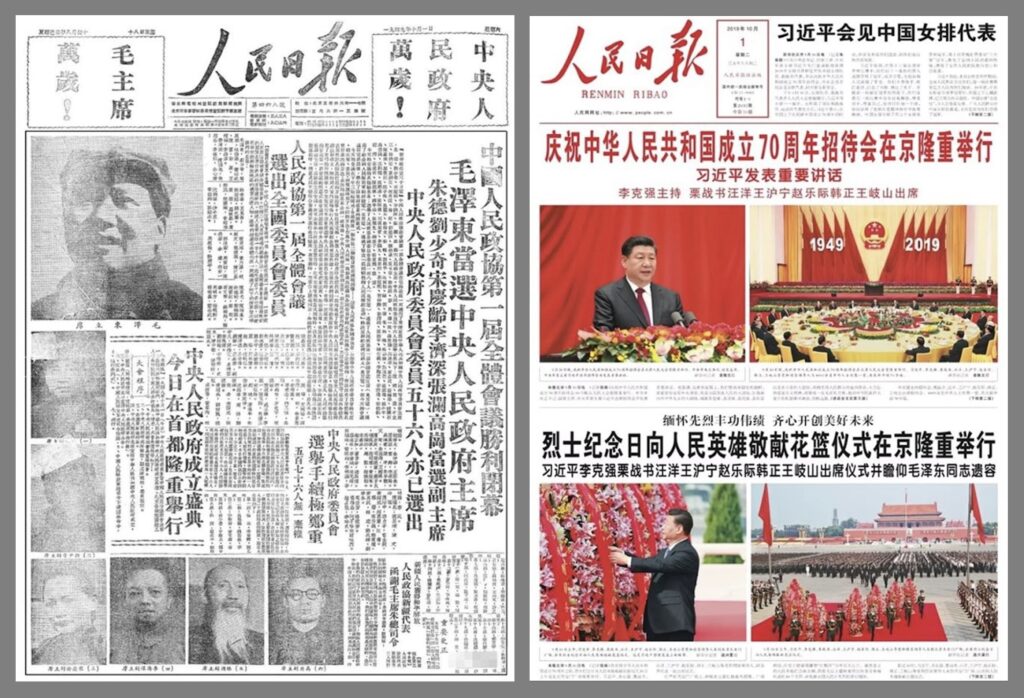
The People’s Daily on the day the People’s Republic of China was founded on October 1, 1949, and the PRC’s 70th anniversary in 2019.
A Fresh Wind Through Chinese Media
In the China of Chairman Mao Zedong, the People’s Daily was one of only a handful of officially sanctioned newspapers run by the CCP — known, fittingly, as “Party-papers” (党报) — to cover the entirety of the newly founded People’s Republic of China. It adhered strictly to Mao’s notion of “politicians running the newspapers” (政治家办报), according to which any printed articles, particularly lead editorials (社论), had to be aligned with the interests of the Party. During the Great Proletarian Cultural Revolution (文化大革命) of 1966-1976, those interests were Mao’s personal political interests, and the chairman’s writings dominated the “two newspapers and one journal” (两报一刊) system, in which the three most influential PRC publications, including the People’s Daily, the People’s Liberation Army Daily and Red Flag journal, reigned supreme.
In the early years of China’s reform and opening up under Deng Xiaoping (邓小平), the number of nationwide publications in China remained small for a country of its size. In 1979 there were just 69 “Party-papers” in print. This contrasts sharply with the latest figures from the National Press and Publication Administration (国家新闻出版署), or NPPA, an agency under the Party’s Central Propaganda Department that supervises print publications in China. The NPPA recorded 2,405 newspapers published in the country in 2023.
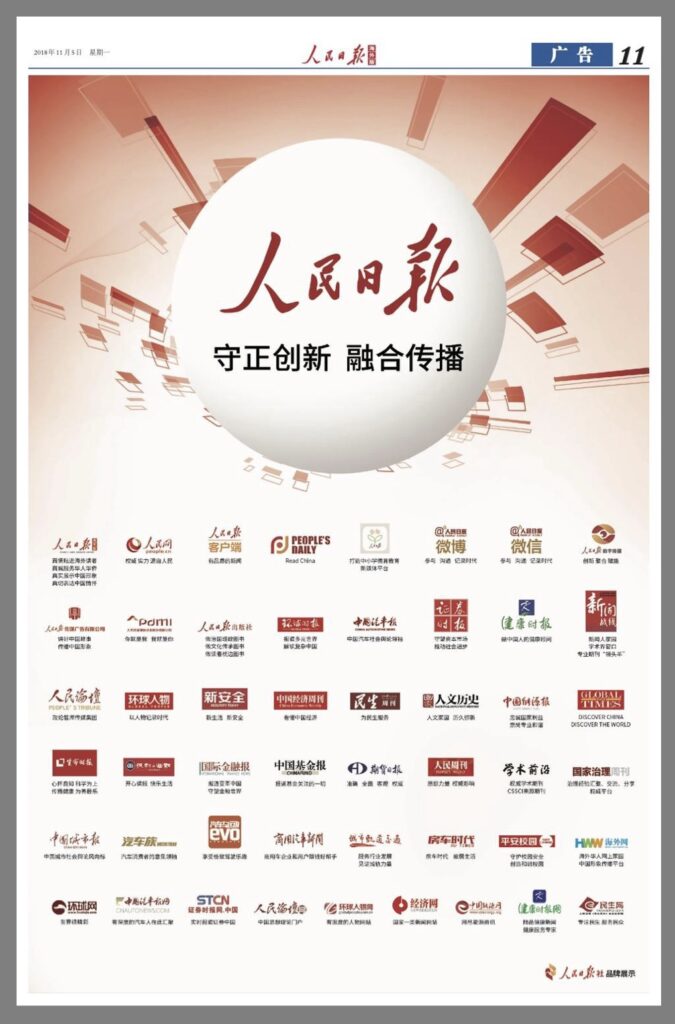
An advertisement is the People’s Daily showcasing the many brands under the People’s Daily umbrella.
This number began its climb from two to four digits in the 1980s, as economic reforms brought a rethink of the role in the media. The term “news reform” (新闻改革) signaled a new openness, including an assessment from the leadership under Deng Xiaoping that the “falsehood, bluster and emptiness” (假大空) of the media from the 1950s onward had to a large extent contributed to the chaos of the period, from the Great Famine through the Cultural Revolution.
Tragically, the push toward greater freedom of speech in the 1980s, seen in the launch of more reform-oriented newspapers like Shanghai’s World Economic Herald (世界经济导报), was brought to a brutal end by the Tiananmen Massacre of June 4, 1989.
But by the mid-1990s, as economic reforms were reinvigorated and accelerated, the spirit of change again swept over the media in China. This era also saw significant liberalization in the industry, with the number of periodicals rising rapidly as a result. Publishing was never a free marketplace of ideas — government licenses remained necessary for any operation — but new voices did begin to emerge. More market-oriented “metro papers” (都市类报纸) served China’s rapidly urbanizing population, oriented around the consumer — of goods and information. The equation meant more readers, more sales, and more ad revenue, a new way for outlets to exist independent of state financial support, even as political ties to the system remained paramount. From time to time, these papers challenged the authorities by reporting more openly on corruption and other political and social issues.
Even the People’s Daily joined the trend, launching its own metro newspaper, the Beijing Times (京华时报), in May 2001. In what has been called the “golden age for metro newspapers,”higher salaries and more comfortable working conditions made the Beijing Times and other commercial competitors attractive to a new generation of young journalists. According to a 2017 account, the “direct approach” and “sharp commentary” found at the Beijing Times in the 2000s made it “like a fresh wind sweeping through Beijing’s then-dull media market.”
Going Public with the People’s Internet
The rise of the internet in China after 1994 was another jolt for the media industry, even though it was heavily regulated from the start to ensure that news gathering remained in the hands of the Party. Inside China, Chinese-language internet portal sites like Sohu.com, launched in 1996, and Sina.com, launched in 1998, could serve as content aggregators — reposting content from Party media and registered commercial spin-offs — but could not themselves maintain teams of journalists. But they revolutionized the consumption of information, even inviting discussion in the comment (跟帖) section underneath news articles.
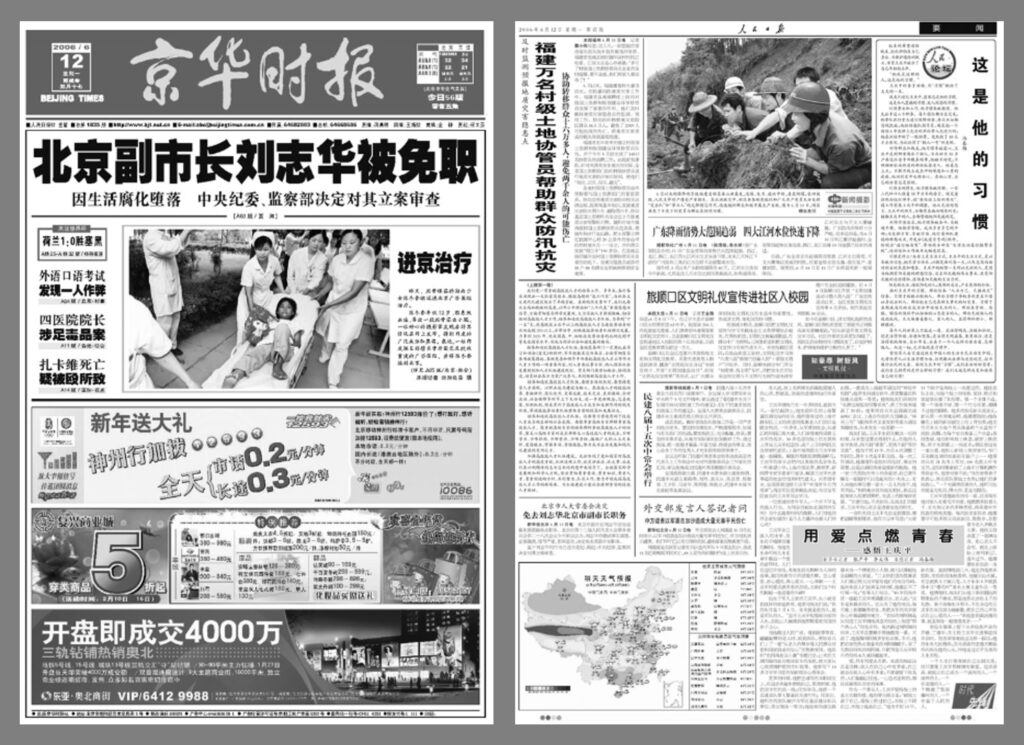
Contrasting reports from 2006 on corruption charges against the vice-mayor of Beijing illustrate the differences between Party papers and their commercial spin-offs. At left, the Beijing Times places the corruption story prominently on the front page. At right, the People’s Daily includes only a small note on page 4.
The People’s Daily was quick to follow suit, entering this space on January 1, 1997, with the launch of its online portal, People’s Daily Online, or renminwang (人民网). As the group’s “About Us” page explains, the emerging online space offered “unique advantages” including “communication value” (i.e., more interactivity) and “technological value.” Today, the official portal site continues to publish a digitized and downloadable version of the People’s Daily print edition, runs the Chinese Communist Party News Network (中国共产党新闻网), and moderates a “leader’s message board” (领导留言板). This last feature, which China’s government has cited as an example of democratic governance, claims to allow citizens to directly pose questions to officials or express their views, but in fact is little more than an officially curated comment service — serving to promote the idea of Party responsiveness rather than enable real accountability.
People’s Daily Onlineis structured more like a conventional company. Listed on the Shanghai Stock Exchange as People.cn Company Limited (人民网股份有限公司) since April 2012, it has its own investor relations page and publishes its annual returns, the latest of which boasts revenues of 2.1 billion RMB (290 million dollars). Like any other company’s annual reports, People.cn’s are replete with references to the firm’s profits. But unlike those of most publicly listed companies, their reports blend profit talk with performative loyalty to the Chinese Communist Party. Investors are reminded, in the management analysis section, that the company strictly adheres to “Xi Jinping Thought on Socialism with Chinese Characteristics for the New Era.” Career openings at the company also list “loving the Party” and having “strong political integrity” as job requirements.
Building an Empire
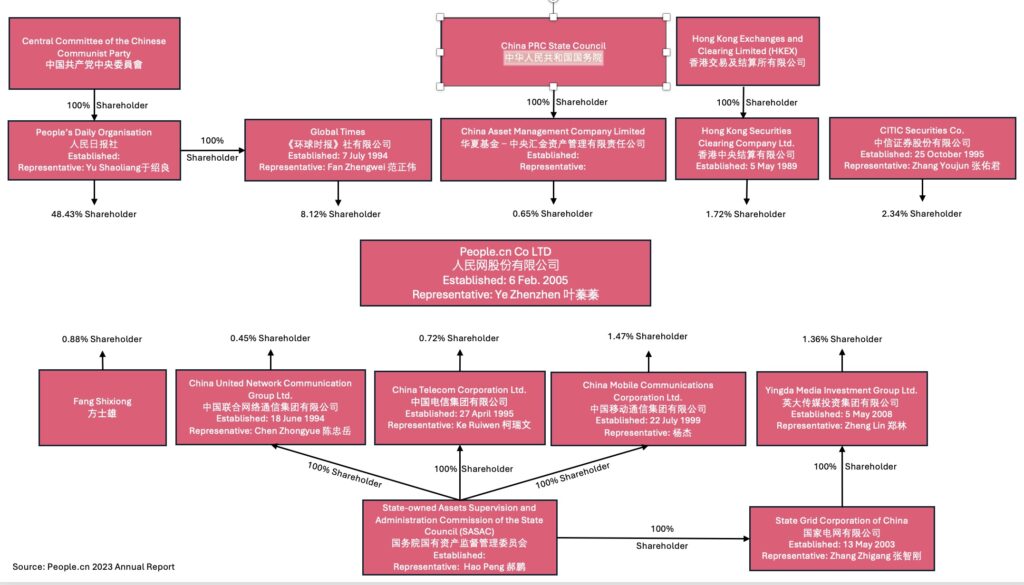
But while the print edition of the People’s Daily falls directly under the CCP’s Central Committee, People’s Daily Online has a series of private buy-ins from investors that complicate its identity. The group’s annual reports reveal their top ten shareholders, compiled into the diagram below. Amongst others, the company’s biggest investors include state-owned investment bank CITIC Securities (中心证券), state-owned telecommunications giant China Mobile (中国移动通信), and the Hong Kong Securities Company (香港中央结算), wholly owned by the Hong Kong Exchange and Clearing Limited (HKEX) that runs the territory’s stock exchange. While the print edition is run unambiguously as part of the Party-state, its online counterpart retains some reform-era features of a legitimate digital news company — although just a little digging reveals that the Party-state is still firmly in control.
Screenshot
Combined with the shares held by the Global Times — a nationalistic tabloid wholly owned by the People’s Daily — the People’s Daily Press has a controlling 56.55 percent stake in People.cn. Even the apparently private minority buy-ins, however, are in fact different arms of the Party-state itself. Take, for example, China Asset Management (华夏基金), which holds 0.65 percent of People’s Daily Online shares and is registered under the State Council. Other investors like China United Network Communications Group (中国联合网络通信), or “China Unicom,” China Telecom (中国电信), and China Mobile Communications are all state-owned enterprises (SOEs) overseen by the State-owned Assets Supervision and Administration Commission of the State Council, which is directly under the management of China’s central government.
So how profitable is the People’s Daily Online? A 2019 article in the industry publication China Newspaper Industry (中国报业) summed up media developments over the previous year in China with a series of bearish keywords. The top three: “decline” (下滑), “loss” (流失), and “avalanche” (雪崩).
While the print edition of the People’s Daily falls directly under the CCP’s Central Committee, People’s Daily Online has a series of private buy-ins from investors that complicate its identity.
But People’s Daily Online doesn’t seem to be faring so poorly.Their 2019 Annual Report logged a 40 percent profit increase from the year before, and they kept growing the next year. Despite a pandemic slump, their profits are on the rise again.
How the outlet manages to be so profitable, however, is not necessarily down to just newsstand sales, subscriptions, or advertising revenue. In the United Kingdom, the People’s Daily Online’s London bureau (People’s Daily Online UK Limited) is based near Hyde Park’s famous Speakers’ Corner, a historic site for free speech and public debate — and famous, too, for having some of the most expensive real estate in the country. The latest financial statement for the UK bureau shows a loss of 2.8 million US dollars, offset only by the 3 million US dollars provided by its head office in Beijing. We have also documented this phenomenon at China Daily USA, where the stateside operations of the state-run newspaper are run at a considerable loss thanks to millions in direct funding from China Daily HQ.
The People’s Daily Online also runs Global Times Online (环球网), the digital edition of the nationalistic tabloid Global Times (环球时报). Ownership of the newspaper is split 60-40, respectively, between the People’s Daily Online and the Global Times Press (环球时报社) — the latter of which also sits directly under the CCP Central Committee. Haiwainet (海外网), the website of the overseas edition of the People’s Daily, is split along the same lines by the People’s Daily Online and the People’s Daily Press.
China Energy and Automobile Communication Group (中国能源汽车传播集团有限公司) is responsible for the People’s Daily’s stable of specialized trade publications (专业行业报). The Group is wholly owned by the People’s Daily Press — again, directly under the Central Committee. Its properties include China City News (中国城市报), a weekly bulletin aimed at “party and government leaders” involved in “urban planning, construction, and management,” as well as China Automotive News (中国汽车报), a print weekly and digital news outlet for fans of cars and engineering.
One Voice, Many Channels
For most companies around the world, corporate social responsibility reports are used to demonstrate how the business has had a positive impact on society and the environments in which it operates. It is underpinned by the idea that for-profit institutions still have a responsibility to the broader community. The People’s Daily Press files its own “social responsibility reports” (社会责任报告), but theirs have a distinctive twist: instead of demonstrating their philanthropic deeds, they are used to demonstrate their unwavering loyalty to the Communist Party.
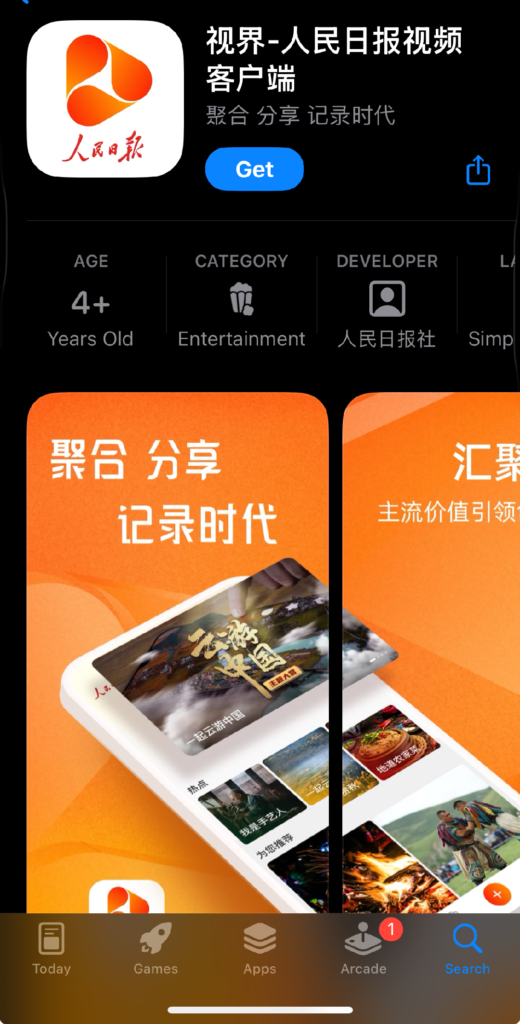
In their latest report, they remind readers that the outlet “strictly adheres to the principle of politicians running the newspapers” — the phrase that was first raised by Mao in the 1950s as he asserted his dominance over the media as a means of consolidating political power, and has since come back in vogue as Xi Jinping has similarly tightened controls on the media. This means that all of the group’s ventures are bound ultimately to the same basic principle: Party first, profit second. This is true whether they are app-based new media outlets like Visual World (视界), at right, sending state-produced video material straight to your mobile, AI text generation tools like “Easy Write” (写易), or just the dry, Xi-filled pages of the flagship People’s Daily newspaper.
Mao’s old phrase, applied in state media today to stake the CCP’s claim over emerging digital media, encompasses the enduring truth behind the many faces of the People’s Daily empire. While this media giant continues to transform through the process of Party-led commercialization that began in the reform era — seen in its diverse inventory of media properties — its core remains unchanged. It is still, in its own words, “the throat and tongue and eyes and ears of the CCP Central Committee.” The principle holds true whether it is reporting on the latest Party plenum or the latest make of luxury camper.
Speculation about Xi Jinping’s waning influence intensified late last month following news of his planned absence from this week’s BRICS summit in Rio, on top of reports suggesting his presence in China’s state-run media has declined. Willy Wo-Lap Lam at the Jamestown Foundation’s China Brief noted that “citations of Xi’s name have become thinner and thinner in authoritative official media,” raising questions about potential leadership changes as China approaches its next Party congress.
However, our analysis of front-page headlines in the Party’s official People’s Daily challenges this narrative. Comparing the second quarters of 2024 and 2025, we found that Xi appeared in headlines 177 times versus 157 times respectively — a modest decline likely explained by incomplete June 2025 data. More significantly, Premier Li Qiang, Xi’s closest competitor, showed virtually no change with 45 appearances in 2024 and 43 in 2025.
While these headline counts cannot capture insider dynamics or leadership effectiveness, they hardly suggest a power shift in the Party’s most important publication. Xi’s dominance in China’s authoritative media remains intact — contradicting speculation about his declining grip on power. The data suggests China’s most powerful leader in generations continues to command overwhelming media attention. Read more on this at the China Media Project website.
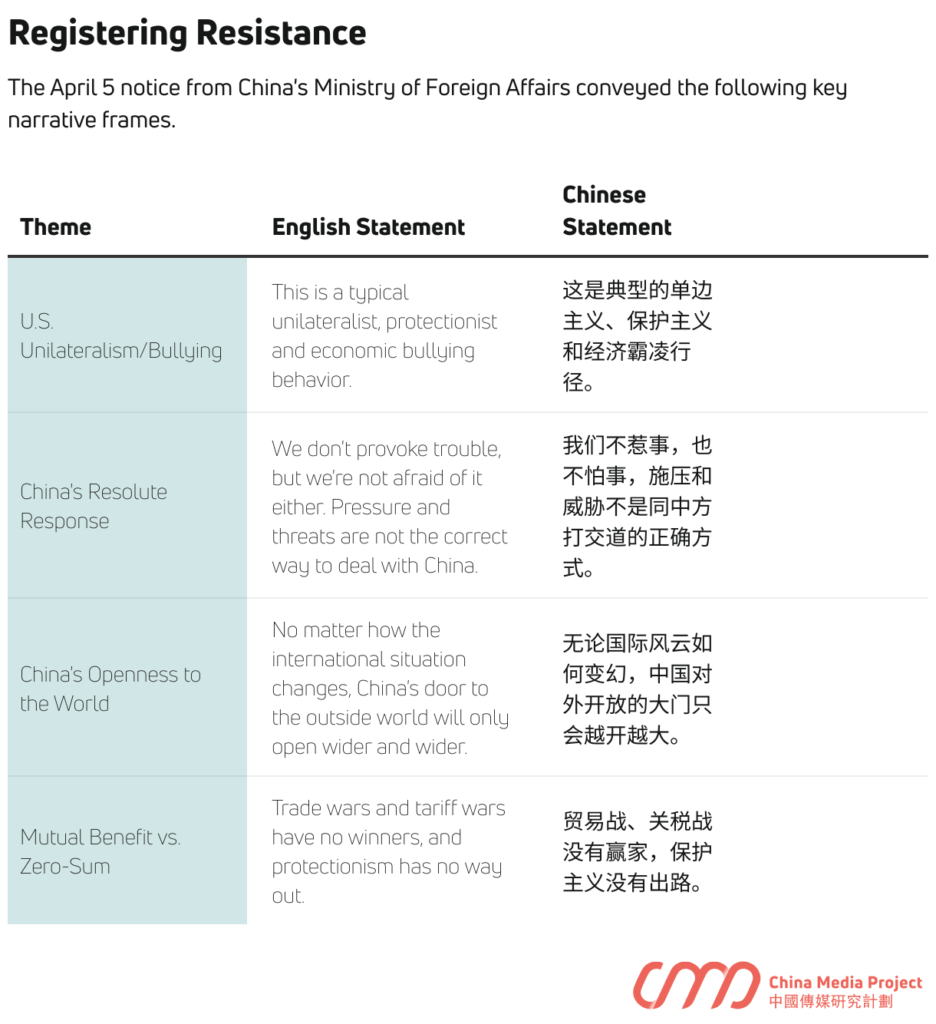
Ever since April 2, when President Donald Trump announced the imposition of deep tariffs from White House Rose Garden as a “Liberation Day” for America, China has pushed back hard, framing the United States as bullying, inflexible, and ultimately harmful to the world and itself. The rallying cry from the Ministry of Foreign Affairs (MFA) three days later set the tone of defiance: “The world needs justice, not hegemony!” (世界要公道,不要霸道).
Filtered out through an official notice, or tonggao (通稿), from Xinhua News Agency, the MFA’s language accused the US of “economic bullying” and “zero-sum game playing,” and warned that “pressure and threats are not the correct way to deal with China.” The message reverberated throughout the media inside China, from the leadership’s People’s Daily (人民日報), to provincial mouthpieces like Guangdong’s Nanfang Daily (南方日報), and on to more commercial outlets like Caixin Media (財新) and the 21st Century Business Herald (21世紀經濟報道). In perhaps the subtlest sign of pique, the professionally-minded Caixin labeled the notice “Authorized by Xinhua for Release” (新华社受权发布). Translation: We were ordered to run this.
For a more detailed look at China’s framing of the US tariffs, stay tuned for our full analysis next week. Until then, here is a breakdown of the key narrative frames driving official coverage over the past two weeks — all evident in the original MFA release.