Tag: Philippines China relations

Monkey Business in the Philippines

Earlier this month, an AI-generated video depicting the Philippines as a frightened monkey ignited outrage in Manila and drew condemnation from the country’s diplomats and lawmakers. Posted on July 10 to the social media account of China Daily (中國日報), the official English-language outlet of the Chinese central government, the video showed a monkey in a salakot and barong — the traditional hat and shirt worn on formal occasions — pushed onto a karaoke stage by giant hands bearing US and Japanese flags, in an apparent suggestion that the Philippines is a puppet of the two countries.

“This is another act that reflects the mindset of an entitled bully,” said Philippine Representative Leila de Lima.

Nearly as outrageous, however, was the flat denial of responsibility that followed later in the month from China’s top diplomat in the Philippines. On July 21, the same day Philippine President Ferdinand Marcos Jr. summoned him over a Chinese Coast Guard attack on a Filipino soldier, Ambassador Jing Quan (井泉) told reporters that the video had not reflected the official stance of the Chinese government — an assertion clearly at odds with the outlet’s role as an arm of the party-state. “We simply cannot control every media outlet, every video, every article, and every newspaper,” he said.

China Daily, in fact, operates directly under the Central Propaganda Department and the State Council, and all its content is subject to political controls under the CCP’s decades-old doctrine of “guidance of public opinion” (舆论導向), which requires media to align coverage with the Party’s messaging. In its own 2025 social responsibility report, an annual exercise required of all core Party and state-run Chinese media, China Daily describes itself as “a major central propaganda and cultural unit” (中央主要宣传文化单位), and pledges strict adherence to the principle of Party control over media.

The monkey video, posted to coincide with the 10th anniversary of the 2016 South China Sea arbitral ruling that invalidated China’s territorial claims, drew a formal diplomatic protest from the Philippines’ Department of Foreign Affairs, which called the depiction “demeaning, dehumanizing, and racist” and demanded its removal.

Drama Diplomacy

Earlier this month, China’s state-run Southeast TV (東南衛視) announced at an annual cross-strait gathering in Xiamen that it will air two recently acquired Taiwanese dramas, marking the first time in more than a decade that a provincial satellite channel in China has carried Taiwanese content. The move is part of a broader pattern this year in which China has used popular entertainment in a redoubled effort to cultivate goodwill in Taiwan — even as its military posture toward the country hardens.

The acquisitions follow an April announcement by the Taiwan Affairs Office (TAO), the official Chinese body overseeing cross-strait policy, of ten cross-strait exchange measures permitting Taiwanese dramas on Chinese satellite channels, provided they are “correctly guided,” a phrase that echoes the Chinese Communist Party’s policy ofpublic opinion guidance demanding media serve key political objectives. 

Southeast TV is a satellite channel of the Fujian Media Group, a broadcast conglomerate directly under the provincial government in Fujian that is a key part of the vast communication array China directs at Taiwan — much of it propaganda and cognitive warfare designed to destabilize the country’s open and democratic society. 

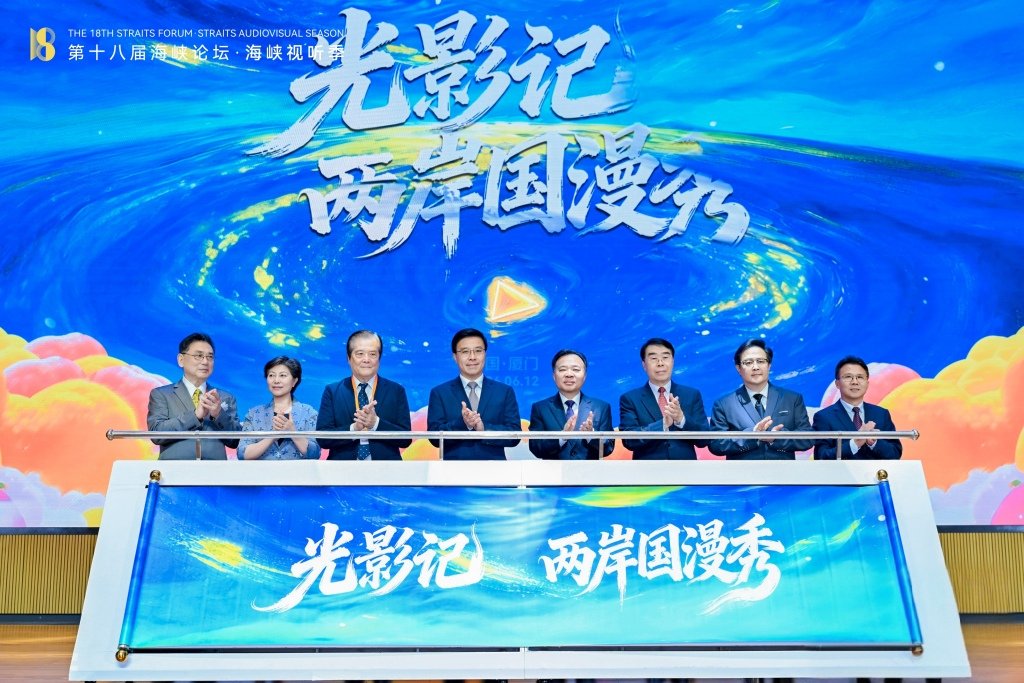
The opening of the 18th Straits Forum, where actor Zhang Linghe delivered a speech. SOURCE: The Paper.

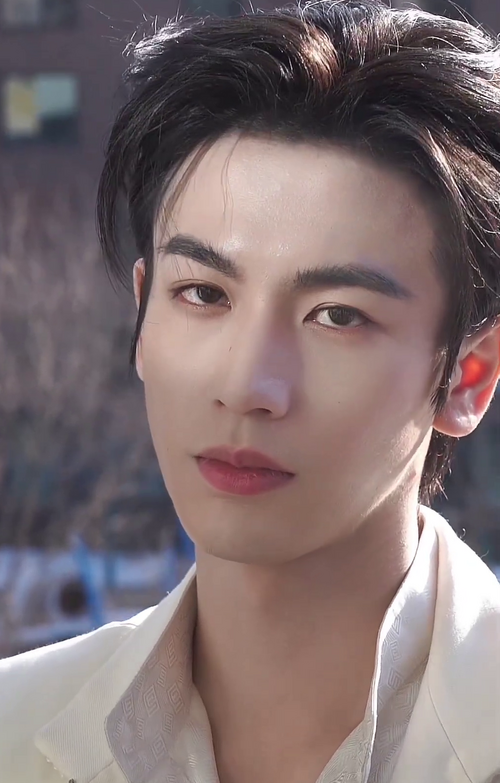
The April TAO announcement came amid what China’s leadership has hoped could be warming relations driven by a visit to China by Cheng Li-wun (鄭麗文), chair of Taiwan’s main opposition Kuomintang (國民黨), or KMT. Scripted or not, entertainment television became a core theme of cross-strait messaging during that visit. In a radio interview shortly after her return to Taiwan, Cheng recalled how young women in the KMT delegation had joked that cross-strait relations could be solved simply by sending actor Zhang Linghe (張凌赫), the male lead of the hit costume drama Pursuit of Jade (逐玉), to Taiwan. 

In fact, Cheng at first mispronounced Zhang Linghe’s name as “Zhang Lingyi” before being corrected by the host. Quickly pivoting, the KMT chairwoman laughed and said: “Send Zhang Linghe to Taiwan and that will do!” The quip was quickly amplified by Chinese state media.

In May, the Taiwan Affairs Office said it “delighted in seeing” news that the Taipei Artist Agency Association (台北演藝經紀文化交流協會) had called for mainland artists including Zhang Linghe to visit Taiwan. The office was referring to remarks made at a China-hosted cultural exchange event, and that had been reported exclusively in Chinese state media.

Zhang Linghe, male lead in China’s hit costume drama Pursuit of Jade (逐玉). SOURCE: Wikimedia Commons

Posts on Chinese official social media accounts pointed to favorable comments on this news story as reported on the program “Strait Talk” (兩岸做伙講) as evidence of popular support in Taiwan for a visit by Zhang. In fact, the “Strait Talk” program is run by China Daily, the Chinese government’s English-language external propaganda outlet.

On June 13 at the 18th Straits Forum, an annual event hosted by the Chinese government to promote cross-strait exchanges, Zhang Linghe delivered a surprise speech calling for deeper cross-strait cultural exchanges. This was the first time ever that a Chinese actor was invited to speak at the forum’s main session. 

The pattern of Zhang Linghe diplomacy extends beyond Taiwan. In the Philippines, where relations with China have grown deeply strained over the past year over South China Sea territorial disputes, the Chinese ambassador extended a personal invitation  in June for Zhang to visit Manila after he said he had learned of the actor’s growing popularity among Filipino audiences. 

China’s drama diplomacy comes as military tensions have intensified in the strait. Last week, Taiwan launched five-day combat readiness drills, designed to test how quickly its armed forces can shift from peacetime to wartime footing. Earlier this month, Taiwan’s president also called for swift US approval of a major arms sale package.

Propaganda Pushback

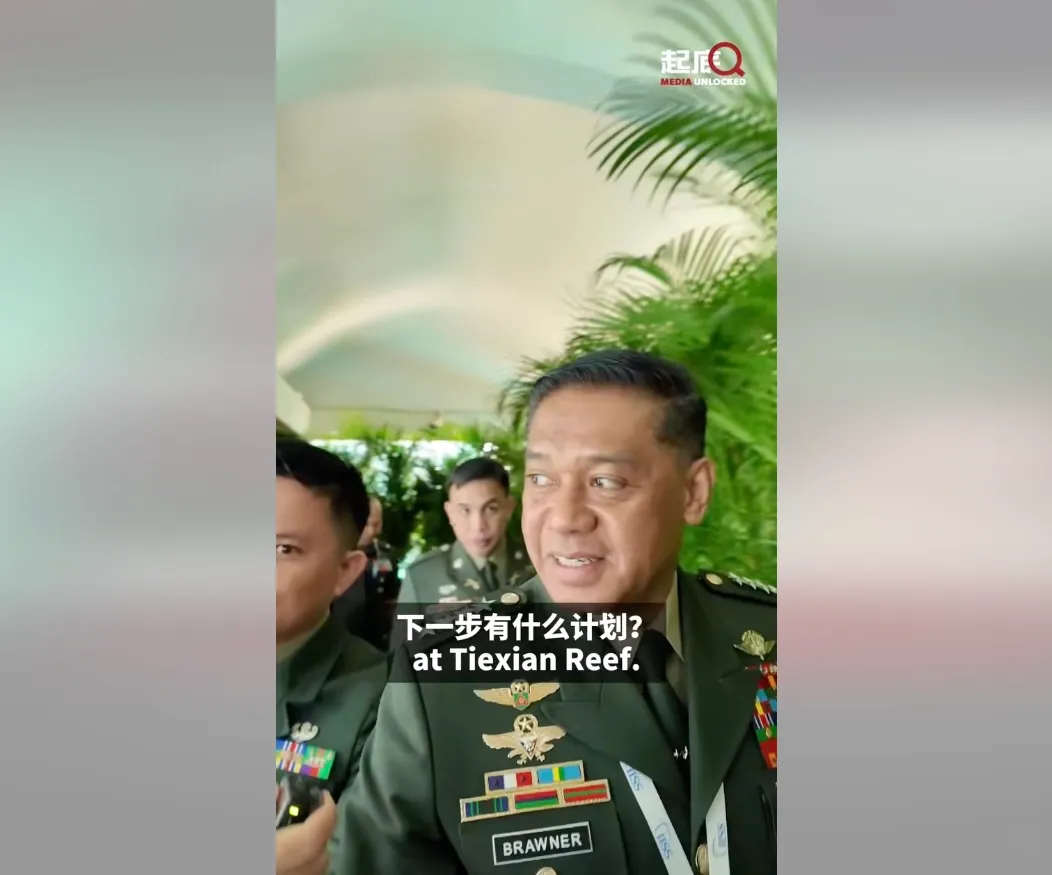
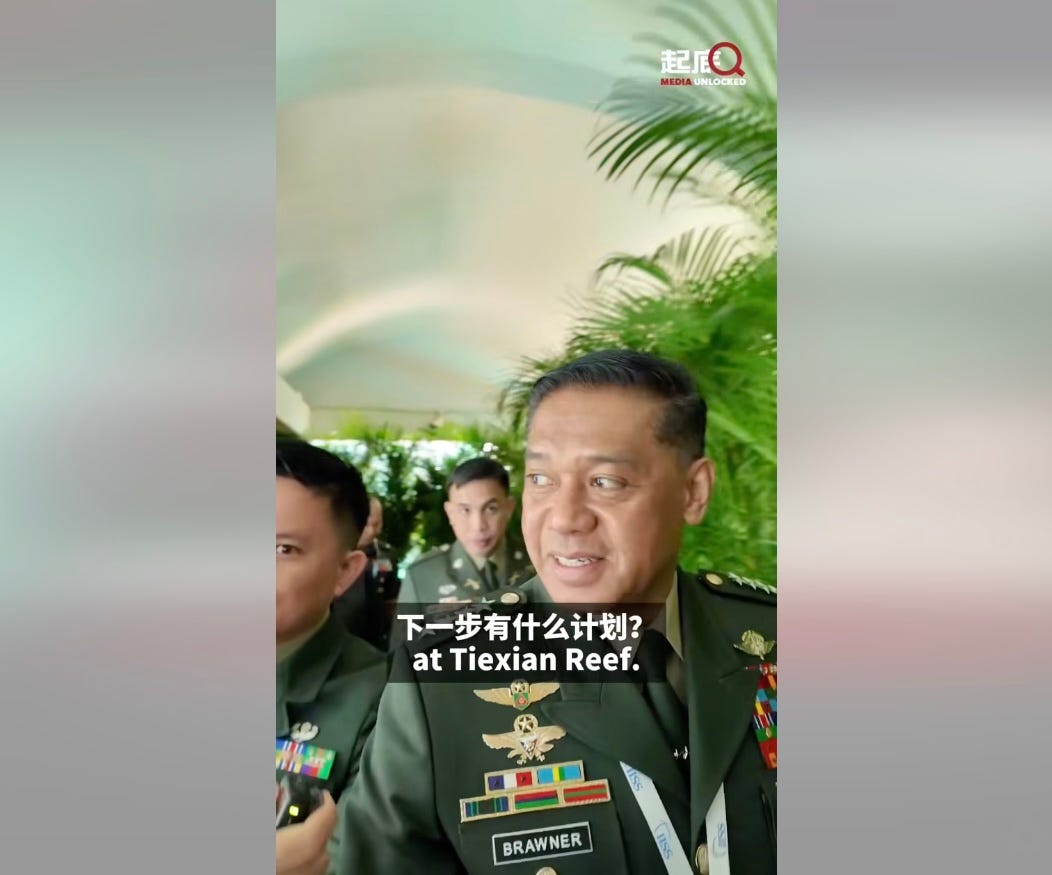
The Armed Forces of the Philippines dismissed as “propaganda” a China Daily video showing General Romeo Brawner Jr. allegedly avoiding reporters at Singapore’s Shangri-La Dialogue, held May 30-June 1. The video was posted online yesterday by “Media Unlocked” (起底), a social media brand of China Daily that takes a shallow and confrontational approach while purporting to explore topics more deeply. In the video, the “Media Unlocked” reporters appear to have not clearly identified themselves as reporters. They then allege that Brawner “dodged the question” about what they characterize as “the Philippines’ recent provocations in the South China Sea.”

A screenshot of the China Daily “Media Unlocked” video in which Brawner and others are cornered for questions about territorial disputes.

Defense Secretary Gilberto Teodoro Jr. noted that China had not sent an official delegation to the security forum, where he addressed Beijing’s assertions in the West Philippine Sea (西菲律賓海) — referring to the portion of the South China Sea claimed by the Philippines.

The incident in Singapore reflects how maritime disputes between the Philippines and China over the South China Sea have intensified in recent months and spilled over into the information space, becoming a contest of narratives. But it also offers an illuminating look at how Chinese state media go on the attack — seeking to create and distribute propaganda and disinformation on issues of core interest through prescribed proxy media brands and viral content. The “Media Unlocked” video was produced by Meng Zhe (孟哲) and Xupan Yiru (徐潘依如), who are identified elsewhere as reporters for “the Unlocked Media Studio of China Daily” — though not in the video itself. The “Unlocked” brand is part of a growing social media “studio” system implemented by central CCP-run media in recent years, partly to distance core state media brands from more provocative statements and conduct, and partly to disguise their state affiliation on social media platforms. Notably, the military delegation from the Philippines was approached at the same time by a reporter from Yutuantantian (玉渊谭天), a social media brand under the CCP-run China Media Group. In April 2023, a top CMG executive said the account had been “planned in advance and prepared over the long term to deliver powerful punches at critical moments.”